
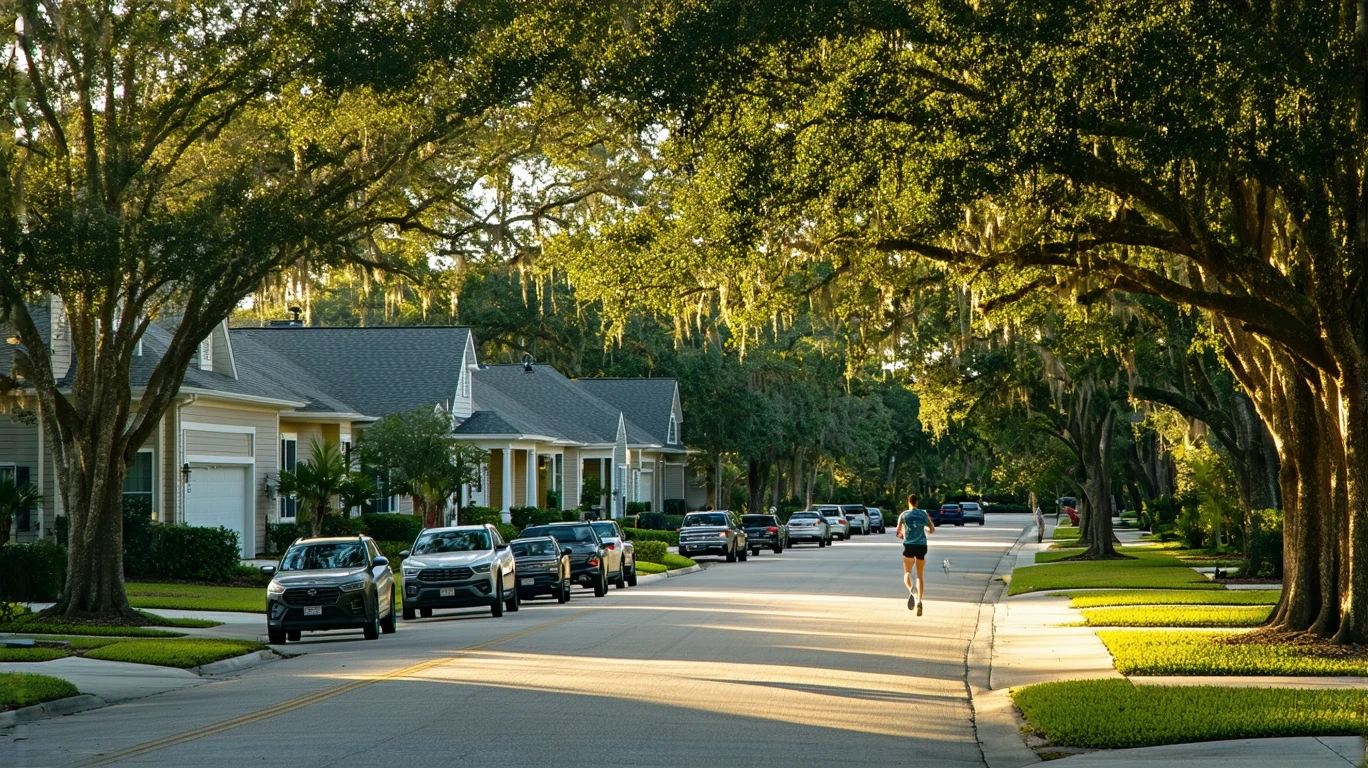
Sanford and Kissimmee sit less than 30 miles apart in the Orlando metro, yet households choosing between them face different cost pressures—not because prices diverge dramatically, but because commute patterns, time budgets, and income baselines shift how the same expenses feel. Both cities offer access to Central Florida’s economy and attractions, but Sanford’s shorter average commute of 24 minutes contrasts sharply with Kissimmee’s 33-minute average, and that nine-minute difference compounds across workdays, school runs, and errand loops. Meanwhile, Kissimmee’s median household income of $45,319 per year sits well below Sanford’s $59,181 per year, meaning identical rent or utility bills occupy different shares of monthly cash flow.
The decision between these two cities rarely hinges on a single cost category. Instead, it turns on which pressures dominate your household’s structure: whether you prioritize minimizing commute friction, maximizing housing space for a fixed budget, or reducing exposure to fuel price swings. Both cities show walkable pockets, rail transit access, and corridor-clustered grocery options, but Sanford’s higher park density and shorter commute times create different day-to-day logistics than Kissimmee’s longer-distance patterns and lower fuel costs. Understanding where cost pressure concentrates—and where flexibility exists—matters more than comparing totals.
This guide breaks down housing, utilities, transportation, groceries, taxes, and lifestyle fit to show how the same income feels different depending on which city’s cost structure aligns with your household’s non-negotiables. Neither city is universally cheaper; each fits different households better depending on what drives your financial and time budgets in 2026.
Housing Costs: Similar Entry Points, Different Market Context
Sanford’s median home value of $241,400 sits below Kissimmee’s $253,000, but the $11,600 difference represents less than 5% of the purchase price—a gap that matters more for down payment planning than for monthly mortgage exposure. Both cities offer access to single-family homes in suburban neighborhoods with similar building stock: one- and two-story homes built primarily in the 1980s through 2010s, with yards, driveways, and layouts designed for car-dependent living. The modest price difference reflects market positioning rather than dramatic quality or size variation, and both cities attract families seeking space and proximity to Orlando’s job centers without paying for urban-core premiums.
Rental markets show even tighter alignment: Sanford’s median gross rent of $1,402 per month and Kissimmee’s $1,419 per month differ by just $17—a gap too small to drive decisions on its own. Both cities offer a mix of apartment complexes, townhomes, and single-family rentals, with availability concentrated along major corridors and near employment hubs. Renters in both cities face similar challenges: limited walkable neighborhoods, reliance on cars for errands, and seasonal turnover driven by tourism and service-sector employment patterns. The rental experience differs more by neighborhood and proximity to transit than by city-level pricing structure.
Where housing costs diverge is in how they interact with income baselines. Sanford’s median household income of $59,181 per year provides more cushion for the same rent or mortgage payment than Kissimmee’s $45,319 per year. A $1,400 monthly rent obligation represents roughly 28% of gross monthly income in Sanford but closer to 37% in Kissimmee, meaning the same apartment or house feels tighter in Kissimmee even though the sticker price is nearly identical. Homeownership follows the same pattern: the modest home price difference matters less than the income gap when evaluating how much financial flexibility remains after housing costs.
Housing takeaway: Entry barriers and ongoing obligations align closely between Sanford and Kissimmee, but households with lower or single incomes may feel more housing cost pressure in Kissimmee due to the income baseline difference. Families prioritizing space over income flexibility will find similar options in both cities; those sensitive to how much remains after rent or mortgage payments should weigh income context alongside sticker prices.
Utilities and Energy Costs: Cooling Dominates in Both Cities
Electricity rates in Sanford (15.80¢/kWh) and Kissimmee (15.02¢/kWh) differ by less than a cent per kilowatt-hour, a gap too narrow to create meaningful monthly bill differences for households with similar usage patterns. Both cities face Florida’s extended cooling season, where air conditioning drives the majority of residential electricity consumption from late spring through early fall. Homes with older HVAC systems, poor insulation, or west-facing windows experience higher usage regardless of which city they’re in, and the rate difference becomes noise compared to the impact of home age, square footage, and thermostat discipline.
Natural gas pricing shows more variation—Sanford’s $23.62 per MCF versus Kissimmee’s $25.39 per MCF—but natural gas plays a smaller role in Florida households than in northern climates. Most homes rely on electric heating during the brief winter months, and natural gas usage concentrates in water heating, cooking, and occasional space heating. The pricing difference matters more for households with gas-intensive appliances or larger homes, but even then, the seasonal nature of heating needs limits total exposure. Predictability matters more than price: both cities see utility bills spike in summer and moderate in winter, creating a rhythm that requires planning rather than constant volatility.
Utility cost exposure varies more by housing type than by city. Apartments and townhomes with shared walls and smaller square footage experience lower cooling costs than detached single-family homes, and newer construction with better insulation and efficient HVAC systems reduces usage regardless of location. Families in older single-family homes face higher baseline usage in both cities, and the rate difference becomes secondary to the structural exposure created by home characteristics. Households sensitive to utility volatility should prioritize housing stock and insulation quality over city-level rate comparisons.
Utility takeaway: Both Sanford and Kissimmee face cooling-dominated utility exposure with minimal rate differences. Households in older or larger homes experience more volatility in both cities; those in newer apartments or townhomes see more predictable bills. The primary cost driver is home efficiency and size, not city-level pricing structure.
Groceries and Daily Expenses: Corridor Access in Both Cities
Both Sanford and Kissimmee show corridor-clustered food and grocery access, meaning supermarkets, discount stores, and dining options concentrate along major roads rather than distributing evenly across neighborhoods. This pattern creates similar shopping experiences: households rely on cars to reach grocery stores, and convenience often trumps price comparison when time budgets are tight. Both cities offer access to national chains, discount grocers, and big-box retailers, with pricing driven more by regional distribution networks and competition than by city-specific factors.
Grocery staples like bread, eggs, milk, and chicken show regional price parity rather than city-level variation, and households shopping at the same chain stores in Sanford or Kissimmee encounter nearly identical shelf prices. Where daily expenses diverge is in how shopping patterns interact with commute friction and time availability. Kissimmee’s longer average commute leaves less time for price comparison or multi-stop shopping trips, potentially pushing households toward convenience stores or prepared foods that carry higher per-unit costs. Sanford’s shorter commute creates slightly more flexibility for strategic shopping, though the difference matters more for households managing tight schedules than for those with flexible work arrangements.
Dining out and convenience spending follow similar patterns in both cities: options cluster along commercial corridors, and frequency depends more on household income and time pressure than on menu pricing. Single adults and dual-income couples without kids may prioritize convenience and eat out more frequently, while families managing larger grocery volumes tend to cook at home regardless of city. The cost pressure comes less from price differences and more from how much time and energy remain after work and commuting to plan meals and shop strategically.
Grocery takeaway: Both cities offer corridor-clustered access to groceries and dining with minimal price differences. Households sensitive to convenience spending creep should consider how commute time affects shopping flexibility; those with predictable schedules can manage grocery costs similarly in either city.
Taxes and Fees: Structural Similarities Across the Metro
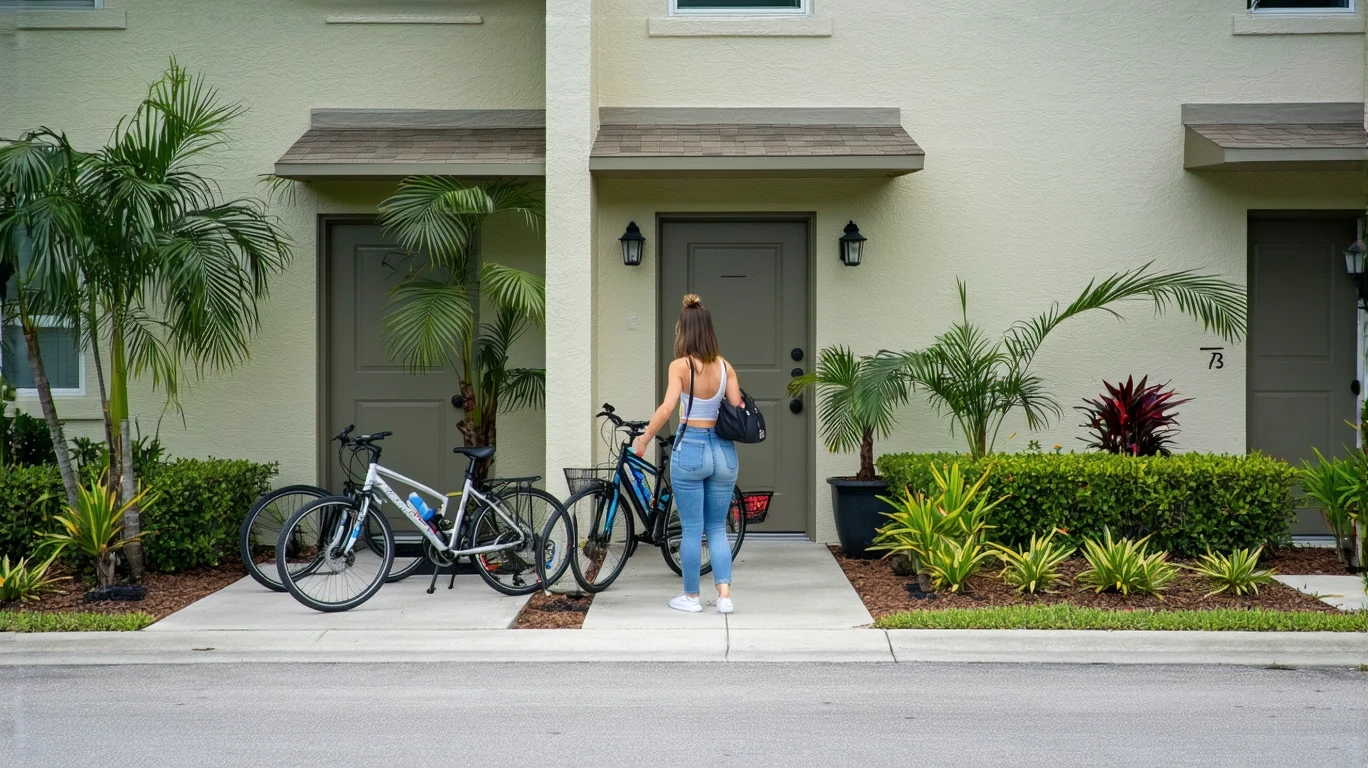
Sanford and Kissimmee both sit within Florida’s tax structure: no state income tax, reliance on sales taxes and property taxes, and local fees for services like trash collection and water. Property tax burdens depend on assessed home values, exemptions, and millage rates set by county and municipal governments, and both cities fall under similar county-level frameworks that limit dramatic variation. Homeowners in both cities face annual property tax bills that fluctuate with assessed values and local budget needs, but the structure—predictable annual billing, homestead exemptions for primary residences—remains consistent across the metro.
Sales taxes apply uniformly to most purchases, and both cities participate in Florida’s tourism-driven economy, meaning local governments rely on consumption taxes and tourism fees to fund services. Households that spend more on taxable goods—furniture, electronics, dining out—pay more in sales taxes regardless of which city they live in, and the impact scales with spending patterns rather than location. Renters face indirect exposure through landlords passing property taxes into rent, but the mechanism remains similar in both cities.
Where fees differ is in neighborhood-level details: HOA fees, special assessments, and service bundling vary by subdivision and housing type rather than by city. Some neighborhoods in both Sanford and Kissimmee include HOAs that bundle landscaping, amenities, and maintenance into monthly fees, while others leave homeowners to manage services individually. The predictability and magnitude of these fees depend more on the specific community than on city-level policy, and households evaluating total housing costs should investigate neighborhood-specific obligations rather than assuming city-wide patterns.
Tax and fee takeaway: Both cities operate under Florida’s tax structure with similar reliance on property and sales taxes. Homeowners face comparable property tax exposure; renters see indirect effects through rent pricing. Neighborhood-level HOA fees and service structures matter more than city-level tax differences.
Transportation & Commute Reality: Time vs Distance Tradeoffs
Sanford’s average commute time of 24 minutes contrasts sharply with Kissimmee’s 33 minutes, and that nine-minute difference compounds across five workdays into nearly an hour and a half of additional commute time per week. The gap reflects both distance and traffic patterns: Kissimmee sits farther from some Orlando job centers, and its 56.4% long-commute percentage—defined as 30 minutes or more one-way—shows that more than half of workers face extended drives. Sanford’s 33.2% long-commute percentage indicates fewer workers endure the longest trips, though car dependency remains high in both cities with work-from-home rates of 7.0% in Sanford and 14.3% in Kissimmee.
Both cities offer rail transit access, providing an alternative to driving for some commuters, but the effectiveness depends on where you live and work. Rail service connects both cities to Orlando’s core, but neighborhoods farther from stations still require cars for the first and last mile, limiting transit’s reach. Bus service exists in both cities, but coverage and frequency favor corridors over comprehensive neighborhood access, meaning most households default to driving for work, errands, and school runs.
Fuel costs add another layer: Sanford’s gas price of $3.98 per gallon sits well above Kissimmee’s $2.93 per gallon—a difference of more than a dollar per gallon. For a household driving 25 miles round-trip at 25 MPG, that’s a gallon per workday, and the price gap translates to roughly $5 more per week in Sanford, or about $20 per month. But Kissimmee’s longer commute distances may require more total fuel, potentially offsetting the lower per-gallon price. The tradeoff depends on where you work: households commuting to Orlando’s northern suburbs may drive fewer miles from Sanford despite paying more per gallon, while those working in Kissimmee or farther south may benefit from Kissimmee’s lower fuel prices even with longer trips.
Cycling infrastructure exists in pockets in both cities, but neither offers comprehensive bike networks that eliminate car dependency. Households prioritizing bike commuting or car-free errands will find limited options in both cities, and most daily logistics require a vehicle regardless of location.
Transportation takeaway: Sanford offers shorter average commutes and lower long-commute exposure but higher gas prices; Kissimmee offers lower fuel costs but longer commute times and higher long-commute percentages. Households sensitive to time budgets may prefer Sanford; those prioritizing fuel cost savings and working closer to Kissimmee may find the longer commute acceptable. Both cities require cars for most daily logistics.
Cost Structure Comparison: Where Pressure Concentrates Differently
Housing costs show tight alignment between Sanford and Kissimmee, with modest differences in home values and nearly identical rent levels. The primary distinction emerges not from sticker prices but from how those prices interact with income baselines: Sanford’s higher median household income creates more cushion for the same rent or mortgage payment, while Kissimmee’s lower income baseline means the same housing obligation feels tighter. Families prioritizing space and suburban layouts will find similar options in both cities, but single-income households or those with lower earnings may feel more housing cost pressure in Kissimmee even though the rent itself is nearly the same.
Utilities introduce minimal differentiation: both cities face cooling-dominated exposure with electricity rates differing by less than a cent per kilowatt-hour. The primary driver of utility costs is home age, size, and efficiency rather than city-level pricing, and households in older single-family homes experience more volatility in both cities. Natural gas pricing varies more, but usage remains low in Florida’s climate, limiting total exposure. Predictability comes from understanding your home’s characteristics, not from choosing one city over the other.
Transportation patterns create the sharpest cost structure difference. Sanford’s shorter average commute and lower long-commute percentage reduce time costs and schedule friction, but higher gas prices increase per-gallon expenses. Kissimmee’s longer commute times and higher long-commute exposure add time pressure and potential fuel consumption, but lower gas prices reduce per-gallon costs. The tradeoff depends on where you work and how you value time versus money: households commuting to Orlando’s northern suburbs may drive fewer total miles from Sanford despite paying more per gallon, while those working closer to Kissimmee may accept longer commute times in exchange for lower fuel costs.
Daily living costs—groceries, dining, convenience spending—show minimal structural differences. Both cities offer corridor-clustered access to supermarkets and restaurants, and pricing reflects regional distribution networks rather than city-specific factors. Where differences emerge is in how commute time affects shopping flexibility: Kissimmee’s longer commute leaves less time for multi-stop trips or price comparison, potentially pushing households toward convenience options that cost more per unit. Sanford’s shorter commute creates slightly more schedule flexibility, though the impact depends on household composition and work arrangements.
The better choice depends on which costs dominate your household. For households sensitive to commute friction and time budgets, Sanford’s shorter average commute and lower long-commute exposure may outweigh higher gas prices. For those prioritizing fuel cost savings and working closer to Kissimmee, the longer commute may feel acceptable. Housing and utility costs remain similar enough that they rarely tip the decision on their own; instead, transportation patterns and income context shape how the same expenses feel in daily life.
How the Same Income Feels in Sanford vs Kissimmee
Single Adult
For a single adult, housing becomes the first non-negotiable cost, and the $17 rent difference between cities matters less than proximity to work. In Sanford, the shorter average commute leaves more time for errands, meal prep, and flexibility in daily routines, reducing reliance on convenience spending. In Kissimmee, the longer commute compresses evening hours, making takeout or prepared foods more tempting when time runs short. Fuel costs cut both ways: Sanford’s higher gas prices increase weekly fill-up expenses, but shorter distances may reduce total consumption; Kissimmee’s lower gas prices help, but longer commutes may burn more fuel overall. Flexibility exists in grocery shopping and discretionary spending, but the time budget differs depending on how much of the day disappears into commuting.
Dual-Income Couple
For a dual-income couple, transportation friction multiplies: two commutes mean two sets of fuel costs, two schedules to coordinate, and less overlap for shared errands. In Sanford, shorter commute times create more evening flexibility for cooking, shopping, or managing household tasks together, reducing the pressure to outsource convenience. In Kissimmee, longer commutes for both partners compress the window for joint logistics, making it harder to avoid convenience spending or multi-stop shopping trips. Housing costs occupy similar shares of combined income in both cities, but the time cost of commuting affects how much energy remains for cost-saving behaviors like meal planning or strategic grocery shopping. Predictability comes from aligning work locations with city choice: if both partners work closer to Sanford, the shorter commute outweighs fuel price differences; if one or both work south or near Kissimmee, the longer commute becomes more manageable.
Family with Kids
For families with kids, non-negotiable costs expand to include school proximity, after-school logistics, and weekend errands that require coordinating multiple schedules. In Sanford, shorter commute times leave more bandwidth for school pickups, extracurriculars, and grocery runs without compressing evening routines. Higher park density provides more accessible outdoor space for kids, reducing the need to drive to recreation. In Kissimmee, longer commutes add friction to daily logistics: getting kids to school, managing after-school activities, and fitting in errands all require more time in the car. Lower gas prices help offset fuel consumption, but the time cost of longer distances affects how much flexibility remains for managing household tasks. Both cities offer similar school density and family infrastructure, so the primary difference is how commute patterns interact with the complexity of managing multiple schedules and the role of accessible green space in reducing recreation-related driving.
Decision Matrix: Which City Fits Which Household?
| Decision factor | If you’re sensitive to this… | Sanford tends to fit when… | Kissimmee tends to fit when… |
|---|---|---|---|
| Housing entry + space needs | Down payment size, monthly rent or mortgage obligation, income cushion after housing costs | You prioritize higher income baseline creating more post-housing flexibility despite similar sticker prices | You accept tighter income-to-housing ratios in exchange for similar space and suburban layout options |
| Transportation dependence + commute friction | Daily commute time, long-commute exposure, time budget compression, schedule flexibility | You work closer to Orlando’s northern suburbs and value shorter commute times over per-gallon fuel savings | You work closer to Kissimmee or farther south and accept longer commute times in exchange for lower gas prices |
| Utility variability + home size exposure | Cooling season bill spikes, home age and efficiency, predictability of monthly utility costs | You prioritize newer housing stock or smaller square footage to minimize cooling exposure despite similar rates | You accept similar cooling-dominated exposure and focus on home efficiency rather than city-level rate differences |
| Grocery strategy + convenience spending creep | Time for multi-stop shopping, meal planning bandwidth, reliance on prepared foods or takeout | You value shorter commute creating more time for strategic shopping and meal prep to control grocery costs | You accept longer commute compressing evening hours and potentially increasing convenience spending |
| Fees + friction costs (HOA, services, upkeep) | Predictability of monthly obligations beyond rent or mortgage, bundled vs unbundled services | You investigate neighborhood-specific HOA and service structures rather than assuming city-wide patterns | You investigate neighborhood-specific HOA and service structures rather than assuming city-wide patterns |
| Time budget (schedule flexibility, errands, logistics) | Evening hours available after work, weekend errand efficiency, coordination of multiple schedules | You prioritize shorter commute preserving time for household logistics and reducing reliance on outsourced convenience | You accept longer commute as tradeoff for lower fuel costs and manage compressed time budgets through planning |
Lifestyle Fit: Suburban Structure with Different Commute Rhythms
Both Sanford and Kissimmee offer suburban layouts designed around car dependency, with single-family homes, yards, and neighborhoods built for families seeking space and proximity to Orlando without urban-core density. Walkable pockets exist in both cities, and rail transit provides an alternative to driving for some trips, but most daily logistics—work, errands, school runs—require a vehicle. The lifestyle experience differs more in commute rhythms and time budgets than in neighborhood character or housing form.
Sanford’s shorter average commute and higher park density create more accessible outdoor space and less time spent in transit, which matters for families managing school pickups, extracurriculars, and weekend recreation. The city’s walkable pockets and mixed land use offer some neighborhoods where errands feel less car-dependent, though these areas represent portions of the city rather than comprehensive coverage. For households prioritizing time flexibility and accessible green space, Sanford’s structure reduces friction in daily routines.
Kissimmee’s longer commute times and higher long-commute exposure compress evening hours and weekend flexibility, but lower gas prices and similar housing options attract households willing to trade time for fuel cost savings. The city’s corridor-clustered grocery access and rail transit mirror Sanford’s structure, and families find similar school density and playground availability. For households working closer to Kissimmee or farther south in the metro, the longer commute from Sanford may not make sense, and Kissimmee’s lower fuel costs become more relevant.
Both cities offer access to Central Florida’s attractions, outdoor recreation, and regional amenities, and neither provides a dramatically different cultural or recreational experience. The choice hinges more on how commute patterns and time budgets interact with household logistics than on lifestyle differences. Sanford’s average commute: 24 minutes. Kissimmee’s long-commute percentage: 56.4%.
How this article was built: In addition to public economic data, this article incorporates location-based experiential signals derived from anonymized geographic patterns—such as access density, walkability, and land-use mix—to reflect how day-to-day living actually feels in Sanford and Kissimmee.
Frequently Asked Questions
Is Sanford or Kissimmee cheaper for renters in 2026?
Sanford’s median gross rent of $1,402 per month and Kissimmee’s $1,419 per month differ by just $17, making them nearly identical in rental cost structure. The primary difference is how that rent obligation interacts with income baselines: Sanford’s higher median household income creates more post-rent cushion, while Kissimmee’s lower income baseline means the same rent occupies a larger share of monthly cash flow. Renters sensitive to how much remains after housing costs should weigh income context alongside sticker prices.
How do commute times affect cost of living between Sanford and Kissimmee in 2026?
Sanford’s average commute of 24 minutes and lower long-commute exposure reduce time costs and schedule friction, leaving more evening hours for meal prep, errands, and household logistics that can reduce convenience spending. Kissimmee’s 33-minute average commute and 56.4% long-commute percentage compress time budgets, potentially increasing reliance on takeout or prepared foods when evening hours run short. The cost impact depends on how you value time versus money: shorter commutes in Sanford preserve flexibility, while Kissimmee’s lower gas prices ($2.93 vs $3.98/gal) offset some fuel expenses if you work closer to Kissimmee.
Which city has lower utility costs, Sanford or Kissimmee?
Electricity rates differ by less than a cent per kilowatt-hour (15.80¢ in Sanford, 15.02¢ in Kissimmee), creating minimal monthly bill differences for households with similar usage patterns. Both cities face cooling-dominated utility exposure in Florida’s extended summer, and the primary cost driver is home age, size, and efficiency rather than city-level pricing. Households in older single-family homes experience higher usage and more volatility in both cities; those in newer apartments or townhomes see more predictable bills regardless of location.
Do Sanford and Kissimmee have similar grocery and daily expense costs in 2026?
Both cities show corridor-clustered grocery access with similar pricing driven by regional distribution networks rather than city-specific factors. Households shopping at the same chain stores encounter nearly identical shelf prices for staples like bread, eggs, and milk. Where daily expenses diverge is in how commute time affects shopping flexibility: Kissimmee’s longer commute leaves less time for multi-stop trips or price comparison, potentially pushing households toward convenience options that cost more per unit. Sanford’s shorter commute creates slightly more schedule flexibility for strategic shopping, though the impact depends on household composition and work arrangements.
Which city is better for families comparing Sanford vs Kissimmee in 2026?
Both cities offer similar family infrastructure, including school density, playground availability, and suburban housing layouts designed for families. Sanford’s higher park density and shorter average commute create more accessible outdoor space and less time spent in transit, which matters for managing school pickups, extracurriculars, and weekend recreation. Kissimmee’s longer commute times add friction to daily logistics but offer lower gas prices and similar housing options. Families working closer to Orlando’s northern suburbs may prefer Sanford’s shorter commute; those working closer to Kissimmee or farther south may find the longer commute acceptable in exchange for fuel cost savings.
Conclusion: Different Households, Different Tradeoffs
Sanford and Kissimmee offer similar suburban housing structures, corridor-clustered grocery access, and cooling-dominated utility exposure, but the decision between them hinges on how commute patterns and income baselines interact with your household’s cost priorities. Sanford’s shorter average commute of 24 minutes and lower long-commute exposure reduce time costs and schedule friction, creating more flexibility for meal prep, errands, and household logistics that can limit convenience spending. Kissimmee’s longer 33-minute average commute and higher long-commute percentage compress evening hours, but lower gas prices ($2.93 vs $3.98/gal) offset some fuel expenses for households working closer to Kissimmee or farther south in the metro.
Housing