
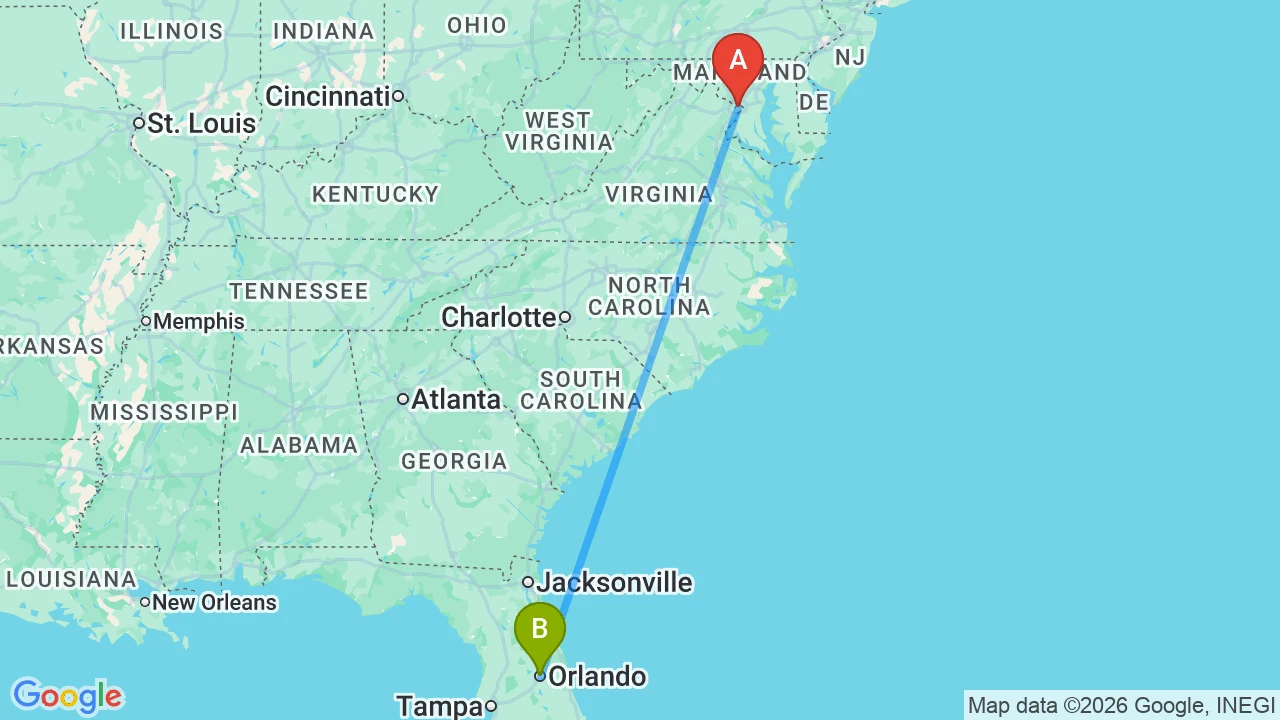
The move from Washington, DC to Orlando represents one of the more dramatic lifestyle and cost structure shifts available within the eastern United States. It’s not simply a question of whether Orlando is “cheaper”—it’s about understanding where financial pressure relocates, how daily rhythms change, and which household priorities get easier or harder to manage.
Washington operates as a high-cost, transit-accessible metro with substantial walkable infrastructure and integrated green space. Orlando functions as a sprawling, car-dependent region with lower housing entry barriers but different ongoing cost exposures. The shift typically reduces upfront housing pressure while increasing transportation dependence and introducing new climate-driven utility patterns.
This guide explains how costs behave differently between the two cities, what changes in daily logistics, and which types of movers tend to adapt most successfully. It does not predict your total expenses or declare one city “better”—it clarifies where pressure moves and why.
Cost Pressure Shifts
The most immediate financial difference involves housing entry barriers. Washington’s median home value and rental costs create substantial upfront pressure that Orlando’s housing market—with a median home value of $332,700 and median rent of $1,509 per month—typically reduces. For renters and first-time buyers, this shift often represents the primary financial motivation for the move.
However, the cost structure doesn’t simply compress—it redistributes. Orlando’s car-dependent urban form means transportation costs become a larger share of household budgets. Gas prices in Orlando run $3.95 per gallon compared to Washington’s $4.18, but the need to drive for nearly every errand, combined with longer trip distances across a sprawling metro, typically increases fuel consumption substantially. Households that relied on Metro in Washington often find themselves managing car payments, insurance, maintenance, and parking costs that weren’t previously necessary.
Utility exposure shifts in both direction and character. Orlando’s electricity rate of 15.92¢/kWh sits well below Washington’s 23.72¢/kWh, but the extended cooling season and high humidity create sustained air conditioning demand that Washington’s milder summers don’t require. Natural gas prices reverse the pattern—Orlando’s $23.62/MCF exceeds Washington’s $15.29/MCF—though heating demand remains minimal in Central Florida. The net effect varies by housing type and thermostat tolerance, but most households experience higher summer electricity bills despite the lower rate.
Grocery costs follow regional price parity differences. Orlando’s overall cost index of 101 compared to Washington’s 111 suggests modest relief in everyday purchases. Ground beef runs about $6.81 per pound in Orlando versus $7.48 in Washington; milk costs approximately $4.07 per half-gallon compared to $4.47. Derived estimate based on national baseline adjusted by regional price parity; not an observed local price. These differences accumulate over time but rarely offset the increased transportation burden for car-dependent households.
The unemployment rate tells part of the economic story: Orlando’s 3.3% suggests a tighter labor market than Washington’s 5.2%, though this doesn’t account for wage levels, industry mix, or career trajectory differences between a federal employment hub and a tourism-driven economy. Median household income in Orlando sits at $66,292 per year, and while comparable Washington income data isn’t available in this analysis, the difference in regional price parity and housing costs suggests that income stretches differently rather than uniformly further.
Housing & Neighborhood Patterns
Washington’s housing market combines high entry costs with access to walkable neighborhoods, Metro connectivity, and integrated urban amenities. Renters and buyers pay a premium for proximity to transit, shorter commutes, and the ability to manage daily errands without a car. The city’s substantial pedestrian infrastructure and high pedestrian-to-road ratio create neighborhoods where car ownership remains optional for some households.
Orlando’s housing market trades lower entry barriers for a fundamentally different spatial structure. The city shows walkable pockets with notable cycling infrastructure and rail transit presence, but these features serve specific corridors rather than defining the regional pattern. Most neighborhoods require a car for grocery shopping, medical appointments, and routine errands. Food and grocery options cluster along commercial corridors rather than distributing evenly across residential areas, meaning convenience depends heavily on proximity to these arterials.
For renters, the shift often feels like a straightforward reduction in monthly housing costs. For buyers, the calculation becomes more complex: lower purchase prices come with ongoing costs that Washington homeowners may not have faced, including higher homeowners insurance (hurricane exposure), potential HOA fees in newer developments, and the near-certainty of needing multiple vehicles per household. Property tax structures differ as well, and Florida’s lack of state income tax doesn’t eliminate the need to budget for these housing-related obligations.
Neighborhood selection in Orlando requires different tradeoffs than in Washington. Proximity to work, school quality, and access to commercial corridors become primary variables, while walkability and transit access function as niche amenities rather than baseline expectations. Families often prioritize school zones and park access—Orlando shows moderate park density with water features present—while younger professionals may seek the limited urban pockets near downtown or Winter Park where car dependence eases slightly.
Lifestyle & Daily Rhythms
Daily life in Washington revolves around Metro lines, bus routes, and pedestrian-friendly corridors. Many residents walk to coffee shops, use public transit for work commutes, and manage errands on foot or via short car trips. The city’s high school density and strong family infrastructure support households with children, while integrated green space and hospital presence create a compact urban environment where multiple needs can be met within a small radius.
Orlando operates on a fundamentally different logic. The car becomes the primary tool for nearly all activities. Commutes lengthen not necessarily in time but in distance and planning complexity—traffic patterns, parking availability, and the need to chain errands into single trips shape daily schedules. The city’s moderate school density and present family infrastructure serve families, but accessing these resources requires intentional route planning rather than spontaneous walking.
Climate exposure shifts dramatically. Washington’s four-season pattern gives way to Orlando’s extended heat and humidity. Triple-digit summer heat indices become routine, and the cooling season stretches across much of the year. This affects not just utility bills but daily routines—outdoor activities shift to early morning or evening, and the rhythm of the year follows tourist seasons and summer storms rather than traditional seasonal markers.
The pace of life often feels slower in Orlando, though this varies by neighborhood and industry. The tourism economy creates pockets of intensity, but residential areas tend toward quieter, more car-oriented rhythms. Social life, dining, and entertainment require more planning and driving than in Washington’s denser urban core. For households that value spontaneity and walkable access to varied amenities, this shift can feel isolating. For those seeking space, lower density, and a car-oriented suburban pattern, it often feels like a relief.
How this article was built: In addition to public economic data, this article incorporates location-based experiential signals derived from anonymized geographic patterns—such as access density, walkability, and land-use mix—to reflect how day-to-day living actually feels in Orlando, FL.
Relocation Logistics & Practical Friction
The physical move from Washington to Orlando covers roughly 850 miles, typically requiring professional movers or a multi-day drive. Timing matters: summer moves coincide with Orlando’s peak heat and humidity, while winter offers milder conditions but also peak tourist season, which can affect lodging costs and traffic during the transition.
Establishing residency involves different administrative patterns. Florida requires vehicle registration and driver’s license updates within 30 days of establishing residency, and insurance rates often shift due to different risk profiles (hurricane exposure, higher accident rates in some corridors). Utility setup can be straightforward, but understanding billing cycles and deposit requirements helps avoid surprises.
The adjustment period often centers on transportation adaptation. Households that didn’t need a car in Washington must budget for purchase or lease, insurance, registration, and maintenance. Those who owned one car may find they need two. Parking, which was often a managed scarcity in Washington, becomes abundant but also mandatory—nearly every destination requires driving and parking rather than walking or transit.
Social and professional networks don’t transfer automatically. Washington’s federal employment ecosystem, dense nonprofit sector, and policy-oriented professional culture give way to Orlando’s tourism, healthcare, and service-driven economy. Career trajectories shift, and building new professional connections requires intentional effort. For families, school transitions and extracurricular access depend heavily on neighborhood selection and willingness to drive for activities.
What surprises movers most often involves the compounding effect of car dependence. It’s not just that you drive more—it’s that every errand, appointment, and social engagement requires planning around traffic, parking, and trip-chaining. The convenience of walking to a corner store or grabbing transit for a spontaneous outing disappears, replaced by a rhythm that rewards batch planning and routine optimization.
Frequently Asked Questions
- Does Orlando feel more or less expensive than Washington, DC?
- Orlando typically reduces housing entry costs and offers lower grocery prices, but transportation expenses increase substantially due to car dependence, and utility bills shift toward higher summer cooling costs. The overall cost structure feels different rather than uniformly cheaper—pressure moves from rent and home prices to vehicles, gas, insurance, and climate-driven electricity use. Households that relied on public transit in Washington often feel the transportation shift most acutely.
- How do housing markets differ between Washington, DC and Orlando?
- Washington’s market emphasizes transit access, walkability, and urban density, with high entry costs but the option to live car-free or car-light in many neighborhoods. Orlando’s market offers lower purchase prices and rents but assumes car ownership, with most neighborhoods requiring driving for daily errands. Ongoing costs shift from rent premiums to vehicle expenses, insurance, and utilities shaped by extended heat exposure.
- What feels different about daily life after moving from Washington to Orlando?
- The rhythm shifts from transit-oriented, walkable routines to car-dependent planning. Errands require driving and parking rather than walking or Metro trips, commutes often lengthen in distance if not always time, and spontaneous outings become less common. Climate exposure changes dramatically—extended heat and humidity replace four-season variety, affecting outdoor activity timing and utility budgets. Social and professional networks require rebuilding in a tourism-driven economy rather than a federal employment hub.
- When does the move from Washington to Orlando tend to feel easiest?
- Fall and early winter offer milder weather for the physical move and adjustment period, avoiding both peak summer heat and tourist season congestion. Professionally, timing depends on industry—tourism and hospitality hiring peaks seasonally, while other sectors follow less predictable patterns. Families often prioritize school calendar alignment, and securing housing before arrival reduces friction, especially in competitive suburban school zones.
- What challenges do people face when relocating from Washington to Orlando?
- Transportation adaptation creates the most immediate friction—acquiring vehicles, adjusting to longer driving distances, and losing the spontaneity that transit and walkability provided. Climate adjustment takes time, especially managing summer heat and understanding hurricane preparedness. Professional network rebuilding requires effort, and the shift from policy-oriented to tourism-driven work culture can feel disorienting. Households that valued urban density and walkable access often struggle most with Orlando’s sprawling, car-dependent form.
- Who tends to benefit most from moving from Washington to Orlando, and who may struggle?
- First-time homebuyers and renters seeking lower housing entry costs often benefit, as do households comfortable with car-oriented suburban living and those seeking space and lower density. Families prioritizing affordability over walkability, and retirees drawn to Florida’s climate and tax structure, tend to adapt well. Households that relied heavily on public transit, valued spontaneous urban access, or built careers around federal employment and policy work often face the steepest adjustment. Young professionals without established networks and those sensitive to heat and humidity may find the transition more challenging than anticipated.
Conclusion
The move from Washington, DC to Orlando trades high housing costs and transit-oriented density for lower entry barriers and car-dependent sprawl. It’s a shift that reduces upfront financial pressure while increasing ongoing transportation costs and introducing new climate-driven utility patterns. The lifestyle change is substantial—walkable routines give way to driving-based logistics, four-season variety shifts to extended heat, and professional networks require rebuilding in a fundamentally different economy.
This move works best for households prioritizing housing affordability and comfortable with car-oriented living, and it challenges those who valued urban walkability, transit access, and the professional ecosystem of the nation’s capital. Success depends less on financial calculation than on honest assessment of daily priorities: whether you value spontaneous access and density, or space and lower entry costs; whether you’re energized by driving-based logistics, or frustrated by the loss of pedestrian freedom.
For deeper exploration of how costs behave in each city, see the Washington, DC cost of living hub and the Orlando cost of living hub on IndexYard.