
Transit Coverage & Commute Snapshot: Sanford, FL
| Metric | Value |
|---|---|
| Average Commute Time | 24 minutes |
| Work From Home | 7.0% |
| Long Commute (60+ min) | 33.2% |
| Rail Transit | Present |
| Walkable Infrastructure | Pockets (high ped-to-road ratio) |
How People Get Around Sanford
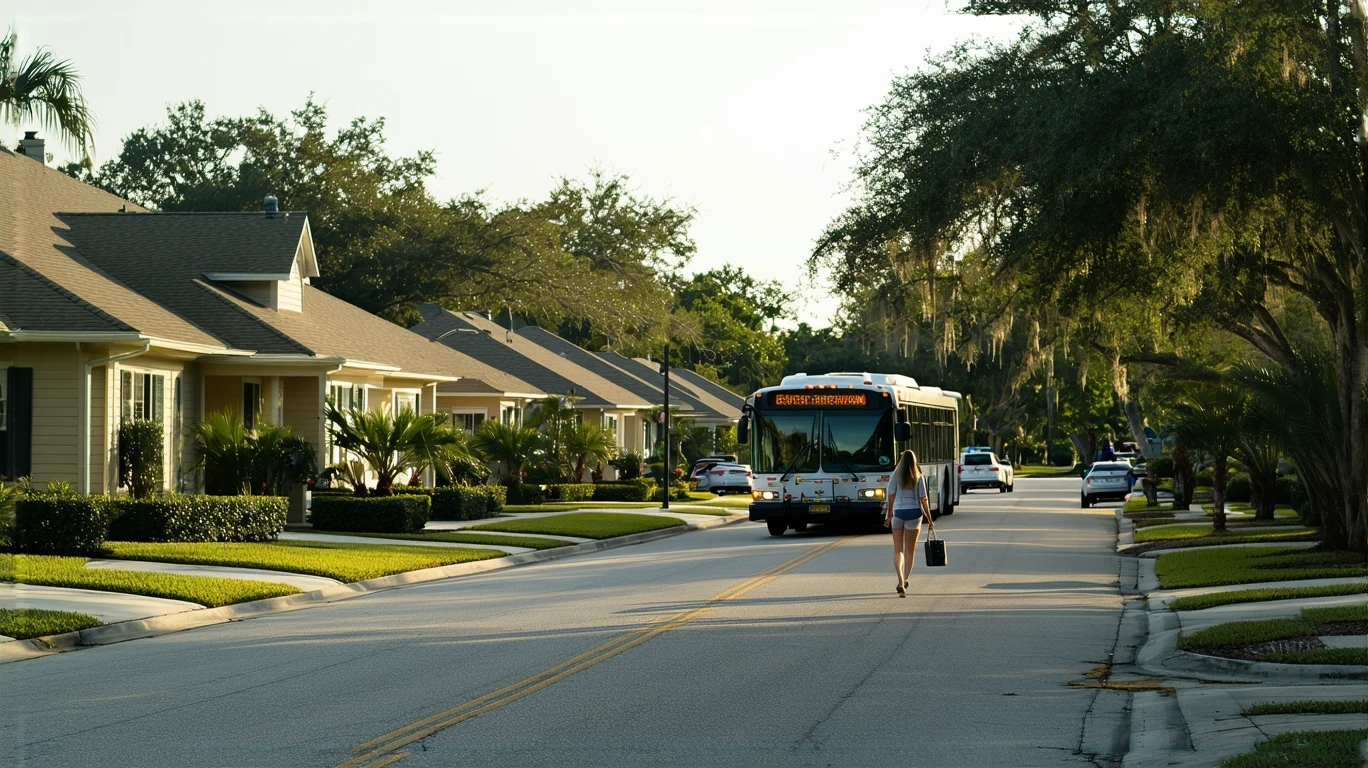
Transportation options in Sanford reflect a hybrid reality: rail transit exists, walkable pockets are real, but most residents still depend on a car for daily life. The city’s layout—a historic downtown core surrounded by suburban neighborhoods—creates zones where transit works well and larger areas where it doesn’t reach. Newcomers often assume Sanford functions like a typical sprawling suburb with no alternatives to driving, but that misses the rail connection and the pedestrian-friendly corridors near the core. At the same time, expecting transit to replace a car for most households overstates its coverage.
What shapes mobility here is not just the presence of transit, but where you live relative to it. Sanford’s pedestrian infrastructure is concentrated, not evenly distributed. The ratio of sidewalks and pathways to road network is high in certain areas, meaning some neighborhoods support walking and short trips without a car. But those pockets don’t extend across the entire city, and errands accessibility follows a similar pattern: grocery and food options cluster along corridors rather than spreading uniformly. That means your transportation reality in Sanford depends heavily on your address.
Public Transit Availability in Sanford
Public transit in Sanford often centers around systems such as SunRail, the regional commuter rail service connecting Sanford to Orlando and surrounding metro areas. Rail service is present and operational, offering a structured commute option for residents working along the corridor. This is not a theoretical amenity—it’s infrastructure that shapes how some households organize their day.
Transit works best for people living near stations and commuting to destinations the rail line serves. It tends to fall short for residents in peripheral neighborhoods, those making multi-stop trips, or anyone needing service outside peak hours or off-corridor. Coverage is not citywide, and the system is designed primarily for work commutes rather than errands, evening activities, or weekend flexibility. Bus service may supplement rail in some areas, but the structure of public transit in Sanford is corridor-based, not grid-based.
For households near the core or within walking distance of a station, transit can reduce car dependence meaningfully. For everyone else, it functions as an occasional option rather than a primary mode of transportation.
Driving & Car Dependence Reality
Most people in Sanford rely on a car. The city’s development pattern—residential neighborhoods radiating outward from a compact downtown—means that even short errands often require driving unless you live in one of the walkable pockets. Parking is generally available and not a major friction point, which reinforces car use. Sprawl is moderate compared to larger metro areas, but it’s enough to make walking or biking impractical for many daily tasks.
Driving offers flexibility that transit cannot match here: multi-stop errands, off-peak trips, and access to jobs or services outside the rail corridor all require a vehicle. For families, car dependence is nearly universal. Groceries, schools, healthcare, and recreational activities are rarely clustered tightly enough to eliminate the need for a car, even in neighborhoods with decent walkability.
The tradeoff is predictability and control. A car insulates you from service gaps, schedule constraints, and coverage limits. It also means absorbing all the fixed and variable costs of ownership, from insurance and maintenance to fuel and parking. In Sanford, that tradeoff tilts heavily toward driving for most households.
Commuting Patterns & Daily Mobility
Commuting in Sanford breaks into two broad patterns: those who work locally or within the city, and those who commute into the Orlando metro area. The average commute time is 24 minutes, which suggests relatively short trips for many residents. But 33.2% of workers face commutes of 60 minutes or longer, indicating a meaningful share of households absorbing significant travel time—likely those commuting to distant job centers or navigating multi-stop routines.
Only 7.0% of workers in Sanford work from home, meaning the vast majority must physically travel to a workplace. For those commuting to Orlando, rail transit can reduce driving stress and fuel costs, but only if the job is near a station and the home is near one too. For everyone else, the commute is car-based by necessity.
Daily mobility in Sanford is shaped by whether your routine aligns with the rail corridor. Single-job commuters with fixed schedules benefit most. Parents managing school drop-offs, workers with irregular hours, or anyone making frequent stops throughout the day will find transit impractical. Proximity to work, schools, and errands determines how much time and cost you absorb, not just how far you live from downtown.
Who Transit Works For — and Who It Doesn’t
Transit in Sanford works well for renters or homeowners living near rail stations who commute to jobs along the SunRail corridor. It works for single commuters with predictable schedules and limited need for mid-day flexibility. It works for households prioritizing lower transportation costs and willing to trade convenience for reduced car dependence.
Transit does not work well for families with children, especially those managing school runs and after-school activities. It does not work for residents in neighborhoods far from stations, where walking or biking to transit is not practical. It does not work for people whose jobs, errands, or social lives fall outside the rail line’s reach. And it does not work for anyone needing frequent, spontaneous trips or late-night mobility.
The distinction is not about preference—it’s about structure. Sanford’s transit system serves a specific use case effectively, but it does not replace the need for a car across all household types or neighborhoods. Fit depends on where you live, where you work, and how you move through your day.
Transportation Tradeoffs in Sanford
Choosing between transit and driving in Sanford is not a binary decision for most people—it’s a question of how much you rely on each. Transit offers lower direct costs and eliminates some driving friction, but it requires living near a station and working along the corridor. Driving offers complete flexibility and access to the entire city and region, but it comes with the full cost structure of vehicle ownership.
Predictability favors driving. You control your schedule, your route, and your capacity to handle unexpected stops. Transit introduces schedule dependence and limits spontaneity. For households that can structure their lives around rail service, the tradeoff can work. For everyone else, driving is not optional.
The real tradeoff is not transit versus driving—it’s proximity versus space. Living near transit-accessible areas often means smaller lots, higher density, and less separation from neighbors. Living farther out means more space, lower housing costs in some cases, and total car dependence. Sanford offers both options, but the transportation consequences follow directly from that choice.
FAQs About Transportation in Sanford (2026)
Is public transit usable for daily commuting in Sanford?
Yes, if you live near a rail station and commute to a job along the SunRail corridor. Rail service is present and functional for structured work commutes. For residents outside walkable distance to a station or commuting to jobs off the line, transit becomes impractical for daily use.
Do most people in Sanford rely on a car?
Yes. The majority of households depend on a car for daily errands, commuting, and flexibility. Transit serves a meaningful but limited share of residents, primarily those near stations with corridor-aligned commutes.
Which areas of Sanford are easiest to live in without a car?
Neighborhoods near the historic downtown core and within walking distance of rail stations offer the most viable car-free or car-light living. These areas have higher pedestrian infrastructure density and better access to clustered errands and transit. Peripheral neighborhoods require a car for nearly all activities.
How does commuting in Sanford compare to nearby cities?
Sanford’s average commute time of 24 minutes is relatively short, but the share of long commutes—33.2% over 60 minutes—suggests significant variability. Proximity to Orlando via rail gives Sanford an advantage for corridor commuters, but car dependence remains higher than in denser urban centers.
Can you get by with one car in Sanford?
Many households can, especially if one partner works from home, uses transit, or has a flexible schedule. Families with two working adults, children, and dispersed daily obligations often find two cars necessary. The feasibility depends on where you live, where you work, and how tightly you can cluster errands and activities.
How Transportation Fits Into the Cost of Living in Sanford
Transportation is not just a line item—it’s a structural factor that shapes where you can live, how much time you spend commuting, and how much control you have over daily logistics. In Sanford, your monthly spending in Sanford: the real pressure points will reflect whether you’re absorbing the full cost of car ownership, benefiting from rail transit, or managing a hybrid approach.
Living near transit can reduce transportation costs meaningfully, but only if your household’s routines align with rail service. Living farther out may lower housing costs but increases car dependence and commute exposure. The tradeoff is not just financial—it’s time, predictability, and flexibility.
Understanding how you’ll actually move through Sanford—daily errands, work commutes, weekend trips—clarifies which neighborhoods fit your logistics and which create friction. Transit exists here, and it works well for the right household in the right location. For everyone else, a car is not optional, and the costs that come with it are unavoidable. Knowing that upfront lets you plan around it rather than discover it after you’ve signed a lease or closed on a house.
How this article was built: In addition to public economic data, this article incorporates location-based experiential signals derived from anonymized geographic patterns—such as access density, walkability, and land-use mix—to reflect how day-to-day living actually feels in Sanford, FL.
—