
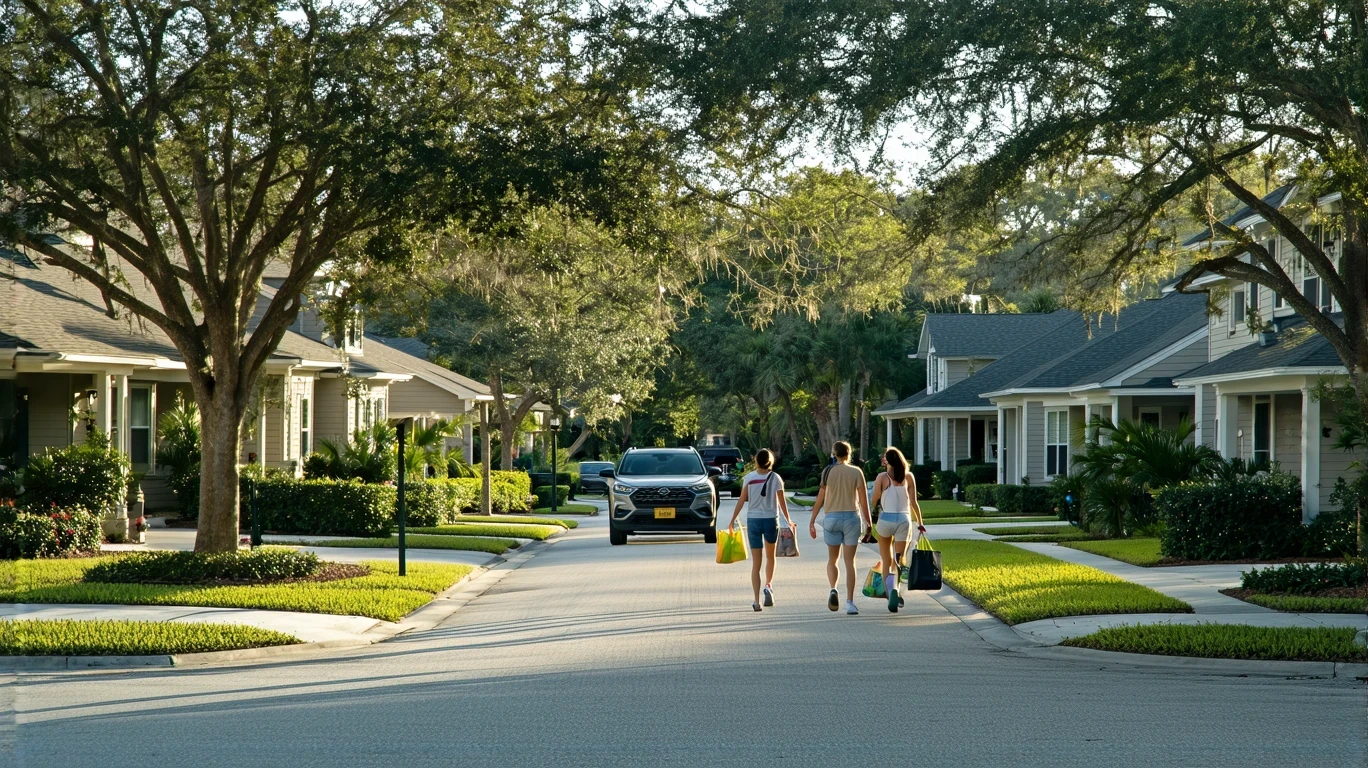
How Grocery Costs Feel in Sanford
Grocery prices in Sanford sit noticeably above the national baseline, shaped by Florida’s regional cost structure and the distribution patterns that define how food reaches Central Florida communities. With a regional price parity index of 123—meaning the overall cost of goods and services runs about 23% higher than the U.S. average—Sanford reflects the broader Orlando metro pricing environment, where housing pressure, logistics, and demand all push everyday costs upward. For households earning close to the city’s median income of $59,181 per year, grocery spending becomes one of the few flexible line items in a budget otherwise dominated by rent, utilities, and transportation. That makes food costs highly visible: families notice when staples climb, and singles feel the pressure of minimum purchase sizes and less ability to spread fixed costs across multiple people.
Who feels grocery costs most in Sanford depends less on the specific items in the cart and more on household composition and income elasticity. A single adult earning near the median can absorb moderate price swings by adjusting quality or frequency, but a family of four faces relentless volume pressure—more gallons of milk, more pounds of chicken, more trips per month. Larger households also lose the ability to wait for sales or substitute easily, because staple depletion happens faster and preferences multiply. Retirees on fixed income occupy a middle ground: their household size is smaller, but their income doesn’t adjust for inflation, so sustained increases in everyday items like eggs, bread, and produce create cumulative strain that’s hard to offset elsewhere.
Sanford’s food retail landscape clusters along commercial corridors rather than spreading evenly across neighborhoods, which means accessing lower-cost grocery options often requires intentional planning rather than convenience. The city’s infrastructure supports a mix of residential and commercial land use, and pedestrian-to-road ratios in parts of town suggest some walkability, but food and grocery density sits in the medium band—enough to avoid true food deserts, but not enough to guarantee a discount grocer, mid-tier chain, and premium market all within a five-minute drive of every household. That access gap amplifies the importance of store choice: driving an extra few miles to reach a different tier can mean the difference between tight weeks and comfortable ones, but only if your schedule, vehicle access, and route allow it.
Grocery Price Signals (Illustrative)
These prices illustrate how staple items tend to compare locally—not a full shopping list. They’re derived from national baselines adjusted for regional price parity, and they reflect broader cost positioning rather than any single store’s shelf on any given week. Use them to understand relative pressure, not to predict your receipt.
| Item | Illustrative Price |
|---|---|
| Bread (per pound) | $2.22/lb |
| Milk (per half-gallon) | $5.00/half-gallon |
| Eggs (per dozen) | $2.89/dozen |
| Chicken (per pound) | $2.50/lb |
| Ground beef (per pound) | $8.24/lb |
| Cheese (per pound) | $5.88/lb |
| Rice (per pound) | $1.30/lb |
Derived estimate based on national baseline adjusted by regional price parity; not an observed local price.
Ground beef stands out as a high-pressure item—over $8 per pound positions it as a discretionary protein for many households, not a weekly given. Chicken, by contrast, offers more flexibility at $2.50 per pound, and rice remains a reliable base at $1.30. Eggs and milk occupy the middle: everyday essentials that most households buy weekly, where even small increases feel immediate. Bread at $2.22 per pound and cheese near $6 per pound reflect the regional premium on processed and packaged goods, where logistics, refrigeration, and shelf-life management all add cost before the item ever reaches the cart.
These signals matter most when compared across store tiers. A discount grocer in Sanford might price chicken closer to $2.20 per pound and ground beef under $7.50, while a premium market could push beef past $10 and organic chicken past $5. The gap between tiers widens on high-turnover staples and narrows on shelf-stable goods, which means the financial impact of store choice grows with household size and protein consumption. Families buying multiple pounds of meat per week see that spread multiply quickly; singles buying smaller quantities may not notice enough difference to justify the drive.
Store Choice & Price Sensitivity
Grocery price pressure in Sanford varies sharply by store tier, and understanding that variation matters more than fixating on any single item’s cost. Discount grocers—the no-frills chains with limited selection, house brands, and fewer services—offer the tightest pricing on high-volume staples like milk, eggs, bread, and chicken. These stores succeed by moving product fast, keeping overhead low, and appealing to households where every dollar of grocery savings creates breathing room elsewhere in the budget. For families stretching $59,000 across rent, utilities, and transportation, discount grocers become the default, not a compromise.
Mid-tier chains—the recognizable supermarkets with broader selection, name brands, and occasional promotions—occupy the middle. They’re more convenient for one-stop shopping, carry more variety in produce and prepared foods, and feel less spartan than discount options. Pricing runs higher on most items, but not uniformly: sales, loyalty programs, and store brands can bring specific staples close to discount levels if you’re willing to track cycles and plan around them. Singles and two-adult households with moderate income often settle here, valuing the time saved and the ability to find specialty items without a second stop.
Premium markets—organic-focused, specialty, or upscale grocers—charge the highest baseline prices but offer quality differentiation, prepared foods, and a shopping experience that feels less transactional. For households with income well above the median, or those prioritizing organic, local, or dietarily specific products, the premium is intentional. But for median-income families, premium grocers function more as occasional stops for specific items than as primary shopping destinations, because the cost gap on everyday staples makes weekly reliance unsustainable.
Sanford’s corridor-clustered grocery access means store tier choice isn’t always frictionless. If the nearest discount grocer sits four miles away and the mid-tier chain is two, the time and fuel cost of seeking the lowest price starts to erode the savings—especially for smaller households making fewer trips per month. Families with predictable, high-volume needs can justify the drive because the per-trip savings scale with cart size. Singles and couples face a tighter calculus: is the $10–$15 saved per trip worth the extra 20 minutes and gallon of gas? The answer depends on schedule flexibility, vehicle reliability, and how much financial margin exists elsewhere in the household budget.
What Drives Grocery Pressure Here
Income interaction defines much of Sanford’s grocery sensitivity. At $59,181 per year, the median household income sits below the threshold where food costs become invisible. For a family of four, even moderate grocery pricing creates a fixed drain that limits flexibility in other categories—less ability to absorb a utility spike, less room to save for a car repair, less cushion when rent renews higher. Singles fare better in percentage terms but face their own friction: smaller package sizes, less ability to buy in bulk, and fewer people to split perishable items with before they spoil. The result is that grocery costs feel tighter in Sanford than the item prices alone might suggest, because the income base doesn’t provide much buffer.
Household size sensitivity compounds that pressure. A two-person household might cycle through a gallon of milk in five days; a family of four burns through it in two. Eggs, bread, chicken, and fresh produce all scale with the number of people eating at home, and the frequency of shopping trips rises accordingly. Larger households also lose the ability to smooth costs by skipping weeks or substituting freely—when you’re feeding kids on a school schedule, staples run out on a predictable cadence, and sales cycles don’t always align with depletion. That makes grocery spending feel less discretionary and more like a recurring bill, which increases the stakes of store choice and the visibility of price increases.
Regional distribution patterns shape what arrives on Sanford’s shelves and what it costs to get there. Central Florida’s grocery supply chains favor volume and speed over localization, meaning much of what residents buy has traveled significant distances and passed through regional distribution hubs before reaching the store. That adds cost—fuel, refrigeration, handling—that gets baked into retail prices even before store-level margins apply. Seasonal variability exists but operates more on the supply side than the demand side: Florida’s climate reduces heating-related food cost swings (no winter produce premiums from scarcity), but hurricane season and summer heat can disrupt logistics and tighten availability on perishables, creating short-term price spikes that feel random but reflect infrastructure exposure.
Practical Ways People Manage Grocery Costs
Households in Sanford manage grocery pressure by controlling frequency, tier, and waste rather than chasing per-item optimization. Shopping less often reduces the temptation to overbuy and the cumulative cost of impulse additions, but it requires planning: knowing what you’ll cook, how much you’ll actually use, and what can survive a week in the fridge without spoiling. Families with predictable routines and freezer space benefit most from this approach, because they can buy proteins and staples in larger quantities when prices dip, then stretch those purchases across multiple weeks. Singles and smaller households face more risk—buying too much leads to waste, which erases any savings from bulk pricing.
Store tier rotation offers another lever: using discount grocers for high-volume staples like milk, eggs, rice, and chicken, then filling gaps at mid-tier chains for variety, produce quality, or specific brands. This strategy works best when the stores sit close enough together that the combined trip doesn’t add significant time or fuel cost. In Sanford, where grocery access clusters along corridors rather than spreading evenly, that proximity isn’t guaranteed—some households can execute a two-store strategy easily, while others face a choice between convenience and cost that makes rotation impractical.
Reducing waste has no direct cost but significant cumulative impact. Letting produce spoil, discarding leftovers, or overbaking perishables all convert grocery spending into garbage, which tightens the budget without providing any nutritional return. Households that plan meals around what’s already in the pantry, repurpose leftovers intentionally, and track what actually gets eaten tend to stretch the same grocery dollar further than those who shop reactively. The discipline required scales with household size—coordinating preferences and schedules across four people is harder than managing for one—but the payoff grows too, because larger households generate more waste when planning breaks down.
Loyalty programs, digital coupons, and store apps provide marginal help but rarely transform the overall cost structure. They work best when layered onto intentional shopping behavior—using a coupon for something you were already buying, or timing a stock-up trip around a sale cycle. Chasing deals for their own sake often leads to buying things you don’t need, which increases total spending even as per-item cost falls. The households that benefit most from these tools are the ones already shopping strategically; for everyone else, the time cost of deal-hunting often exceeds the savings.
Groceries vs Eating Out (Directional)
The tradeoff between cooking at home and eating out in Sanford hinges on time, convenience, and how much a household values predictability over flexibility. Groceries require planning, prep, and cleanup—costs that don’t show up on the receipt but consume time and energy that many households, especially dual-income families or single parents, struggle to spare. Eating out eliminates that friction but introduces a different cost structure: higher per-meal expense, less control over ingredients and portion sizes, and less ability to stretch leftovers across multiple meals. For median-income households, eating out frequently becomes unsustainable, but cooking every meal demands a level of organization and schedule margin that isn’t always available.
The financial crossover depends on household size and frequency. A single adult eating a $12 fast-casual meal pays roughly the same as cooking a comparable dinner at home once you factor in the cost of ingredients that won’t all get used in one sitting. A family of four eating that same $12-per-person meal spends $48, which could buy enough groceries to cover two or three dinners if planned carefully. That’s why larger households feel more pressure to cook at home—not because they want to, but because the math makes frequent restaurant meals unworkable within a median income budget.
Sanford’s dining landscape offers the usual suburban mix—fast food, fast-casual chains, and a scattering of local sit-down spots—but the cost of eating out still runs higher than in less expensive metros, reflecting the same regional price pressures that affect groceries. Households treat restaurant meals as occasional relief rather than routine, reserving them for weeks when schedules collide, cooking fatigue peaks, or a specific craving justifies the expense. The key insight isn’t that cooking always wins—it’s that the decision involves more than price, and households that don’t account for time, energy, and waste often misjudge which option actually costs less.
FAQs About Grocery Costs in Sanford (2026)
Is it cheaper to shop in bulk in Sanford? Bulk buying reduces per-unit cost on non-perishables like rice, canned goods, and household staples, but only if you have the upfront cash, storage space, and consumption rate to use what you buy before it expires. Families and larger households benefit most; singles often end up with waste that erodes the savings.
Which stores in Sanford are best for low prices? Discount-tier grocers consistently offer the lowest baseline pricing on high-turnover staples like milk, eggs, bread, and chicken. Mid-tier chains can match or beat those prices on specific items during sales, but discount stores win on everyday reliability. Store location and access matter—if the nearest discount option requires a long drive, the fuel cost starts to offset the grocery savings.
How much more do organic items cost in Sanford? Organic and specialty products typically carry a significant premium over conventional equivalents, with the gap widening on high-demand items like chicken, eggs, and produce. Premium-tier grocers stock the widest organic selection but charge the highest prices; mid-tier chains offer limited organic options at somewhat lower cost. For median-income households, organic purchases tend to be selective rather than across-the-board.
How do grocery costs for families in Sanford compare to nearby cities? Sanford shares the Orlando metro’s regional price structure, meaning grocery costs run similarly to other Central Florida communities with comparable income levels and store access. Cities with higher median incomes or denser grocery competition may offer more premium options, but baseline staple pricing remains fairly consistent across the metro.
How do households in Sanford think about grocery spending when cooking at home? Most treat groceries as one of the few flexible budget categories—easier to adjust than rent or car payments, but harder to cut without affecting quality of life. Families focus on stretching staples and minimizing waste; singles balance convenience against per-unit cost. Store choice, trip frequency, and meal planning discipline all influence whether grocery spending feels manageable or relentless.
Do grocery costs in Sanford change much with the seasons? Florida’s climate reduces the kind of winter produce scarcity that drives prices up in colder states, but summer heat and hurricane season can disrupt logistics and tighten availability on perishables, creating short-term price spikes. Most seasonal variation shows up as supply-side volatility rather than predictable cost cycles.
Can shopping at multiple stores really save money in Sanford? Yes, but only if the stores are close enough that the combined trip doesn’t add significant time or fuel cost. Families with high-volume needs and flexible schedules benefit most from tier rotation—buying staples at discount grocers and filling gaps at mid-tier chains. Smaller households or those with tight schedules often find the convenience cost outweighs the savings.
How Groceries Fit Into the Cost of Living in Sanford
Groceries occupy a middle position in Sanford’s cost structure—less dominant than housing, more visible than utilities, and more controllable than transportation for households without the flexibility to relocate or change commutes. For a family earning near the median income, food costs represent one of the few line items where behavior, planning, and store choice can create meaningful monthly variation. That makes grocery spending feel both flexible and relentless: you can adjust it, but you can’t eliminate it, and every week brings another trip, another decision, another tradeoff between cost, quality, and convenience.
Understanding how groceries interact with the rest of your budget requires seeing the full picture—how much rent or mortgage consumes, what utilities demand during Florida’s long cooling season, and whether your commute leaves time and energy for meal planning. The Monthly Spending in Sanford: The Real Pressure Points article breaks down where money actually goes each month, how fixed and flexible costs balance, and which households feel the most pressure. Groceries are part of that equation, but they don’t exist in isolation—what you spend on food depends on what’s left after housing, transportation, and utilities take their share.
If you’re evaluating whether Sanford works for your household, start by mapping the non-negotiables—rent, car payment, insurance, commute costs—then see what remains for food, savings, and discretionary spending. Grocery costs in Sanford won’t break a budget on their own, but they will test your ability to plan, prioritize, and adapt when other costs rise. The households that manage best are the ones who treat grocery spending as a strategic decision, not an afterthought, and who understand that store choice, trip frequency, and waste management all influence whether the city feels affordable or tight.
How this article was built: In addition to public economic data, this article incorporates location-based experiential signals derived from anonymized geographic patterns—such as access density, walkability, and land-use mix—to reflect how day-to-day living actually feels in Sanford, FL.