
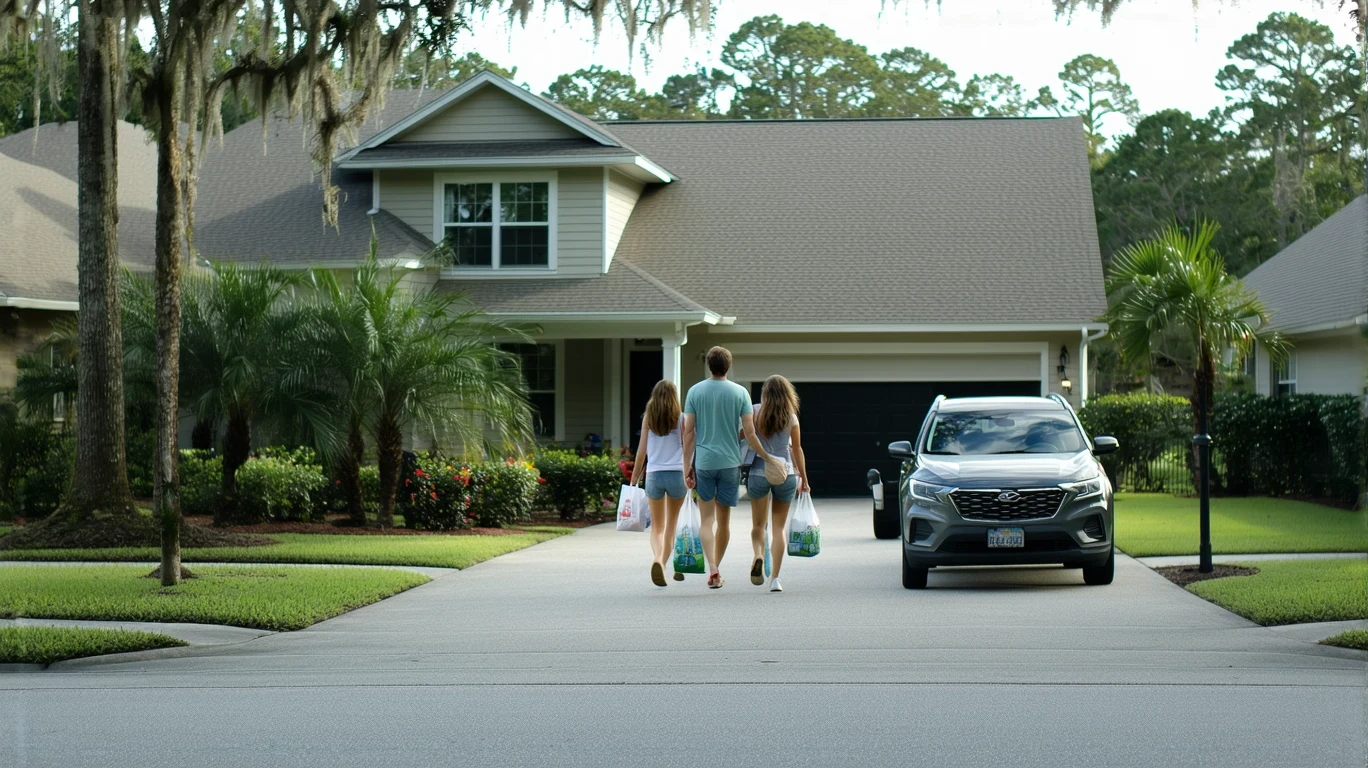
How Grocery Costs Feel in Maitland
Grocery prices in Maitland sit close to the national baseline, with a regional price parity index of 101—just one point above the U.S. average. That proximity suggests food costs here track national patterns fairly closely, without the sharp premiums seen in high-cost metros or the discounts common in lower-cost rural areas. For most households, the grocery experience in Maitland feels neither unusually cheap nor prohibitively expensive; it’s the volume purchased, the stores chosen, and the household composition that determine whether the weekly shop feels manageable or tight.
Singles and couples without children often find grocery spending straightforward to control. A professional living alone can shop selectively, lean toward discount or mid-tier stores, and absorb occasional premium purchases without meaningful budget strain. Couples experience slightly more sensitivity—routine restocking adds up faster, and the choice between discount chains and premium grocers starts to matter week over week. But it’s families with children who feel grocery cost pressure most acutely in Maitland. Volume amplifies every price difference: a 30-cent gap per pound of chicken or a 50-cent difference in a gallon of milk compounds across multiple weekly trips, turning small item-level variances into meaningful monthly pressure.
Maitland’s cost structure is dominated by housing, which absorbs the largest share of household income. Groceries sit in the middle tier of recurring expenses—less volatile than utilities, more predictable than transportation fuel, but still sensitive enough to household size that families often treat food spending as a primary lever for monthly budget adjustment. The city’s median household income of $89,871 per year provides meaningful cushion for many households, but that income level also reflects a mix of dual-income couples, retirees, and single earners, meaning grocery sensitivity varies widely depending on household structure and competing financial obligations.
Grocery Price Signals (Illustrative)
These prices illustrate how staple items tend to compare locally—not a full shopping list. They’re derived estimates based on national baseline data adjusted by regional price parity, and they reflect typical positioning rather than week-to-week retail accuracy. Use them as anchors for understanding relative cost pressure, not as checkout predictions.
| Item | Price |
|---|---|
| Bread (per pound) | $1.86/lb |
| Cheese (per pound) | $4.89/lb |
| Chicken (per pound) | $2.06/lb |
| Eggs (per dozen) | $2.60/dozen |
| Ground beef (per pound) | $6.82/lb |
| Milk (per half-gallon) | $4.14/half-gallon |
| Rice (per pound) | $1.07/lb |
Ground beef stands out as the highest-cost staple on a per-pound basis, reflecting broader national trends in meat pricing. Chicken remains a more affordable protein option, and rice offers a low-cost base for meal planning. Eggs and milk sit in the moderate range, though both are subject to seasonal and supply-chain volatility that can shift pricing quickly. Cheese, bread, and other processed staples reflect the regional price parity adjustment—close to national norms, but not discounted.
These item-level prices help explain why families feel grocery pressure more intensely than singles. A household buying five pounds of chicken, two gallons of milk, and a dozen eggs weekly will see those per-unit costs multiply quickly, while a single person buying half those quantities experiences far less cumulative impact. The price positioning also highlights why store tier choice matters: a discount grocer offering chicken at $1.85 per pound instead of $2.06 creates meaningful savings for high-volume buyers, while the difference barely registers for low-volume shoppers.
Store Choice & Price Sensitivity
Grocery cost pressure in Maitland varies more by store tier than by a single “average” experience. Discount grocers—typically no-frills chains with limited selection, house brands, and fewer prepared foods—offer the lowest per-item pricing and appeal most to budget-conscious families and cost-sensitive shoppers. Mid-tier stores balance price and convenience, offering broader selection, name brands, and more predictable stock without the premium markup. Premium grocers emphasize organic options, specialty items, prepared foods, and curated selection, charging noticeably more per item but offering convenience and quality differentiation that some households prioritize.
For families with children, discount stores often become the default. The volume purchased each week makes even small per-item savings meaningful, and the trade-off—less variety, fewer prepared options, occasionally inconsistent stock—feels manageable when the alternative is meaningfully higher spending. Couples and singles, by contrast, often gravitate toward mid-tier stores, where the convenience and selection justify slightly higher prices given lower overall volume. Premium grocers serve a narrower audience in Maitland: households with higher discretionary income, specific dietary preferences, or a strong preference for organic and specialty items.
The city’s day-to-day costs are shaped in part by the distribution of grocery options. Food and grocery density in Maitland falls in the medium band, with options concentrated along commercial corridors rather than evenly distributed across neighborhoods. That pattern means some residents can easily compare prices across multiple stores within a short drive, while others face longer trips to access discount options, effectively raising the cost of seeking lower prices. The presence of both residential and commercial land use throughout the city supports mixed-use errands trips, allowing some households to combine grocery shopping with other tasks, but the car remains the primary mode for most grocery runs despite pockets of higher pedestrian infrastructure.
What Drives Grocery Pressure Here
Income interaction plays a significant role in how grocery costs feel in Maitland. The city’s median household income of $89,871 per year provides meaningful capacity for most households, but that figure masks wide variation. Dual-income couples without children often experience minimal grocery pressure, even when shopping at mid-tier or premium stores. Single earners supporting children, by contrast, feel the squeeze more acutely, especially when housing and transportation costs claim large shares of income. Retirees on fixed incomes occupy a middle position: lower household size reduces volume, but limited income growth makes price increases more noticeable over time.
Household size sensitivity is the clearest driver of grocery cost pressure in Maitland. A single professional might spend $250 to $350 per month on groceries without strain, even with occasional premium purchases. A family of four, by contrast, can easily see monthly grocery spending climb past $800 or $900, particularly if children are older and eating more, or if dietary preferences lean toward fresh produce, meat, and dairy rather than shelf-stable staples. The difference isn’t just volume—it’s also the loss of flexibility. Singles can skip a week, eat out more, or shift spending toward convenience without meaningful consequence. Families face more rigid demand and fewer opportunities to defer or substitute.
Regional distribution and access patterns also shape grocery pressure. Maitland’s corridor-clustered food and grocery density means that proximity to commercial corridors determines how easily households can compare prices and access discount options. Residents living near major retail corridors benefit from shorter trips and more store choice, while those in more residential pockets may face longer drives to reach discount grocers, effectively raising the friction cost of seeking lower prices. Seasonal variability in produce pricing, supply-chain disruptions, and periodic shifts in meat and dairy costs add unpredictability, but these factors affect all households similarly and are less distinctive to Maitland than to cities with more extreme regional price premiums or isolation from distribution networks.
Practical Ways People Manage Grocery Costs
Households in Maitland manage grocery costs primarily through store choice, shopping frequency, and meal planning discipline. Switching from a mid-tier grocer to a discount chain reduces per-item costs across most staples, and for families buying in volume, that shift can ease monthly pressure meaningfully. Shopping less frequently—consolidating trips to once per week instead of multiple smaller runs—reduces impulse purchases and helps households stick to planned lists. Meal planning around sales, seasonal produce, and versatile staples like rice, beans, and chicken lowers per-meal costs and reduces waste, though it requires more upfront time and discipline.
Buying in bulk works well for non-perishable staples and household items, but it requires storage space and upfront cash, making it more practical for families with larger homes and stable budgets than for singles or renters in smaller units. Leaning toward house brands instead of name brands cuts costs without sacrificing much quality for most staples, and discount grocers often carry house-brand versions of nearly every category. Reducing prepared foods and convenience items—pre-cut vegetables, marinated meats, ready-to-eat meals—lowers spending noticeably, though it shifts time cost onto the household in the form of more meal prep and cooking.
Some households reduce grocery pressure by growing herbs, tomatoes, or other high-use produce at home, though Florida’s heat and humidity require consistent watering and pest management. Others join buying co-ops or shop at farmers’ markets for seasonal produce, though these options require flexibility in meal planning and aren’t always cheaper than discount grocers. The most effective strategy for most households remains straightforward: shop at the lowest-cost store that meets baseline needs, plan meals around what’s already on sale, and avoid frequent small trips that invite unplanned spending.
Groceries vs Eating Out (Directional)
The tradeoff between cooking at home and eating out in Maitland depends on household size, time availability, and income flexibility. For singles and couples, eating out occasionally feels manageable and often competitive with the time cost of cooking, especially for quick lunches or weeknight dinners. For families, the math shifts sharply: restaurant meals for four add up quickly, and even casual dining can exceed the cost of a week’s worth of home-cooked dinners. Families with children typically treat eating out as an occasional convenience or social activity rather than a routine substitute for grocery shopping.
Cooking at home consistently offers the most control over food spending, but it requires time, planning, and a tolerance for repetition. Households that batch-cook, use leftovers strategically, and plan meals around versatile staples see the greatest cost advantage. Those who cook sporadically or rely heavily on convenience items—pre-marinated proteins, pre-washed greens, frozen meals—narrow the gap between home cooking and eating out, sometimes to the point where the time savings of restaurant meals feel worth the premium.
The decision isn’t purely financial. Eating out reduces meal prep time, eliminates cleanup, and offers variety that home cooking can’t always match. But for households feeling grocery pressure in Maitland, the directional guidance remains clear: cooking at home, shopping at discount or mid-tier stores, and planning meals around sales and staples will always cost less than frequent restaurant meals, and the gap widens sharply as household size increases.
FAQs About Grocery Costs in Maitland (2026)
Is it cheaper to shop in bulk in Maitland? Bulk buying reduces per-unit costs for non-perishable staples like rice, pasta, canned goods, and household items, but it requires upfront cash and storage space. Families with larger homes and stable budgets benefit most; singles and renters in smaller units may find bulk buying impractical.
Which stores in Maitland are best for low prices? Discount grocers—no-frills chains with limited selection and house brands—offer the lowest per-item pricing and work well for budget-conscious families. Mid-tier stores balance price and convenience, while premium grocers charge more for organic, specialty, and prepared foods. Store choice matters most for high-volume buyers.
How much more do organic items cost in Maitland? Organic produce, dairy, and meat typically carry premiums over conventional options, though the gap varies by item and store. Premium grocers stock more organic options but charge higher baseline prices; discount grocers carry fewer organic items but offer lower premiums when available. Households prioritizing organic should expect meaningfully higher grocery spending.
How do grocery costs for two adults in Maitland tend to compare to nearby cities? Maitland’s regional price parity index of 101 sits near the national baseline, suggesting grocery costs here track closely with similar suburban cities in central Florida. Households moving from higher-cost metros may find groceries slightly more affordable; those moving from lower-cost rural areas may notice modest increases.
How do households in Maitland think about grocery spending when cooking at home? Most households treat grocery spending as a controllable expense, adjusting store choice, shopping frequency, and meal planning to fit their budget. Families with children feel the most pressure and often prioritize discount stores and planned meals; singles and couples have more flexibility to absorb occasional premium purchases without strain.
Does shopping at farmers’ markets in Maitland save money? Farmers’ markets can offer competitive prices on seasonal produce, but they require flexibility in meal planning and aren’t always cheaper than discount grocers. They work best for households prioritizing freshness and variety over predictable low prices.
How does household size affect grocery costs in Maitland? Household size is the clearest driver of grocery cost pressure. Singles and couples can control spending through store choice and selective purchasing; families with children face higher volume demand, less flexibility, and greater sensitivity to per-item price differences, making store tier choice and meal planning critical.
How Groceries Fit Into the Cost of Living in Maitland
Groceries occupy the middle tier of recurring household expenses in Maitland, sitting below housing and often below transportation, but above many discretionary categories. For most households, food spending feels more controllable than rent, mortgage, or utility bills, but less flexible than entertainment or dining out. That positioning makes groceries a common adjustment lever: when other costs rise or income tightens, households often respond by shifting to lower-cost stores, cutting back on premium items, or cooking more meals at home.
The city’s median household income of $89,871 per year provides meaningful capacity for most residents, but grocery sensitivity still varies widely depending on household size, competing financial obligations, and proximity to discount grocery options. Families with children, single earners, and retirees on fixed incomes feel grocery cost pressure most acutely, while dual-income couples without children typically experience minimal strain. The regional price parity index of 101 keeps Maitland’s grocery costs close to national norms, meaning the primary drivers of pressure are household-specific rather than city-specific.
For a complete picture of how groceries fit into monthly household expenses—including housing, utilities, transportation, and discretionary spending—see the full monthly budget breakdown for Maitland. That article walks through how different household types allocate income across all major categories, helping you understand where grocery spending sits relative to other recurring costs and how much flexibility you’re likely to have. Groceries are one piece of the puzzle, but understanding the full cost structure is what builds confidence in whether Maitland fits your financial situation.
How this article was built: In addition to public economic data, this article incorporates location-based experiential signals derived from anonymized geographic patterns—such as access density, walkability, and land-use mix—to reflect how day-to-day living actually feels in Maitland, FL.