
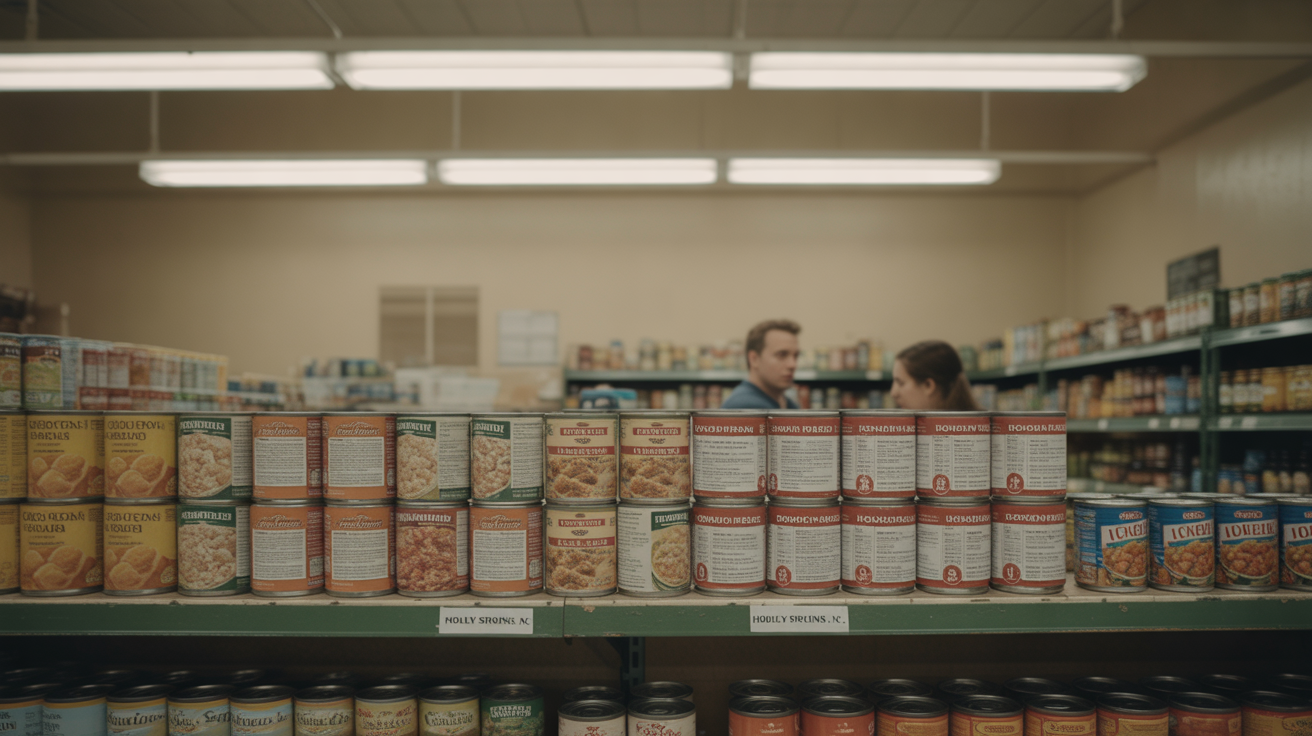
How Grocery Costs Feel in Holly Springs
Grocery prices in Holly Springs sit slightly above the national baseline, reflecting the area’s regional price parity index of 103—meaning everyday staples cost about 3% more than the U.S. average after adjusting for local economic conditions. For most households here, that modest premium doesn’t create significant pressure. With a median household income of $127,755 per year, families in Holly Springs generally absorb grocery costs as a smaller share of their overall budget compared to communities with tighter income constraints. The result is a food-cost environment that feels manageable rather than stressful for the majority of residents, though the experience varies depending on household size, income level, and shopping habits.
Singles and couples without children tend to notice grocery costs more acutely than larger families, not because prices are higher, but because food represents a more visible line item when other major expenses—like housing or childcare—aren’t competing for attention. A single professional might spend $250–$350 monthly on groceries depending on preferences and store choice, and that amount stands out more clearly in a budget than it would for a family of four managing multiple cost centers simultaneously. Families, by contrast, face higher absolute spending but often benefit from bulk purchasing, meal planning at scale, and the ability to distribute fixed costs like pantry staples across more people. The pressure families feel is less about per-item prices and more about volume and the compounding effect of feeding multiple people daily.
What shapes the grocery experience in Holly Springs isn’t just the price level—it’s how food and grocery options are distributed. Local access patterns show that stores tend to cluster along commercial corridors rather than spreading evenly across neighborhoods. That means most residents rely on short drives to reach their preferred grocery store, and the choice between discount, mid-tier, and premium retailers becomes a deliberate decision rather than a convenience-driven one. This corridor-clustered accessibility adds a layer of intentionality to grocery shopping: households that prioritize low prices need to plan their trips around specific stores, while those willing to pay for convenience or specialty items have fewer obstacles. The structure doesn’t create hardship, but it does mean that grocery costs in Holly Springs are shaped as much by where and how you shop as by the baseline price environment.
Grocery Price Signals (Illustrative)
The table below shows how staple items tend to compare locally, offering a sense of relative price positioning rather than a complete shopping list or receipt-level accuracy. These figures are derived estimates based on national baseline data adjusted by regional price parity; they are not observed local prices and should be understood as illustrative anchors only. Actual prices vary by store tier, brand, package size, and weekly promotions.
| Item | Price |
|---|---|
| Bread | $1.91/lb |
| Cheese | $4.82/lb |
| Chicken | $2.11/lb |
| Eggs | $2.58/dozen |
| Ground Beef | $6.94/lb |
| Milk | $4.15/half-gallon |
| Rice | $1.11/lb |
These prices illustrate how staple items tend to compare locally—not a full shopping list. Ground beef and cheese represent the higher end of everyday protein and dairy costs, while rice and bread anchor the lower end of pantry staples. Eggs and milk fall in the middle, sensitive to seasonal and supply-chain shifts but generally stable within a predictable range. Chicken remains one of the most cost-effective proteins, and its per-pound price makes it a cornerstone of budget-conscious meal planning. What these numbers don’t capture is the variation across store tiers: discount grocers often price ground beef $1–$2 lower per pound than premium chains, and organic or specialty versions of any item can double the baseline cost. The table provides context, not a forecast of what any individual cart will total at checkout.
Price volatility matters more than static comparisons. Eggs, for instance, can swing dramatically depending on supply disruptions or seasonal demand, while rice and dried goods remain largely insulated from short-term shocks. Households that build flexibility into their meal planning—substituting chicken for beef when prices spike, or buying cheese in larger blocks rather than pre-sliced—gain more control over their grocery spending than those who shop from a fixed list regardless of weekly price shifts. In Holly Springs, where income levels provide cushion for most families, the ability to adapt to price signals is less about necessity and more about optimizing value without sacrificing quality or convenience.
Store Choice & Price Sensitivity
Grocery price pressure in Holly Springs varies significantly by store tier, and understanding that variation is more useful than focusing on a single “average” cost. Discount grocers—regional chains and value-focused stores—anchor the low end of the pricing spectrum, offering staples at prices that can run 15–25% below mid-tier competitors. These stores prioritize high-volume turnover, limited selection, and minimal service, which translates directly into lower per-item costs. For households managing tight budgets or simply prioritizing grocery savings, discount stores provide the most control over food spending. The tradeoff is reduced convenience: fewer locations, less variety, and a shopping experience that requires more planning and flexibility around brand and packaging options.
Mid-tier grocers—the most common option in suburban areas like Holly Springs—balance price, selection, and convenience. These stores stock national brands alongside private-label alternatives, offer broader produce and meat selections, and maintain more locations, making them the default choice for most families. Prices here sit near the regional baseline reflected in the derived estimates above, and the experience feels neither budget-focused nor premium. Mid-tier stores work well for households that value predictability and convenience over aggressive cost minimization, and they’re where most routine grocery shopping happens for families with moderate to high incomes. The cost difference between mid-tier and discount stores is meaningful but not prohibitive: a household spending $150 weekly at a mid-tier store might spend $120–$130 for a comparable cart at a discount grocer, assuming similar choices.
Premium grocers—specialty stores, organic-focused chains, and upscale markets—serve households prioritizing quality, variety, or specific dietary preferences over price. These stores charge 20–40% more than mid-tier competitors for comparable items, and the premium widens further for organic, specialty, or prepared foods. For high-income households in Holly Springs, the premium is often invisible: grocery spending remains a small enough share of total income that the convenience and quality justify the cost. For others, premium stores function as occasional destinations rather than primary shopping locations, visited for specific items or special occasions rather than weekly staples. The key insight is that grocery costs in Holly Springs aren’t fixed—they’re a function of where you shop and what tradeoffs you’re willing to make between price, convenience, and selection.
Because food and grocery options in Holly Springs tend to cluster along commercial corridors rather than spreading evenly across neighborhoods, store choice becomes a deliberate decision rather than a proximity-driven default. Most households drive to their preferred store, and that drive time is similar whether you’re heading to a discount grocer or a premium market. The result is that price sensitivity—how much you care about minimizing grocery costs—matters more than geographic access in determining where you shop. Families that prioritize savings plan their trips around discount stores; those that prioritize convenience or quality default to mid-tier or premium options. Neither approach is wrong, but the choice has a measurable impact on monthly food spending.
What Drives Grocery Pressure Here
Income is the single largest factor determining how grocery costs feel in Holly Springs. At a median household income of $127,755 per year, most families allocate a relatively small share of their budget to food, even when shopping at mid-tier or premium stores. A household spending $800–$1,000 monthly on groceries is dedicating roughly 7–9% of gross income to food, well below the threshold where cost pressure becomes a constraint on other spending categories. For these families, grocery costs are a managed expense rather than a source of financial stress. The experience shifts for households earning below the median—particularly those in the $50,000–$75,000 range—where grocery spending can represent 12–18% of gross income depending on household size. At that level, store choice and shopping habits move from optional optimizations to necessary strategies for maintaining budget balance.
Household size amplifies grocery costs in ways that income alone doesn’t capture. A single adult might spend $250–$350 monthly on groceries and barely notice the expense; a family of four with two school-age children might spend $900–$1,200 monthly and feel significantly more pressure, even if their income is proportionally higher. The difference isn’t just volume—it’s the compounding effect of feeding multiple people with different preferences, managing snacks and school lunches, and absorbing the inefficiencies of food waste and impulse purchases that increase with household size. Larger families benefit more from bulk purchasing, meal planning, and discount store strategies, but they also face less flexibility: skipping a grocery trip or substituting a cheaper protein isn’t as simple when you’re managing multiple daily meals for several people.
Regional distribution and access patterns also shape grocery pressure, though more subtly. In Holly Springs, the corridor-clustered layout of food and grocery stores means most households drive to shop, and the choice of store is less constrained by proximity than by preference. That structure benefits households with reliable transportation and the time to compare prices across stores, but it adds friction for those without cars or with limited schedules. The impact is less about absolute access—most residents can reach a grocery store within 10–15 minutes—and more about the ability to shop strategically. Families that can visit multiple stores or time their trips around sales cycles gain more control over costs; those that default to the nearest or most convenient option pay a modest premium for that convenience.
Seasonal variability affects specific categories more than overall grocery costs. Produce prices fluctuate with growing seasons and supply-chain conditions, and proteins like chicken and beef respond to feed costs and demand cycles. Eggs remain the most volatile staple, capable of doubling in price during supply disruptions and returning to baseline within months. Households that adapt their meal planning to these cycles—buying more seasonal produce, substituting proteins based on weekly prices—experience less pressure than those who shop from a fixed list regardless of cost signals. In Holly Springs, where income levels provide cushion, seasonal variability is more of an optimization opportunity than a hardship, but it still rewards flexibility and attention.
Practical Ways People Manage Grocery Costs
Store tier selection is the most direct lever households have for controlling grocery spending. Shifting routine shopping from a mid-tier grocer to a discount chain reduces per-item costs across nearly every category, and the cumulative effect over a month is significant without requiring changes to diet or meal planning. The tradeoff is convenience: discount stores stock fewer brands, offer less variety in specialty items, and require more flexibility around packaging sizes and availability. For households willing to accept those constraints, the savings are immediate and consistent. Some families split their shopping between discount stores for staples and mid-tier or premium stores for specific items—fresh produce, specialty ingredients, or prepared foods—capturing most of the savings without fully sacrificing selection or quality.
Meal planning and bulk purchasing reduce waste and improve cost efficiency, particularly for larger families. Planning a week’s meals in advance allows households to buy only what they’ll use, avoiding impulse purchases and the expense of replacing spoiled or unused ingredients. Bulk purchasing works best for non-perishable staples—rice, pasta, canned goods, frozen proteins—where unit costs drop significantly with larger package sizes. The strategy requires upfront spending and storage space, but it smooths grocery costs over time and reduces the frequency of shopping trips. Families that combine meal planning with bulk purchasing gain the most control over their food budgets, though the approach demands more time and organizational effort than reactive, trip-by-trip shopping.
Private-label and store-brand products offer comparable quality to national brands at lower prices, and the gap is widest in categories like dairy, canned goods, and dry staples. Switching from name-brand to store-brand items across a typical cart reduces total spending without requiring changes to recipes or meal quality. The savings are incremental per item but compound across a monthly shopping cycle. Some households resist store brands due to perceived quality differences, but blind taste tests and ingredient comparisons often reveal minimal distinctions, particularly in commodity categories like flour, sugar, rice, and frozen vegetables. For budget-conscious families, store brands represent one of the easiest and most effective cost-control strategies.
Shopping frequency and trip discipline also influence grocery spending. Households that shop once weekly with a planned list spend less than those who make multiple trips per week, because each additional trip introduces opportunities for impulse purchases and unplanned spending. The discipline required to stick to a list and avoid browsing is harder to maintain across frequent trips, and the cumulative effect of small, unplanned purchases adds up quickly. Some families find that designating one primary shopper—rather than splitting trips among multiple household members—improves cost control by centralizing decision-making and reducing variability in purchasing habits. The strategy isn’t about restriction; it’s about reducing friction and maintaining consistency in how grocery decisions are made.
Groceries vs Eating Out (Directional)
The tradeoff between cooking at home and eating out is less about absolute cost comparison and more about time, convenience, and household priorities. Cooking at home consistently costs less per meal than dining out or ordering takeout, but the gap varies depending on the type of restaurant, the complexity of the home-cooked meal, and how efficiently groceries are used. A simple home-cooked dinner for four—pasta, sauce, salad—might cost $12–$18 in ingredients, while the same meal at a casual restaurant could run $50–$70 before tip. The savings are clear, but they come at the expense of time spent planning, shopping, cooking, and cleaning. For households with tight schedules or limited interest in cooking, the convenience premium of eating out often feels worth the cost.
Frequency matters more than individual meal costs. A household that eats out twice weekly spends significantly less than one that dines out five or six times, even if the per-meal cost is identical. The cumulative effect of frequent restaurant meals or takeout orders can rival or exceed monthly grocery spending, particularly for families that default to dining out when schedules are busy or meal planning falters. In Holly Springs, where household incomes are high, many families treat dining out as a regular part of their routine rather than an occasional indulgence, and the cost is absorbed without strain. For others, particularly those managing tighter budgets, reducing dining frequency and shifting more meals to home cooking is one of the most effective ways to control overall food spending.
The decision isn’t binary. Many households blend home cooking with occasional dining out, using restaurants for social occasions, convenience during busy weeks, or meals that are difficult or time-consuming to prepare at home. The key is understanding the cost structure: dining out consistently adds a significant premium over groceries, but the premium buys time, convenience, and variety that home cooking can’t always replicate. Families that treat dining out as a deliberate choice rather than a default habit gain more control over their food budgets, and those that reserve restaurant meals for specific occasions or circumstances find it easier to balance cost and convenience without feeling deprived.
FAQs About Grocery Costs in Holly Springs (2026)
Is it cheaper to shop in bulk in Holly Springs? Bulk purchasing reduces unit costs for non-perishable staples like rice, pasta, canned goods, and frozen proteins, and the savings compound over time. The strategy works best for larger families or households with storage space, but it requires upfront spending and discipline to avoid waste.
Which stores in Holly Springs are best for low prices? Discount-tier grocers offer the lowest prices, typically running 15–25% below mid-tier competitors for comparable items. The tradeoff is reduced selection and convenience, but for households prioritizing cost control, discount stores provide the most direct savings lever.
How much more do organic items cost in Holly Springs? Organic versions of staple items typically cost 20–50% more than conventional equivalents, with the premium widest for produce, dairy, and meat. Premium grocers stock the broadest organic selection but charge higher baseline prices, while mid-tier stores offer limited organic options at more moderate premiums.
How do grocery costs for families in Holly Springs compare to nearby cities? Holly Springs sits slightly above the national baseline due to its regional price parity index of 103, meaning grocery costs run about 3% higher than the U.S. average. Nearby cities with similar income levels and suburban characteristics tend to show comparable pricing, though rural areas farther from the metro core may offer modestly lower costs.
How do households in Holly Springs think about grocery spending when cooking at home? Most families view groceries as a manageable line item rather than a source of financial pressure, particularly given the area’s high median income. Store choice, meal planning, and shopping habits influence costs more than baseline prices, and households that prioritize savings can control spending without sacrificing quality or variety.
Do grocery costs in Holly Springs vary by season? Produce prices fluctuate with growing seasons and supply-chain conditions, and proteins like eggs and chicken respond to demand cycles and feed costs. Seasonal variability is more pronounced in specific categories than in overall grocery spending, and households that adapt their meal planning to price signals experience less pressure than those shopping from fixed lists.
How does food accessibility in Holly Springs affect grocery costs? Food and grocery stores in Holly Springs tend to cluster along commercial corridors rather than spreading evenly across neighborhoods, which means most households drive to shop. That structure makes store choice a deliberate decision rather than a proximity-driven default, and it rewards households that can plan trips around discount stores or compare prices across multiple locations.
How Groceries Fit Into the Cost of Living in Holly Springs
Grocery costs in Holly Springs represent a smaller share of household budgets than housing, utilities, or transportation, but they’re more visible and more controllable on a day-to-day basis. Housing dominates cost-of-living pressure in the area, with a median home value of $449,600 and median gross rent of $1,745 per month setting the baseline for financial planning. Utilities add seasonal variability, particularly during summer cooling months, and transportation costs depend heavily on commute length and vehicle efficiency. Groceries, by contrast, are a recurring expense that households can adjust weekly through store choice, meal planning, and shopping habits. That flexibility makes food spending one of the most responsive categories in a household budget, even if the absolute dollar amount is modest compared to fixed costs like rent or mortgage payments.
For a complete picture of monthly expenses, budget planning, and cost breakdown, readers should consult the dedicated budget guide, which integrates housing, utilities, transportation, and groceries into a unified framework. This article focuses specifically on grocery cost pressure and food-spending strategies, but it’s only one component of the broader cost structure that shapes financial decisions in Holly Springs. Understanding how groceries interact with other spending categories—how much room remains in a budget after housing and transportation are accounted for, or how grocery savings can offset higher utility bills—requires a holistic view that this article alone can’t provide.
The takeaway for households considering a move to Holly Springs, or those already living here and reassessing their budgets, is that grocery costs are manageable and largely within individual control. The regional price environment sits slightly above the national baseline, but income levels in the area provide substantial cushion for most families. Store choice matters more than baseline prices, and households that shop strategically—using discount stores for staples, planning meals around weekly price signals, and avoiding frequent dining out—can control food spending without sacrificing quality or variety. Grocery costs in Holly Springs don’t define affordability, but they do offer one of the clearest opportunities for households to exercise agency over their monthly expenses. The structure is there; the choices are yours.
How this article was built: In addition to public economic data, this article incorporates location-based experiential signals derived from anonymized geographic patterns—such as access density, walkability, and land-use mix—to reflect how day-to-day living actually feels in Holly Springs, NC.