
Budgeting Smarter in Palm Harbor
Understanding the monthly budget in Palm Harbor means recognizing how costs stack in ways that don’t always show up on a simple rent-versus-income calculator. With a median gross rent of $1,567 per month and a median household income of $70,493 per year (roughly $5,874 gross monthly), newcomers often underestimate the cumulative weight of transportation, cooling-season utilities, and the administrative friction that comes with maintaining a household in a car-dependent, suburban Florida community. Palm Harbor sits in a region where the cost structure runs about 26% above the national baseline, and that premium doesn’t distribute evenly—it concentrates in housing, fuel, and the less visible fees that accompany homeownership and even some rental arrangements.
What catches people off guard isn’t necessarily one dominant expense, but rather the interaction between moderate housing costs, extended cooling seasons, and a commute pattern that leans heavily on personal vehicles. Nearly 41.3% of workers face long commutes, and with only 7.2% working from home, most households are managing regular fuel expenses at $4.22 per gallon, alongside electricity billed at 15.92¢ per kWh in a climate where air conditioning isn’t optional. The result is a budget that feels stable on paper but tightens quickly when seasonal utility swings, fuel volatility, or unexpected maintenance costs arrive in the same month.
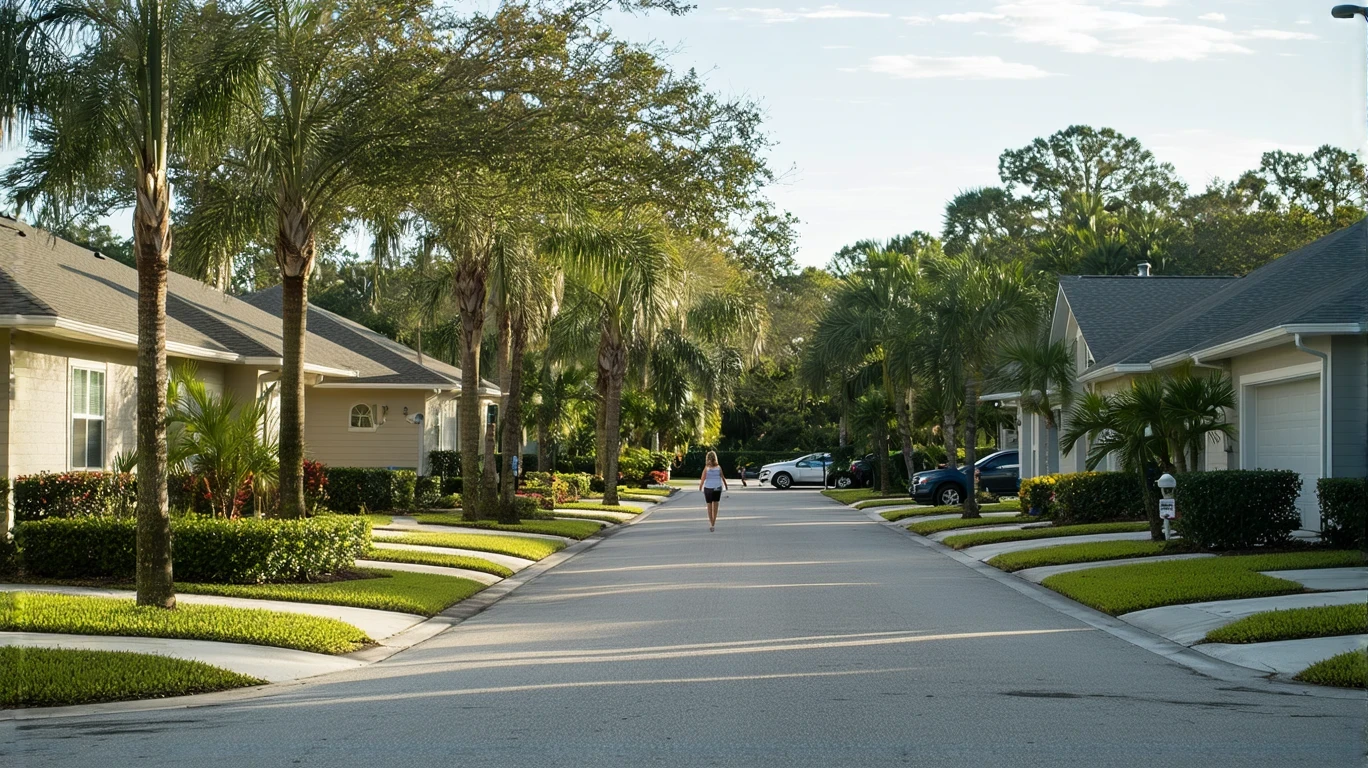
Palm Harbor’s infrastructure reflects a mixed suburban form: walkable pockets exist, but errands and daily needs are corridor-clustered rather than broadly accessible. That means even short trips often require a car, and the cost of mobility—fuel, insurance, maintenance—becomes a fixed rather than flexible line item. For families, retirees, and younger renters alike, the challenge isn’t surviving on a shoestring; it’s managing a budget where predictability matters more than any single headline number.
A Simple Budget Map: How Costs Behave by Household Type
The table below illustrates how cost behavior and exposure differ across three representative household types in Palm Harbor. Rather than simulate exact spending, it shows which categories are stable, which are volatile, and what drives variability for each household. Numbers appear only where the feed provides them; otherwise, entries describe the mechanism of cost pressure.
| Category | Jasmine (single renter) | Sam & Elena (couple) | Ortiz family (2 kids, owners) |
|---|---|---|---|
| Housing (Rent or Mortgage) | $1,567/month median rent; stable if lease-locked | Shared rent or entry mortgage; fixed short-term | Mortgage on $319,300 median home; fixed rate but tax/insurance volatile |
| Utilities | Cooling-season dominant; efficiency-sensitive in smaller unit | Seasonal swings moderate; shared thermostat control | Size-sensitive; extended cooling season drives peak exposure |
| Food (Groceries + Eating Out) | Flexible but corridor-clustered access requires planning | Shared grocery trips reduce per-person friction | Volume-sensitive; batch shopping reduces fuel waste |
| Transportation | Commute-dependent; solo fuel and insurance exposure | Potential for shared commute or second vehicle; exposure doubles if both commute | Multi-vehicle household; school, work, errands create fixed fuel baseline |
| Fees / Friction Costs | Minimal if renting; trash/water often bundled | Moderate; some rentals pass through utility admin fees | HOA, trash, water/sewer billed separately; admin-heavy |
| Discretionary (life + surprises) | Compressed by solo cost absorption | Moderate flexibility; two incomes buffer volatility | Episodic (kid activities, maintenance); discretionary-compressed by fixed obligations |
| What Changes This Most | Commute distance and cooling-season length | Whether both partners commute; lease renewal timing | Fuel volatility, HVAC efficiency, and property tax/insurance adjustments |
Methodology: This guide uses only city-level figures provided in the IndexYard data feed for 2026. Where exact category totals aren’t provided, categories are described directionally to show budget behavior rather than a receipt-accurate total.
The Real Cost Drivers in Palm Harbor
In Palm Harbor, the budget stress point is rarely one big bill—it’s the stack of small “friction” costs that show up after move-in. Housing anchors the budget, whether through the $1,567 median rent or a mortgage on a $319,300 home, but the pressure builds in the interaction between utilities, transportation, and the administrative overhead that comes with maintaining a household in a car-dependent suburb. Cooling costs dominate the utility picture: using a typical household baseline of 1,000 kWh per month and the local electricity rate of 15.92¢ per kWh, an illustrative monthly electricity cost runs around $159 before fees and taxes during peak cooling months. That’s not a ceiling—it’s a reference point that shifts with thermostat discipline, home size, and insulation quality.
Transportation costs layer on top. With 41.3% of workers facing long commutes and gas priced at $4.22 per gallon, a standard round-trip commute of 25 miles in a vehicle averaging 25 MPG translates to roughly $4.22 per day in fuel alone, or about $85 per month assuming a typical work schedule. That’s illustrative context, not a prediction—it excludes insurance, maintenance, and the reality that many households run multiple vehicles to manage school drop-offs, errands, and dual-income logistics. The structure of Palm Harbor—where errands and grocery access are corridor-clustered rather than walkable from most neighborhoods—means that even non-commute trips require fuel, and the cost of mobility becomes a fixed baseline rather than a discretionary line item.
Friction costs add another layer. For homeowners, these include HOA dues (common in many Palm Harbor neighborhoods), separate billing for trash and recycling, water and sewer charges that don’t always align with usage intuition, and the seasonal cost of HVAC servicing to keep cooling systems efficient through Florida’s extended summer. Renters face fewer of these directly, but some landlords pass through utility admin fees or require separate trash service contracts. The result is a budget where the headline rent or mortgage figure doesn’t capture the full monthly obligation, and the gap between “affordable on paper” and “manageable in practice” often comes down to how well a household anticipates these smaller, recurring costs.
Common Friction Costs in Palm Harbor (Directional Overview):
- HOA/association dues: Often cover exterior maintenance, landscaping, and sometimes trash service; vary widely by neighborhood
- Trash/recycling service: May be bundled with HOA or billed separately; structure varies by housing type
- Water/sewer billing: Typically separate from rent or mortgage; usage-sensitive but base fees apply
- Parking permits: Less common in suburban areas but may apply in certain condo or apartment complexes
- HVAC seasonal servicing: Preventive maintenance to manage cooling efficiency; often recommended twice yearly in Florida
- Storm preparation costs: Periodic expenses for hurricane shutters, generator fuel, or emergency supplies
How Households Keep the Budget Under Control (Without Living Like a Monk)
Managing a monthly budget in Palm Harbor isn’t about extreme frugality—it’s about understanding which costs respond to behavior and which don’t. Housing and insurance premiums are largely fixed once locked in, but utilities, transportation, and food costs offer meaningful control through timing, habits, and tradeoffs. The most effective strategies focus on reducing volatility rather than chasing savings percentages, because in a climate where cooling season stretches across most of the year and commuting is non-negotiable for the majority of workers, small adjustments in high-frequency categories compound faster than one-time cuts.
Utility costs respond to thermostat discipline and maintenance cycles. Running air conditioning at a consistent, moderate temperature rather than cycling between extremes reduces both energy waste and system strain. Replacing HVAC filters regularly and scheduling seasonal tune-ups keeps cooling efficiency stable, which matters more in a long cooling season than in climates where air conditioning is occasional. Shifting high-energy tasks—laundry, dishwashing, charging devices—to off-peak hours can reduce exposure to time-of-use rate structures where they apply, though the primary benefit in Palm Harbor is simply spreading the load to avoid peak-hour strain on the grid and the home system.
Transportation costs tighten through route optimization and errand batching. Because groceries and daily errands are corridor-clustered rather than neighborhood-accessible, planning trips to combine multiple stops reduces fuel waste and the cumulative time cost of repeated short drives. For dual-income households, coordinating schedules to share a commute or consolidate kid drop-offs can cut fuel consumption without requiring a lifestyle overhaul. The goal isn’t to eliminate driving—Palm Harbor’s structure makes that impractical for most—but to reduce the frequency of solo, single-purpose trips that add up over the course of a month.
Practical Budget Controls (No Savings Claims, Behavior Only):
- Shift high-energy tasks (laundry, dishwashing) to off-peak hours when possible
- Batch errands to reduce fuel waste and solo trip frequency
- Use programmable thermostats to maintain consistent cooling without manual cycling
- Share commute costs when schedules align (carpooling, coordinated drop-offs)
- Plan grocery trips around weekly sales cycles to reduce per-item cost exposure
- Maintain HVAC filters monthly to reduce cooling load and system strain
- Negotiate HOA service bundles or annual payment discounts where offered
- Monitor water usage during summer months when outdoor irrigation drives spikes
How this article was built: In addition to public economic data, this article incorporates location-based experiential signals derived from anonymized geographic patterns—such as access density, walkability, and land-use mix—to reflect how day-to-day living actually feels in Palm Harbor, FL.
FAQs About Monthly Budgets in Palm Harbor (2026)
Is $5,000 per month enough to live in Palm Harbor?
It depends on household size and housing situation. A single renter paying the $1,567 median rent has room for utilities, transportation, and food, but discretionary spending tightens quickly if commuting is long or cooling costs run high. For a family, $5,000 gross monthly income would compress discretionary categories significantly, especially if managing a mortgage, multiple vehicles, and child-related costs.
What’s the biggest budget surprise for people moving to Palm Harbor?
The extended cooling season and the cumulative cost of car dependency. Newcomers often underestimate how much air conditioning runs year-round and how quickly fuel costs add up when nearly every errand requires driving. The combination of $4.22-per-gallon gas and a commute structure where 41.3% of workers face long trips creates a transportation baseline that’s higher than in more walkable or transit-rich areas.
How much should I budget for utilities in Palm Harbor each month?
Electricity is the dominant utility cost. Using an illustrative baseline of 1,000 kWh per month at 15.92¢ per kWh, expect around $159 before fees and taxes during peak cooling months. Natural gas, where used for heating, runs closer to $24 per month in winter using a typical 1 MCF baseline at $23.62 per MCF. Actual costs vary with home size, insulation, and thermostat settings, but the seasonal swing is predictable: summer months drive the highest bills.
Do most people in Palm Harbor need two cars?
For dual-income households or families with school-age children, two vehicles are common. The corridor-clustered layout of errands and grocery access, combined with limited transit options (bus service only, no rail), makes it difficult to manage work commutes, school drop-offs, and daily errands with a single vehicle unless schedules align tightly. Solo renters or couples with flexible work arrangements may manage with one car, but car dependency is the norm.
How does the cost of living in Palm Harbor compare to the rest of Florida?
Palm Harbor’s regional price parity index of 126 indicates costs run about 26% above the national baseline, which places it in the higher range for Florida suburbs. Housing, fuel, and utilities all reflect that premium, though the gap is less pronounced than in coastal metro cores. The cost structure favors households with stable dual incomes and the ability to absorb seasonal utility swings without budget strain.
Planning Your Next Step
The monthly budget reality in Palm Harbor comes down to three primary drivers: housing costs that anchor the budget at $1,567 median rent or a $319,300 median home value, transportation expenses shaped by car dependency and $4.22-per-gallon fuel, and utilities dominated by cooling-season electricity at 15.92¢ per kWh. The friction costs—HOA dues, separate utility billing, HVAC maintenance—add administrative weight that’s easy to overlook during the apartment search or home tour but becomes a recurring reality once the lease is signed or the mortgage closes.
For a clearer picture of how housing costs break down and what tradeoffs renters and buyers face, see the Palm Harbor housing pressure guide. To understand how seasonal utility swings affect different household types and what efficiency measures actually reduce exposure, explore the utilities breakdown. And for insight into how food costs behave in a corridor-clustered suburb where grocery access requires planning, the grocery costs guide walks through category-level pressure and shopping strategy.
Budgeting in Palm Harbor isn’t about cutting every discretionary dollar—it’s about recognizing which costs are fixed, which respond to behavior, and where volatility concentrates. The households that manage best are the ones that plan for seasonal swings, batch errands to control fuel waste, and treat friction costs as part of the baseline rather than an afterthought. The income is there for many—median household income of $70,493 per year provides a foundation—but the budget works when the structure matches the city’s realities: car dependency, extended cooling seasons, and a suburban form that rewards planning over spontaneity.