
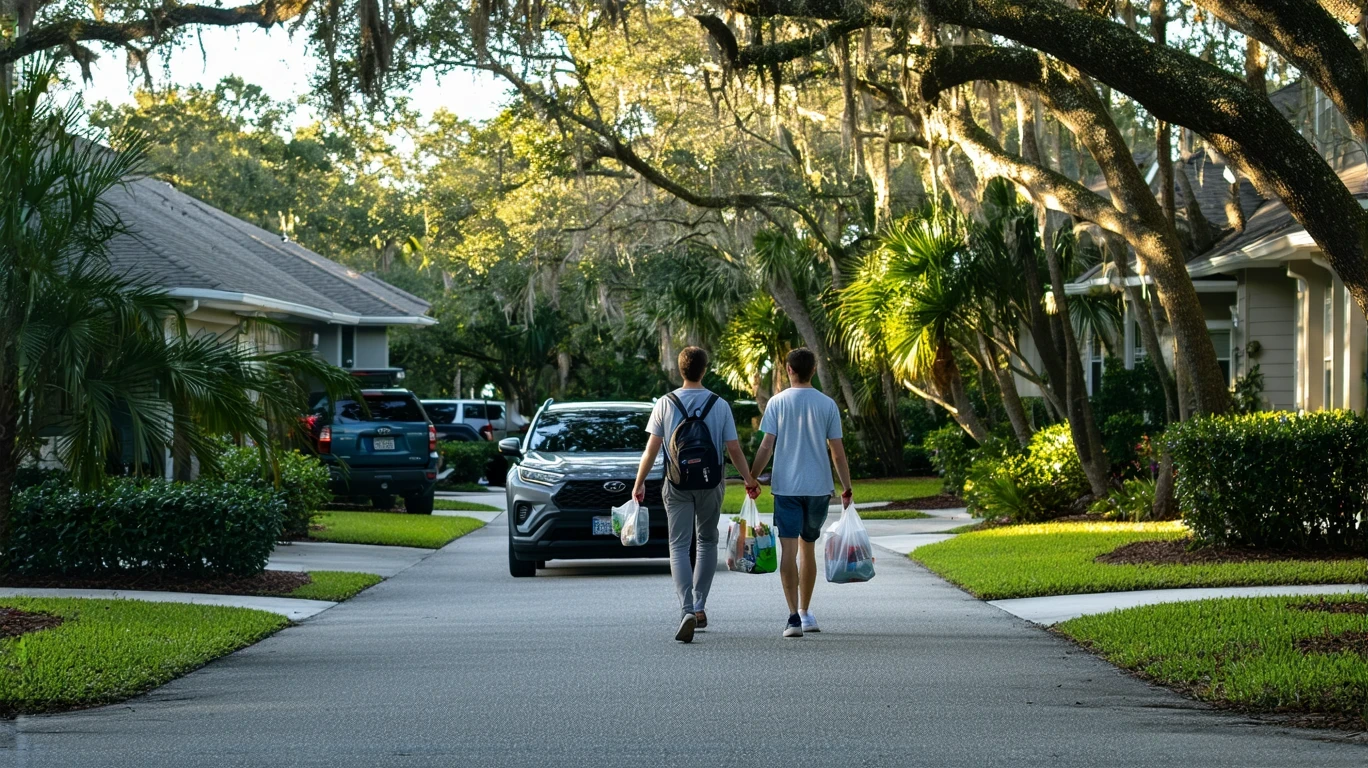
How Grocery Costs Feel in Palm Harbor
Grocery prices in Palm Harbor reflect the broader cost structure of Florida’s Gulf Coast suburbs—moderately elevated compared to national baselines, shaped by regional distribution patterns and the area’s position as a comfortable retirement community. With a regional price parity index of 126, Palm Harbor sits roughly 26% above the national average across all goods and services, and food prices track that premium closely. For households accustomed to Midwest or Southeast pricing, the difference shows up quickly in produce, dairy, and proteins. For those moving from higher-cost metros, Palm Harbor often feels like relief.
Who notices grocery costs most? Singles and couples on fixed incomes tend to feel price pressure more acutely than larger families with economies of scale. In a city where median household income sits at $70,493 per year, grocery spending becomes a meaningful line item—not catastrophic, but significant enough that store choice and shopping habits matter. Retirees, who make up a substantial share of Palm Harbor’s population, often approach grocery shopping with more time flexibility and price sensitivity than younger working families rushing through weeknight runs. The rhythm of grocery spending here isn’t about scarcity; it’s about managing a cost that adds up quietly over time.
Food costs don’t exist in isolation. They interact with housing pressure, utility volatility, and transportation expenses to shape what a budget has to handle in Palm Harbor. A household spending $1,567 per month on rent and managing seasonal cooling bills will experience grocery price increases differently than a homeowner with stable housing costs. The grocery aisle becomes a place where financial margin—or lack of it—becomes visible week to week.
Grocery Price Signals (Illustrative)
The table below shows illustrative prices for common staple items in Palm Harbor, adjusted for the area’s regional price parity. These figures are not store-specific or week-specific snapshots; they represent how staple items tend to compare locally relative to national baselines. They’re useful for understanding relative price positioning, not for estimating a full shopping trip.
| Item | Illustrative Price |
|---|---|
| Bread (per pound) | $2.33/lb |
| Cheese (per pound) | $5.90/lb |
| Chicken (per pound) | $2.58/lb |
| Eggs (per dozen) | $3.15/dozen |
| Ground beef (per pound) | $8.49/lb |
| Milk (per half-gallon) | $5.07/half-gallon |
| Rice (per pound) | $1.35/lb |
Ground beef stands out as the most expensive item per pound, reflecting both national protein pricing trends and regional distribution costs. Eggs and milk, while not cheap, remain accessible for most households. Cheese and chicken fall into a middle band—noticeable but not prohibitive. Rice and bread anchor the low end, offering reliable, affordable staples for households stretching budgets. These prices don’t tell you what you’ll spend in a week; they tell you how Palm Harbor’s grocery landscape is positioned relative to other markets.
What’s missing from this table matters as much as what’s included. Produce prices fluctuate seasonally and vary widely by variety and sourcing. Processed and packaged goods carry brand premiums that shift by store tier. Organic, specialty, and prepared foods introduce another layer of cost variability. The prices above are anchors, not a complete picture—they help orient expectations, not simulate a cart.
Store Choice & Price Sensitivity
Grocery price pressure in Palm Harbor varies significantly by store tier, and understanding that variation is essential for managing food costs effectively. The discount tier—chains focused on private-label goods, limited selection, and no-frills environments—offers the lowest baseline prices. Households willing to plan around what’s available rather than what’s preferred can reduce their grocery spending substantially by shopping discount-first. The trade-off isn’t quality in most cases; it’s convenience, variety, and brand familiarity.
Mid-tier grocers dominate Palm Harbor’s everyday shopping landscape. These stores balance selection, cleanliness, and competitive pricing, appealing to families and retirees who want a predictable experience without paying premium prices. Mid-tier stores often run weekly promotions, loyalty programs, and fuel rewards that soften the sticker shock on high-ticket items like meat and seafood. For households with moderate income and time constraints, mid-tier stores represent the path of least resistance—familiar, accessible, and reasonably priced.
Premium grocers cater to households prioritizing organic options, specialty ingredients, prepared foods, and curated shopping experiences. The price gap between premium and discount can reach 30–50% on comparable items, but the gap isn’t always about the product itself—it’s about convenience, atmosphere, and selection depth. Retirees with disposable income and singles seeking ready-to-eat solutions often find premium stores worth the cost. Families stretching budgets typically don’t.
Store choice isn’t static. Many Palm Harbor households mix tiers strategically: discount stores for pantry staples and household goods, mid-tier for weekly produce and proteins, premium for occasional specialty items. This hybrid approach requires more planning and travel time but offers meaningful cost control without sacrificing variety. The key insight is that grocery costs in Palm Harbor aren’t determined by a single “average” experience—they’re shaped by the intentional or habitual choices households make about where and how they shop.
What Drives Grocery Pressure Here
Income plays the central role in determining how grocery costs feel. At a median household income of $70,493 per year, Palm Harbor sits comfortably above Florida’s state median, but that figure masks significant variation. Retirees on fixed Social Security and pension income experience grocery inflation differently than dual-income working families. A household earning $50,000 annually will feel the pinch of $8.49-per-pound ground beef far more than one earning $90,000. The same cart of groceries doesn’t carry the same weight across income bands.
Household size amplifies grocery sensitivity. A single retiree buying for one can navigate price increases by shifting brands, reducing waste, and shopping sales without major lifestyle disruption. A family of four faces a different calculus: more mouths mean less flexibility, more frequent trips, and higher baseline spending. Protein costs, snack expenses, and beverage purchases scale quickly with household size, and the margin for error shrinks. Families feel grocery pressure not just in absolute dollars but in the rigidity of their needs.
Regional distribution patterns also shape grocery costs in Palm Harbor. Florida’s Gulf Coast relies on supply chains that funnel goods through regional hubs, adding transportation and handling costs that don’t exist in cities closer to agricultural centers or major ports. Seasonal tourism and population swings in nearby coastal areas can create demand surges that ripple into suburban grocery pricing. Palm Harbor doesn’t experience the extreme seasonal volatility of beach towns, but it’s not insulated from it either.
Seasonal variability affects produce and protein availability more than pricing stability. Florida’s climate supports year-round agriculture for some crops, but national and imported produce still dominates grocery shelves. Winter months bring higher prices for berries, stone fruits, and certain vegetables. Summer heat stresses supply chains for dairy and meat. These fluctuations are qualitative—shoppers notice them in selection and freshness more than in dramatic price swings—but they contribute to the overall texture of grocery shopping in Palm Harbor.
Practical Ways People Manage Grocery Costs
Households in Palm Harbor manage grocery costs primarily through behavioral strategies that emphasize control and predictability rather than extreme frugality. Shopping with a list remains the most effective tool for avoiding impulse purchases and staying within a planned budget. The discipline of list-based shopping reduces waste, prevents duplicate purchases, and keeps spending aligned with actual needs rather than in-store temptations.
Buying in bulk works well for non-perishables, household goods, and freezer-friendly proteins, but it requires upfront capital and storage space. Retirees with garage or pantry capacity often stockpile sale items, spreading cost over time and reducing per-unit expense. Families in smaller homes or apartments face tighter storage constraints, limiting bulk-buying effectiveness. The strategy works, but it’s not universally accessible.
Meal planning reduces food waste and allows households to shop strategically around sales and seasonal availability. Planning a week’s meals in advance turns grocery shopping from a reactive chore into a deliberate financial decision. It also reduces reliance on expensive convenience foods and last-minute takeout. The trade-off is time—meal planning requires thought, organization, and cooking skill. For working families and retirees with limited energy, the time cost can outweigh the financial benefit.
Store loyalty programs, digital coupons, and fuel rewards offer modest but real savings for households willing to engage with them. Mid-tier grocers in Palm Harbor typically offer points-based systems that translate into discounts on future purchases or cents off per gallon at partner gas stations. These programs don’t transform grocery budgets, but they soften the edges—particularly for households already shopping at participating stores regularly. The key is consistency: sporadic use yields little; habitual use compounds over time.
Private-label and store-brand products deliver comparable quality to name brands at lower prices, particularly for pantry staples, dairy, and frozen goods. Households willing to experiment with store brands can reduce grocery spending without sacrificing nutrition or taste. The psychological barrier is brand loyalty, which runs deep for many shoppers. Overcoming it requires trial, comparison, and a willingness to prioritize cost over familiarity.
Groceries vs Eating Out (Directional)
The trade-off between cooking at home and eating out shapes grocery spending in ways that aren’t always obvious. Households that cook most meals at home experience grocery costs as a primary food expense, with restaurant spending reserved for occasional convenience or social outings. Households that eat out frequently—whether by choice or necessity—experience groceries as supplemental, covering breakfast staples, snacks, and weekend meals while relying on takeout and dining for weeknight dinners.
Palm Harbor’s food landscape includes a mix of chain restaurants, local diners, and fast-casual options, but it’s not a dining-dense urban core. Eating out regularly in Palm Harbor typically means driving to commercial corridors or nearby Clearwater and Tampa for variety. The friction of distance and time nudges many households toward home cooking by default, particularly retirees and families with school-age children. Groceries become the path of least resistance, not just the cheaper option.
The cost gap between cooking and dining out is substantial but not infinite. A home-cooked meal for two adults might cost $12–$18 in ingredients; the same meal at a mid-tier restaurant runs $35–$50 before tip. Over a week, the difference compounds, but it’s not purely financial—it’s also about time, effort, and mental load. Households with two working adults and limited evening energy often find the convenience premium worth paying, even when they know cooking would save money.
Groceries and dining aren’t mutually exclusive; most households blend both. The question isn’t whether to cook or eat out—it’s how often, under what circumstances, and with what trade-offs. Retirees with time flexibility tend to cook more and dine out selectively. Working families toggle between home cooking on weekends and takeout on weeknights. Singles often find cooking for one inefficient, leading to higher reliance on prepared foods and dining out. The grocery-versus-dining balance reflects lifestyle, income, and household composition more than pure cost optimization.
How this article was built: In addition to public economic data, this article incorporates location-based experiential signals derived from anonymized geographic patterns—such as access density, walkability, and land-use mix—to reflect how day-to-day living actually feels in Palm Harbor, FL.
FAQs About Grocery Costs in Palm Harbor (2026)
Is it cheaper to shop in bulk in Palm Harbor? Bulk buying reduces per-unit costs for non-perishables and freezer-friendly items, but it requires upfront spending and storage space. Households with garage or pantry capacity benefit most; those in smaller homes face practical limits.
Which stores in Palm Harbor are best for low prices? Discount-tier grocers offer the lowest baseline prices, focusing on private-label goods and limited selection. Mid-tier stores balance price and variety, while premium grocers cater to households prioritizing organic and specialty items. Many households mix tiers strategically.
How much more do organic items cost in Palm Harbor? Organic products typically carry a noticeable premium over conventional equivalents, with the gap widening for produce, dairy, and proteins. The premium reflects sourcing, certification, and distribution costs, not just local pricing dynamics.
How do grocery costs for two adults in Palm Harbor tend to compare to nearby cities? Palm Harbor’s grocery prices track closely with the broader Tampa Bay area, sitting moderately above national averages due to regional distribution costs and Florida’s price parity. Coastal cities with higher tourism demand may run slightly higher; inland areas slightly lower.
How do households in Palm Harbor think about grocery spending when cooking at home? Most households view groceries as a controllable expense that rewards planning and consistency. Cooking at home reduces reliance on dining out, but it requires time, energy, and meal-planning discipline. The trade-off between cost savings and convenience varies by household composition and work schedules.
Do seasonal price swings affect grocery costs in Palm Harbor? Seasonal variability shows up more in produce selection and freshness than in dramatic price changes. Winter months bring higher costs for certain fruits and vegetables; summer heat affects dairy and meat supply chains. The impact is noticeable but not extreme.
Are grocery loyalty programs worth using in Palm Harbor? Store loyalty programs, digital coupons, and fuel rewards offer modest but real savings for households shopping consistently at participating stores. The benefit compounds over time but requires habitual engagement to deliver meaningful value.
How Groceries Fit Into the Cost of Living in Palm Harbor
Groceries occupy a middle position in Palm Harbor’s cost structure—less dominant than housing, more predictable than utilities, and more controllable than transportation for most households. A family spending $1,567 per month on rent and $150–$250 on utilities will find groceries adding another meaningful layer to monthly expenses, but not the decisive one. The financial pressure groceries create is cumulative rather than catastrophic: steady, visible, and responsive to behavior.
For retirees on fixed incomes, groceries represent one of the few major expenses they can actively manage through store choice, meal planning, and strategic shopping. Housing costs are locked in by mortgage or lease; utilities fluctuate with weather; transportation costs depend on vehicle ownership and maintenance. Groceries, by contrast, offer weekly decision points where small changes—switching stores, buying store brands, cooking more—translate into measurable savings over time.
Families with children face a different dynamic. Grocery costs scale with household size, and the flexibility to cut spending shrinks as nutritional needs, preferences, and schedules multiply. A family of four can’t easily halve grocery spending without sacrificing variety, quality, or convenience. The margin for optimization exists, but it’s narrower than for singles or couples. Groceries become a fixed-ish variable—controllable within limits, but not elastic.
Understanding how groceries fit into Palm Harbor’s broader cost picture requires looking at the full monthly budget: housing, utilities, transportation, insurance, and discretionary spending. Groceries don’t exist in isolation; they interact with every other line item. A household with low housing costs and no car payment has more room to absorb grocery price increases. A household stretched thin by rent and commuting costs will feel every uptick in the produce aisle. The role of groceries in your budget depends on what else your budget has to handle.
For a complete breakdown of how groceries, housing, utilities, and transportation combine into a realistic monthly budget for Palm Harbor, see the dedicated monthly budget guide. That article walks through the full cost structure, household-by-household, with the detail and context needed to plan confidently. Groceries are one piece; the budget is the whole picture.