
“I thought I could bike to the grocery store when I moved here—and I can, from my neighborhood. But getting to work in Orlando? That’s all car, every day.”
That tension captures the transportation reality in Oviedo. The city has invested in pedestrian and cycling infrastructure in specific areas, creating pockets where daily errands feel manageable on foot or bike. But for most households, especially those commuting beyond Oviedo’s borders or living outside those walkable corridors, the car remains the primary—and often only—practical option for daily life.
Understanding transportation options in Oviedo means recognizing where the infrastructure supports alternatives and where it doesn’t. This article explains how people actually get around, what public transit offers (and what it doesn’t), and how mobility shapes the rhythm and cost structure of living here.
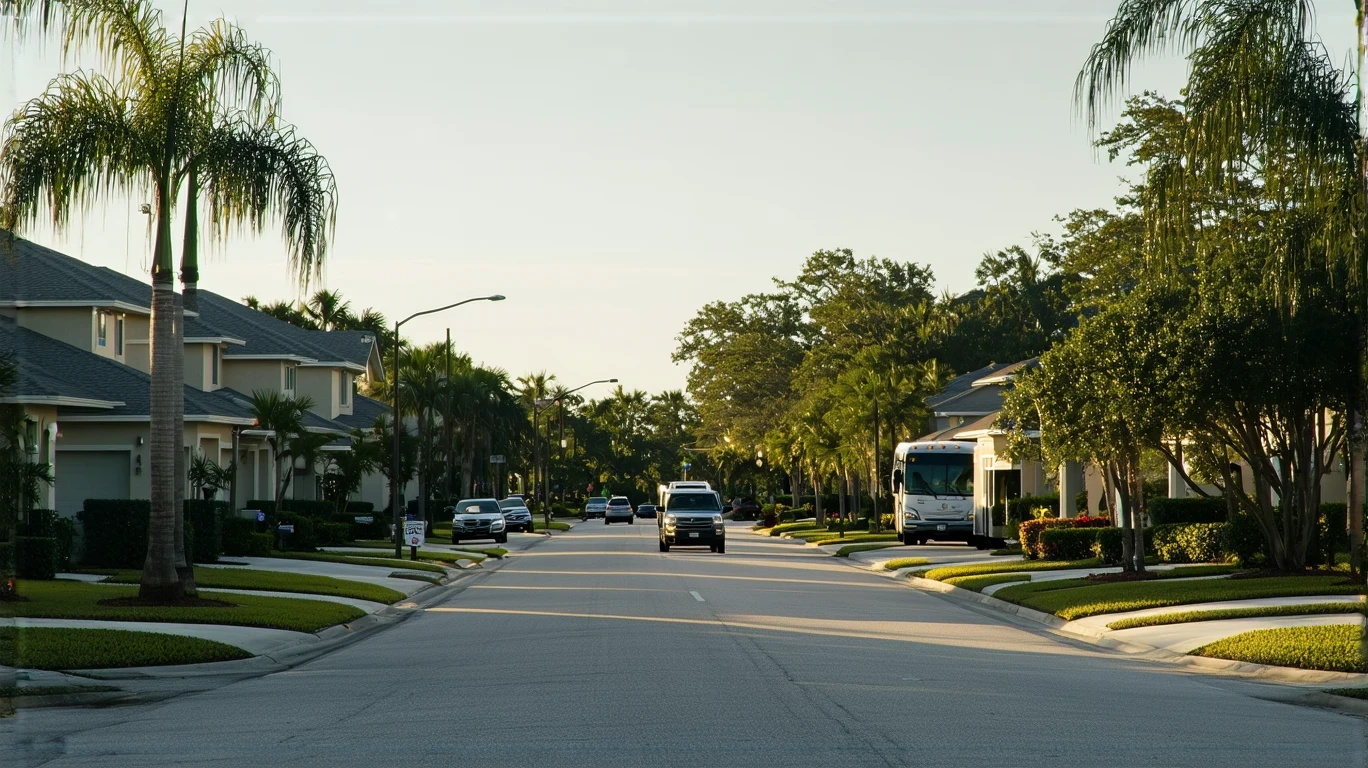
How People Get Around Oviedo
Oviedo operates as a car-first suburban city within the Orlando metro area. Most households depend on personal vehicles for commuting, errands, and family logistics. The city’s layout—residential subdivisions, commercial corridors, and employment centers spread across a wide area—reinforces that dependence.
But Oviedo isn’t uniformly car-dependent. Certain neighborhoods benefit from pedestrian infrastructure that exceeds typical suburban standards. The ratio of sidewalks, crosswalks, and pedestrian paths to road network density is notably high in parts of the city, creating pockets where walking to nearby shops, parks, or schools is genuinely practical. Bike infrastructure is similarly present and well-developed in select areas, with dedicated lanes and paths that support cycling as a real transportation option—not just recreation.
Grocery access follows a corridor-clustered pattern. Density is high along specific commercial corridors, meaning residents near those areas can reach supermarkets, pharmacies, and other essentials without driving. But households outside those corridors—or those needing to reach employment, healthcare, or services elsewhere in the metro—still rely heavily on cars.
Newcomers often misunderstand this duality. Oviedo feels suburban, and it is. But it’s not uniformly sprawling or isolated. The infrastructure exists to support non-car mobility in specific contexts. The question is whether your daily routine aligns with those contexts.
Public Transit Availability in Oviedo
Public transit in Oviedo is limited to bus service. There is no rail transit, and bus coverage is sparse compared to denser urban cores. The system serves specific routes and schedules, but it does not function as a backbone for daily commuting or errands for most residents.
Transit works best—if at all—for residents living near bus stops along major corridors and commuting to destinations also served by those routes. For households in residential subdivisions away from main roads, or for those with multi-stop daily routines (school drop-offs, grocery runs, after-work errands), bus service offers little practical value.
Late-hour and weekend service is particularly limited, which narrows the pool of people who can rely on transit even partially. Shift workers, evening commuters, and households without flexible schedules face significant gaps in coverage.
Public transit in Oviedo is not absent, but it plays a supplementary role at best. It does not reduce car dependence for the majority of households, and it does not provide the frequency, coverage, or connectivity that would make it a primary mobility option.
Driving & Car Dependence Reality
For most Oviedo residents, driving is not optional—it’s structural. Commuting to Orlando or other metro employment centers requires a car. Reaching healthcare facilities, larger retail centers, or services outside Oviedo’s commercial corridors requires a car. Even within Oviedo, households outside walkable pockets or grocery-dense corridors depend on driving for daily errands.
Parking is generally abundant and free, which removes one friction point common in denser cities. Subdivisions include driveways and garages; commercial areas provide surface lots. This makes car ownership more practical and less costly in terms of parking fees or competition for street space.
But car dependence introduces other tradeoffs. Households must budget for vehicle acquisition, insurance, maintenance, and fuel. They absorb the time cost of commuting, the exposure to traffic variability, and the need to plan around driving for nearly every activity. Families with multiple drivers often need multiple vehicles, compounding those costs.
The flexibility that comes with car ownership—being able to leave when you want, take multiple stops, or adjust routes—is real. But so is the dependency. Without a car, access to employment, services, and even social life contracts sharply in Oviedo.
Commuting Patterns & Daily Mobility
Commuting in Oviedo typically means driving to employment centers in the Orlando metro area. The city itself is primarily residential and commercial, with limited large-scale employment within its borders. That means most workers commute outward, often to Orlando, Winter Park, or other nearby cities.
Commute structure varies by household. Single-job commuters with predictable schedules may find the drive routine and manageable. Households juggling multiple jobs, school drop-offs, or caregiving responsibilities face more complex logistics, and the lack of viable transit alternatives means every trip requires a car.
Proximity to major corridors and highway access points affects commute friction. Residents near SR 417 or SR 426 benefit from faster connections to Orlando and surrounding areas. Those in more interior subdivisions may add several minutes of local driving before reaching those arteries.
Commute times and distances vary widely depending on destination and departure time, but the pattern is consistent: driving is the default, and the commute is a fixed part of daily life for most working households.
Who Transit Works For — and Who It Doesn’t
Public transit in Oviedo serves a narrow slice of the population. It works best for individuals who live near a bus route, work near a stop on the same or a connecting route, and have schedules that align with service hours. That might include some renters in apartments along major corridors or students commuting to nearby institutions.
Transit does not work well for families with children, households with irregular schedules, or residents in subdivisions away from bus lines. It also falls short for anyone whose daily routine includes multiple stops—grocery shopping, picking up kids, running errands—because the time cost and route inflexibility make it impractical.
Renters in core areas with access to grocery-dense corridors and walkable infrastructure may find they can reduce car dependence for some errands, relying on walking or biking instead. But even in those cases, commuting to work outside Oviedo almost always requires a car.
Homeowners in peripheral neighborhoods, families with school-age children, and anyone commuting beyond Oviedo’s borders will find transit largely irrelevant to their daily mobility. The infrastructure simply doesn’t support it.
Transportation Tradeoffs in Oviedo
Choosing between transit and driving in Oviedo isn’t really a choice for most households—it’s a constraint. Transit offers limited coverage, infrequent service, and narrow route options. Driving offers flexibility, control, and access to the full metro area, but it requires vehicle ownership, ongoing costs, and time spent commuting.
For the small number of households whose routines align with bus routes and schedules, transit can reduce some driving. But it doesn’t eliminate car dependence, and it doesn’t provide the predictability or convenience that would make it a primary option.
The real tradeoff in Oviedo is between living in a walkable pocket with access to nearby amenities versus living in a more affordable or spacious subdivision that requires driving for everything. Walkable areas offer reduced friction for daily errands and some lifestyle flexibility. Peripheral areas offer larger homes, quieter streets, and often lower housing costs—but they lock in car dependence completely.
Understanding where you fall in that tradeoff helps clarify what transportation will actually cost—not just in dollars, but in time, flexibility, and daily logistics.
FAQs About Transportation in Oviedo (2026)
Is public transit usable for daily commuting in Oviedo?
Public transit in Oviedo is limited to bus service with sparse coverage and infrequent schedules. It may work for a small number of residents whose home and work locations align with existing routes, but it is not a practical primary commute option for most households. Commuting to Orlando or other metro employment centers almost always requires a car.
Do most people in Oviedo rely on a car?
Yes. The vast majority of Oviedo residents depend on personal vehicles for commuting, errands, and daily logistics. While some neighborhoods have walkable infrastructure and bike lanes that reduce car dependence for nearby errands, broader access to employment, services, and activities requires driving.
Which areas of Oviedo are easiest to live in without a car?
Neighborhoods with high pedestrian and bike infrastructure density, particularly those near grocery-dense commercial corridors, offer the most practical car-free or car-light living. Residents in these areas can walk or bike to nearby shops, parks, and services. However, even in these pockets, commuting to work outside Oviedo typically requires a car, and households with complex daily routines will still face significant limitations without one.
How does commuting in Oviedo compare to nearby cities?
Oviedo’s commute patterns are typical of suburban cities in the Orlando metro area. Most residents drive to employment centers in Orlando, Winter Park, or other nearby cities. Commute friction depends on proximity to major highways and the specific destination. Compared to denser urban cores with rail transit, Oviedo offers less commute flexibility but also less parking competition and congestion within the city itself.
Can you bike safely in Oviedo?
Oviedo has notable bike infrastructure in certain areas, with dedicated lanes and paths that support cycling. The bike-to-road ratio is high compared to many suburban cities, indicating real investment in cycling infrastructure. However, bike infrastructure is not evenly distributed, and cycling remains most practical within specific neighborhoods or along certain corridors. Commuting by bike to destinations outside Oviedo or across the metro area is generally not feasible.
How Transportation Fits Into the Cost of Living in Oviedo
Transportation in Oviedo is not just a line item—it’s a structural factor that shapes housing choice, time use, and household flexibility. Car dependence is the default for most residents, which means budgeting for vehicle costs, fuel, insurance, and maintenance is non-negotiable. Households with multiple drivers often need multiple vehicles, compounding that exposure.
But transportation costs don’t exist in isolation. Choosing a home in a walkable pocket near grocery-dense corridors may reduce some driving and create more flexibility for daily errands. Choosing a more affordable or spacious home in a peripheral subdivision may lower housing costs but lock in higher transportation dependence and time costs.
For a fuller picture of how transportation fits into monthly expenses, budget planning, cost breakdown, the Monthly Spending article provides detailed context on where money goes and how different cost categories interact.
Understanding how you’ll actually move through Oviedo—how often you’ll drive, where you’ll need to go, and what alternatives exist—clarifies what living here will require, both financially and logistically. The infrastructure exists to support some non-car mobility, but only in specific contexts. Knowing whether your daily life aligns with those contexts is the key to making transportation work in Oviedo.
How this article was built: In addition to public economic data, this article incorporates location-based experiential signals derived from anonymized geographic patterns—such as access density, walkability, and land-use mix—to reflect how day-to-day living actually feels in Oviedo, FL.
—