
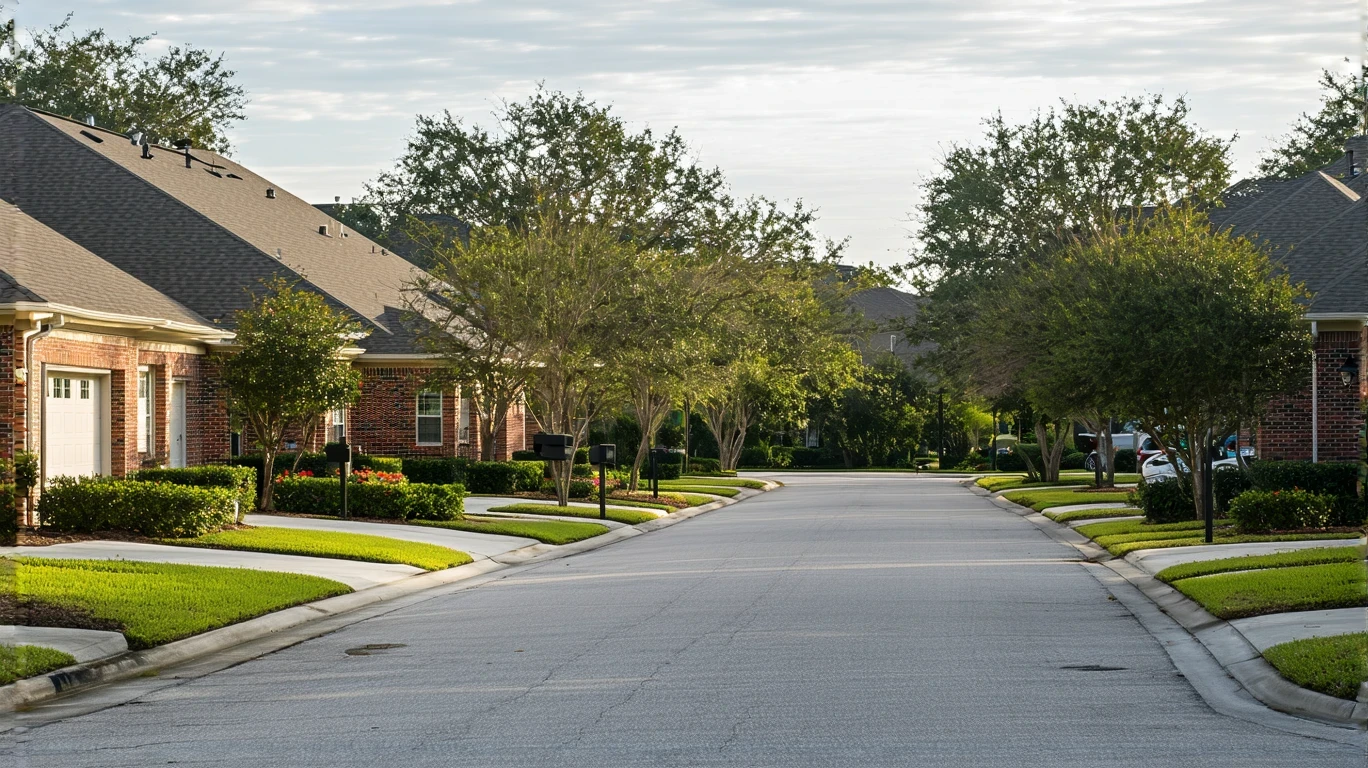
Oviedo and Kissimmee sit within the same Orlando metro area, yet the financial and logistical experience of living in each city diverges sharply in 2026. Oviedo attracts households prioritizing proximity, walkable pockets, and integrated green space, while Kissimmee draws those willing to accept longer commutes and rail-dependent transit in exchange for significantly lower housing entry costs. The choice isn’t about which city costs less overall—it’s about which cost pressures dominate your household and how much control you have over the tradeoffs that matter most.
Both cities share corridor-clustered grocery access, routine local healthcare, and mixed building height profiles, but the structural differences in housing entry barriers, transportation dependence, and family infrastructure create distinct financial textures. Oviedo’s median household income of $116,764 per year reflects a higher-earning resident base, while Kissimmee’s $45,319 per year signals a different income distribution and cost tolerance. Regional price parity also diverges: Oviedo’s index of 123 versus Kissimmee’s 101 means that even identical purchases carry different price tags across city lines.
This comparison explains where costs concentrate, how predictability and volatility differ, and which households feel the gap most acutely. It does not calculate total monthly expenses or declare a winner—it clarifies the mechanisms that make the same income feel stable in one place and stretched in another.
Housing Costs
Housing entry costs separate these two cities more than any other factor. Oviedo’s median home value stands at $397,300, while Kissimmee’s sits at $253,000—a gap that reshapes access, equity accumulation, and monthly obligation structure for buyers. Renters face a similar divide: Oviedo’s median gross rent reaches $1,902 per month compared to Kissimmee’s $1,419 per month. These aren’t minor variations—they represent fundamentally different housing markets serving different income bands and household strategies.
For renters, Kissimmee offers lower monthly obligations but often requires longer commutes to employment centers, particularly for those working in northern Orlando suburbs. Oviedo renters pay more but gain proximity to job clusters and access to walkable pockets with notable bike infrastructure. The rental stock in both cities skews toward single-family homes and townhomes rather than high-rise apartments, so renters in either location often face landlord-managed utilities, yard maintenance expectations, and lease structures that reflect suburban norms rather than urban apartment dynamics.
First-time buyers confront starkly different entry barriers. Oviedo’s higher home values demand larger down payments, higher closing costs, and greater income documentation to qualify for financing. Kissimmee’s lower entry point opens homeownership to households earning closer to the regional median, though property appreciation potential and neighborhood stability vary widely within the city. Families prioritizing space and yard access may find Kissimmee’s housing stock more aligned with their needs at their income level, while those prioritizing shorter commutes and integrated park access may justify Oviedo’s higher entry costs as a tradeoff for time savings and lifestyle fit.
Housing Takeaway: Oviedo’s housing market serves higher-income households willing to pay for proximity, walkability, and green space integration. Kissimmee’s market serves cost-sensitive households prioritizing lower entry barriers and accepting longer commutes. Renters in Kissimmee gain monthly flexibility; renters in Oviedo gain logistical simplicity. Buyers in Kissimmee face lower thresholds; buyers in Oviedo face higher equity stakes and faster access to employment corridors.
Utilities and Energy Costs
Utility cost exposure in both cities reflects Florida’s extended cooling season, high humidity, and reliance on air conditioning as a non-negotiable expense rather than a seasonal luxury. Oviedo’s electricity rate sits at 15.92¢/kWh, while Kissimmee’s stands at 15.02¢/kWh—a modest difference that compounds over months of heavy usage. Natural gas pricing also diverges slightly: Oviedo at $23.62/MCF versus Kissimmee at $25.39/MCF, though natural gas plays a smaller role in Florida homes compared to electric-dominant HVAC systems.
The real utility pressure comes from cooling intensity and home size. Larger single-family homes—common in both cities—drive higher baseline usage, and older housing stock (more prevalent in parts of Kissimmee) often lacks the insulation and HVAC efficiency of newer construction. Households in older homes face more volatile summer bills, while those in newer builds experience more predictable monthly obligations. Apartment dwellers in either city benefit from smaller conditioned square footage, but landlord-controlled HVAC systems and shared metering structures can limit control over usage optimization.
Families with children face compounded exposure: larger homes, higher occupancy, and daytime cooling needs during school breaks all push usage upward. Single adults in smaller apartments or townhomes maintain tighter control, particularly if they can shift usage to off-peak hours or tolerate warmer indoor temperatures during the day. Dual-income couples working from home lose that flexibility—cooling becomes an all-day obligation rather than an evening-only expense.
Utility Takeaway: Utility costs in both cities are driven more by housing type, home age, and household occupancy than by rate differences. Oviedo’s slightly higher electricity rate matters less than whether you’re cooling 1,200 or 2,400 square feet. Kissimmee’s older housing stock introduces more volatility; Oviedo’s newer builds offer more predictability. Families and work-from-home households face the highest exposure in both locations.
Groceries and Daily Expenses
Grocery costs reflect the regional price parity gap between these cities. Oviedo’s RPP index of 123 versus Kissimmee’s 101 means that staple items carry different price tags even when purchased at the same chain stores. Ground beef runs $8.24/lb in Oviedo compared to $6.82/lb in Kissimmee; milk costs $5.00/half-gallon versus $4.14/half-gallon. These differences accumulate quickly for families managing weekly shopping trips and meal planning for multiple people.
Both cities show corridor-clustered grocery access, meaning that food and grocery options concentrate along major roads rather than distributing evenly across neighborhoods. This structure favors car-dependent households and penalizes those relying on walking or transit to reach stores. Oviedo’s higher grocery density provides more choice within a given radius, but Kissimmee’s lower prices offset some of the access friction for households willing to drive farther for discount options or bulk purchasing.
Dining out and convenience spending follow similar patterns. Oviedo’s higher-income resident base supports more specialty dining, coffee shops, and prepared food options, which increases temptation for convenience spending creep. Kissimmee’s restaurant landscape skews toward chain dining and fast-casual options, which can lower per-meal costs but may reduce variety. Single adults and couples eating out frequently feel Oviedo’s price premium more acutely; families cooking at home feel the staple price gap in their weekly grocery totals.
Grocery Takeaway: Oviedo’s higher regional price parity drives up grocery costs across all categories, particularly for families managing large weekly volumes. Kissimmee’s lower prices provide relief, but corridor-clustered access means car dependence remains high in both cities. Households sensitive to convenience spending face more temptation in Oviedo; those prioritizing staple affordability gain more margin in Kissimmee.
Taxes and Fees
Property taxes, sales taxes, and recurring fees shape ongoing cost obligations differently for homeowners and renters in each city. Florida’s lack of state income tax shifts revenue reliance onto property and consumption taxes, meaning homeowners bear a larger share of the tax burden than renters. Oviedo’s higher home values translate to higher absolute property tax bills even if millage rates align closely with Kissimmee’s, creating a structural disadvantage for homeowners in the higher-priced market.
HOA fees appear more frequently in Oviedo’s newer subdivisions, where master-planned communities bundle landscaping, amenity access, and exterior maintenance into monthly or quarterly assessments. These fees add predictability—homeowners know what they’ll pay—but reduce flexibility, as opting out isn’t possible. Kissimmee’s housing stock includes more standalone single-family homes without HOA obligations, giving homeowners more control over maintenance timing and cost but also more exposure to unexpected repair expenses.
Sales taxes affect all households equally in terms of rate, but higher-income households in Oviedo often spend more on taxable goods and services, amplifying the cumulative impact. Renters in both cities avoid direct property tax exposure but indirectly fund it through rent pricing. Long-term homeowners in either city benefit from Florida’s Save Our Homes cap, which limits annual assessed value increases and creates growing tax advantages the longer they stay.
Tax and Fee Takeaway: Oviedo homeowners face higher absolute property tax bills due to higher home values, and HOA fees add predictable but inflexible obligations. Kissimmee homeowners gain more control but accept more variability. Renters in both cities avoid direct property tax exposure but pay indirectly through rent. Long-term residents in either location benefit from assessment caps that reward staying in place.
Transportation & Commute Reality
Transportation costs and commute friction diverge sharply between Oviedo and Kissimmee, driven by employment proximity, transit infrastructure, and car dependence. Kissimmee’s average commute time reaches 33 minutes, with 56.4% of workers facing long commutes—a signal that many residents travel significant distances to reach job centers in Orlando, Lake Nona, or northern suburbs. Kissimmee does offer rail transit, providing an alternative to driving for some commuters, though coverage and frequency determine real-world viability. Oviedo lacks rail service, but its location closer to northern Orlando employment clusters often shortens drive times for those working in research parks, healthcare campuses, or corporate offices.
Gas prices also differ: Kissimmee’s $2.93/gal versus Oviedo’s $4.06/gal. For households driving 25 miles round-trip daily, that gap compounds over weeks and months, though shorter commutes in Oviedo may offset some of the per-gallon premium. Work-from-home prevalence in Kissimmee sits at 14.3%, meaning the majority of workers still commute regularly and face both time and fuel costs. Oviedo’s commute data isn’t available in the feed, but its proximity to northern employment centers and notable bike infrastructure suggest shorter, more flexible commute options for some households.
Car dependence remains high in both cities despite walkable pockets and corridor-clustered errands. Oviedo’s higher bike-to-road ratio and walkable pockets offer more flexibility for short trips and recreational mobility, but daily errands still require a vehicle for most households. Kissimmee’s rail presence provides a structural alternative for commuters willing to align their housing and employment around station access, though this limits neighborhood choice and may not serve all job locations.
Cost Structure Comparison
Housing dominates the cost experience in Oviedo, where higher home values and rents create steep entry barriers and ongoing obligations that require higher household income to sustain. Kissimmee’s lower housing costs open access to a broader income range, but transportation friction—longer commutes, higher long-commute prevalence, and car dependence—shifts pressure from monthly housing payments to time, fuel, and vehicle maintenance. For households prioritizing proximity and logistical simplicity, Oviedo’s higher housing costs may feel more manageable than Kissimmee’s commute burden. For those prioritizing lower monthly obligations and accepting longer travel times, Kissimmee’s structure offers more breathing room.
Utilities introduce similar volatility in both cities, driven more by home size, age, and occupancy than by rate differences. Families in larger homes face compounded exposure regardless of location, while single adults in smaller units maintain tighter control. Oviedo’s slightly higher electricity rate matters less than whether you’re cooling a 1,200-square-foot townhome or a 2,400-square-foot single-family house. Kissimmee’s older housing stock may introduce more unpredictability, while Oviedo’s newer builds offer more consistent monthly bills.
Daily living costs—groceries, dining, and convenience spending—reflect Oviedo’s higher regional price parity. Families managing large weekly grocery volumes feel the staple price gap more acutely, while single adults and couples eating out frequently face higher per-meal costs in Oviedo’s restaurant landscape. Kissimmee’s lower prices provide relief, but corridor-clustered access means both cities require car trips for most errands, limiting the practical advantage of lower prices if time and fuel costs remain constant.
Transportation patterns matter more in Kissimmee, where longer commutes and higher long-commute prevalence create daily friction that compounds over weeks and months. Oviedo’s proximity to northern employment centers and notable bike infrastructure reduce time costs for some households, though car dependence remains high. Kissimmee’s rail transit offers a structural alternative, but only for households able to align housing and employment around station access—a constraint that limits flexibility and neighborhood choice.
The better choice depends on which costs dominate your household. Households sensitive to housing entry barriers and monthly rent or mortgage obligations may find Kissimmee’s lower costs essential, even if commute friction increases. Those prioritizing time savings, walkable pockets, and integrated green space may justify Oviedo’s higher housing costs as a tradeoff for logistical simplicity and shorter commutes. For families, the difference is less about price and more about whether school density, park access, and commute predictability align with daily routines and long-term plans.
How the Same Income Feels in Oviedo vs Kissimmee
Single Adult
For a single adult, housing becomes the first non-negotiable cost, and the gap between Oviedo’s $1,902 median rent and Kissimmee’s $1,419 median rent reshapes what’s left for everything else. In Oviedo, higher rent consumes a larger share of income upfront, but shorter commutes and walkable pockets reduce time costs and offer more flexibility for errands and recreation. In Kissimmee, lower rent creates more monthly margin, but longer commutes and car dependence shift pressure to fuel, vehicle maintenance, and time spent traveling. Flexibility exists in Kissimmee through lower housing obligations; it disappears in Oviedo if rent crowds out savings or discretionary spending.
Dual-Income Couple
For a dual-income couple, the cost structure becomes more about predictability and logistics than absolute dollars. Oviedo’s higher housing and grocery costs demand higher combined income, but proximity to employment centers and integrated parks reduce friction in daily routines. Kissimmee’s lower housing entry allows one partner’s income to cover housing while the other funds everything else, but if both partners commute long distances, time costs compound and erode the advantage of lower rent or mortgage payments. Flexibility exists in Kissimmee if one partner works from home or nearby; it disappears if both face long commutes and rail transit doesn’t align with job locations.
Family with Kids
For families, non-negotiable costs expand to include larger housing, higher utility usage, bigger grocery volumes, and school access. Oviedo’s integrated parks and walkable pockets support outdoor recreation and neighborhood mobility, but limited school density may require longer drives or private school consideration. Kissimmee’s moderate school density and lower housing entry create more accessible family living, but longer commutes for working parents and moderate park access shift pressure to time management and household logistics. Flexibility exists in Kissimmee through lower housing costs; it disappears in Oviedo if higher rent or mortgage payments crowd out savings for childcare, activities, or unexpected expenses.
Decision Matrix: Which City Fits Which Household?
| Decision factor | If you’re sensitive to this… | Oviedo tends to fit when… | Kissimmee tends to fit when… |
|---|---|---|---|
| Housing entry + space needs | You need to minimize upfront costs or monthly obligations | You prioritize proximity and can sustain higher rent or mortgage payments | You prioritize lower entry barriers and accept longer commutes |
| Transportation dependence + commute friction | You value time savings and shorter daily travel | You work in northern Orlando suburbs and prioritize proximity | You can align housing and employment around rail transit or accept long commutes |
| Utility variability + home size exposure | You want predictable monthly bills and efficient housing stock | You choose newer builds with better insulation and HVAC efficiency | You accept more volatility in older housing stock or prioritize lower rent |
| Grocery strategy + convenience spending creep | You manage large weekly volumes or cook at home frequently | You tolerate higher staple prices for more grocery choice and proximity | You prioritize lower staple prices and accept corridor-clustered access |
| Fees + friction costs (HOA, services, upkeep) | You want control over maintenance timing and costs | You value predictable HOA-bundled services and amenity access | You prefer standalone homes without HOA fees and accept more variability |
| Time budget (schedule flexibility, errands, logistics) | You need to minimize daily friction and maximize free time | You prioritize walkable pockets, integrated parks, and shorter commutes | You accept longer commutes and car dependence for lower housing costs |
Lifestyle Fit
Oviedo and Kissimmee offer distinct lifestyle textures shaped by mobility infrastructure, green space access, and family amenities. Oviedo’s walkable pockets and notable bike infrastructure support households prioritizing outdoor recreation, neighborhood mobility, and integrated park access. The city’s park density exceeds high thresholds, and water features add to the outdoor environment, creating a setting where families and active adults can access green space without driving. Kissimmee’s moderate park density and rail transit presence offer different advantages: families gain access to schools that meet density thresholds, and commuters willing to align housing around rail stations can reduce car dependence for work trips.
Both cities show corridor-clustered errands accessibility, meaning grocery stores, restaurants, and daily services concentrate along major roads rather than distributing evenly across neighborhoods. This structure favors car-dependent households and limits walkability for routine errands, though Oviedo’s higher grocery density provides more choice within a given radius. Kissimmee’s rail transit offers a structural alternative for some trips, but coverage and frequency determine whether it serves as a practical daily option or a limited-use amenity.
Cultural and recreational differences reflect each city’s resident base and income distribution. Oviedo’s higher median household income supports more specialty dining, coffee shops, and boutique retail, while Kissimmee’s landscape skews toward chain dining, discount retail, and family-oriented entertainment. Both cities lack hospitals, relying instead on clinics and pharmacies for routine healthcare, meaning serious medical needs require travel to larger facilities in Orlando or nearby suburbs. For families prioritizing school access, Kissimmee’s moderate school density offers more options, while Oviedo’s limited school density may require longer drives or private school consideration.
Quick Facts: Oviedo’s bike-to-road ratio exceeds high thresholds, supporting cycling as a viable transportation option for some trips. Kissimmee’s rail transit presence provides a structural alternative to car commuting for households able to align housing and employment around station access.
Frequently Asked Questions
Is Oviedo or Kissimmee cheaper for renters in 2026? Kissimmee offers lower median rent at $1,419 per month compared to Oviedo’s $1,902 per month, creating more monthly margin for renters prioritizing lower housing obligations. Oviedo’s higher rent reflects proximity to northern Orlando employment centers, walkable pockets, and integrated park access, which may reduce transportation and recreation costs for some households. The better choice depends on whether you prioritize lower monthly rent or shorter commutes and logistical simplicity.
How do commute patterns differ between Oviedo and Kissimmee? Kissimmee’s average commute time reaches 33 minutes, with 56.4% of workers facing long commutes, signaling that many residents travel significant distances to reach employment centers. Kissimmee offers rail transit, providing an alternative for commuters able to align housing and work around station access. Oviedo lacks rail service but sits closer to northern Orlando employment clusters, often shortening drive times for those working in research parks or corporate offices. Commute friction in Kissimmee shifts cost pressure from housing to time and fuel; proximity in Oviedo reduces travel burden but demands higher housing costs.
Which city is better for families with kids in 2026? Kissimmee offers moderate school density and lower housing entry costs, making family living more accessible for households prioritizing affordability and school access. Oviedo provides integrated park access and walkable pockets but shows limited school density, which may require longer drives or private school consideration. Families prioritizing outdoor recreation and neighborhood mobility may justify Oviedo’s higher costs; those prioritizing school access and lower housing entry may find Kissimmee’s structure more aligned with their needs.
Do grocery costs differ significantly between Oviedo and Kissimmee? Oviedo’s regional price parity index of 123 versus Kissimmee’s 101 means staple items carry higher price tags in Oviedo, with ground beef at $8.24/lb compared to $6.82/lb in Kissimmee and milk at $5.00/half-gallon versus $4.14/half-gallon. These differences accumulate quickly for families managing large weekly volumes. Both cities show corridor-clustered grocery access, meaning car trips remain necessary for most errands, but Kissimmee’s lower prices provide more margin for cost-sensitive households.
Is it easier to live without a car in Oviedo or Kissimmee? Both cities require car dependence for most daily errands due to corridor-clustered access, but Kissimmee’s rail transit presence offers a structural alternative for commuters able to align housing and employment around station access. Oviedo’s notable bike infrastructure and walkable pockets support cycling and walking for some trips, but routine errands still require a vehicle for most households. Neither city eliminates car dependence, but Kissimmee’s rail service provides more flexibility for work commutes, while Oviedo’s bike infrastructure supports recreational and short-distance mobility.
Conclusion
Oviedo and Kissimmee serve different households with different priorities, and the cost structure differences reflect those divergent needs. Oviedo fits higher-income households prioritizing proximity, walkable pockets, integrated parks, and shorter commutes, even if that means accepting higher housing costs and grocery prices. Kissimmee fits cost-sensitive households willing to accept longer commutes, car dependence, and rail transit reliance in exchange for lower housing entry and ongoing obligations. Neither city is universally cheaper—each concentrates cost pressure in different places and rewards different tradeoffs.
The decision comes down to which costs dominate your household and how much control you have over the variables that matter most. If housing entry and monthly obligations constrain your budget, Kissimmee’s lower costs create essential margin. If commute friction and time costs erode your quality of life, Oviedo’s proximity and logistical simplicity may justify higher rent or mortgage payments. For families, school density, park access, and commute predictability shape daily routines more than absolute dollar differences. The right choice isn’t about finding the cheaper city—it’s about matching cost structure to household priorities and accepting the tradeoffs that come with each location.
How this article was built: In addition to public economic data, this article incorporates location-based experiential signals derived from anonymized geographic patterns—such as access density, walkability, and land-use mix—to reflect how day-to-day living actually feels in Oviedo, FL.