
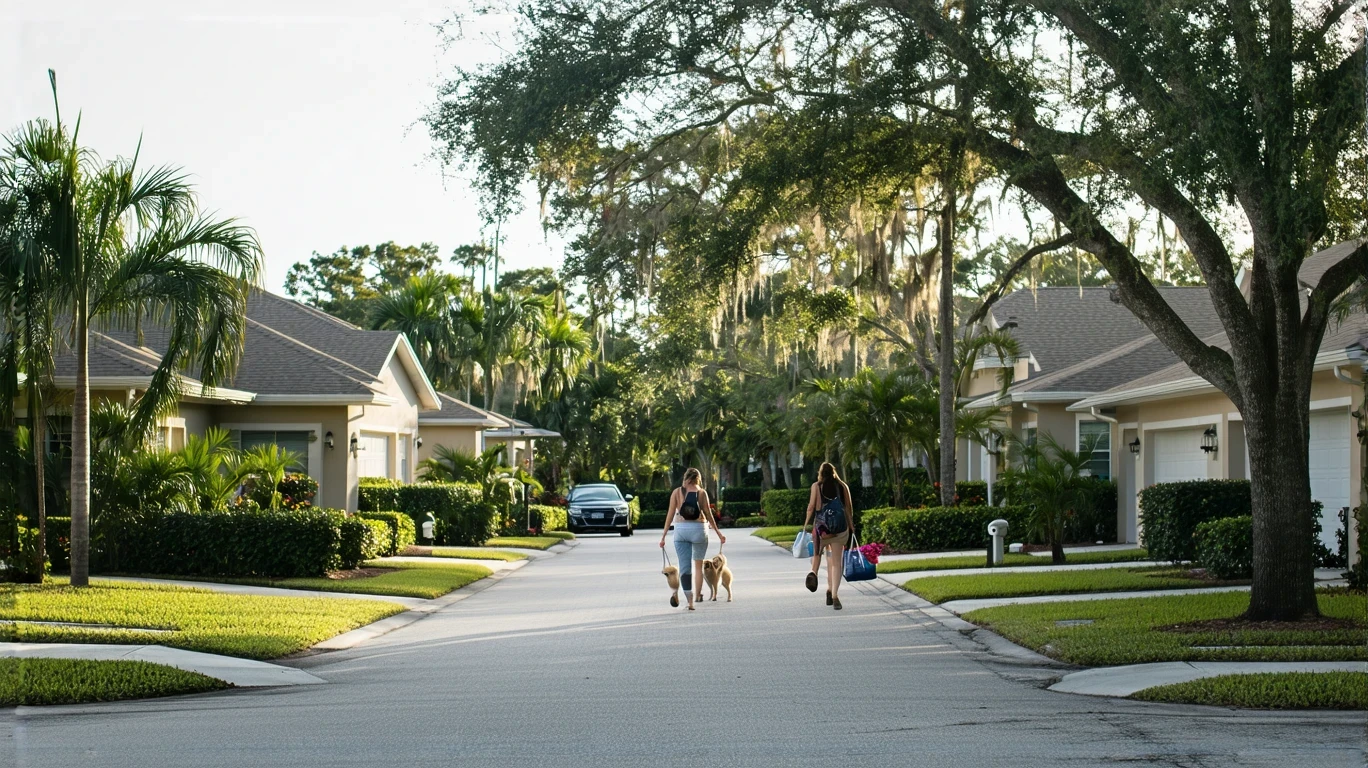
How Grocery Costs Feel in New Port Richey
Grocery prices in New Port Richey sit slightly above the national baseline, reflecting a regional price parity index of 103—modest elevation, but enough to register for households managing tight budgets. With median household income at $42,254 per year, food costs occupy a larger share of take-home pay than they might in higher-income suburbs. Families with children, single earners, and retirees on fixed incomes feel grocery price pressure most acutely here. A $5 difference in weekly staples—milk, eggs, chicken—compounds quickly when margins are slim. For dual-income households without dependents, grocery shopping remains manageable, but price-conscious habits still matter. The experience of grocery costs in New Port Richey isn’t defined by a single checkout total; it’s shaped by how much room a household has between income and essentials, and how deliberately they navigate store choice.
Store access in New Port Richey follows a corridor-clustered pattern, with grocery density exceeding typical thresholds but concentrated along commercial strips rather than distributed evenly across neighborhoods. This means most households drive to groceries rather than walk, and the decision of where to shop—discount, mid-tier, or premium—becomes a meaningful lever in managing weekly food costs. The city’s low-rise, mixed-use suburban form supports a variety of grocery formats, from national discount chains to regional mid-market stores, but accessing the best prices often requires intentional routing. For households already stretching income to cover housing and utilities, the friction of comparing stores and planning trips isn’t just about convenience—it’s about control over one of the few flexible line items in the budget.
Grocery cost pressure in New Port Richey doesn’t hit all households equally. Singles and couples without children have more flexibility to adjust portion sizes, shop sales, and absorb price swings. Families with school-age kids face relentless volume demand—cereal, snacks, proteins, produce—that limits their ability to wait for deals or substitute freely. Retirees on fixed incomes experience grocery inflation as a direct reduction in purchasing power, with no wage adjustment to offset it. The city’s income distribution amplifies this sensitivity: when median household income sits below $45,000, even modest regional price elevation translates into weekly trade-offs that higher-income metros rarely confront.
Grocery Price Signals (Illustrative)
These prices illustrate how staple items tend to compare locally—not a full shopping list. They’re derived estimates based on national baselines adjusted by regional price parity, useful for understanding relative positioning but not precise enough for receipt-level budgeting. Actual prices vary by store tier, brand, sale cycles, and package size. The table below provides context for how everyday grocery items price out in New Port Richey, helping households gauge whether their weekly spending aligns with regional norms or signals an opportunity to adjust store choice.
| Item | Illustrative Price |
|---|---|
| Bread (per pound) | $1.91/lb |
| Cheese (per pound) | $4.82/lb |
| Chicken (per pound) | $2.11/lb |
| Eggs (per dozen) | $2.58/dozen |
| Ground beef (per pound) | $6.94/lb |
| Milk (per half-gallon) | $4.15/half-gallon |
| Rice (per pound) | $1.11/lb |
Derived estimate based on national baseline adjusted by regional price parity; not an observed local price.
Ground beef and cheese represent the highest per-pound costs among staples, making protein and dairy the categories where store choice and brand flexibility matter most. Chicken, rice, and bread offer more accessible price points, but volume purchases—common in larger households—still add up quickly. Eggs and milk, both subject to seasonal and supply-chain volatility, can swing noticeably week to week, especially in discount versus premium formats. These illustrative anchors help frame where households feel grocery pressure most, but they don’t replace the need to compare actual shelf prices across the stores you’re willing to drive to.
Store Choice & Price Sensitivity
Grocery price pressure in New Port Richey varies significantly by store tier, and understanding that spread is essential for households managing tight budgets. Discount grocers—both national chains and regional no-frills formats—anchor the low end of the price spectrum, often running 15–25% below mid-tier competitors on staples like milk, eggs, bread, and canned goods. These stores prioritize high turnover, limited selection, and private-label dominance, which keeps costs down but requires flexibility on brand preference and product variety. For families stretching income to cover housing and utilities, discount stores provide the most direct path to reducing weekly grocery spend without sacrificing volume.
Mid-tier grocers—the familiar supermarket chains that dominate suburban commercial corridors—offer broader selection, consistent stock, and more name-brand options, but at a price premium over discount formats. These stores serve households willing to pay incrementally more for convenience, product variety, and a more predictable shopping experience. For dual-income households or those prioritizing time over marginal savings, mid-tier stores represent a reasonable compromise. Premium grocers, where present, cater to households with discretionary income to spare, emphasizing organic options, specialty products, and prepared foods. The price gap between premium and discount can exceed 40% on comparable items, making premium formats a poor fit for cost-conscious shoppers unless specific dietary needs justify the expense.
In New Port Richey, where grocery density is high but access is corridor-clustered, store choice isn’t just about proximity—it’s about willingness to drive an extra few miles to capture meaningful savings. Households near commercial strips may have multiple tiers within a short radius, but those in residential pockets often face a trade-off between convenience and cost. The city’s low-rise, car-oriented layout means most grocery trips involve driving regardless, which reduces the friction of choosing a discount store over the closest mid-tier option. For households earning near or below the median income of $42,254, that choice compounds into hundreds of dollars annually, making store strategy one of the most effective levers for managing food costs without cutting nutrition or volume.
What Drives Grocery Pressure Here
Income interaction defines grocery cost pressure in New Port Richey more than raw price levels. With median household income at $42,254, food spending occupies a larger share of take-home pay than it would in higher-income suburbs, even when item prices are only modestly elevated. A household earning near the median has less cushion to absorb price swings in proteins, dairy, or produce, and less flexibility to stockpile sale items or buy in bulk. This income sensitivity means grocery inflation—whether driven by supply-chain disruption, seasonal shortages, or regional distribution costs—translates directly into weekly trade-offs: fewer fresh vegetables, more starches, smaller portions, or delayed purchases. For households below the median, grocery costs become a binding constraint, limiting their ability to prioritize nutrition, variety, or convenience.
Household size amplifies grocery pressure in predictable but relentless ways. Singles and couples can adjust portion sizes, eat leftovers, and skip categories without consequence. Families with children face fixed volume demand—school lunches, snacks, breakfast staples, proteins for growing kids—that leaves little room for substitution or delay. A family of four earning near the median income in New Port Richey confronts grocery costs as a non-negotiable weekly burden, where even disciplined shopping and discount store loyalty may not prevent budget strain. Retirees on fixed incomes experience a different pressure: their household size may be small, but their income is static, meaning grocery inflation erodes purchasing power with no wage offset. For these households, every price increase is permanent unless they actively shift store tier or category mix.
Regional distribution patterns and the city’s corridor-clustered grocery access also shape cost pressure. New Port Richey’s grocery infrastructure is concentrated along commercial strips, which supports competition and variety but requires intentional travel to access the best prices. Households without reliable transportation, or those unwilling to drive across town for savings, face higher effective costs simply due to proximity constraints. Seasonal variability—particularly in produce and proteins—adds another layer of unpredictability, though Florida’s year-round growing season moderates some of the extremes seen in colder climates. Still, supply-chain disruptions, fuel costs, and regional distribution inefficiencies can push prices higher temporarily, and households with tight budgets feel those spikes immediately.
Practical Ways People Manage Grocery Costs
Store rotation—shopping discount grocers for staples and mid-tier stores for specific needs—gives households control over weekly spending without sacrificing variety entirely. Buying private-label products on high-markup categories like cereal, canned goods, and dairy reduces costs meaningfully, though it requires letting go of brand loyalty. Planning meals around sale cycles and seasonal availability helps avoid paying peak prices for proteins and produce, though it demands more upfront effort than convenience-driven shopping. Buying in bulk on non-perishables—rice, pasta, canned tomatoes—lowers per-unit costs for households with storage space and upfront cash, but it’s not viable for everyone.
Cooking from scratch rather than relying on pre-packaged or prepared foods reduces grocery spending by shifting cost from labor (done by manufacturers) to time (done at home). Batch cooking and freezing portions extends the value of bulk purchases and reduces the temptation to eat out when time is short. Shopping with a list and avoiding impulse purchases keeps spending aligned with planned meals, though it requires discipline in-store. Using loyalty programs and digital coupons—offered by most mid-tier and discount grocers—captures incremental savings without requiring extreme couponing effort, though the benefit is modest unless applied consistently.
Reducing food waste—using leftovers intentionally, storing produce properly, freezing proteins before they spoil—stretches grocery dollars without requiring additional purchases. Substituting cheaper proteins—chicken thighs instead of breasts, eggs instead of steak—maintains nutrition while lowering per-meal costs. Shopping less frequently reduces the opportunity for unplanned spending, though it requires more disciplined meal planning and storage management. These strategies don’t eliminate grocery cost pressure in New Port Richey, but they shift control back to the household, reducing exposure to price volatility and allowing income-constrained families to maintain nutrition and variety within a tighter budget.
Groceries vs Eating Out (Directional)
The tradeoff between cooking at home and eating out in New Port Richey hinges on time, energy, and how much margin a household has above essential expenses. Cooking from scratch remains the most cost-effective option for families and budget-conscious households, particularly when using discount grocers and planning meals around sales. A home-cooked dinner built around chicken, rice, and seasonal vegetables costs a fraction of a comparable restaurant meal, even at casual dining chains. But cooking requires time, planning, and cleanup—resources that dual-income households or single parents often lack after long commutes and full workdays.
Eating out, whether fast food or sit-down restaurants, offers convenience and eliminates meal prep burden, but it introduces a steep per-meal cost premium that compounds quickly for families. A single fast-food meal for a family of four can approach or exceed the cost of several days’ worth of home-cooked groceries, making frequent restaurant visits unsustainable for households earning near the median income. For singles and couples, the calculus shifts slightly—occasional takeout or dining out may fit within discretionary spending without destabilizing the overall budget—but it still represents a trade-off against other flexible expenses.
In New Port Richey, where monthly expenses are shaped heavily by housing and transportation costs, grocery spending becomes one of the few categories where households can exert meaningful control. Choosing to cook at home rather than eat out multiple times per week creates budget margin that can absorb utility swings, car repairs, or medical copays. The decision isn’t purely financial—it’s also about energy, skill, and whether a household values time savings over cost savings—but for income-constrained families, cooking at home isn’t optional. It’s the baseline assumption that makes the rest of the budget work.
FAQs About Grocery Costs in New Port Richey (2026)
Is it cheaper to shop in bulk in New Port Richey? Bulk purchasing lowers per-unit costs on non-perishables like rice, pasta, canned goods, and household staples, but it requires upfront cash and storage space. For households with both, bulk buying at warehouse clubs or discount grocers reduces long-term spending, though the savings are incremental rather than transformative.
Which stores in New Port Richey are best for low prices? Discount-tier grocers consistently offer the lowest prices on staples, often running 15–25% below mid-tier supermarkets. Households willing to prioritize cost over brand selection or store ambiance will find the most budget relief at discount formats, though mid-tier stores may offer better sales on specific categories during promotional cycles.
How much more do organic items cost in New Port Richey? Organic products typically carry a significant premium over conventional equivalents—often 30–50% higher—making them a poor fit for cost-conscious households unless specific dietary or health needs justify the expense. Conventional produce and proteins remain the most accessible option for families managing tight grocery budgets.
How do grocery costs for two adults in New Port Richey tend to compare to nearby cities? New Port Richey’s regional price parity sits slightly above the national baseline, meaning grocery costs run modestly higher than the U.S. average but remain competitive within the Tampa metro area. Households moving from lower-cost rural areas may notice the difference, while those relocating from higher-cost metros will likely find groceries more manageable here.
How do households in New Port Richey think about grocery spending when cooking at home? For income-constrained households, cooking at home isn’t a lifestyle choice—it’s a financial necessity that creates margin for other essential expenses. Families earning near or below the median income prioritize discount stores, private-label products, and meal planning to keep weekly grocery costs predictable and aligned with take-home pay.
Does New Port Richey’s corridor-clustered grocery access make shopping harder? Grocery density is high, but stores are concentrated along commercial corridors rather than distributed evenly across neighborhoods, meaning most households drive to shop. This layout rewards intentional store choice—driving a few extra miles to a discount grocer can yield meaningful savings—but it also penalizes households without reliable transportation or those unwilling to travel for better prices.
How does household size affect grocery cost pressure in New Port Richey? Singles and couples can adjust portion sizes and skip categories without consequence, giving them flexibility to absorb price swings. Families with children face relentless volume demand—school lunches, snacks, proteins—that limits substitution and makes grocery inflation a binding budget constraint, especially when income sits near the city’s median.
How Groceries Fit Into the Cost of Living in New Port Richey
Grocery costs in New Port Richey occupy a smaller share of total household spending than housing or transportation, but they represent one of the few flexible categories where deliberate choices yield measurable budget relief. For households earning near the median income of $42,254, food spending becomes a weekly negotiation between nutrition, variety, and affordability—one that requires intentional store selection, meal planning, and willingness to prioritize cost over convenience. Unlike rent or car payments, grocery spending responds directly to household behavior, making it a critical lever for families managing tight margins.
Housing pressure and utility volatility dominate the cost structure in New Port Richey, leaving less room for discretionary spending and amplifying the importance of controlling variable expenses like groceries. Households that master discount store rotation, private-label substitution, and home cooking create budget margin that absorbs unexpected costs—medical bills, car repairs, seasonal utility spikes—without destabilizing their finances. Those who default to mid-tier stores, frequent restaurant meals, or impulse purchases face tighter constraints and less resilience when other expenses rise.
For a complete picture of how grocery costs interact with housing, utilities, transportation, and other essentials, see the monthly budget breakdown for New Port Richey. That resource provides the total-cost context this article intentionally avoids, helping households understand where food spending fits within the broader financial landscape. Grocery costs alone don’t determine affordability in New Port Richey, but they reveal how much control a household has over its day-to-day financial experience—and whether income provides enough margin to absorb the price volatility that defines food costs in 2026.
How this article was built: In addition to public economic data, this article incorporates location-based experiential signals derived from anonymized geographic patterns—such as access density, walkability, and land-use mix—to reflect how day-to-day living actually feels in New Port Richey, FL.