
Deciding between renting and buying in New Port Richey means understanding how this Gulf Coast city’s housing market behaves—not just what it costs today, but how ownership and rental exposure differ over time. New Port Richey sits in the Tampa metro area as a bedroom community with an older housing stock, low-rise neighborhoods, and limited transit options. The median home value is $139,500, well below many Florida coastal markets, while median rent is $1,095 per month. But price alone doesn’t tell the full story. Florida’s climate, insurance environment, and tax structure create ownership costs that renters avoid, while renters face different exposure to rent volatility and limited housing control. This article breaks down what shapes the cost of living in New Port Richey, focusing on how housing costs behave for renters, owners, and households weighing the tradeoff between the two.
The Housing Market in New Port Richey Today
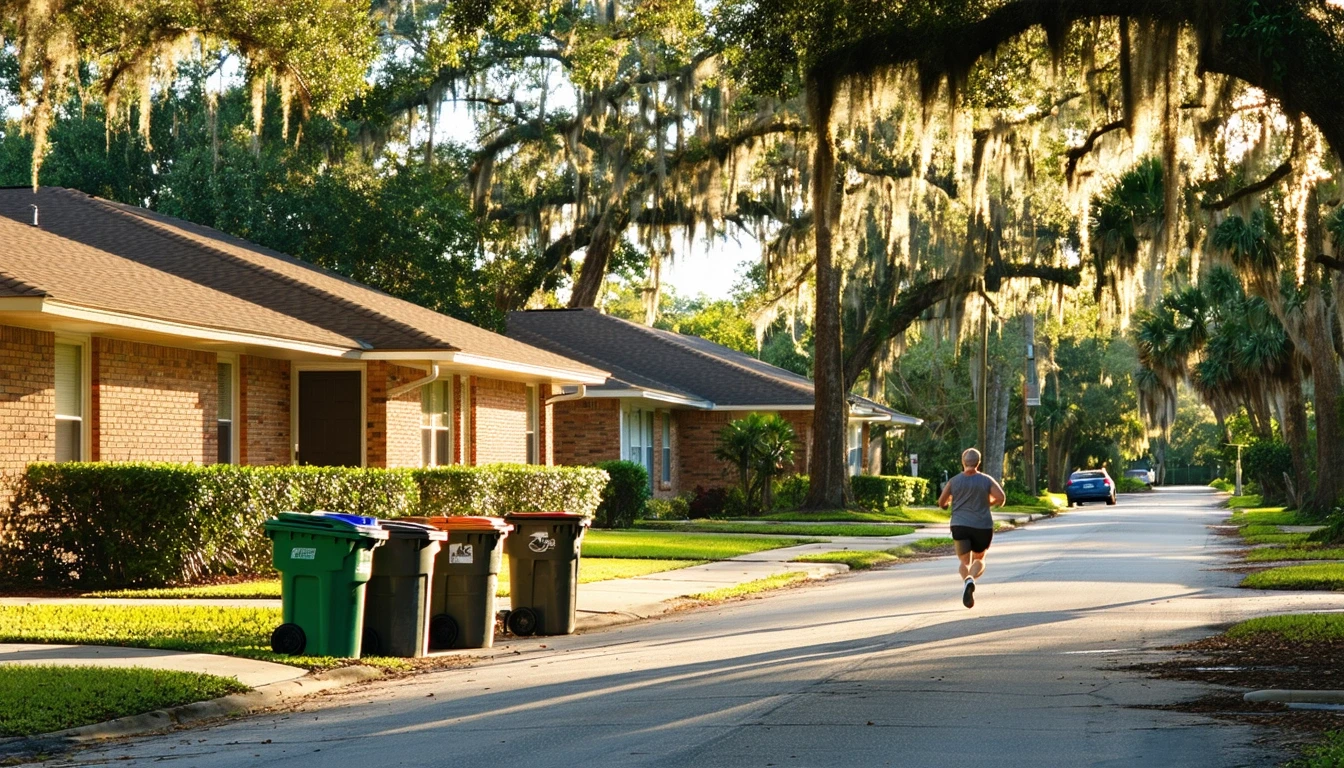
New Port Richey’s housing market reflects its role as an affordable alternative within the Tampa metro region. The city developed primarily in the mid-to-late 20th century, resulting in a housing stock dominated by single-family homes on modest lots. The low-rise character is consistent across most neighborhoods, with mixed residential and commercial land use concentrated along key corridors rather than distributed evenly. This creates a car-oriented environment where errands and services require planning, even though grocery density is relatively high in certain areas.
Home values here are shaped by proximity to Tampa, the age and condition of housing stock, and the Gulf Coast climate. At $139,500, the median home value is accessible compared to beachfront or downtown Tampa properties, but it comes with Florida-specific ownership costs that aren’t immediately visible in the purchase price. The market attracts first-time buyers, retirees seeking lower entry costs, and families looking for space without the premium of newer developments. However, the affordability advantage assumes buyers can absorb the ongoing costs of ownership in a coastal climate—costs that can be unpredictable and that renters don’t carry.
What newcomers often misunderstand is that New Port Richey’s housing market isn’t just cheaper—it’s structurally different. The city lacks the walkable density or transit infrastructure that would allow households to reduce car dependency, and the housing stock’s age means maintenance and utility exposure are higher than in newer suburban developments. These factors don’t show up in listing prices but shape the total cost experience significantly.
Renting in New Port Richey
Renting in New Port Richey offers predictability in monthly housing costs and eliminates exposure to property taxes, insurance volatility, and major maintenance expenses. At $1,095 per month, median rent represents a significant share of the city’s median household income of $42,254 per year, but it remains moderate compared to rental markets closer to Tampa’s urban core or beachfront areas.
Rental availability in New Port Richey is shaped by the city’s single-family housing dominance. While apartments exist, much of the rental stock consists of older single-family homes or small multi-unit properties. This can create variability in quality, utility efficiency, and landlord responsiveness. Renters should expect that older housing stock may come with higher cooling costs during Florida’s extended summer season, as insulation and HVAC systems in older units are often less efficient than in newer construction.
Location within New Port Richey affects rental experience primarily through access to services and commute time. The city’s corridor-clustered commercial development means that some rental locations require more driving for daily errands, even though grocery options are relatively accessible. With bus service present but no rail transit, renters without reliable personal transportation face meaningful friction in getting to work or managing household logistics. This car dependency is a hidden cost that doesn’t appear in rent figures but shapes the total cost of living as a renter here.
Renters in New Port Richey avoid the long-term financial exposure that comes with Florida homeownership—insurance rate changes, tax reassessments, and major repairs—but they also lack control over rent increases and housing stability. In markets with limited rental supply or rising regional demand, rent can increase meaningfully at lease renewal, and renters have little recourse beyond moving.
Owning a Home in New Port Richey
Owning a home in New Port Richey means taking on costs that renters don’t face: property taxes, homeowners insurance, maintenance, and in some cases HOA fees. The $139,500 median home value makes entry accessible, but the ongoing cost structure is where ownership in Florida diverges from renting or owning in other regions.
Property taxes in Florida are influenced by assessed value, millage rates, and exemptions, but without specific rate data, buyers should expect that taxes will adjust over time based on local government budgets and property reassessments. Homeowners insurance is a dominant cost factor in coastal Florida, driven by hurricane exposure, flood risk, and the state’s insurance market volatility. Even properties not directly on the water face elevated premiums compared to inland or non-coastal states, and insurance costs can increase sharply in response to regional storm activity or insurer exits from the Florida market.
Maintenance exposure in New Port Richey is shaped by the Gulf Coast climate. Heat, humidity, and seasonal storms stress roofs, HVAC systems, and exterior materials. Older housing stock—common in New Port Richey—requires more frequent repair and replacement of major systems. Air conditioning is not optional; it runs for much of the year, and system failure is both costly and urgent. Roof longevity is shorter in Florida than in drier or cooler climates, and exterior paint, siding, and seals degrade faster under sun and moisture exposure.
Ownership also means navigating local governance and regulation. Some neighborhoods have HOAs that bundle services or enforce standards, adding a monthly fee but also limiting owner autonomy. Even without an HOA, Florida’s building codes, flood zone requirements, and insurance mandates create compliance costs that owners must manage.
The tradeoff is control and stability. Owners aren’t subject to rent increases or lease non-renewals. They can modify their property, lock in a portion of their housing cost through a fixed-rate mortgage, and build equity if property values rise. But they also absorb all cost volatility and must have reserves to cover large, unpredictable expenses.
Apartment vs House in New Port Richey — Cost Behavior Comparison
| Expense Category | Apartment | House |
|---|---|---|
| Cooling Costs | Lower square footage and shared walls reduce cooling load; older units may lack efficiency upgrades | Larger conditioned space and full sun exposure increase cooling demand; older single-family stock often has less efficient HVAC and insulation |
| Maintenance Responsibility | Landlord covers structural, HVAC, and exterior repairs; tenant handles minor issues only | Owner absorbs all costs: roof replacement, HVAC repair, storm damage, and humidity-related degradation common in Gulf Coast climate |
| Insurance | Renters insurance covers personal property only; building coverage is landlord’s responsibility | Homeowners insurance required and costly in coastal Florida; flood insurance may be mandatory depending on zone; premiums volatile |
| Outdoor Upkeep | Typically none; landscaping and exterior managed by property owner | Lawn care, irrigation, pest control, and storm debris removal are owner’s responsibility; Florida growth rates and humidity increase frequency and cost |
Why these differences matter in New Port Richey: The city’s low-rise, single-family housing stock and Gulf Coast climate create a meaningful gap in utility and maintenance exposure between apartments and houses. Cooling costs dominate household energy use due to extended heat and humidity, and older housing stock—common here—often lacks the efficiency features that would moderate those costs. Houses also face exterior maintenance burdens that Florida’s climate accelerates, from roof wear to pest pressure. Categories like property taxes and trash service were excluded because they don’t vary meaningfully by housing type in this market, and the table is designed to highlight only the costs that behave differently based on structure and occupancy type.
Utilities & Upkeep Differences
Utility and maintenance costs in New Port Richey are shaped by Florida’s climate and the city’s housing stock age. Cooling is the dominant utility expense. Air conditioning runs from late spring through early fall at high intensity, and even in winter, cooling needs are more common than heating. At 15.02¢ per kWh, electricity rates are moderate, but the volume of usage driven by climate makes cooling a major line item for both renters and owners.
Apartments, especially those with shared walls and smaller square footage, require less energy to cool than detached single-family homes. However, older apartment units may have less efficient HVAC systems or poor insulation, which can offset the size advantage. Single-family homes face full sun exposure on all sides, larger interior volumes, and often older, less efficient cooling equipment. Owners of single-family homes also bear the cost of replacing HVAC systems when they fail—a repair that can run several thousand dollars and is more frequent in Florida due to year-round system use.
Maintenance exposure is higher in New Port Richey than in drier or cooler climates. Humidity accelerates mold, mildew, and wood rot. Roofs degrade faster under intense sun and seasonal storms. Exterior paint and sealants require more frequent replacement. Pest control is not optional; termites, ants, and other insects are persistent in the Gulf Coast environment. Renters are insulated from most of these costs, though they may experience delays in repairs depending on landlord responsiveness. Homeowners must budget for these expenses as recurring, not occasional.
Water and trash service costs are typically modest and don’t vary dramatically between housing types. Natural gas is available at $23.62 per MCF, but many homes in Florida rely entirely on electricity, so gas costs are often not a factor.
Rent vs Buy: Long-Term Exposure in New Port Richey
The choice between renting and buying in New Port Richey is not primarily about monthly payment comparison—it’s about which set of risks and exposures a household can manage. Renters face rent increases and lack of control. Owners face cost volatility in insurance, taxes, and maintenance, but gain stability in their housing situation and the ability to build equity.
Renting keeps housing costs more predictable in the short term. Monthly rent is fixed for the lease term, and renters avoid large, unexpected expenses like roof replacement or HVAC failure. However, rent can increase at renewal, and in a market with limited rental supply or rising demand, those increases can be significant. Renters also have no control over whether a landlord chooses to sell the property or decline to renew a lease, creating potential displacement risk.
Owning in New Port Richey means accepting that some costs will fluctuate in ways that are difficult to predict. Homeowners insurance in Florida has become increasingly volatile, with premiums rising sharply in response to hurricanes, insurer exits, and reinsurance costs. Property taxes can increase due to reassessments or changes in local millage rates. Major maintenance expenses—particularly HVAC, roofing, and storm-related repairs—are irregular but inevitable, and their timing is unpredictable. Owners must maintain financial reserves to cover these costs, and households on fixed incomes or tight budgets may find that ownership creates more financial stress than renting, even if the mortgage payment is lower than rent.
The long-term advantage of ownership is control and potential equity accumulation. A fixed-rate mortgage locks in the principal and interest portion of the housing cost, even as other expenses fluctuate. Owners can make improvements, avoid rent increases, and benefit if property values rise. But in New Port Richey, where a month of expenses includes significant non-housing costs driven by car dependency and climate, ownership only makes sense if a household can absorb the volatility and has the liquidity to handle large, unplanned expenses.
For retirees or households with fixed incomes, the unpredictability of Florida ownership costs can outweigh the benefit of stable mortgage payments. For younger households with income growth potential and emergency savings, ownership offers a path to stability and equity that renting does not. The decision depends on financial resilience, not just current affordability.
FAQs About Housing Costs in New Port Richey
Is it cheaper to rent or buy in New Port Richey?
It depends on the household’s financial resilience and time horizon. At $1,095 per month, rent is moderate, and renters avoid property taxes, insurance, and maintenance costs. The $139,500 median home value makes ownership accessible, but Florida homeowners face volatile insurance costs, property tax adjustments, and climate-driven maintenance that renters don’t carry. Ownership can be cheaper monthly if mortgage payments are lower than rent, but total cost of ownership includes expenses that are irregular and difficult to predict. Renting is often cheaper for households that lack emergency reserves or expect to move within a few years. Ownership makes more sense for households that can absorb cost volatility and plan to stay long enough to benefit from equity accumulation and payment stability.
What drives housing costs up in New Port Richey over time?
For renters, housing costs increase primarily through lease renewals, driven by regional rental demand and landlord operating costs. For owners, the main drivers are homeowners insurance, property taxes, and major maintenance. Insurance costs in coastal Florida have increased significantly in recent years due to hurricane risk and insurer market instability, and premiums can rise sharply even for properties that haven’t filed claims. Property taxes adjust based on assessed value and local government budgets. Maintenance costs are driven by Florida’s climate—HVAC systems, roofs, and exterior materials degrade faster here than in cooler or drier regions, and replacement costs rise with inflation and labor availability.
How does New Port Richey’s housing stock affect utility costs?
Much of New Port Richey’s housing stock was built in the mid-to-late 20th century, and older homes often have less efficient insulation, windows, and HVAC systems than newer construction. In Florida’s climate, where cooling dominates energy use, inefficiency translates directly into higher electricity bills. Single-family homes face greater cooling loads than apartments due to larger square footage and full sun exposure. Renters in older units may see higher utility costs than expected, but they don’t pay for system upgrades. Homeowners can invest in efficiency improvements—new HVAC, insulation, windows—but those upgrades require upfront capital and take years to pay off through lower bills.
Does New Port Richey’s car dependency affect housing decisions?
Yes. New Port Richey has moderate pedestrian infrastructure but limited transit—bus service only, no rail. Most households need a car to commute, run errands, and access services. This affects housing decisions because transportation costs are not optional, and they compound housing costs. Renters and owners alike must budget for vehicle ownership, fuel, insurance, and maintenance. Households considering homeownership should account for the fact that living in New Port Richey means car expenses are fixed and significant, reducing the income available to cover mortgage, insurance, and home maintenance. The city’s corridor-clustered commercial development means that even neighborhoods with nearby grocery stores may require driving for other errands, and commute times average 29 minutes, with over 40% of workers facing long commutes.
What should first-time buyers know about buying in New Port Richey?
First-time buyers should understand that the low median home value is an entry point, not a total cost picture. Florida homeownership comes with insurance costs that are higher and more volatile than in most other states, and flood insurance may be required depending on the property’s location. Buyers should budget for ongoing maintenance that is more frequent and costly due to the Gulf Coast climate—HVAC systems, roofs, and pest control are recurring expenses, not one-time fixes. First-time buyers should also ensure they have financial reserves beyond the down payment and closing costs, because unexpected repairs are common in older housing stock and can’t be deferred in Florida’s climate. Finally, buyers should factor in car ownership costs, as New Port Richey’s infrastructure requires reliable transportation, and that cost is in addition to housing.
Making Housing Choices in New Port Richey
Housing costs in New Port Richey are shaped by the city’s role as an affordable bedroom community in the Tampa metro, its older single-family housing stock, and the cost exposures that come with Florida’s coastal climate. Renting offers predictability and avoids the volatility of insurance, taxes, and maintenance, but it leaves households exposed to rent increases and limits control. Owning provides stability and equity potential but requires financial reserves to manage costs that are irregular, significant, and difficult to predict.
The decision between renting and buying here is not about which is cheaper today—it’s about which cost structure a household can manage over time. Renters who value flexibility, lack emergency savings, or expect to move within a few years will find that renting avoids the risks of ownership without sacrificing access to New Port Richey’s affordability. Buyers who can absorb cost volatility, plan to stay long-term, and have liquidity to cover large expenses will benefit from payment stability and equity accumulation that renting doesn’t offer.
What matters most is understanding how housing costs behave in this market—not just the price, but the exposure. New Port Richey’s housing is accessible, but it’s not simple, and the costs that follow the initial rent payment or down payment are where the real financial decisions are made. For more on how housing fits into the broader cost structure, see our 2025 moving company picks to plan your transition, or explore how daily expenses and transportation shape the total cost of living here.
How this article was built: In addition to public economic data, this article incorporates location-based experiential signals derived from anonymized geographic patterns—such as access density, walkability, and land-use mix—to reflect how day-to-day living actually feels in New Port Richey, FL.