
New Port Richey Transit Coverage Overview
| Metric | Value |
|---|---|
| Average Commute Time | 29 minutes |
| Work From Home | 16.2% |
| Long Commute (60+ min) | 40.6% |
How People Get Around New Port Richey
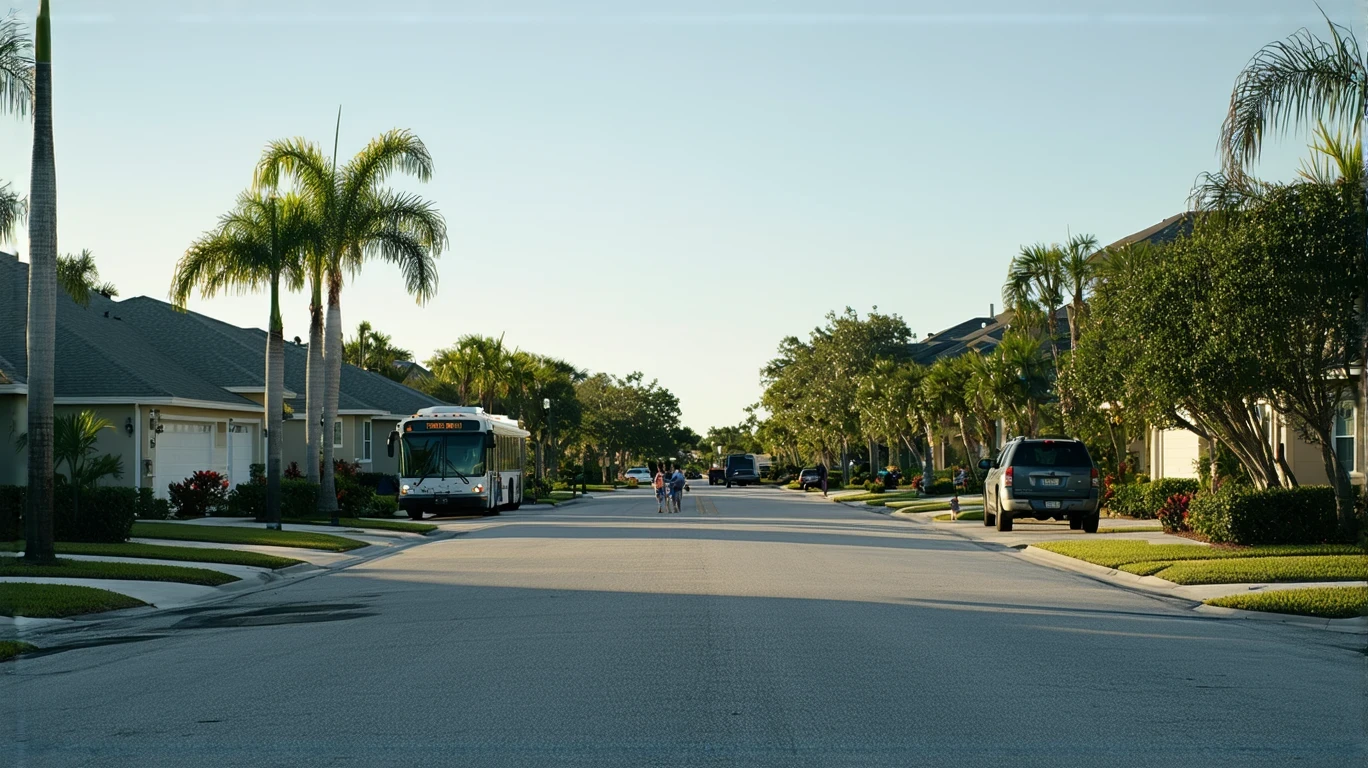
Understanding transportation options in New Port Richey starts with recognizing the city’s fundamental structure: low-rise residential neighborhoods spread across a layout that concentrates commercial activity along specific corridors rather than distributing it evenly. This pattern shapes how people move through daily life here. Most residents rely on personal vehicles for the majority of trips, but bus service exists for those whose routines align with available routes.
Newcomers often underestimate how much driving matters in New Port Richey. The city’s development pattern—residential blocks set back from commercial strips—means that even short errands typically require a car. Pedestrian infrastructure exists in moderate density, but the distance between home and daily destinations makes walking impractical for most households. The result is a mobility system where flexibility and control come from car ownership, and transit serves as a supplemental option rather than a primary mode.
What this means in practice: if you live near one of the commercial corridors where grocery stores and services cluster, and your schedule allows for bus timing, transit can work for specific trips. For everyone else—especially those in purely residential areas or with time-sensitive commitments—driving becomes non-negotiable.
Public Transit Availability in New Port Richey
Public transit in New Port Richey centers around bus service, which provides coverage along major routes but does not blanket the city. The system works best for residents living near established corridors where service runs regularly during standard hours. These routes connect residential areas to commercial zones, making transit viable for errands or work commutes that align with the schedule.
Where transit falls short is in reach and frequency. Neighborhoods set back from main roads often lack convenient access to stops, requiring a walk or drive just to reach the bus. Evening and weekend service tends to be more limited, which restricts transit’s usefulness for shift work, late errands, or spontaneous trips. For households that need to make multiple stops—daycare, grocery, pharmacy—the time cost of waiting and transferring often outweighs the benefit.
Transit here plays a supporting role. It serves residents who live along the right routes and have the time flexibility to work within its structure. It does not replace the need for a car for most households, but it does provide an alternative for specific, predictable trips.
Driving & Car Dependence Reality
Driving is the default mode of transportation in New Port Richey, not because of preference but because of geography. The city’s layout—residential blocks separated from commercial corridors, low-density development, limited mixed-use zones—makes car ownership a practical necessity for most daily activities. Grocery runs, medical appointments, school pickups, and work commutes all assume access to a vehicle.
Parking is generally abundant and free, which removes one friction point common in denser cities. Roads are designed to prioritize vehicle flow, and most destinations include dedicated parking. This makes driving convenient and predictable, but it also means that households without cars face significant logistical challenges. The distance between home and services, combined with limited transit coverage, creates real barriers for those relying on alternatives.
Car dependence also shapes housing decisions. Proximity to major roads and commercial corridors becomes more valuable when driving is required, and neighborhoods farther from these routes often feel more isolated. The tradeoff is space and quiet versus access and convenience, and that tradeoff is sharpened by the need to drive for nearly everything.
Commuting Patterns & Daily Mobility
Commuting in New Port Richey reflects the broader Tampa metro area’s structure: many residents travel outside the city for work, often to Tampa, Clearwater, or other nearby employment centers. The average commute time is 29 minutes, but that figure masks significant variation. A substantial share of residents—40.6%—face commutes exceeding 60 minutes, indicating that long-distance travel is a reality for a large portion of the workforce.
Daily mobility here is typically structured around single-occupancy vehicle trips. Multi-stop commutes—dropping kids at school, stopping for errands on the way home—are common, and the flexibility of a personal vehicle makes these routines manageable. Transit does not easily accommodate this kind of complexity, which is why even households that could use the bus for a direct work commute often choose to drive instead.
Remote work has provided relief for some: 16.2% of workers are based at home, eliminating the commute entirely. For everyone else, the question is not whether to commute, but how far and how often. Proximity to employment centers or major highways becomes a key factor in determining how much time and fuel a household absorbs each week.
Who Transit Works For — and Who It Doesn’t
Transit in New Port Richey works best for a narrow set of circumstances: individuals living near bus routes, with work or errands located along those same routes, and with schedules flexible enough to accommodate transit timing. This often includes renters in apartments near commercial corridors, retirees with predictable routines, or workers commuting to fixed-schedule jobs accessible by bus.
Transit does not work well for households with children, especially those managing school drop-offs and pickups. It struggles to serve residents in peripheral neighborhoods where stops are sparse or nonexistent. It is not practical for jobs requiring irregular hours, multiple daily trips, or travel outside the bus network’s coverage area. And it becomes nearly impossible for households managing complex logistics—groceries, daycare, medical appointments—all in one outing.
The difference is not about willingness to use transit; it is about whether the city’s structure allows it. New Port Richey’s layout, with errands and services clustered along corridors rather than distributed evenly, means that transit can connect specific points but cannot replace the flexibility a car provides. Households in the core with simple, linear routines may find transit sufficient. Everyone else will need to drive.
Transportation Tradeoffs in New Port Richey
Choosing between transit and driving in New Port Richey is less about cost and more about control, predictability, and time. Driving offers flexibility: you leave when you want, stop where you need, and adjust plans on the fly. Transit offers structure: fixed routes, fixed schedules, and the need to plan around the system rather than your own priorities.
For households that value spontaneity or manage complex daily routines, driving is the only realistic option. For those with predictable schedules and proximity to bus routes, transit can reduce some of the burden of car ownership—though it rarely eliminates it entirely. The tradeoff is not equal across household types. Families, shift workers, and residents in outer neighborhoods face much higher friction when relying on transit, while single adults or retirees near commercial corridors may find it workable.
The broader tradeoff is between time and autonomy. Transit requires waiting, transferring, and adjusting plans to fit the schedule. Driving requires fuel, maintenance, and parking costs, but it returns time and control. In a city where monthly expenses are shaped by housing and transportation together, understanding this tradeoff helps clarify where flexibility is worth the cost.
FAQs About Transportation in New Port Richey (2026)
Is public transit usable for daily commuting in New Port Richey?
Public transit can work for daily commuting if your home and workplace are both located near bus routes and your schedule aligns with service hours. For residents in areas without convenient stops or those with irregular work hours, transit becomes impractical. Most commuters in New Port Richey rely on personal vehicles because the city’s layout and transit coverage do not support comprehensive bus-based commuting.
Do most people in New Port Richey rely on a car?
Yes. The city’s low-density, corridor-based development pattern makes car ownership necessary for most daily activities. Grocery stores, medical facilities, schools, and workplaces are typically spread out in ways that require driving. While bus service exists, it serves a limited share of residents whose routines fit within the transit network’s structure.
Which areas of New Port Richey are easiest to live in without a car?
Areas near major commercial corridors with direct bus access offer the most viable car-free or car-light living. Residents in these zones can reach grocery stores, pharmacies, and some services on foot or by bus. Neighborhoods farther from these corridors, especially those in purely residential zones, require a car for nearly all errands and commutes.
How does commuting in New Port Richey compare to nearby cities?
Commuting in New Port Richey reflects the broader Tampa metro area’s car-dependent structure. Average commute times are comparable to other suburban cities in the region, but a significant share of residents face long commutes exceeding 60 minutes, often traveling to Tampa or Clearwater for work. Transit options are more limited here than in the urban core, making driving the dominant mode across the metro area.
Can you manage without a car if you work from home in New Port Richey?
Working from home eliminates the commute, which removes the largest transportation burden. However, daily errands—groceries, medical appointments, household needs—still require mobility. If you live near a commercial corridor with bus access and are willing to plan trips around transit schedules, you can reduce car dependence. For most households, even remote workers find that occasional car access is necessary for flexibility and convenience.
How Transportation Fits Into the Cost of Living in New Port Richey
Transportation in New Port Richey is not just a line item; it is a structural factor that shapes where you can live, how much time you spend commuting, and what kind of flexibility you have in daily life. Car dependence means that households must account for vehicle ownership, fuel, insurance, and maintenance as ongoing necessities, not optional expenses. The city’s layout makes driving unavoidable for most, which means transportation costs are baked into the baseline cost of living here.
For households evaluating New Port Richey, the question is not whether you will need a car, but how much driving you will do and whether your location minimizes commute length and errand friction. Proximity to work, schools, and commercial corridors reduces time and fuel costs, even if it does not eliminate them. Transit offers limited relief, primarily for those whose routines align with bus service and who live near established routes.
Understanding how transportation works here helps clarify the broader picture of affordability and daily logistics. It is not about finding the cheapest option; it is about recognizing how mobility shapes your time, your choices, and your exposure to ongoing costs. For a fuller view of how transportation fits alongside housing, utilities, and other expenses, the monthly budget breakdown provides the numeric context that complements this structural overview.
New Port Richey’s transportation reality is straightforward: most people drive, most of the time. Transit exists, but it serves a narrow set of use cases. The city’s layout rewards car ownership with convenience and flexibility, and penalizes those without cars with time costs and logistical friction. Knowing this upfront allows you to plan accordingly, choose housing that minimizes commute burden, and build a realistic picture of what daily life here actually requires.
How this article was built: In addition to public economic data, this article incorporates location-based experiential signals derived from anonymized geographic patterns—such as access density, walkability, and land-use mix—to reflect how day-to-day living actually feels in New Port Richey, FL.