
“I tried the bus for about two weeks when I first moved here,” says Marcus, who commutes from La Vergne to a warehouse job near the airport. “It worked fine as long as I was going straight there and back. But the day I needed to pick up my daughter after school and grab groceries? I was back in the car.”
That tension—between what’s technically available and what actually works for daily life—defines transportation options in La Vergne. This is a city where bus service exists, where some neighborhoods have surprisingly walkable pockets, and where the commute to Nashville feels manageable on paper. But it’s also a place where 53% of workers face long commutes, where errands cluster along commercial corridors rather than spreading evenly across neighborhoods, and where the structure of daily life—school pickups, grocery runs, weekend errands—pushes most households toward car ownership regardless of transit access.
Understanding how people actually get around La Vergne means looking past the presence of transit stops and asking harder questions: Who does the bus system serve well? What does car dependence actually cost in time, not just money? And how does mobility shape where people choose to live, work, and build routines?
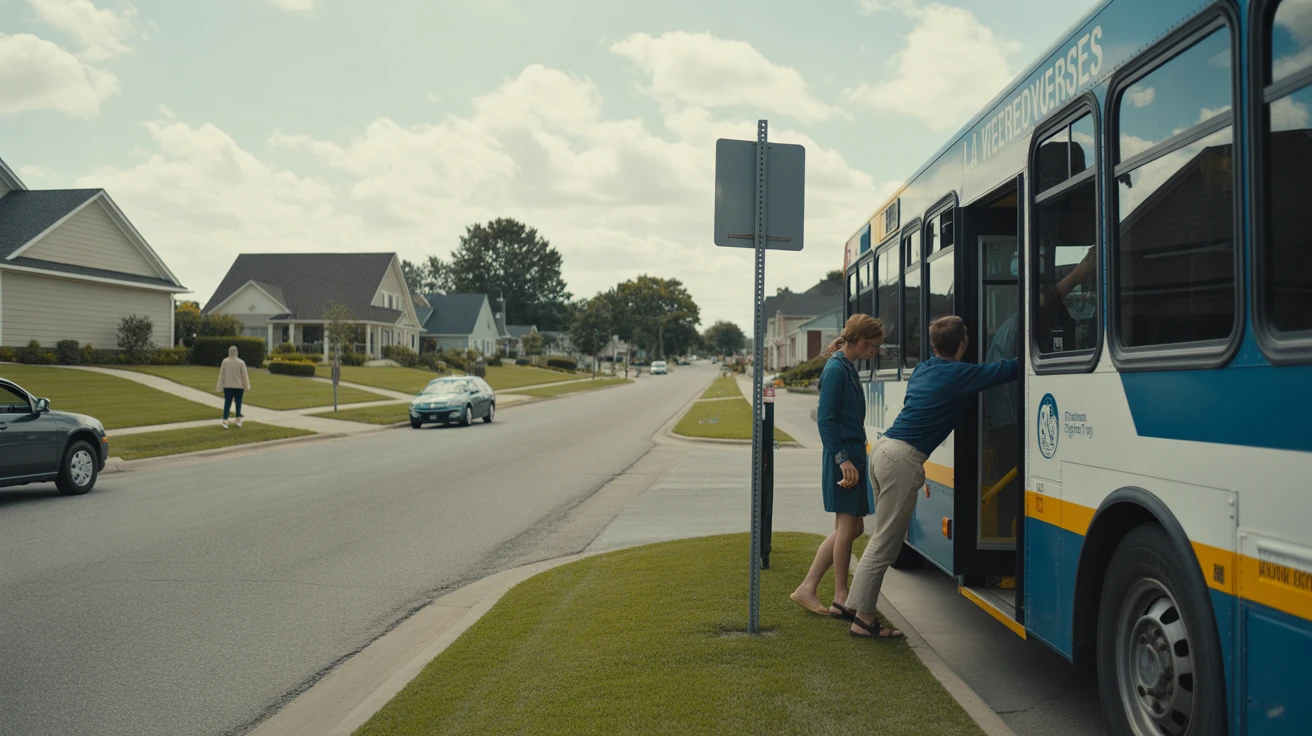
How People Get Around La Vergne
La Vergne sits in the Nashville metro, close enough to the city to feel connected but far enough out that most residents drive. The dominant pattern is car-first: people own vehicles, use them for most trips, and structure their days around the assumption that they’ll drive. But that’s not the whole story.
The city has pockets where pedestrian infrastructure is denser than you’d expect in a suburban setting—sidewalks, crosswalks, and residential streets that support walking within a neighborhood. These areas make it possible to take a short walk to a nearby park or a neighbor’s house without getting in the car. But those walkable moments don’t extend to daily errands. Grocery stores, pharmacies, and restaurants tend to cluster along a few main corridors, and reaching them on foot from most residential streets means crossing gaps in sidewalk coverage or navigating roads built for through-traffic, not pedestrians.
Bus service is present, and for residents living near key routes, it provides a real alternative for commuting to work or reaching parts of Nashville without driving. But the system is corridor-based: it connects specific points efficiently and leaves others untouched. If your home, workplace, and daily destinations all align with those corridors, the bus can work. If any one of them falls outside that network—or if your day involves multiple stops in different directions—you’re back to driving.
What newcomers often misunderstand is that La Vergne’s transportation reality isn’t about whether options exist. It’s about whether those options line up with the specific shape of your day. A single commuter working a fixed schedule near a bus line can make transit work. A parent managing school pickups, daycare, and grocery runs across multiple parts of town cannot.
Public Transit Availability in La Vergne
Public transit in La Vergne often centers around systems such as Nashville’s regional bus network, which extends service into parts of the city. The role transit plays here is supplemental rather than foundational: it works best for people commuting to a single destination along a well-served route, and it works less well for those trying to string together multiple errands or reach areas outside the main corridors.
The bus system tends to be most useful in neighborhoods closer to commercial corridors, where stops are more frequent and routes connect to job centers in Nashville or Smyrna. For residents in those areas, transit can reduce the need to drive every day, particularly for work commutes. But coverage thins out quickly in more peripheral or residential-only parts of the city. If you live in a neighborhood set back from the main roads, reaching a bus stop might require a drive or a long walk, which undermines the point.
Late hours and weekend service are typically lighter, which limits transit’s usefulness for shift workers, evening plans, or weekend errands. The system is built around peak commute times, and outside those windows, frequency drops and wait times lengthen. That makes transit less practical for households with variable schedules or anyone who needs flexibility in when and how they move around.
Transit also falls short for multi-stop trips. If your day involves dropping off a child, stopping at the pharmacy, picking up groceries, and getting to work, the bus can’t compete with the car’s ability to handle that sequence efficiently. The infrastructure is there, but it’s designed for linear trips, not the branching, multi-destination patterns that define daily life for many families.
Driving & Car Dependence Reality
For most people in La Vergne, driving isn’t a preference—it’s a structural necessity. The city’s layout, the spacing of commercial centers, and the limited reach of transit all point toward car ownership as the default. Parking is abundant and free in most places, which removes one of the friction points that makes driving costly or inconvenient in denser cities. But that ease comes with tradeoffs.
Car dependence means that households absorb the fixed costs of ownership—insurance, registration, maintenance—whether they drive five miles a day or fifty. It also means that day-to-day costs are shaped by distance and fuel prices, which fluctuate but never disappear. The flexibility of driving is real: you can leave when you want, stop where you need to, and adjust your route on the fly. But that flexibility comes at the cost of exposure to variables you don’t control—gas prices, traffic, wear on the vehicle.
Sprawl plays a role here. La Vergne’s development pattern spreads residential neighborhoods, shopping centers, and employment hubs across a wider area than older, denser cities. That spacing makes walking or biking impractical for most trips and limits the efficiency of transit. The result is that even short errands—picking up a prescription, grabbing takeout—often require getting in the car, because the alternative is a 20-minute walk along a road without sidewalks.
For families, car dependence multiplies. One vehicle might work for a single commuter, but households with multiple workers, school-age children, or aging parents often need two. That doubles the fixed costs and adds logistical complexity: who takes the car when, how do schedules overlap, what happens when one vehicle is in the shop.
Commuting Patterns & Daily Mobility
The typical commute in La Vergne averages 30 minutes, but that number hides significant variation. Some residents work locally or in nearby Smyrna and face short, predictable drives. Others commute into Nashville or beyond, and for them, 30 minutes is the best-case scenario—traffic, weather, or road construction can push it much longer.
More telling is the fact that 53% of workers in La Vergne face long commutes, a threshold that reflects not just time but distance and complexity. These aren’t quick hops to a nearby office park. They’re drives that cross multiple municipalities, navigate interstate merges, and require enough fuel and vehicle reliability to sustain the pattern five days a week.
Commute structure varies by household type. Single workers with fixed schedules and a direct route often settle into a rhythm: leave at the same time, take the same roads, arrive predictably. For them, the commute becomes routine, and transit might even be viable if the route aligns. But households managing multiple jobs, school schedules, or caregiving responsibilities face a different reality. The commute isn’t a single trip—it’s a sequence of pickups, drop-offs, and detours, and only the car offers the flexibility to handle that complexity.
Remote work has shifted the equation for some. With 12.4% of workers in La Vergne working from home, a portion of households have eliminated the daily commute entirely, which reduces transportation costs and frees up time. But that benefit is unevenly distributed: it’s available to knowledge workers with flexible employers, not to retail employees, healthcare workers, or tradespeople whose jobs require physical presence.
Proximity matters more than people expect. Living five miles closer to work doesn’t just shave ten minutes off the commute—it reduces fuel consumption, lowers the risk of traffic delays, and makes it easier to get home quickly if something comes up. But proximity in La Vergne often means higher rent or home prices, so households face a tradeoff: pay more to live closer, or accept a longer commute and lower housing costs.
Who Transit Works For—and Who It Doesn’t
Transit in La Vergne works best for a specific profile: single commuters with a fixed workplace along a bus corridor, predictable hours, and minimal need for mid-day errands. For those households, the bus can replace the daily drive, reduce vehicle wear, and eliminate parking hassles in Nashville. It’s not seamless, but it’s functional.
Renters living near commercial corridors—areas where bus stops, grocery stores, and pharmacies cluster—are more likely to benefit from transit than homeowners in residential-only neighborhoods. The infrastructure is denser, the distances shorter, and the need to drive for every small task diminishes. But even in those areas, transit works better for some trips than others. Commuting to work? Often viable. Running three errands on a Saturday afternoon? Much harder.
Families face the steepest barriers. School schedules don’t align with bus routes, daycare pickups require speed and flexibility, and grocery runs with young children are difficult without a car. The bus can’t accommodate a week’s worth of groceries, a stroller, and a toddler in the same trip. For households with multiple children or aging parents, the logistical complexity makes transit impractical even when stops are nearby.
Shift workers and anyone with non-standard hours also struggle. If your job starts at 6 a.m. or ends at 11 p.m., bus service may not run frequently enough—or at all—to make it a reliable option. The system is built around peak commute windows, and outside those times, you’re either waiting a long time or driving.
Peripheral neighborhoods, where residential streets branch off from main roads and bus stops are farther apart, see the least transit utility. Reaching a stop might require a 15-minute walk, and once you’re there, the route may not go where you need it to. In those areas, the car isn’t just more convenient—it’s the only realistic option.
Transportation Tradeoffs in La Vergne
Choosing between transit and driving in La Vergne isn’t about comparing two equally viable options. It’s about understanding which tradeoffs you’re willing to accept.
Transit offers predictability in some ways: no need to worry about parking, traffic, or fuel prices on a per-trip basis. But it sacrifices flexibility. You’re bound to the schedule, the route, and the coverage area. If the bus doesn’t go where you need to be, or doesn’t run when you need it to, the system stops working.
Driving offers control. You leave when you want, stop where you need to, and adjust on the fly. But that control comes with exposure: to fuel price swings, to traffic delays, to maintenance costs that arrive without warning. The car gives you freedom, but it also makes you responsible for every variable in the system.
For households trying to minimize transportation costs, the question isn’t whether to take the bus or drive—it’s whether your daily pattern allows the bus to replace enough car trips to matter. If you can eliminate the commute but still need the car for errands, you’re still paying for insurance, registration, and upkeep. The savings are real but partial.
Time is another tradeoff. Driving is almost always faster for point-to-point trips, but transit can reclaim time in other ways: you can read, work, or rest on the bus in ways you can’t behind the wheel. For some commuters, that shift in how time is spent matters more than the total minutes.
The tradeoff that matters most, though, is between proximity and affordability. Living close to transit, close to work, and close to errands reduces transportation friction across the board. But in La Vergne, proximity often costs more in rent or home prices. Households have to decide whether they’d rather pay more for housing and less for transportation, or accept a longer commute and lower housing costs. There’s no universal right answer—it depends on income, schedule, and what kind of friction you’re least willing to tolerate.
FAQs About Transportation in La Vergne (2026)
Is public transit usable for daily commuting in La Vergne?
Public transit can work for daily commuting if your home and workplace both align with bus corridors and your schedule matches service hours. Single commuters with fixed routes and predictable hours are most likely to find transit viable. Families, shift workers, and anyone needing to make multiple stops during the day will find the system harder to rely on.
Do most people in La Vergne rely on a car?
Yes. The majority of residents drive for most trips. The city’s layout, the spacing of commercial centers, and the limited reach of transit all make car ownership the default for daily life. Even households with access to bus service often keep a car for errands, emergencies, and trips outside the transit network.
Which areas of La Vergne are easiest to live in without a car?
Neighborhoods near commercial corridors, where bus stops, grocery stores, and services cluster, offer the most car-free viability. But even in those areas, living without a car requires a lifestyle that centers around a single commute route and minimal mid-day errands. Peripheral residential neighborhoods are much harder to navigate without a vehicle.
How does commuting in La Vergne compare to nearby cities?
La Vergne’s average commute time of 30 minutes is typical for the Nashville metro, but the high percentage of long commutes—53%—suggests that many residents are traveling significant distances, likely into Nashville or other parts of the region. Compared to denser parts of Nashville, La Vergne offers less transit coverage but more parking ease and lower traffic congestion on local roads.
Can you get by with one car in La Vergne?
Single-person households or couples with aligned schedules can often manage with one car, especially if one partner works from home or uses transit. Families with multiple workers, school-age children, or caregiving responsibilities usually find that one car creates logistical strain. The need for a second vehicle depends more on schedule complexity than distance.
How Transportation Fits Into the Cost of Living in La Vergne
Transportation in La Vergne isn’t just a line item—it’s a structural factor that shapes where you can live, how you spend your time, and what kind of flexibility you have in daily life. The presence of bus service matters, but it matters less than whether that service aligns with the specific shape of your day. For some households, transit reduces costs and reclaims time. For others, it’s a theoretical option that doesn’t survive contact with real schedules.
What’s certain is that most households in La Vergne will own at least one car, and many will own two. That reality doesn’t reflect preference—it reflects the city’s layout, the spacing of jobs and services, and the limits of transit coverage. The question isn’t whether to drive, but how much driving your household can absorb and what tradeoffs you’re willing to make to reduce it.
Proximity is the most powerful lever. Living closer to work, closer to transit, and closer to the places you go regularly reduces time, fuel, and friction. But proximity costs more in housing, and that tradeoff plays out differently depending on income, household size, and schedule. There’s no single right answer, but understanding the tradeoff makes the decision clearer.
For a fuller picture of how transportation costs interact with housing, utilities, and other expenses, the Monthly Spending in La Vergne: The Real Pressure Points article breaks down where money actually goes and how different household types experience cost pressure across categories.
Getting around La Vergne requires a clear-eyed view of what works and what doesn’t. Transit exists, walkable pockets are real, and some households can reduce car dependence. But for most people, the car remains the backbone of daily life—not because it’s cheaper, but because it’s the only tool flexible enough to handle the complexity of getting from here to there, on time, with everything you need.
How this article was built: In addition to public economic data, this article incorporates location-based experiential signals derived from anonymized geographic patterns—such as access density, walkability, and land-use mix—to reflect how day-to-day living actually feels in La Vergne, TN.