
“It’s not Nashville, and that’s kind of the point — you get space, you get a yard, you’re not paying downtown rent. But you’re also driving everywhere, and if you don’t have a car, good luck.”
That tension — affordability and access traded against convenience and texture — runs through nearly every conversation about life in La Vergne. This is a city shaped by its role as a Nashville bedroom community, where the emotional experience depends heavily on what you’re optimizing for: square footage and savings, or spontaneity and walkability.
La Vergne tends to work well for people who see the car as a tool, not a burden — households that plan their weeks around errands, batch trips, and accept that “quick” means a 10-minute drive. It tends to frustrate people who want to walk to dinner, grab groceries on the way home, or feel embedded in a dense, textured neighborhood. The city offers suburban comfort at a metro-accessible price point, but that comfort comes with logistical overhead that not everyone finds worth it.
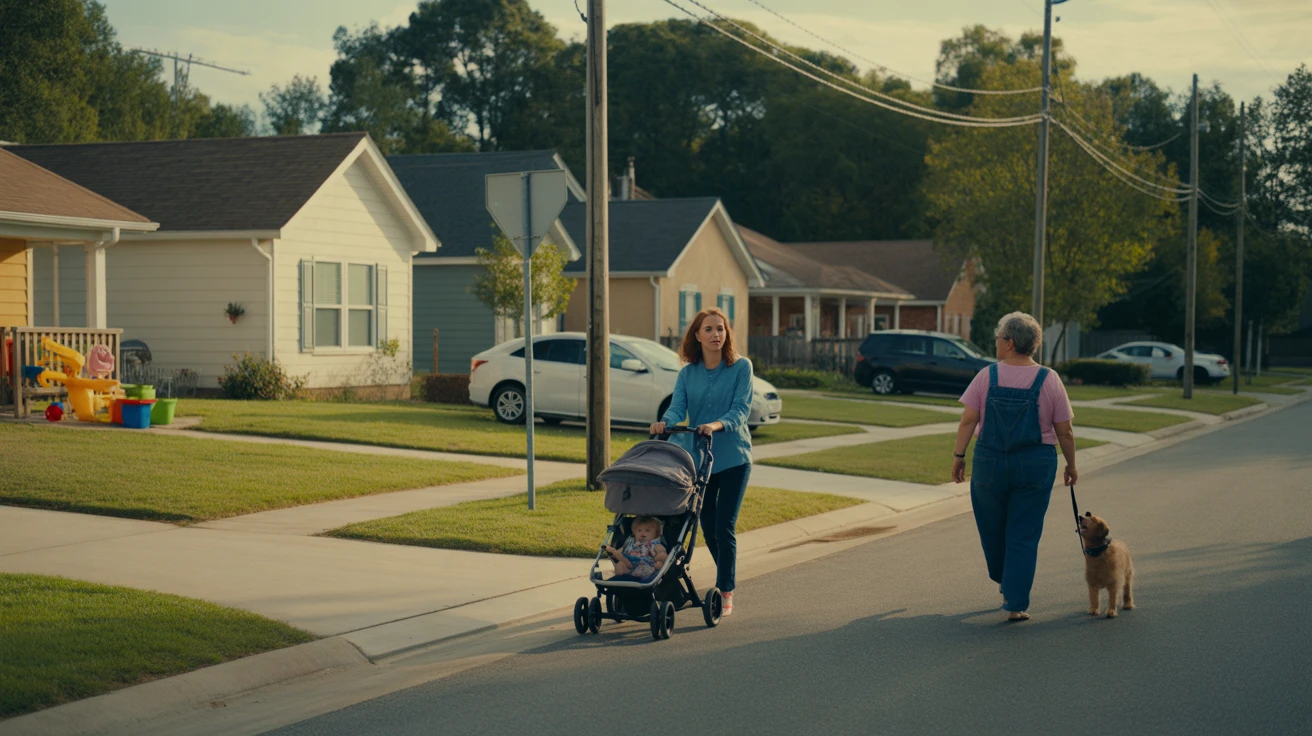
What the Emotional Tradeoff Feels Like
La Vergne sits in a sweet spot for cost-conscious commuters: median home values around $248,300 and median rent at $1,603 per month position it as one of the more accessible entry points into the Nashville metro. For households earning the city’s median income of roughly $77,531 per year, housing costs stay within traditional affordability bounds — but only if you’re willing to accept the infrastructure that comes with that price.
The city’s layout reflects its growth pattern: pockets of walkable infrastructure exist, but the overall texture leans car-oriented. Food and grocery options cluster along commercial corridors rather than spreading evenly through neighborhoods, which means errands require intentionality. Park density sits below thresholds that would make green space feel woven into daily life, and family infrastructure — schools, playgrounds — remains limited relative to household density. Bus service is present, but without rail and with a 30-minute average commute (and over half of workers facing long commutes), most residents default to driving.
For people who grew up in car-dependent suburbs or who see driving as a non-issue, this feels normal — even preferable to the expense and crowding of denser areas. For people who’ve lived in walkable cities, or who are trying to manage a household without reliable car access, La Vergne can feel like a daily negotiation: every outing requires a plan, every errand requires a trip, and spontaneity has a higher activation cost.
Social Media Buzz in La Vergne
Online discussion about La Vergne tends to center on three recurring themes: value, growth, and the commute. Residents often defend the city’s affordability and space, especially when comparing it to Nashville proper or more expensive suburbs like Brentwood or Franklin. But that defense frequently comes with caveats about what you’re giving up.
“You get a lot more house for your money, and if you work in Nashville, it’s doable. But you’re spending time in the car, and there’s not a ton to do here after work.”
“It’s quiet, it’s safe, it’s boring. If you have kids and want a yard, great. If you’re young and want to walk to a bar, you’re going to hate it.”
“People complain about La Vergne being bland, but honestly, that’s what I wanted. I don’t need nightlife. I need space and lower rent.”
Growth comes up frequently, often with mixed feelings. Long-time residents express concern about traffic, new development, and the loss of small-town character. Newcomers tend to focus on whether infrastructure — roads, schools, retail — is keeping pace with population. The tone isn’t hostile, but it’s not celebratory either; it’s more like cautious adjustment.
Local News Tone
Coverage of La Vergne tends to frame the city through the lens of change and identity. Stories often explore how a historically quieter suburb is absorbing growth, what that means for infrastructure and services, and how residents feel about the tradeoffs. The tone is generally neutral to mildly optimistic, but with an undercurrent of “we’ll see.”
Typical topic buckets include:
- “New Retail and Dining Options Arrive Along Major Corridors”
- “Residents Weigh Suburban Quiet Against Growing Pains”
- “Commuters Balance Nashville Access with Drive Time”
- “City Explores Infrastructure Upgrades as Population Grows”
- “Families Drawn to Affordability, Space, and School Options”
The framing rarely declares La Vergne a “winner” or a “problem.” Instead, it positions the city as a work in progress — a place that’s figuring out what it wants to be as it grows, with residents navigating that uncertainty in real time.
Review-Based Public Perception
Public reviews of La Vergne — whether about the city generally, specific neighborhoods, or local businesses — tend to reflect expectation alignment more than objective quality. People who moved here for affordability and space tend to be satisfied. People who moved here hoping for walkability, nightlife, or dense amenities tend to be disappointed.
Positive reviews often highlight:
- Value: more house, lower rent, manageable property taxes
- Proximity: close enough to Nashville for work, far enough to avoid downtown prices
- Quiet: less traffic, less noise, more space between neighbors
- Family-friendly: yards, newer developments, suburban safety
Critical reviews often mention:
- Lack of walkability: everything requires a car, sidewalks are sparse outside certain pockets
- Limited dining and entertainment: chain-heavy retail, few local spots, not much nightlife
- Commute burden: time spent driving to Nashville or Murfreesboro adds up
- Generic feel: newer areas can feel interchangeable with other suburban developments
Neighborhood variation exists but isn’t always sharply defined. Newer planned areas tend to feel more polished and family-oriented, with HOAs and uniform landscaping. Older pockets closer to the city’s core can feel more lived-in, with a mix of housing ages and styles. Neither is universally preferred; it depends on whether you want newness and consistency or character and variability.
Comparison to Nearby Cities
| Dimension | La Vergne | Smyrna | Mount Juliet |
|---|---|---|---|
| Overall Vibe | Affordable, car-dependent, quiet suburban | Slightly more established, mixed suburban texture | Newer growth, family-focused, polished feel |
| Walkability | Limited outside pockets | Moderate in select areas | Minimal, car-essential |
| Dining & Retail | Corridor-clustered, chain-heavy | More variety, some local spots | Growing but still limited |
| Commute to Nashville | Moderate, traffic-dependent | Similar, slightly better highway access | Longer, more eastward |
| Housing Cost | Accessible, good value | Slightly higher, more options | Higher, newer inventory |
La Vergne, Smyrna, and Mount Juliet all serve similar roles in the Nashville metro: they’re suburbs where people trade urban convenience for space and savings. The differences are subtle but meaningful.
Smyrna feels slightly more established, with a bit more retail variety and walkable pockets. It’s not dramatically different, but if you’re looking for a few more local dining options or a slightly less generic suburban feel, Smyrna might edge ahead. La Vergne is a bit more affordable and a bit quieter, which appeals to households prioritizing cost and simplicity over texture.
Mount Juliet skews newer and more polished, with a strong family-oriented identity. It’s farther east, which means a longer commute to Nashville but potentially easier access to jobs in Lebanon or Hermitage. Housing costs run higher, and the overall feel is more “planned community” than “small town.” If you want newness and don’t mind the drive, Mount Juliet works. If you want a lower price point and don’t need the polish, La Vergne fits better.
None of these cities will satisfy someone looking for walkability, transit access, or dense urban amenities. They’re all car-dependent suburbs where the primary question is: which flavor of suburban tradeoff do you prefer?
What Locals Are Saying
“We moved here from East Nashville because we wanted a yard and couldn’t afford one there. It’s been an adjustment — we miss being able to walk places — but our mortgage is $600 less a month, and that matters.”
— Young couple, first-time homebuyers
“I’ve been here 15 years, and it’s changed a lot. More traffic, more people, more development. I’m not against growth, but I hope we don’t lose what made this place affordable and low-key.”
— Long-time resident, homeowner
“It’s fine if you have a car and a plan. I work from home, so the commute isn’t an issue, but I do have to think ahead about groceries, errands, everything. Nothing’s just ‘on the way.’”
— Remote worker, renter
“Great place to raise kids. Good schools, safe neighborhoods, space to play. We don’t go into Nashville much anymore — it’s expensive and parking is a hassle — so we’ve adjusted to a quieter routine.”
— Family with young children
“I thought I’d be okay with the car thing, but it wears on you. Every single outing is a production. I miss being able to just walk out the door and grab coffee or run to the store.”
— Young professional, renter
“If you’re retired and want quiet, this works. If you’re looking for excitement, look elsewhere. We like it because it’s calm and we’re not paying city prices.”
— Retiree couple
“The commute to Nashville is doable, but it’s not nothing. Some days it’s 25 minutes, some days it’s 45. You learn to time it, but it’s part of the deal.”
— Commuter, works downtown Nashville
Does La Vergne Feel Like a Good Fit?
La Vergne doesn’t try to be something it’s not. It’s a car-dependent suburb where affordability and space come first, and walkability, nightlife, and dense amenities come last — if at all. The city works well for households that see that tradeoff as a feature, not a bug: people who want lower housing pressure, who don’t mind planning their errands, who value quiet over spontaneity, and who see the car as a tool rather than a burden.
It tends to frustrate people who want to walk to dinner, who rely on transit, or who feel constrained by the need to drive everywhere. The day-to-day costs of car dependency — gas at $3.59 per gallon, long commutes, time spent in traffic — add up in ways that aren’t always obvious until you’re living it.
The emotional experience of La Vergne is shaped less by what’s here and more by what you’re comparing it to. If you’re coming from a denser, more expensive part of Nashville, La Vergne feels like relief: more space, lower rent, less chaos. If you’re coming from a walkable city or hoping for urban texture, La Vergne feels like compromise: cheaper, yes, but also more isolated, more logistically demanding, and less spontaneous.
The city is growing, and with that growth comes both opportunity and tension. Infrastructure is catching up slowly, retail options are expanding, and the population is diversifying. But the fundamental structure — car-oriented, corridor-clustered, low-density — isn’t changing quickly. If that structure aligns with your lifestyle needs, La Vergne offers solid value and a manageable entry point into the Nashville metro. If it doesn’t, no amount of affordability will make the daily friction feel worth it.
How this article was built: In addition to public economic data, this article incorporates location-based experiential signals derived from anonymized geographic patterns—such as access density, walkability, and land-use mix—to reflect how day-to-day living actually feels in La Vergne, TN.
The perspectives shown reflect commonly expressed local sentiment and recurring themes in public discussion, rather than individual accounts.