
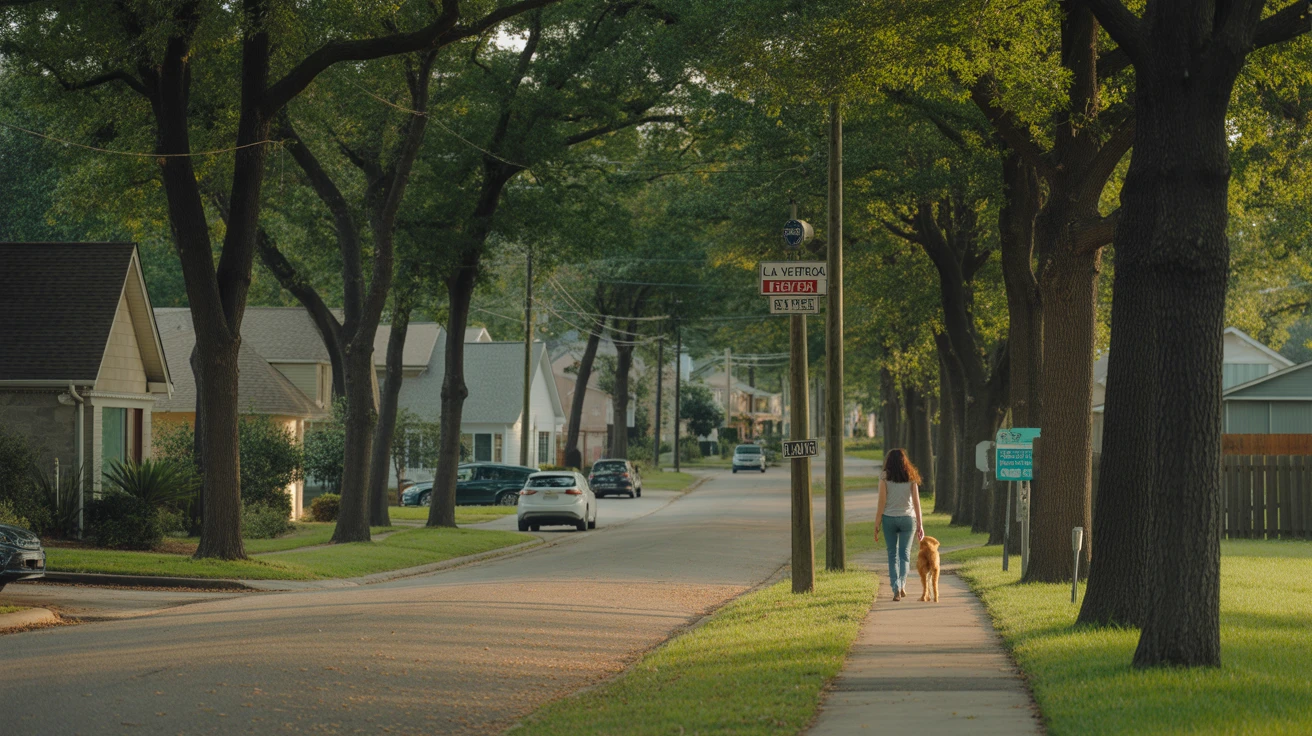
La Vergne and Smyrna sit just miles apart in the Nashville metro, sharing the same utility providers, gas stations, and regional economy. Yet the Morales family—debating where to settle after relocating from out of state—quickly discovered that identical paychecks feel different in each city. The decision isn’t about which place costs less overall, but about where specific cost pressures show up and which household priorities each city protects or strains. In 2026, choosing between these two Tennessee suburbs means understanding how housing entry barriers, commute friction, and daily logistics create distinct financial experiences for different household types.
Both cities reflect modern suburban Nashville growth: low-rise neighborhoods with mixed residential and commercial land use, bus service connecting to the metro, and grocery options concentrated along major corridors. But beneath that surface similarity, the cost structure diverges in ways that matter. Smyrna’s housing market demands more upfront, while La Vergne’s rental market runs tighter. Smyrna offers shorter commutes and better park access; La Vergne trades those conveniences for lower home purchase prices. Neither city is universally cheaper—each simply organizes financial pressure differently, rewarding households whose priorities align with what that city makes predictable versus volatile.
This comparison explains where costs concentrate in each city, which households feel specific differences most acutely, and how the same gross monthly income translates into different levels of flexibility, predictability, and control. The goal is not to declare a winner, but to clarify which tradeoffs each city asks you to accept.
Housing Costs: Entry Barriers vs. Ongoing Obligations
Housing dominates the cost experience in both La Vergne and Smyrna, but the pressure shows up at different stages. Smyrna’s median home value sits at $285,200, compared to La Vergne’s $248,300—a difference that translates directly into down payment requirements, mortgage principal, and property tax baselines. For the Morales family considering homeownership, that $36,900 gap represents months of additional saving, higher monthly mortgage obligations, and steeper exposure to property tax increases over time. Smyrna’s housing stock skews slightly newer in some neighborhoods, which can mean lower immediate maintenance costs but higher purchase prices reflecting that condition.
The rental market flips the pressure. La Vergne’s median gross rent stands at $1,603 per month, while Smyrna’s sits at $1,281 per month—a $322 monthly difference that accumulates quickly for renters. La Vergne’s tighter rental market may reflect fewer apartment complexes relative to single-family homes, concentrating demand among renters who need flexibility or can’t yet access homeownership. Smyrna’s lower rent doesn’t necessarily mean lower housing quality; it may signal a larger rental inventory or different housing type distribution. Both cities show walkable pockets with substantial pedestrian infrastructure in parts of town, but neither offers the density or transit connectivity that would allow most households to avoid car ownership, meaning housing location decisions must also account for commute exposure.
For first-time buyers, Smyrna’s higher home values create a steeper entry barrier but may offer more equity-building potential if the Nashville metro continues appreciating. For renters planning to stay flexible, La Vergne’s higher rent increases ongoing obligations without building equity. For families prioritizing space and outdoor access, Smyrna’s better park density (medium band versus La Vergne’s low density) may justify the higher purchase price, especially if children’s daily routines depend on nearby green space. La Vergne’s lower home values appeal to households willing to trade park access and commute time for faster equity accumulation and lower mortgage payments.
| Housing Metric | La Vergne | Smyrna |
|---|---|---|
| Median Home Value | $248,300 | $285,200 |
| Median Gross Rent | $1,603/month | $1,281/month |
| Median Household Income | $77,531/year | $76,115/year |
Housing takeaway: Smyrna front-loads cost pressure into the purchase decision, rewarding buyers who can clear the higher entry barrier with slightly shorter commutes and better park access. La Vergne shifts pressure to renters, offering lower homeownership entry but tighter rental availability and higher monthly rent obligations. Households sensitive to upfront costs versus ongoing obligations will feel these differences most acutely, and neither city eliminates housing as the dominant cost driver.
Utilities and Energy Costs: Identical Rates, Different Exposure
La Vergne and Smyrna share the same utility infrastructure, with electricity priced at 12.87¢/kWh and natural gas at $11.31/MCF across both cities. The rate structure is identical because both cities draw from the same regional providers. Yet utility bills still vary household to household based on home size, age, and construction quality—not city location. The Morales family, touring homes in both cities, noticed that older single-family homes in either location tend to show higher heating and cooling exposure than newer townhomes or apartments with shared walls and modern insulation.
Middle Tennessee’s climate drives utility behavior: hot, humid summers demand extended air conditioning use, while winters require moderate heating during occasional cold snaps. Cooling dominates summer bills, and households in larger, older single-family homes face more volatility than those in newer, smaller units. Both cities show low-rise building profiles, meaning most housing stock consists of single-family homes rather than multi-unit buildings, which increases per-household energy exposure compared to denser urban areas. Apartments and townhomes in either city benefit from shared walls and centralized HVAC systems, reducing baseline usage and smoothing seasonal swings.
For single adults in apartments, utility costs remain predictable and modest in both cities, with cooling season spikes manageable through thermostat discipline. For couples or small families in single-family homes, summer cooling and winter heating create noticeable seasonal peaks, especially in homes built before modern efficiency standards. For larger families in older homes, utility volatility becomes a meaningful budget factor, with summer months potentially doubling baseline winter usage. Households planning to stay long-term may consider efficiency upgrades—programmable thermostats, attic insulation, or HVAC maintenance—to reduce exposure, though these investments require upfront spending and don’t eliminate seasonal swings.
Utility takeaway: Neither La Vergne nor Smyrna offers a structural utility cost advantage, since both cities share identical rates and similar housing stock profiles. Utility exposure depends far more on housing type, home age, and household size than city choice. Households sensitive to seasonal volatility should prioritize newer construction or smaller floor plans in either city, while those in older single-family homes should budget for higher summer cooling exposure regardless of location.
Groceries and Daily Expenses: Corridor-Clustered Access in Both Cities
Grocery and everyday spending patterns look remarkably similar in La Vergne and Smyrna. Both cities show food and grocery establishment density in the medium band, with options concentrated along major corridors rather than distributed evenly across neighborhoods. This means most households in either city drive to grocery stores, big-box retailers, and dining options rather than walking to corner markets or neighborhood cafes. The Morales family found that both cities offer familiar chains—regional grocers, national big-box stores, and fast-casual dining—without the specialty markets or walkable commercial districts that might reduce car dependency or enable price comparison shopping on foot.
Because both cities sit in the same regional price environment (RPP index of 97, slightly below the national baseline), grocery staples cost roughly the same in either location. Derived estimates suggest bread around $1.79/lb, chicken near $1.99/lb, and eggs approximately $2.42/dozen, though these figures reflect regional price adjustments rather than observed local prices and should be used only to understand category-level costs, not to budget precisely. The real difference in grocery spending comes from household behavior: how often families dine out versus cook at home, whether they shop discount chains or premium grocers, and how much convenience spending (coffee runs, takeout, prepared foods) creeps into weekly routines.
For single adults, grocery costs remain modest in both cities, with flexibility to choose between budget and convenience options depending on schedule and priorities. For dual-income couples, dining out frequency and convenience spending can escalate quickly if both partners work long hours and commute friction reduces time for meal prep. For families managing larger grocery volumes, the corridor-clustered layout in both cities requires intentional trip planning to avoid multiple weekly drives, and the lack of nearby discount grocers in some neighborhoods can limit price flexibility. Households sensitive to grocery costs should prioritize proximity to preferred stores when choosing neighborhoods in either city, since walkable access to groceries is rare in both locations.
Grocery takeaway: La Vergne and Smyrna offer nearly identical grocery cost structures, with similar establishment density, regional pricing, and car-dependent access patterns. The meaningful differences come from household behavior—dining out frequency, convenience spending habits, and trip consolidation discipline—not from city-level price variation. Households looking to control grocery spending should focus on housing location relative to preferred stores and on managing convenience creep, since neither city offers structural advantages in food access or pricing.
Taxes and Fees: Shared State Structure, Local Variation
Tennessee’s state-level tax structure applies equally to La Vergne and Smyrna: no state income tax, moderate sales taxes, and property taxes that vary by county and municipality. Both cities sit in Rutherford County, meaning they share the same county-level property tax assessment practices, though city-specific rates and fees can introduce differences. Property taxes in either city depend on assessed home value, meaning Smyrna’s higher median home values translate into higher baseline property tax obligations for homeowners, even if the millage rate were identical. The Morales family’s real estate agent noted that property tax bills in Smyrna would likely run higher simply because the home they were considering cost more, not because the city imposed steeper rates.
Beyond property taxes, both cities charge fees for services like water, sewer, and trash collection, though the specific amounts and billing structures can vary. Some neighborhoods in either city may include HOA fees that bundle landscaping, shared amenities, or exterior maintenance, shifting predictable costs into monthly obligations but reducing surprise repair expenses. Households in older neighborhoods without HOAs may face lower monthly fees but higher volatility when roofs, HVAC systems, or driveways require replacement. Sales taxes apply uniformly across both cities for everyday purchases, meaning grocery, dining, and retail spending face the same consumption tax burden regardless of location.
For homeowners, property taxes represent the largest tax exposure in either city, with Smyrna’s higher home values creating steeper ongoing obligations. For renters, property taxes remain invisible but indirectly affect rent levels as landlords pass through costs. For long-term residents planning to stay several years, property tax predictability matters more than initial rates, since assessments can rise over time as home values appreciate. Households sensitive to tax volatility should investigate recent assessment trends and city budget priorities in either location, since both cities may adjust rates to fund infrastructure, schools, or services.
Tax takeaway: La Vergne and Smyrna share Tennessee’s no-income-tax advantage and similar sales tax structures, but property tax exposure differs due to home value baselines. Smyrna’s higher median home values create steeper property tax obligations for homeowners, while La Vergne’s lower home values reduce that burden. Renters in either city face indirect tax exposure through rent levels, and households planning long-term stays should prioritize understanding assessment trends over initial rates, since both cities may adjust taxes as budgets evolve.
Transportation & Commute Reality: Minutes Matter More Than Miles
Commute patterns separate La Vergne and Smyrna more clearly than most cost categories. Smyrna’s average commute clocks in at 26 minutes, while La Vergne’s stretches to 30 minutes—a four-minute difference that compounds daily. For the Morales family, both working in Nashville proper, those extra eight minutes per day (round trip) add up to nearly an hour per week, over three hours per month, and roughly 40 hours per year spent in the car. Smyrna’s shorter commute doesn’t eliminate car dependency—only 8.5% of Smyrna workers and 12.4% of La Vergne workers telecommute—but it does reduce the time cost of accessing Nashville’s job centers.
Both cities show bus service connecting to the broader Nashville metro, but neither offers the frequency or coverage that would allow most households to rely on transit for daily commuting. The walkable pockets detected in both cities—areas where pedestrian infrastructure is substantial relative to road networks—serve neighborhood errands more than regional commutes. Gas prices sit at $3.59/gallon in both locations, meaning fuel costs per mile remain identical, but the time friction of longer commutes in La Vergne affects schedule flexibility, childcare logistics, and household stress in ways that don’t show up on a fuel receipt.
La Vergne’s longer commute exposure is reflected in its 53.0% long-commute percentage (residents traveling 30+ minutes to work), compared to Smyrna’s 41.0%. For single adults with flexible schedules, the four-minute difference may feel negligible. For dual-income couples coordinating childcare drop-offs and pickups, those extra minutes shrink the window for managing household logistics. For families with school-age children, shorter commutes in Smyrna create more time for after-school activities, meal prep, and evening routines, even if the dollar cost of commuting stays similar.
Commute takeaway: Smyrna’s shorter average commute and lower long-commute percentage reduce time friction for households working in Nashville, while La Vergne’s longer commute exposure increases schedule pressure without significantly changing fuel costs. Both cities require car ownership for daily life, and neither offers transit as a viable commute alternative for most workers. Households sensitive to time budget and schedule flexibility will feel Smyrna’s commute advantage more acutely than those with remote work options or flexible hours.
Cost Structure Comparison: Where Pressure Concentrates
Housing pressure dominates both cities but arrives at different stages. Smyrna front-loads cost into the purchase decision, with higher home values creating steeper down payment requirements and larger mortgage obligations. La Vergne shifts pressure to renters, with higher monthly rent obligations but lower homeownership entry barriers. Buyers prioritizing faster equity accumulation and lower monthly mortgage payments may prefer La Vergne’s housing market, while those who can clear Smyrna’s higher entry barrier gain access to shorter commutes and better park access.
Utilities introduce similar volatility in both cities, since they share identical electricity and natural gas rates and comparable low-rise housing stock. Seasonal cooling exposure affects summer bills in either location, with older single-family homes facing more volatility than newer apartments. Households sensitive to utility predictability should prioritize housing type and construction age over city choice, since neither La Vergne nor Smyrna offers structural advantages in energy costs.
Groceries and daily expenses follow nearly identical patterns in both cities, with corridor-clustered food access requiring car trips and regional pricing creating similar baseline costs. The meaningful differences come from household behavior—dining out frequency, convenience spending, and trip consolidation—not from city-level price variation. Families managing larger grocery volumes should prioritize housing location relative to preferred stores in either city, since walkable grocery access is rare in both locations.
Transportation patterns matter more than transportation costs. Both cities charge the same gas prices and require car ownership for daily logistics, but Smyrna’s shorter average commute reduces time friction and schedule pressure. La Vergne’s longer commute exposure doesn’t significantly increase fuel spending but does shrink the time available for household errands, childcare coordination, and evening routines. Dual-income households and families with school-age children feel this difference most acutely, while remote workers or flexible-schedule households may find the commute gap negligible.
The decision between La Vergne and Smyrna isn’t about which city costs less overall—it’s about which cost pressures dominate your household and which city makes those pressures more predictable or more volatile. Households sensitive to upfront housing costs may prefer La Vergne’s lower home values; those prioritizing time budget and schedule flexibility may prefer Smyrna’s shorter commutes. Renters face higher monthly obligations in La Vergne, while buyers face steeper entry barriers in Smyrna. Neither city eliminates the need for careful budgeting, and both require car ownership and intentional household logistics planning.
How the Same Income Feels in La Vergne vs Smyrna
Single Adult
For a single adult, housing becomes the first non-negotiable cost, with La Vergne’s higher rent creating steeper monthly obligations for renters while Smyrna’s lower rent offers more breathing room. Flexibility exists in dining out frequency and convenience spending, since both cities offer similar grocery and restaurant access. Commute friction matters less for single adults with flexible schedules, though Smyrna’s shorter average commute creates more evening time for errands or recreation. The role of car dependence is identical in both cities—neither offers walkable access to work or daily errands for most residents—meaning transportation costs remain predictable but unavoidable.
Dual-Income Couple
For dual-income couples, housing costs split between rent and ownership depending on savings and timeline, with La Vergne offering faster homeownership entry but higher rent exposure for those still saving. Flexibility disappears quickly when both partners commute, since Smyrna’s shorter average commute creates more time for shared meal prep and household coordination. Commute friction compounds when both partners work in Nashville, with La Vergne’s longer average commute shrinking the window for evening routines and increasing reliance on convenience spending. The role of housing form matters more than city choice—newer apartments or townhomes reduce utility volatility in either location, while older single-family homes increase seasonal exposure.
Family with Kids
For families, housing space becomes non-negotiable first, with Smyrna’s higher home values creating steeper entry barriers but offering better park access for children’s outdoor routines. Flexibility exists in grocery strategy—cooking at home versus dining out—but both cities require car trips for errands, limiting spontaneous price comparison shopping. Commute friction affects childcare logistics most acutely, with Smyrna’s shorter commutes creating more time for school pickups, after-school activities, and evening meals. The role of park density becomes meaningful for families with young children, since Smyrna’s medium-band park access offers more nearby outdoor space than La Vergne’s limited park density, reducing the need to drive to recreation.
Decision Matrix: Which City Fits Which Household?
| Decision factor | If you’re sensitive to this… | La Vergne tends to fit when… | Smyrna tends to fit when… |
|---|---|---|---|
| Housing entry + space needs | You prioritize lower down payments and faster equity building over rent predictability | You can accept higher rent or want lower home purchase prices to accelerate ownership | You can clear higher entry barriers and value shorter commutes and park access |
| Transportation dependence + commute friction | You value evening time for household logistics and schedule flexibility | You work remotely or have flexible hours that reduce commute time sensitivity | You commute to Nashville daily and prioritize minimizing time spent in the car |
| Utility variability + home size exposure | You want predictable seasonal bills and lower cooling/heating volatility | You prioritize newer construction or smaller floor plans to reduce energy exposure | You prioritize newer construction or smaller floor plans to reduce energy exposure |
| Grocery strategy + convenience spending creep | You want to control food costs through intentional shopping and meal prep | You choose housing near preferred stores and consolidate trips to reduce driving | You choose housing near preferred stores and consolidate trips to reduce driving |
| Fees + friction costs (HOA, services, upkeep) | You want to minimize ongoing obligations and prefer lower property tax baselines | You accept lower home values to reduce property tax exposure and upfront costs | You accept higher home values and property taxes for shorter commutes and amenities |
| Time budget (schedule flexibility, errands, logistics) | You need more evening hours for childcare, errands, and household coordination | You have flexible work arrangements that reduce the impact of longer commutes | You prioritize shorter commutes to create more time for family routines and recreation |
Lifestyle Fit: Suburban Rhythms with Different Time Budgets
La Vergne and Smyrna share the low-rise, car-oriented suburban character common across the Nashville metro, with both cities offering mixed residential and commercial land use and bus connections to the broader region. Yet lifestyle differences emerge in how households spend their non-work hours. Smyrna’s better park access—with park density in the medium band compared to La Vergne’s limited density—creates more options for families seeking nearby outdoor space for children’s play, dog walking, or weekend recreation. La Vergne’s limited park density means households often drive to green space rather than walking to neighborhood parks, adding friction to spontaneous outdoor activity.
Both cities show walkable pockets where pedestrian infrastructure is substantial, but these areas serve neighborhood errands more than regional connectivity. Grocery stores, dining options, and services cluster along major corridors in both locations, requiring car trips for most households. The Morales family noticed that neither city offers the dense, walkable commercial districts that would allow them to run errands on foot or rely on transit for daily needs. Instead, both cities reward households comfortable with car-dependent routines and intentional trip planning.
Smyrna’s shorter average commute creates more evening time for household routines, after-school activities, and recreation, which can indirectly affect costs by reducing reliance on convenience spending and takeout meals. La Vergne’s longer commute exposure shrinks that time buffer, increasing the temptation to outsource meal prep or skip home maintenance tasks that require evening hours. Both cities offer clinics and pharmacies for routine healthcare but lack hospital facilities, meaning emergency care requires travel to Nashville or nearby regional hospitals. Quick fact: Both cities report a 2.8% unemployment rate, reflecting the broader Nashville metro’s stable job market. Quick fact: Current temperatures hover in the mid-to-upper 50s°F in both cities, with similar feels-like conditions reflecting their shared regional climate.
Frequently Asked Questions
Is La Vergne or Smyrna cheaper for renters in 2026?
Smyrna offers lower median gross rent at $1,281 per month compared to La Vergne’s $1,603 per month, creating a $322 monthly difference that favors renters in Smyrna. This gap reflects La Vergne’s tighter rental market, where fewer apartment complexes relative to single-family homes concentrate demand among renters. Smyrna’s larger rental inventory or different housing type distribution may explain the lower rent baseline. For renters planning to stay flexible or unable to access homeownership yet, Smyrna reduces ongoing monthly housing obligations without requiring the upfront costs of buying.
Which city has lower home prices, La Vergne or Smyrna, in 2026?
La Vergne’s median home value sits at $248,300, compared to Smyrna’s $285,200—a $36,900 difference that translates directly into lower down payment requirements, smaller mortgage principal, and reduced property tax baselines in La Vergne. First-time buyers prioritizing faster equity accumulation and lower monthly mortgage payments may find La Vergne’s housing market more accessible. Smyrna’s higher home values create steeper entry barriers but may offer more equity-building potential if Nashville metro home values continue appreciating, and they come with the benefit of shorter average commutes and better park access.
Do La Vergne and Smyrna have different utility costs in 2026?
No, both cities share identical utility rates—electricity at 12.87¢/kWh and natural gas at $11.31/MCF—because they draw from the same regional providers. Utility bill differences between households come from home size, construction age, and housing type rather than city location. Older single-family homes in either city face higher heating and cooling exposure than newer apartments or townhomes with shared walls and modern insulation. Households sensitive to utility volatility should prioritize housing characteristics over city choice, since neither La Vergne nor Smyrna offers structural advantages in energy costs.
How do commute times compare between La Vergne and Smyrna in 2026?
Smyrna’s average commute runs 26 minutes, while La Vergne’s stretches to 30 minutes—a four-minute difference that compounds to nearly an hour per week and over three hours per month for daily commuters. Smyrna also shows a lower long-commute percentage (41.0% of workers traveling 30+ minutes) compared to La Vergne’s 53.0%, meaning more Smyrna residents experience shorter, more predictable commutes. Both cities require car ownership for daily logistics, and neither offers transit as a viable commute alternative for most workers, but Smyrna’s shorter commutes reduce time friction and create more evening hours for household coordination and recreation.
Which city is better for families with kids, La Vergne or Smyrna, in 2026?
Both cities show limited family infrastructure, with school and playground density below thresholds in La Vergne and school density below thresholds in Smyrna. However, Smyrna offers better park access, with park density in the medium band compared to La Vergne’s limited park density, creating more nearby outdoor space for children’s play and weekend recreation. Smyrna’s shorter average commute also creates more evening time for after-school activities, meal prep, and family routines. La Vergne’s lower home values reduce housing entry barriers for families, but the limited green space and longer commute exposure may increase household logistics friction. Families prioritizing outdoor access and time budget may prefer Smyrna despite higher home prices, while those focused on faster homeownership and lower monthly mortgage payments may choose La Vergne.
Conclusion: Different Households, Different Tradeoffs
La Vergne and Smyrna don’t divide neatly into “cheaper” and “more expensive”—they organize cost pressure differently, rewarding households whose priorities align with what each city makes predictable. Smyrna front-loads cost into homeownership, with higher home values creating steeper entry barriers but offering shorter commutes, better park access, and lower rent for those not yet buying. La Vergne shifts pressure to renters and reduces homeownership entry costs, appealing to buyers prioritizing faster equity accumulation and lower monthly mortgage payments, even if that means accepting longer commutes and limited nearby green space.
The Morales