
Kennesaw is considered moderately priced in 2026, with a median home value of $262,000 and median rent of $1,673 per month. The value proposition depends on housing entry cost versus car dependence, with commuting and vehicle ownership creating recurring exposure beyond day-to-day prices.
When Maya transferred to a Kennesaw office in early 2026, she expected Atlanta-area pricing without Atlanta-level density. What she didn’t anticipate was how much the city’s layout would shape her monthly routine—and her expenses. Groceries weren’t at her corner. Her commute required a car. And her first summer utility bill arrived the same week she realized her apartment complex sat two miles from the nearest walkable corridor.
Kennesaw’s cost structure rewards those who enter with clarity about trade-offs: ownership over renting, driving over transit, and planning over spontaneity. For households willing to navigate those realities, the city offers suburban access and strong family infrastructure at a price point below metro Atlanta’s inner ring. For those expecting walkable convenience or low transportation overhead, the financial texture can feel more demanding than the sticker price suggests.
Overall Cost of Living Snapshot
Kennesaw’s regional price parity index sits at 111, meaning the overall cost level runs approximately 11% above the national baseline. That premium concentrates in housing and transportation, not groceries or utilities. The median household income of $81,467 per year reflects a working population with steady employment—the local unemployment rate stands at just 3.2%—but income alone doesn’t determine cost fit. What matters more is how households allocate expenses across categories that don’t flex easily.
Housing dominates the cost picture. Whether buying at $262,000 or renting at $1,673 per month, shelter claims the largest single share of household budgets. Transportation follows closely, driven by a 29-minute average commute and a metro structure that makes car ownership nearly universal. Only 12.7% of workers operate from home, and 44.6% face commutes long enough to add meaningful fuel and maintenance exposure. Utilities introduce seasonal swings—hot, humid summers drive cooling costs—but remain secondary to the housing-transportation axis.
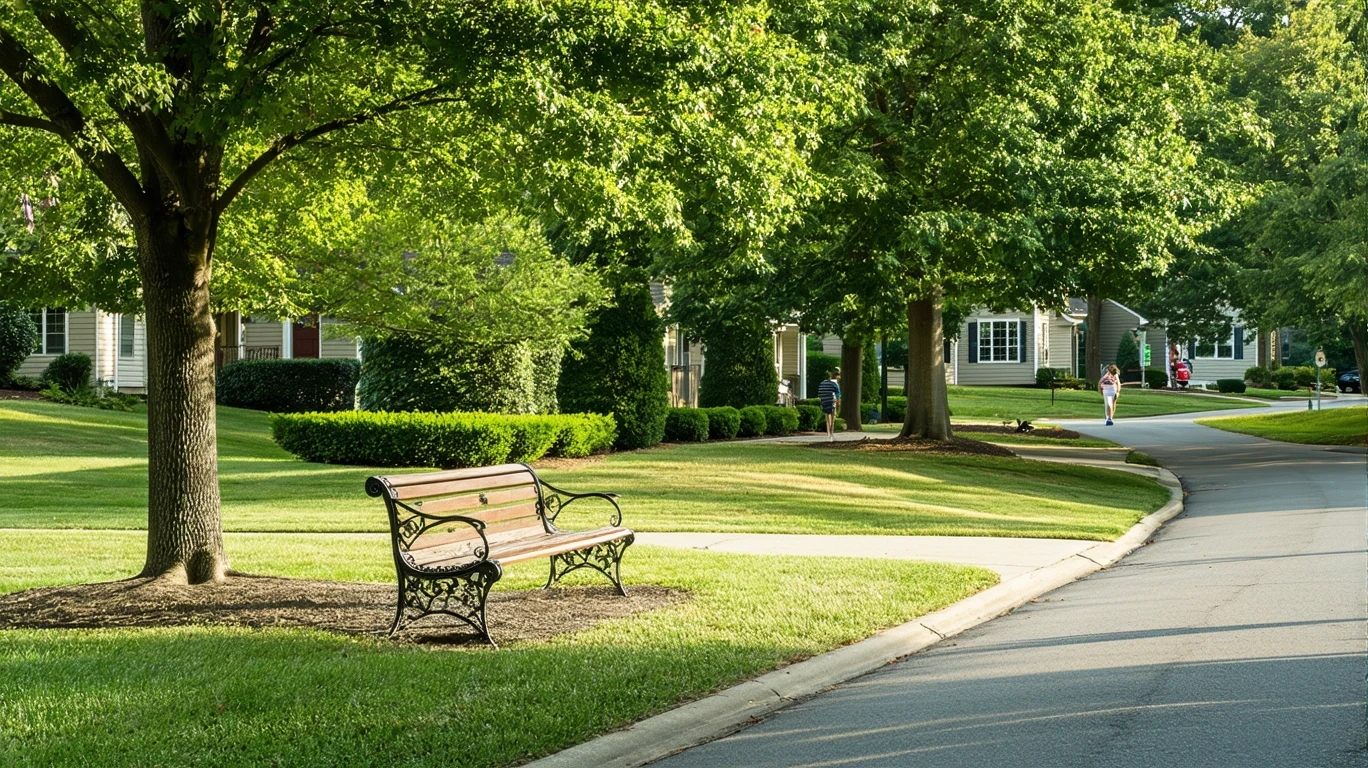
The shape of costs in Kennesaw is suburban and car-dependent, with expenses clustering around entry (down payment or first month’s rent) and recurring mobility (fuel, insurance, vehicle wear). Day-to-day spending on groceries and services tracks close to regional averages, and the city’s infrastructure—particularly its integrated park access and strong school and playground density—supports family routines without requiring premium fees. Surprises tend to come not from price levels but from logistical friction: errands require planning, and walkable access exists only in pockets, not across the entire city.
Driver verdict: Housing entry cost and car dependency dominate financial pressure. Surprises come from transportation’s recurring weight and the planning burden created by corridor-clustered errands, not from volatile grocery or utility pricing.
Housing Costs (Primary Driver)
At $262,000, Kennesaw’s median home value positions the city as accessible for buyers with stable income and down payment capacity, particularly compared to closer-in Atlanta suburbs where values routinely exceed $350,000. For renters, the $1,673 median gross rent reflects a market oriented toward families and longer-term residents rather than transient populations. Neither figure includes the secondary costs of ownership—property taxes, insurance, and maintenance—or the upfront friction of rental applications and deposits, but both anchor the city’s housing reality: this is a place where people settle, not cycle through.
The renting-versus-owning calculus in Kennesaw tilts toward ownership for households planning to stay beyond three years. Renting offers flexibility and eliminates maintenance exposure, but it also means absorbing annual lease renewals in a market where landlords can adjust to regional demand. Owning locks in a mortgage payment (if financed at a fixed rate) and builds equity, but it also introduces property tax exposure, insurance that rises with climate risk, and the need to fund repairs without a landlord backstop. For households in transition—relocating for work, testing the metro, or uncertain about long-term plans—renting provides a lower-risk entry. For those confident in their timeline, ownership captures more of the value created by a stable, family-oriented community.
Kennesaw functions as an ownership-oriented city with a viable rental transition layer. Buyers gain access to space, schools, and parks at a price point that doesn’t require two high incomes. Renters gain time to evaluate fit before committing to a metro defined by [car dependency and commute length](https://indexyard.com/best-moving-companies-guide/).
| Housing Type | Cost Anchor | What That Buys You |
|---|---|---|
| Median Home Value | $262,000 | Ownership entry, equity build, fixed mortgage lock, property tax and maintenance exposure |
| Median Gross Rent | $1,673/month | Flexibility, no maintenance burden, lease renewal risk, no equity capture |
Utilities & Energy Risk
Electricity in Kennesaw is priced at 14.46¢ per kilowatt-hour, a rate that sits near the middle of Georgia’s range and slightly above the national average. Natural gas costs $15.63 per thousand cubic feet (MCF), or roughly $0.16 per therm when converted for context. These rates matter less than how they interact with the city’s climate: hot, humid summers that stretch air conditioning season well into September, and mild winters that require heating but rarely for extended cold snaps.
For illustrative context, a household using around 1,000 kWh per month—typical for a moderately sized home with standard appliances and summer cooling—would face a baseline electricity cost near $145 before fees and taxes. That figure climbs during peak summer months when air conditioning runs daily, and it drops during spring and fall when heating and cooling needs lighten. Natural gas, used primarily for heating and water heating in homes equipped with gas service, introduces smaller swings but still responds to winter cold snaps and household size.
The risk here is moderate. Kennesaw doesn’t face the extreme heating costs of northern climates or the utility volatility of deregulated markets, but it also doesn’t benefit from mild year-round weather that minimizes HVAC use. Households in older homes, or those with poor insulation and single-pane windows, will see sharper seasonal swings. Renters in apartments where utilities aren’t included should budget for summer peaks. Owners have more control—programmable thermostats, attic insulation, and air sealing all reduce exposure—but those upgrades require upfront investment.
Risk classification: Moderate. Seasonal swings are predictable, but summer cooling dominates the annual profile, and older housing stock amplifies exposure.
Groceries & Daily Costs
Grocery costs in Kennesaw track slightly above the national baseline, consistent with the city’s 111 regional price parity index. Derived estimates suggest staples like bread, chicken, and rice run about 11% higher than the national average, with items like ground beef and cheese reflecting similar adjustments. These aren’t extreme premiums—Kennesaw isn’t a high-cost urban core—but they do mean that weekly shopping trips cost more than they would in lower-cost metros or rural areas.
What matters more than individual item pricing is how the city’s layout shapes grocery routines. Food and grocery establishments cluster along commercial corridors rather than spreading evenly across neighborhoods, a pattern confirmed by the city’s corridor-clustered errands accessibility. That means most households drive to shop, often consolidating trips to minimize fuel costs and time. Walkable access to groceries exists in pockets, but it’s not the norm. For families running multiple errands—groceries, pharmacy, dry cleaning—the planning burden adds friction that doesn’t show up in per-pound pricing but does affect weekly routines.
The grocery pressure in Kennesaw is moderate and logistical. Prices don’t spike unpredictably, and the city supports a mix of national chains and regional grocers that keep competition steady. The cost comes from needing a car to access those options efficiently and from the time required to navigate a dispersed retail landscape.
Transportation Reality
Kennesaw’s transportation costs are high, not because gas is expensive—at $3.71 per gallon, it’s close to the state average—but because the city’s structure makes car ownership nearly mandatory. The average commute runs 29 minutes, and 44.6% of workers face long commutes that push well beyond that mark. Only 12.7% work from home, meaning the vast majority of employed residents drive daily, often to job centers in Marietta, Atlanta, or other parts of the metro.
The city’s experiential signals confirm what commute times suggest: while walkable pockets exist and the pedestrian-to-road ratio exceeds typical suburban thresholds in some areas, those pockets don’t eliminate the need for a vehicle. Errands cluster along corridors. Schools and parks are accessible, but getting to work, running weekend errands, or reaching medical appointments requires a car. Public transit is limited, and the metro’s rail network doesn’t extend meaningfully into Kennesaw’s daily radius.
Transportation in Kennesaw isn’t a one-time cost—it’s a recurring exposure that scales with household size and work patterns. A single-car household with one commuter faces steady fuel, insurance, and maintenance costs. A two-car household with two commuters doubles that exposure. Families with teenagers add a third vehicle and a third insurance premium. The cost isn’t catastrophic, but it’s structural, and it doesn’t compress easily.
For households evaluating Kennesaw, the question isn’t whether to own a car—it’s how many, and whether the commute length justifies the trade-off against closer-in metro options with shorter drives or transit access.
How Place Structure Shapes Daily Costs
Kennesaw’s cost profile can’t be fully understood through price points alone. The city’s layout—its mix of walkable pockets, corridor-clustered retail, and car-oriented commuting—directly affects how households spend time and money. Errands don’t happen on foot for most residents. Grocery runs, pharmacy stops, and even coffee pickups require a car, which means every trip adds incremental fuel cost and vehicle wear. That’s not unique to Kennesaw, but it’s more pronounced here than in denser suburbs with distributed retail or walkable town centers.
At the same time, the city’s infrastructure supports routines that reduce other costs. Park density exceeds high thresholds, meaning families have access to free outdoor recreation without needing memberships or travel. School and playground density both meet moderate thresholds, which supports family logistics without requiring private alternatives. The presence of clinics—though no hospital is located within city limits—means routine healthcare is accessible locally, even if emergency or specialist care requires a drive.
The trade-off is clear: Kennesaw reduces costs in categories that benefit from public infrastructure (parks, schools) but increases costs in categories tied to mobility and access (transportation, time). Households that value space, greenery, and family amenities will find the structure advantageous. Households that prioritize walkability, transit access, or minimizing car dependency will find the cost structure more demanding, even if the sticker prices look moderate.
How this article was built: In addition to public economic data, this article incorporates location-based experiential signals derived from anonymized geographic patterns—such as access density, walkability, and land-use mix—to reflect how day-to-day living actually feels in Kennesaw, GA.
Cost Exposure Profiles
Cost exposure in Kennesaw varies more by household structure and commute pattern than by income level. The primary exposures are housing entry, transportation dependence, and seasonal utility swings. How those exposures combine depends on whether a household owns or rents, how many vehicles it operates, and how far its workers commute.
Low-exposure situation: A household that owns a home with a fixed-rate mortgage, works from home or commutes short distances, operates one fuel-efficient vehicle, and lives in a well-insulated house faces minimal cost volatility. Housing is locked in, transportation is light, and utilities stay within predictable bands. The main variable is property tax and insurance, both of which rise gradually rather than spiking.
High-exposure situation: A household that rents and faces annual lease renewals, commutes 40+ minutes each way with two vehicles, and occupies an older, poorly insulated unit faces compounding cost pressure. Rent can adjust to market conditions, fuel and maintenance costs scale with mileage, and summer utility bills spike when cooling an inefficient space. None of these costs are optional, and none compress easily without major life changes (moving closer to work, switching jobs, relocating to a different unit).
The difference between these profiles isn’t affordability in the abstract—it’s control. Low-exposure households have locked in their largest costs and minimized the categories that fluctuate. High-exposure households remain vulnerable to external forces: landlords, gas prices, utility rate changes, and vehicle repairs. Kennesaw’s cost structure rewards those who can convert recurring expenses (rent, long commutes) into fixed or controllable ones (ownership, shorter drives, efficiency upgrades).
Frequently Asked Questions
Is Kennesaw more affordable than Marietta or Smyrna in 2026? Kennesaw’s median home value of $262,000 generally runs below Marietta and Smyrna, where proximity to Atlanta’s core pushes prices higher. Rent levels are comparable, but Kennesaw offers more space per dollar in exchange for longer average commutes.
What does a typical cost profile look like in Kennesaw? Housing and transportation dominate, with a median rent of $1,673 or a mortgage based on $262,000 purchase price, plus steady vehicle costs driven by a 29-minute average commute. Utilities add seasonal swings, and groceries track slightly above national averages but remain secondary to mobility costs.
Do utilities cost more in Kennesaw than in nearby cities? Electricity at 14.46¢/kWh and natural gas at $15.63/MCF sit near regional averages. The bigger variable is housing quality—older homes with poor insulation see sharper seasonal swings regardless of the rate.
What costs tend to surprise newcomers in Kennesaw? Transportation exposure surprises households used to walkable neighborhoods or transit access. Errands require a car, commutes are longer than in denser suburbs, and the need for multiple vehicles in multi-worker households adds up faster than expected.
Are property taxes higher in Kennesaw than in other Cobb County cities? Property taxes are set at the county level, so Kennesaw, Marietta, and Smyrna face similar millage rates. The difference comes from assessed home values—higher-priced homes pay more in absolute terms, even at the same rate.
Is Kennesaw a good value for families in 2026? Families benefit from strong school and playground density, integrated park access, and moderate housing costs relative to closer-in suburbs. The trade-off is car dependency and commute length, which add recurring costs that don’t appear in rent or mortgage figures.
How much does commuting add to monthly costs in Kennesaw? Commuting costs scale with distance and vehicle efficiency. A 29-minute average commute suggests meaningful daily mileage, which translates to steady fuel, insurance, and maintenance exposure. Households with two commuters or long-distance drives face compounded transportation costs.
Does Kennesaw have walkable areas, or is a car required? The city has walkable pockets with higher pedestrian infrastructure density, but errands and groceries cluster along corridors rather than spreading across neighborhoods. Most households rely on a car for daily logistics, even if some recreational walking is possible near parks and schools.
—