
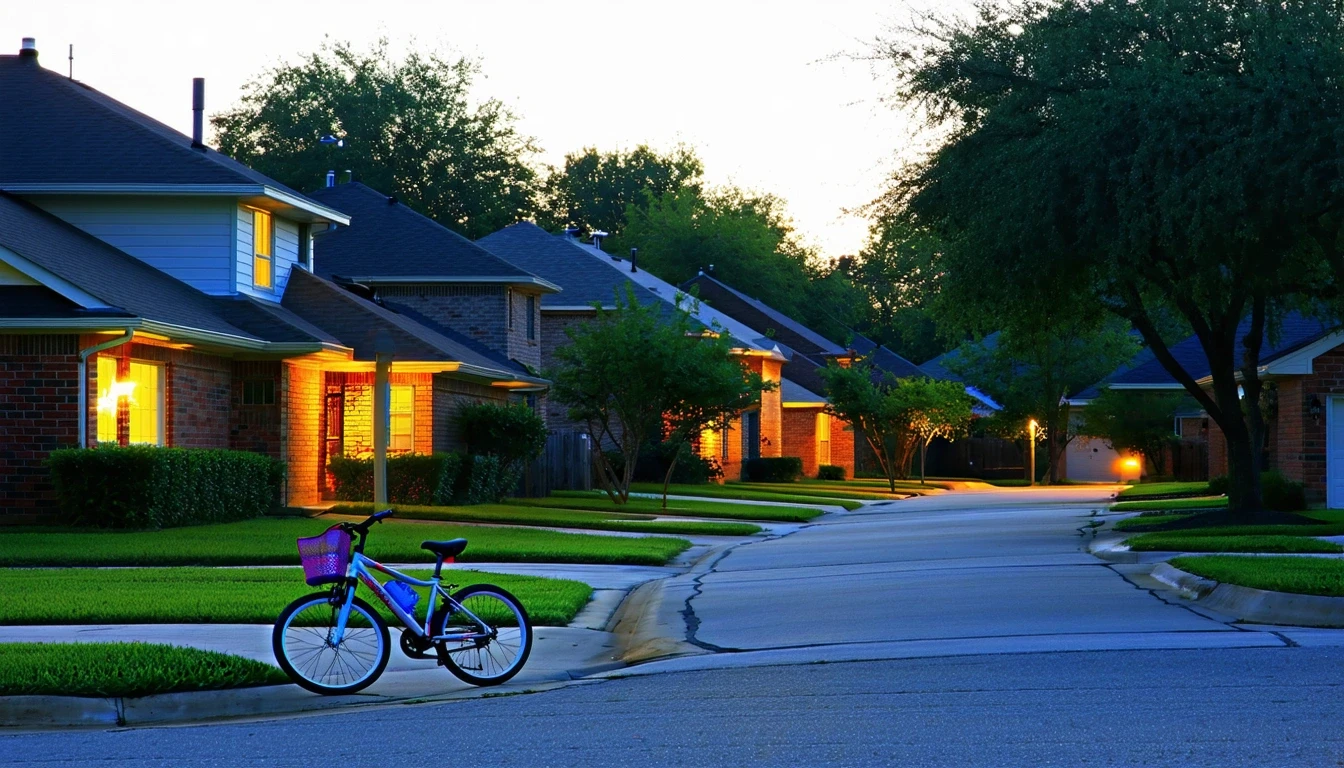
The Housing Market in Lewisville Today
Lewisville sits in the northern Dallas metro corridor, where housing costs reflect both suburban accessibility and proximity to regional employment centers. The median home value of $328,300 positions the city in a mid-tier range—not the most expensive option in the metro, but priced above purely outlying communities. This reflects Lewisville’s functional role: it offers rail transit access, mixed commercial and residential development, and infrastructure that supports both commuters and local employment.
What newcomers often misunderstand is that Lewisville’s housing market isn’t uniform. The city contains walkable pockets with higher pedestrian-to-road ratios and corridor-clustered grocery and food access, meaning location choice within Lewisville significantly affects daily logistics. Choosing a home near transit or commercial corridors changes the cost experience—not just in commute time, but in how often you need a second vehicle, how far you drive for errands, and how much time you spend managing household tasks.
The regional price parity index of 118 indicates that goods and services cost about 18% more here than the national baseline. This affects not just housing, but everything tied to it: maintenance labor, utilities, and the services that make homeownership manageable. The housing market here isn’t shaped by a single factor—it’s the intersection of metro access, local infrastructure, and Texas-specific cost structures like property taxation.
Renting in Lewisville
The median gross rent in Lewisville is $1,455 per month. Against a median household income of $82,006 per year, this represents a moderate but noticeable share of gross income. Renters here face the same pressure found across the Dallas metro: rental stock is available, but competition for units near transit, walkable areas, or strong school access tightens quickly.
Lewisville’s rail presence matters more for renters than many realize. Households that can position themselves near a station reduce car dependency, which lowers transportation costs and creates flexibility in household logistics. But rental units near transit or within the city’s walkable pockets often command a premium, and availability fluctuates with broader metro demand cycles.
Renters also avoid property tax exposure entirely, which in Texas is a significant structural difference. While rent renewals can be volatile, they don’t carry the same long-term escalation risk as property tax reassessments. For households prioritizing mobility, lower upfront costs, or uncertainty about long-term plans, renting in Lewisville offers predictability in responsibilities even if monthly costs feel high relative to income.
Owning a Home in Lewisville
The median home value of $328,300 reflects a market where ownership is accessible to middle-income households, but only if they account for the full cost structure. In Texas, property taxes replace state income tax as a primary revenue mechanism, meaning homeowners face annual tax bills that rise with assessed values. Lewisville homeowners must plan for this exposure—it’s not a one-time cost or a fixed percentage, and it compounds over time as home values appreciate.
Ownership in Lewisville also means managing maintenance and utilities in a climate dominated by extended cooling seasons. Homes here run air conditioning from late spring through early fall, and older housing stock or poorly insulated builds amplify electricity consumption. The electricity rate of 15.69¢/kWh is moderate, but usage intensity drives total exposure. Homeowners control when and how they upgrade insulation, HVAC systems, or windows—renters don’t.
Governance structures vary widely. Some neighborhoods operate under homeowners associations with monthly or annual fees that cover landscaping, amenities, or exterior maintenance. Others leave all upkeep to the owner. This isn’t a minor distinction—it changes both monthly cash flow and long-term responsibility. Buyers must verify governance terms before closing, because assumptions about “typical” suburban HOA costs don’t hold uniformly across Lewisville’s development patterns.
Apartment vs House in Lewisville — Cost Behavior Comparison
| Expense Category | Apartment | House |
|---|---|---|
| Property Tax Exposure | None (embedded in rent, but landlord manages reassessment risk) | Direct annual liability; rises with assessed value over time |
| Cooling Season Utility Load | Lower square footage and shared wall insulation reduce total kWh consumption | Larger conditioned space and often older HVAC systems increase summer electricity costs |
| Exterior Maintenance | Managed by property; no direct cost or time burden | Owner responsibility; includes roof, siding, landscaping, and storm damage repair |
| Governance and Amenity Fees | Included in rent; may cover pool, fitness, or parking | Optional HOA fees if applicable; vary widely by neighborhood and cover different services |
| Transit and Walkability Access | More likely to be located near rail or commercial corridors due to density patterns | More dispersed; access to walkable areas or transit requires intentional location choice |
Why these categories: The table reflects cost distinctions that vary meaningfully in Lewisville due to Texas property tax structure, extended cooling seasons, mixed development patterns, and the presence of rail transit. Categories like basic utilities or internet service were omitted because they don’t differ structurally between housing types in this city. The differences shown are driven by Lewisville’s climate, governance fragmentation, and infrastructure layout—not generic apartment-versus-house assumptions.
Utilities & Upkeep Differences
Lewisville’s extended cooling season dominates household utility exposure. Apartments benefit from smaller square footage and shared-wall insulation, which reduces the total conditioned space. Houses, especially older single-family builds, often have larger floor plans, vaulted ceilings, and aging HVAC systems that cycle more frequently during triple-digit summer heat. The electricity rate is moderate, but consumption intensity is what drives bills—and houses face higher intensity by design.
Natural gas usage in Lewisville is minimal outside of heating appliances and water heaters. Winters are mild, with only occasional cold snaps, so heating costs remain a minor factor compared to cooling. Homeowners with gas heating may see noticeable bills during rare freezing periods, but these are short-lived. Apartment dwellers often have electric heating or benefit from building-wide systems that distribute load more evenly.
Exterior maintenance is where ownership diverges sharply. Texas weather includes intense sun exposure, occasional hail, and heavy summer storms. Roofs, siding, and fencing degrade faster here than in milder climates, and replacement costs are significant. Homeowners also manage landscaping in a climate where irrigation is often necessary to maintain yards during dry summer months. Apartments transfer all of this responsibility to property management, which simplifies budgeting and eliminates surprise repair costs.
Rent vs Buy: Long-Term Exposure in Lewisville
Renting and owning represent different risk profiles, not just different monthly costs. Renters face renewal volatility—landlords can raise rent annually, and those increases are difficult to predict. But renters avoid property tax escalation, major repair costs, and the long-term responsibility of maintaining a structure in a climate that stresses building materials. When market conditions shift, renters can relocate without selling an asset or absorbing transaction costs.
Homeowners gain cost control in some areas but accept exposure in others. Property taxes in Texas rise with assessed home values, and those reassessments happen regularly. Homeowners can’t avoid this; they can appeal assessments, but the structural trend is upward as the city and metro grow. Maintenance costs also compound—roofs, HVAC systems, and water heaters have finite lifespans, and replacement timing is often dictated by failure rather than convenience.
Ownership does create stability in housing costs that aren’t tied to market rent cycles. A fixed-rate mortgage payment doesn’t change, and homeowners control when and how they invest in efficiency upgrades, landscaping, or improvements. This control matters most for households planning to stay long enough that upfront transaction costs and ongoing tax exposure are offset by avoiding rent increases and building equity. But that calculus depends entirely on household income stability, job mobility, and tolerance for maintenance risk.
The decision isn’t about which option costs less in year one—it’s about which cost structure aligns with your household’s time horizon, income predictability, and willingness to manage long-term exposure.
FAQs About Housing Costs in Lewisville
Is Lewisville affordable for first-time homebuyers?
The median home value of $328,300 is accessible for middle-income households, but affordability depends on understanding total ownership costs. Property taxes, insurance, and maintenance add significant annual expenses beyond the mortgage payment. First-time buyers should verify tax rates, HOA obligations, and utility exposure before committing, because those costs vary widely by neighborhood and housing age.
How does renting in Lewisville compare to nearby cities?
Lewisville’s median rent of $1,455 per month reflects its position in the northern Dallas metro corridor. It’s not the cheapest option, but it offers rail transit access and mixed development that some outlying suburbs lack. Renters paying similar amounts in cities without transit or walkable pockets face higher transportation costs, which offsets any nominal rent savings.
Do all Lewisville neighborhoods have HOA fees?
No. Governance structures vary widely across Lewisville’s housing stock. Some neighborhoods have mandatory HOAs with monthly fees covering landscaping, amenities, or exterior maintenance. Others have no HOA at all, leaving all responsibilities to the homeowner. Buyers must verify governance terms for each property individually—there’s no city-wide standard.
What drives utility costs higher in Lewisville homes?
Cooling season intensity is the dominant factor. Lewisville experiences extended summer heat, and homes with larger square footage, older HVAC systems, or poor insulation consume significantly more electricity. The electricity rate is moderate, but total bills are driven by usage, not price per kilowatt-hour. Homeowners can reduce exposure through insulation upgrades, programmable thermostats, and HVAC maintenance, but those require upfront investment.
Should I rent or buy in Lewisville if I’m relocating for work?
If your job stability or long-term plans are uncertain, renting reduces risk. Selling a home in Texas involves transaction costs, and property tax exposure begins immediately upon purchase. Renting allows you to learn Lewisville’s neighborhood differences—transit access, school quality, walkability—before committing to a location. Ownership makes sense when you’re confident in both your timeline and your ability to absorb maintenance and tax costs over multiple years.
Making Housing Choices in Lewisville
Housing costs in Lewisville are shaped by the city’s position in the Dallas metro, its mixed infrastructure, and Texas-specific cost structures like property taxation. The median home value of $328,300 and median rent of $1,455 per month reflect a market where both options are accessible to middle-income households, but each carries distinct long-term exposure.
Renters avoid property tax risk and maintenance responsibility but face renewal volatility and limited control over housing stability. Homeowners gain cost predictability in some areas but accept ongoing exposure to taxes, repairs, and climate-driven utility intensity. The right choice depends on your household’s time horizon, income stability, and willingness to manage long-term responsibilities.
Location within Lewisville matters as much as housing type. Proximity to rail transit, walkable commercial corridors, and strong playground or school infrastructure changes daily logistics and long-term costs. Households that prioritize access to these features will find them, but they’re not uniformly distributed across the city.
For a broader view of how housing costs fit into Lewisville’s overall expense structure, or to understand where housing sits within a typical monthly budget, explore the related guides. And if you’re planning a move to Lewisville, understanding the logistics and costs of relocating can help you manage the transition more effectively.
How this article was built: In addition to public economic data, this article incorporates location-based experiential signals derived from anonymized geographic patterns—such as access density, walkability, and land-use mix—to reflect how day-to-day living actually feels in Lewisville, TX.