
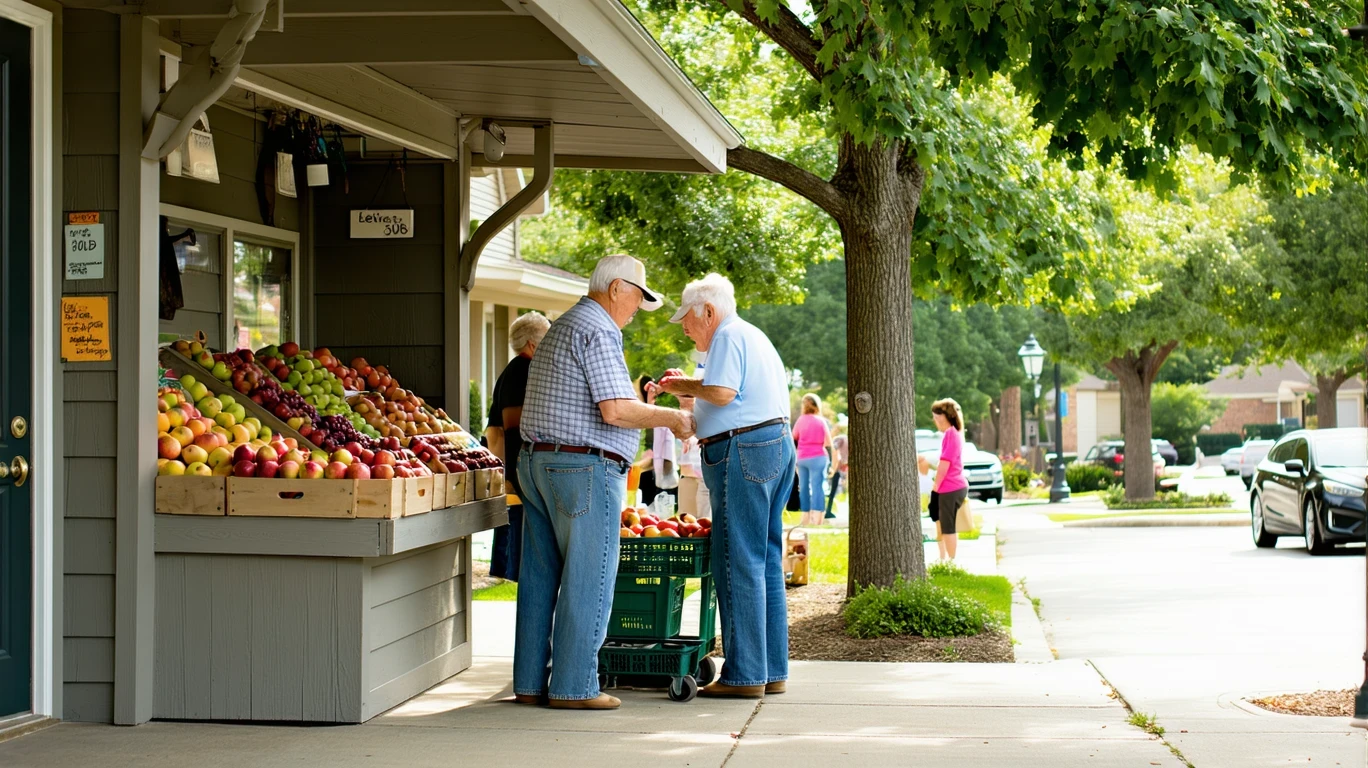
How Grocery Costs Feel in Lewisville
Grocery prices in Lewisville reflect the city’s position within the Dallas metro area, where regional price parity sits at 118—meaning the cost of goods and services runs roughly 18% above the national baseline. That upward pressure shows up clearly in staple food prices, from dairy and protein to pantry basics. For households earning near the city’s median income of $82,006 per year, groceries represent a noticeable but manageable share of monthly spending. The pressure becomes more acute for single-income households, families with children, or anyone living below that median threshold.
Unlike housing or utilities, grocery costs don’t arrive as a single monthly bill. They accumulate across weekly trips, impulse purchases, and the gap between discount and premium store tiers. In Lewisville, food and grocery establishments cluster along commercial corridors rather than spreading evenly across neighborhoods. That spatial pattern—confirmed by local accessibility signals—means not every household enjoys the same proximity to low-price options. Store choice becomes a deliberate cost lever, not a convenience decision.
Singles and couples without children tend to notice grocery price variation most acutely on a per-capita basis. A $2 difference in ground beef or a $1 swing in cheese adds up faster when you’re shopping for one or two. Families, by contrast, face higher absolute spending but gain more leverage from bulk purchasing and meal planning—if they have access to stores that reward volume. Across all household types, the combination of regional price pressure and corridor-based store distribution makes grocery spending in Lewisville more sensitive to behavior and location than in cities with denser, more evenly distributed food retail.
Grocery Price Signals (Illustrative)
The table below shows derived price estimates for common staple items in Lewisville, adjusted for regional cost structure. These figures illustrate how staple items tend to compare locally—not a complete shopping list or a guarantee of what any single store charges on any given week.
Derived estimate based on national baseline adjusted by regional price parity; not an observed local price.
| Item | Price |
|---|---|
| Bread | $2.18/lb |
| Cheese | $5.52/lb |
| Chicken | $2.42/lb |
| Eggs | $2.95/dozen |
| Ground Beef | $7.95/lb |
| Milk | $4.75/half-gallon |
| Rice | $1.27/lb |
Ground beef and cheese represent the highest per-pound costs among everyday staples, while rice and bread anchor the lower end. Protein and dairy drive the largest share of weekly grocery variance. Households that rely heavily on meat-based meals or fresh dairy will feel regional price pressure more than those who build meals around grains, beans, and seasonal produce. The gap between the most and least expensive staples widens when you compare discount chains to premium or specialty grocers.
These price signals don’t account for sales, loyalty programs, or weekly promotions—all of which introduce meaningful variability. A shopper who tracks circulars and rotates protein purchases around markdowns can reduce effective costs substantially. Conversely, a household that shops reactively or prioritizes convenience over price will experience the higher end of the range consistently. In Lewisville, where food retail clusters along corridors rather than spreading uniformly, the ability to comparison-shop or visit multiple stores in a single trip depends heavily on where you live and how much time you can allocate to errands.
Store Choice & Price Sensitivity
Grocery price pressure in Lewisville varies significantly by store tier, and understanding that variation matters more than chasing a single “average” price. Discount-tier grocers—typically no-frills chains focused on private-label goods and high-volume turnover—offer the lowest baseline prices on staples. Mid-tier stores provide broader selection, national brands, and more service but charge a premium for that convenience. Premium grocers emphasize organic options, prepared foods, and specialty items, with prices that reflect both product differentiation and store experience.
For a household shopping exclusively at a discount chain, the regional price index of 118 may feel less burdensome. Staples like rice, beans, eggs, and store-brand dairy remain accessible even on a constrained budget. The same household shopping at a premium grocer could see effective costs rise 20–30% or more on identical categories, driven by brand positioning and product mix rather than underlying commodity prices. Mid-tier stores occupy the middle ground, offering familiarity and convenience at a moderate markup over discount options.
In Lewisville, where grocery access concentrates along commercial corridors, the ability to choose between tiers depends on proximity, transportation, and time. A household with a car and flexible schedule can optimize across stores—buying bulk staples at a discount chain, filling in fresh produce at a mid-tier grocer, and occasionally visiting a premium store for specific items. A household relying on transit or constrained by work schedules may default to the nearest option, regardless of tier. That structural difference turns store choice from a simple preference into a meaningful cost determinant, especially for families or anyone shopping on a fixed income.
What Drives Grocery Pressure Here
The regional price parity index of 118 reflects broader cost structure across the Dallas metro area, not just food retail. Housing, labor, and distribution costs all feed into the prices grocers charge. Lewisville sits within a high-demand metro where land values, wages, and logistics networks run above the national average. Those upstream costs show up in checkout totals, even for commodity items like milk, eggs, and bread.
Household size amplifies grocery pressure in predictable ways. A single person might spend less in absolute terms but faces higher per-capita costs and less ability to benefit from bulk pricing. A family of four or five encounters the opposite problem: lower per-person costs through volume purchasing, but much higher weekly totals and greater exposure to price swings in high-cost categories like meat and dairy. For families earning below the median household income of $82,006, grocery spending competes directly with housing pressure, utilities, and transportation—categories that don’t flex downward easily.
Seasonal variability also plays a role, though it operates more subtly than utility bills or fuel costs. Produce prices shift with growing seasons and weather disruptions. Protein costs fluctuate with feed prices and supply chain conditions. Holiday periods introduce temporary demand spikes. These patterns don’t follow a rigid calendar, but they do create windows where careful shoppers can reduce costs by shifting meal plans toward whatever’s abundant and competitively priced. Households that cook from scratch and adapt menus seasonally gain more control over grocery totals than those committed to fixed meal routines or convenience-focused purchasing.
Practical Ways People Manage Grocery Costs
Meal planning remains the most effective behavioral lever for controlling grocery spending. Households that plan a week’s worth of meals before shopping avoid impulse purchases, reduce waste, and buy only what they’ll actually use. Planning also enables smarter use of sales and bulk pricing—stocking up on shelf-stable staples when prices drop, rather than paying full price out of necessity. In a city where grocery access clusters along corridors, planning reduces the need for multiple mid-week trips, saving both time and fuel.
Store loyalty programs and digital coupons offer another layer of control, though they require consistent engagement. Many grocers now offer app-based discounts, personalized offers, and fuel rewards tied to purchase volume. Households willing to track these programs and consolidate spending at one or two chains can lower effective costs without changing what they buy. The tradeoff is time and attention—clipping digital coupons, reviewing weekly ads, and timing purchases around promotion cycles. For some households, that effort pays off; for others, the convenience cost outweighs the savings.
Cooking from scratch and minimizing prepared or pre-packaged foods reduces per-meal costs substantially, though it demands more kitchen time and skill. A household that buys whole chickens, dried beans, and bulk grains will spend far less than one relying on rotisserie chicken, canned beans, and instant rice. The gap widens further when comparing home-cooked meals to frozen dinners or meal kits. The calculus isn’t purely financial—time, energy, and cooking confidence all matter—but for households with the capacity to cook regularly, the cost difference is significant and sustained.
Groceries vs Eating Out (Directional)
The tradeoff between grocery spending and restaurant meals shapes household budgets in ways that extend beyond simple cost comparison. Cooking at home almost always costs less per meal than eating out, but the gap varies by restaurant type and household cooking habits. A family that prepares meals from staple ingredients will spend a fraction of what they’d pay for equivalent restaurant portions. A single person or couple buying premium prepared foods from a grocer may find the cost difference narrower, especially when comparing to fast-casual or quick-service dining.
In Lewisville, where food establishments cluster along commercial corridors, dining out often competes with grocery shopping for both time and money. A household working long hours or managing complex schedules may default to restaurant meals or takeout not because they prefer it, but because grocery shopping, meal prep, and cooking demand time they don’t have. The financial impact accumulates quickly—what feels like an occasional convenience becomes a structural budget pressure when repeated multiple times per week.
Households that treat dining out as a deliberate choice rather than a default gain more control over total food spending. Reserving restaurant meals for weekends or special occasions, while committing to home cooking during the week, creates a clear boundary that prevents cost creep. The inverse pattern—frequent takeout supplemented by occasional grocery trips—tends to produce the highest combined food costs, because it captures the expense of dining out without fully leveraging the efficiency of home cooking.
FAQs About Grocery Costs in Lewisville (2026)
Is it cheaper to shop in bulk in Lewisville? Bulk purchasing lowers per-unit costs on shelf-stable staples like rice, beans, canned goods, and household items, but only if you have storage space and can use the volume before expiration. Families and multi-person households benefit most; singles may find bulk buying creates waste unless they focus on non-perishables.
Which stores in Lewisville are best for low prices? Discount-tier grocers focused on private-label goods and high-volume turnover offer the lowest baseline prices. Mid-tier stores provide broader selection and national brands at a moderate premium, while premium grocers emphasize organic and specialty items at higher price points. Store choice depends on proximity, transportation, and willingness to trade convenience for cost.
How much more do organic items cost in Lewisville? Organic products typically carry a premium over conventional equivalents, with the gap widening on fresh produce, dairy, and meat. The exact difference varies by store tier and product category, but households prioritizing organic goods should expect meaningfully higher grocery totals unless they focus selectively on high-impact categories.
How do grocery costs for two adults in Lewisville tend to compare to nearby cities? Lewisville’s regional price parity of 118 places it above the national baseline, consistent with the broader Dallas metro cost structure. Nearby cities within the metro area face similar upward pressure, though local store competition and accessibility patterns introduce variation. Comparing across metros requires looking at both price indices and household income levels.
How do households in Lewisville think about grocery spending when cooking at home? Households that cook from scratch and plan meals around staple ingredients experience lower per-meal costs and greater control over weekly totals. Those relying on convenience foods, prepared items, or frequent restaurant supplementation face higher combined food costs. The tradeoff between time, skill, and money shapes how each household navigates grocery pressure.
Does shopping at multiple stores save money in Lewisville? Splitting purchases across a discount chain for staples, a mid-tier grocer for fresh items, and occasional premium store visits for specialty goods can lower total costs, but only if the time and fuel required for multiple trips don’t offset the savings. Households with flexible schedules and reliable transportation gain the most from multi-store strategies.
How does seasonal produce affect grocery costs in Lewisville? Produce prices fluctuate with growing seasons, weather conditions, and supply chain dynamics. Households that adapt meal plans to favor in-season fruits and vegetables can reduce costs and improve quality. Sticking to fixed shopping lists year-round means paying premium prices during off-seasons.
How Groceries Fit Into the Cost of Living in Lewisville
Grocery spending occupies a distinct position within household budgets—less rigid than housing or utilities, but more essential than discretionary categories. Unlike rent or mortgage payments, which arrive as a fixed monthly obligation, grocery costs flex based on behavior, store choice, and meal planning discipline. That flexibility creates opportunity for households willing to engage actively, but it also introduces variability that can destabilize budgets if left unmanaged.
In Lewisville, where the regional price index of 118 pushes costs above the national baseline, groceries interact with other expense categories in ways that matter for overall affordability. A household stretched thin by housing costs or utility bills has less room to absorb grocery price swings. Conversely, a household with manageable housing expenses and stable income can treat grocery spending as a controllable variable, adjusting quality, variety, and convenience based on financial priorities. The interplay between fixed and flexible costs determines how much pressure any single category exerts.
For a complete picture of how grocery costs fit within monthly household expenses—including housing, utilities, transportation, and other essentials—see the detailed breakdown in Your Monthly Budget in Lewisville: Where It Breaks. That resource provides the full cost structure and helps clarify where grocery spending ranks relative to other financial demands. Understanding groceries in isolation is useful; understanding them within the broader budget is essential for making confident decisions about where to live and how to allocate resources.
How this article was built: In addition to public economic data, this article incorporates location-based experiential signals derived from anonymized geographic patterns—such as access density, walkability, and land-use mix—to reflect how day-to-day living actually feels in Lewisville, TX.