
“Poway feels like the kind of place where you know your neighbors’ dogs’ names but have to drive 15 minutes to find decent Thai food.”
That tension—between suburban comfort and urban convenience—sits at the heart of what living in Poway actually feels like. This isn’t a city where people casually stumble into happiness or frustration. It’s a place that rewards specific priorities and quietly penalizes others, and the emotional fit depends almost entirely on what you’re optimizing for.
Poway tends to work beautifully for families who want safety, space, and a planned community aesthetic. It tends to frustrate young professionals craving spontaneity, walkable variety, and the kind of density that makes errands feel effortless. Understanding which camp you fall into matters more than any ranking or reputation ever could.
What Poway’s Emotional Landscape Actually Feels Like
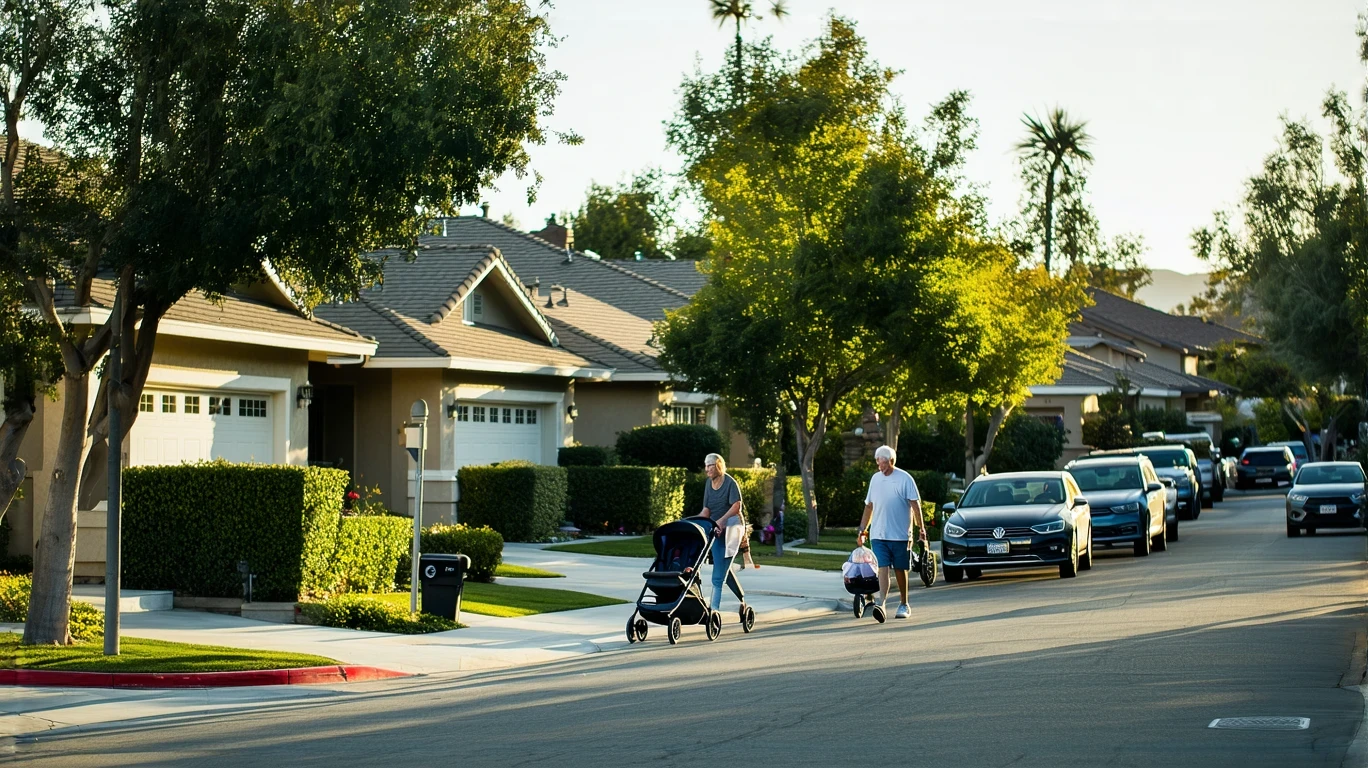
Poway carries the emotional signature of a carefully planned suburban community that takes pride in what it’s built—and protective of what it isn’t. The vibe skews family-oriented, orderly, and deliberately paced. People who love it here tend to describe a sense of intentional refuge: a place where kids can bike around the neighborhood, where parks feel accessible without being crowded, and where the trade-off for peace is accepting that you’ll drive to most things.
The city’s structure reflects this. Food and grocery options cluster along certain corridors rather than spreading evenly across neighborhoods, which means some residents enjoy walkable errands while others plan their weeks around car trips. Pedestrian infrastructure exists in pockets—enough to make some areas feel pleasantly strollable, but not enough to eliminate car dependency for most households. Rail transit is present, offering a lifeline for those who need it, but the day-to-day rhythm here still leans heavily on personal vehicles.
What tends to feel rewarding: the blend of suburban quiet with enough amenities to avoid feeling completely isolated. Parks are woven into the community, playgrounds show up consistently, and a hospital presence means you’re not driving to the next city for urgent care. The building character mixes low-rise residential with some vertical variety, and land use integrates residential and commercial spaces in ways that feel planned rather than haphazard.
What tends to feel limiting: the friction of getting to the things you want when they’re not in your immediate corridor. If your favorite coffee shop, gym, or grocery store isn’t along your usual route, the errand becomes a deliberate outing rather than a casual stop. For people used to urban density where options layer on top of each other, Poway can feel like it requires more logistical forethought than they’d prefer.
The Buzz on Social Media: Pride, Protectiveness, and Practical Complaints
Poway’s online conversation tends to split along predictable lines: longtime residents defending the community’s character, newcomers adjusting expectations, and everyone debating whether the tradeoffs still pencil out given the cost of entry.
On neighborhood Facebook groups and local Reddit threads, you’ll find recurring themes around maintaining the “small-town feel” even as growth pressures mount. There’s pride in local schools, frustration with traffic during peak hours, and ongoing discussion about whether new development enhances or dilutes what people moved here for.
“We moved here for the schools and the safety, and we got exactly that. But I didn’t realize how much I’d miss being able to walk to a bookstore or grab dinner without planning it like an expedition.”
“Poway is what you make of it. If you want community events and parks and a place where your kids can roam, it delivers. If you want nightlife or walkable urban energy, you’re in the wrong zip code.”
“The cost of housing here is wild for what you get. Yes, it’s safe and clean, but you’re paying a premium for suburban predictability, and that’s not everyone’s priority.”
The tone isn’t bitter, but it’s realistic. People recognize they’re paying for a specific lifestyle package, and the emotional fit depends on whether that package aligns with what they actually want day-to-day.
How Local Coverage Frames the City
Local news and community coverage tend to frame Poway through the lens of growth management, identity preservation, and the ongoing negotiation between maintaining character and accommodating change. The stories aren’t about dramatic incidents—they’re about the slower, quieter questions that shape how a place evolves.
Typical coverage themes include:
- “Community Debates What Growth Should Look Like” — ongoing tension between development and preservation
- “New Amenities Arrive as Town Identity Evolves” — retail and dining additions that shift convenience without transforming character
- “Residents Weigh Convenience vs Quiet” — the tradeoff between accessibility and suburban pace
- “Local Events Draw Families to Downtown Corridor” — emphasis on community-building through organized gatherings
- “Housing Costs Shape Who Can Afford to Stay” — acknowledgment that affordability pressures affect long-term residents and newcomers alike
The framing reflects a community that’s self-aware about its tradeoffs and protective of what it values, even as economic realities reshape who can participate.
What Review Platforms Reveal About Expectations
Public reviews of Poway—whether on Google, Yelp, or neighborhood platforms—tend to reveal more about expectation matching than objective quality. People who wanted suburban comfort tend to praise exactly what they got. People who hoped for urban texture tend to feel let down by what’s missing.
Common praise:
- Safe, clean, family-friendly with good schools
- Parks and playgrounds well-maintained and accessible
- Quieter pace without feeling completely remote
- Strong sense of community among neighbors
Common complaints:
- Limited dining and entertainment variety
- Car dependency for most errands
- High cost of entry relative to amenities
- Lack of spontaneous walkable experiences
Neighborhood variation exists but tends to be subtle—newer planned areas skew toward uniform aesthetics and HOA-managed landscaping, while older pockets offer slightly more character and variability. Neither is objectively better; they just appeal to different sensibilities.
The recurring theme: Poway delivers predictably on what it promises (safety, schools, suburban order) and predictably underdelivers on what it doesn’t (density, variety, walkable spontaneity). Emotional satisfaction hinges on which side of that equation matters more to you.
How Poway Compares to Nearby Alternatives
| Dimension | Poway | Escondido | Carlsbad |
|---|---|---|---|
| Overall Vibe | Planned suburban refuge, family-first | More urban texture, mixed income, grittier edges | Coastal polish, resort-town feel, higher price floor |
| Walkability | Pockets exist, mostly car-dependent | Denser downtown core, better pedestrian flow | Village areas walkable, beach access adds appeal |
| Dining & Variety | Functional but limited, corridor-clustered | Broader variety, more casual and ethnic options | Upscale dining, coastal cuisine, tourist-oriented |
| Community Feel | Tight-knit, protective, organized events | Diverse, less cohesive, more independent vibe | Polished, resort-adjacent, transient population mix |
| Cost Pressure | High entry, suburban premium | More accessible, wider range of housing stock | Coastal premium, highest cost floor of three |
If you prioritize family infrastructure and suburban predictability over spontaneity, Poway likely fits better than Escondido. If you want coastal access and don’t mind paying for polish, Carlsbad pulls ahead. If you need more walkable density and dining variety without coastal prices, Escondido offers a grittier but more textured alternative.
None of these cities is objectively “better.” They reward different priorities, and the right choice depends entirely on what friction you’re willing to tolerate and what rewards you’re actually chasing.
What Locals Are Actually Saying
“We’ve been here eight years, raised two kids, and honestly can’t imagine leaving. Yes, we drive everywhere. Yes, it’s expensive. But our kids walk to school, we know our neighbors, and I don’t worry when they’re playing outside. That peace of mind is worth the tradeoffs.”
— Long-time family, north Poway
“I moved here thinking it would feel like a smaller San Diego with better schools. It does, but I underestimated how much I’d miss the energy of a walkable neighborhood. Everything here requires a plan and a car, and that gets exhausting.”
— Young professional, remote worker
“Poway is perfect if you’re in the life stage where you want structure, safety, and a place that feels like it’s ‘for families.’ If you’re looking for nightlife, walkable coffee shops, or spontaneous anything, you’ll feel like you’re constantly driving to find it.”
— Parent of teens, considering staying long-term
“The cost of housing pressure here is rough. We’re paying a lot for a very specific kind of suburban experience, and I’m not sure it’s sustainable for us long-term. The schools are great, but we’re stretched thin.”
— Newer family, renting
“I love that Poway has parks, trails, and open space. It’s not crammed with people, and you can actually breathe. But if you want variety in restaurants or things to do, you’re heading to the coast or into the city.”
— Retiree, downsized from larger home
“It’s a trade-off city. You get safety and schools and a kind of old-fashioned neighborhood vibe. You give up convenience, walkability, and the kind of spontaneous lifestyle you’d get closer to downtown San Diego. Know what you’re trading before you commit.”
— Mid-career couple, no kids
“Poway feels like it was designed for a very specific kind of household, and if that’s you, it’s great. If it’s not, you’ll constantly feel like you’re working around the city instead of with it.”
— Single professional, considering moving
Does Poway Feel Like a Good Fit?
Poway doesn’t ask you to love everything about it. It asks whether you’re willing to accept car dependency, corridor-clustered errands, and limited spontaneous variety in exchange for safety, family infrastructure, and suburban predictability.
This tends to work beautifully for families in the stage where schools, parks, and neighborhood cohesion matter more than walkable nightlife. It tends to frustrate people who want urban texture, dense amenity layers, or the ability to run errands on foot without planning.
The city’s structure—walkable pockets rather than uniform walkability, rail present but car-dominant, amenities clustered rather than distributed—means your day-to-day experience will vary significantly depending on where you live and what you prioritize. Some households find the rhythm intuitive and rewarding. Others find it logistically exhausting.
If you’re considering Poway, the question isn’t whether it’s a “happy” place in the abstract. The question is whether the specific tradeoffs it offers align with the life you’re actually trying to live. The city delivers predictably on what it promises and predictably underdelivers on what it doesn’t. Emotional fit comes from knowing which side of that equation matters more to you.
For a clearer sense of how the financial side shapes daily decisions, explore monthly spending patterns or dig into what makes life feel tight or spacious depending on your household type.
How this article was built: In addition to public economic data, this article incorporates location-based experiential signals derived from anonymized geographic patterns—such as access density, walkability, and land-use mix—to reflect how day-to-day living actually feels in Poway, CA.
The perspectives shown reflect commonly expressed local sentiment and recurring themes in public discussion, rather than individual accounts.