
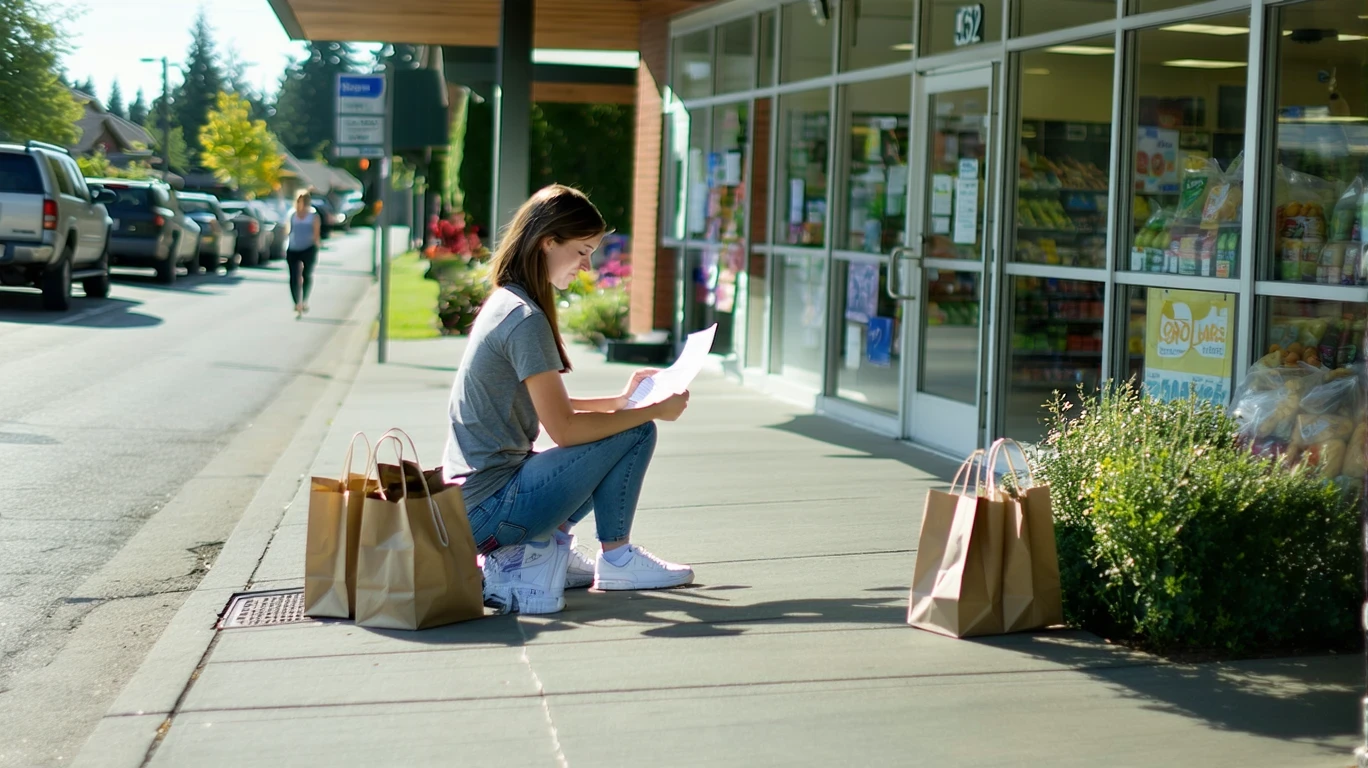
How Grocery Costs Feel in Sherwood
Grocery prices in Sherwood sit noticeably above the national baseline, shaped by the Portland metro’s higher regional price environment and the city’s suburban positioning. With a regional price parity index of 125, everyday staples—bread, eggs, chicken, dairy—carry a premium that becomes visible quickly for households managing tight food budgets. This isn’t about luxury or specialty items; it’s the foundational cost of feeding a family or stocking a kitchen that runs higher here than in much of the country. For families with children or single-income households, that difference compounds across weekly shopping trips, making grocery spending one of the more persistent sources of cost structure pressure in Sherwood.
The intensity of grocery cost pressure varies sharply by household composition. Singles and couples without children often absorb the higher prices without major lifestyle disruption, especially when median household income sits at $109,770 per year. But larger families—particularly those with multiple children or single parents managing on one income—feel the squeeze more acutely. Every additional mouth to feed multiplies the impact of elevated staple prices, and the gap between what groceries cost here versus what they cost in lower-price regions becomes a recurring budget challenge. It’s not that food is unaffordable in absolute terms; it’s that the margin for flexibility shrinks faster for households where grocery spending scales with size.
What makes Sherwood’s grocery environment distinct is the combination of suburban density and access to both chain retailers and smaller local markets. The city’s broadly accessible food establishment network—supported by high food and grocery density across the area—means residents aren’t forced into a single shopping pattern. That access creates opportunity for price sensitivity to translate into real savings, but it also means that grocery costs aren’t uniform across all shoppers. Where you shop, how often you shop, and whether you’re willing to drive a bit farther for lower prices all shape the actual cost experience more than any single average price point can capture.
Grocery Price Signals (Illustrative)
The table below offers a snapshot of how staple grocery items tend to compare locally, based on regional price adjustments. These aren’t checkout-accurate prices or a complete shopping list—they’re illustrative anchors that help explain why grocery bills in Sherwood run higher than in many other parts of the country. The prices reflect typical positioning for common items, not weekly or monthly totals, and they’re meant to show relative cost pressure rather than simulate an actual cart.
| Item | Typical Price |
|---|---|
| Bread (per pound) | $2.26/lb |
| Cheese (per pound) | $5.98/lb |
| Chicken (per pound) | $2.54/lb |
| Eggs (per dozen) | $2.93/dozen |
| Ground beef (per pound) | $8.38/lb |
| Milk (per half-gallon) | $5.08/half-gallon |
| Rice (per pound) | $1.33/lb |
Derived estimate based on national baseline adjusted by regional price parity; not an observed local price.
Ground beef at over eight dollars per pound and milk approaching five dollars per half-gallon illustrate the kind of pricing that makes meal planning more expensive in Sherwood, especially for protein-heavy diets or households that go through dairy quickly. Chicken remains more accessible, but even at mid-two-dollar pricing per pound, it’s still elevated compared to lower-cost regions. Eggs and bread sit in a middle zone—not shockingly high, but enough above national averages that they contribute to the cumulative pressure families feel when restocking basics week after week. Rice, as a shelf-stable staple, offers relative affordability, but it doesn’t offset the higher cost of perishable proteins and dairy that drive most household grocery spending.
These prices don’t account for organic premiums, specialty diets, or prepared foods, all of which layer additional cost on top of these baselines. For households managing food allergies, dietary restrictions, or preferences for organic or locally sourced items, the starting point is already elevated, and the premium for specialty products compounds from there. The illustrative pricing here is useful for understanding the floor, not the ceiling, of grocery costs in Sherwood.
Store Choice & Price Sensitivity
Grocery cost pressure in Sherwood varies significantly by store tier, and understanding that variation is essential for managing food spending effectively. Discount-tier grocers—chains focused on no-frills layouts, limited selection, and private-label dominance—offer the lowest baseline prices and the tightest margins. These stores strip out convenience and ambiance in exchange for lower per-item costs, and for households where every dollar of grocery spending matters, they provide the most direct path to reducing food bills. Mid-tier grocers balance price and selection, offering broader product variety, better produce quality, and more name-brand options, but at a noticeable markup over discount stores. Premium grocers—whether focused on organic, specialty, or prepared foods—command the highest prices, and while they deliver quality and convenience, they’re not designed for cost-conscious shopping.
The difference between shopping at a discount grocer versus a premium grocer in Sherwood isn’t trivial. A household committed to discount-tier shopping can often cut grocery spending by a meaningful margin compared to one that defaults to premium stores, even when buying similar staples. That gap widens further when factoring in store brands versus name brands, sale timing, and bulk purchasing. For families with children or single-income households, store choice isn’t just about preference—it’s one of the most controllable levers in the grocery budget. Singles and high-income couples may not notice the difference as acutely, but for larger households or those managing tighter margins, the tier of store becomes a structural decision that shapes monthly spending.
Sherwood’s access to multiple grocery options—supported by high food and grocery establishment density—means residents aren’t locked into a single store tier by geography. That access creates real opportunity for price-sensitive shoppers to optimize, but it also requires intentionality. Driving a bit farther to reach a discount grocer or timing trips around sales cycles takes effort, and not all households have the time, transportation flexibility, or storage capacity to take full advantage. The result is that grocery costs in Sherwood aren’t uniform—they’re shaped as much by household behavior and store choice as by the underlying price environment.
What Drives Grocery Pressure Here
The primary driver of grocery cost pressure in Sherwood is the regional price environment, reflected in the 125 regional price parity index. That elevated baseline affects all food categories, from fresh produce to packaged goods, and it’s not something individual shoppers can negotiate away. The Portland metro’s higher cost structure—driven by distribution logistics, labor costs, and regional demand—flows directly into grocery pricing, and Sherwood, as a suburban node within that metro, inherits that pressure. Unlike housing or utilities, where costs can vary sharply by neighborhood or provider, grocery prices are more regionally uniform, meaning the premium applies broadly across the city.
Household size amplifies grocery cost sensitivity in predictable ways. A single person or couple can absorb higher per-item prices without major budget disruption, especially when income is strong. But a family of four or five—particularly one with teenagers or young adults—faces a fundamentally different cost equation. The same elevated staple prices get multiplied across more meals, more snacks, and more frequent restocking, and the cumulative impact grows quickly. For single-parent households or families on a single income, that multiplication effect is where grocery costs shift from manageable to genuinely constraining. The pressure isn’t just about the price of milk or chicken; it’s about how many gallons of milk and how many pounds of chicken the household goes through in a week.
Seasonal variability also plays a role, though it’s less predictable than housing or utility costs. Produce prices fluctuate with growing seasons and supply chain conditions, and while Sherwood’s access to regional agriculture can sometimes moderate those swings, the city isn’t insulated from broader market volatility. Meat and dairy prices respond to national and global commodity trends, and when those trends spike, Sherwood households feel the impact just as quickly as shoppers elsewhere. The difference is that the starting baseline is already elevated, so volatility compounds from a higher floor. For households managing tight food budgets, that combination of elevated baseline and unpredictable swings makes grocery planning harder and reduces the margin for error.
Practical Ways People Manage Grocery Costs
The most effective strategy for managing grocery costs in Sherwood is deliberate store choice. Shifting from premium or mid-tier grocers to discount-tier stores reduces per-item costs across nearly every category, and for households willing to trade convenience and selection for lower prices, the impact is immediate. That shift doesn’t require couponing or extreme planning—it’s a structural decision that lowers the baseline cost of restocking staples. Pairing discount-tier shopping with a focus on store brands over name brands compounds the savings further, and for families with children or single-income households, those two changes alone can meaningfully reduce monthly grocery spending.
Bulk purchasing offers another path to cost control, but it requires upfront capital and storage capacity. Buying rice, pasta, canned goods, and frozen proteins in larger quantities reduces per-unit costs and smooths out price volatility, but it’s not accessible to all households. Renters in smaller units or families without extra freezer space face real constraints, and the upfront cost of bulk buying can strain tight budgets even when the long-term savings are clear. For households that can manage it, bulk purchasing works best when paired with careful inventory management to avoid waste, which can erase the savings quickly if food spoils before it’s used.
Meal planning and cooking from scratch reduce reliance on prepared foods and restaurant meals, both of which carry significant markups over raw ingredients. Planning meals around sale items, seasonal produce, and versatile staples like rice, beans, and eggs lowers costs while maintaining nutritional quality. The tradeoff is time—cooking from scratch requires more labor and planning than grabbing prepared meals or eating out—but for households where grocery spending is a meaningful budget pressure, that time investment translates directly into lower food costs. The strategy works best when combined with batch cooking and freezing, which spreads the time cost across multiple meals and reduces the temptation to default to convenience options on busy nights.
Groceries vs Eating Out (Directional)
The cost gap between cooking at home and eating out in Sherwood is substantial, and for households managing tight budgets, that gap represents one of the clearest opportunities to control food spending. Restaurant meals—even at casual or fast-casual spots—carry markups that far exceed the cost of preparing similar meals at home, and while the convenience and experience have real value, they come at a price that compounds quickly with frequency. A household that eats out multiple times per week will see food costs rise sharply compared to one that cooks most meals at home, even accounting for Sherwood’s elevated grocery prices.
The tradeoff isn’t purely financial. Eating out saves time and reduces the labor of meal planning, cooking, and cleanup, and for dual-income households or parents managing complex schedules, that time has real value. But from a cost perspective, the math is clear: cooking at home, even with higher grocery prices, delivers far more meals per dollar spent than restaurant dining. For families with children, the difference is even more pronounced, as restaurant costs scale with household size faster than grocery costs do. A family of four eating out regularly will face food expenses that dwarf what the same household would spend cooking at home, even when shopping at mid-tier or premium grocers.
The key is finding a sustainable balance. Households that cook most meals at home but allow for occasional restaurant meals or takeout can manage food costs effectively without sacrificing all convenience. The pressure comes when eating out becomes the default rather than the exception, at which point food spending can spiral well beyond what grocery costs alone would suggest. For cost-conscious households in Sherwood, the discipline of cooking at home—supported by deliberate store choice and meal planning—is one of the most powerful tools for keeping overall food expenses manageable.
FAQs About Grocery Costs in Sherwood (2026)
Is it cheaper to shop in bulk in Sherwood? Bulk purchasing can lower per-unit costs for shelf-stable staples like rice, pasta, canned goods, and frozen proteins, but it requires upfront capital and storage space. For households with the capacity to buy and store larger quantities, bulk shopping reduces long-term grocery spending and smooths out price volatility, though the savings depend on avoiding waste.
Which stores in Sherwood are best for low prices? Discount-tier grocers focused on private-label products and no-frills layouts offer the lowest baseline prices, while mid-tier stores balance selection and cost. Premium grocers deliver quality and convenience but command higher prices. Store choice is one of the most controllable levers in the grocery budget, and shifting to discount-tier shopping can meaningfully reduce monthly food costs.
How much more do organic items cost in Sherwood? Organic products typically carry a premium over conventional items, and that premium compounds on top of Sherwood’s already elevated grocery baseline. The exact markup varies by product and store tier, but households focused on organic or specialty diets should expect food costs to run noticeably higher than the illustrative staple prices shown earlier.
How do grocery costs for two adults in Sherwood tend to compare to nearby cities? Sherwood’s grocery prices reflect the Portland metro’s elevated regional cost structure, meaning staple prices run higher than in many other parts of the country. Within the metro, pricing is relatively consistent across suburban nodes, though store choice and proximity to discount grocers can create variation. The regional price parity index of 125 signals that food costs here sit well above the national baseline.
How do households in Sherwood think about grocery spending when cooking at home? Most households balance cost control with convenience by choosing store tiers that match their budget priorities, planning meals around versatile staples, and cooking from scratch to avoid the markups on prepared foods and restaurant meals. For families with children or single-income households, grocery spending is one of the more visible and controllable parts of the monthly budget, and deliberate choices around store selection and meal planning can reduce food costs meaningfully without sacrificing quality.
How Groceries Fit Into the Cost of Living in Sherwood
Grocery costs in Sherwood represent a persistent but manageable component of the broader cost structure, sitting well below housing and utilities in terms of total budget impact but above many other discretionary categories. For most households, food spending is more controllable than rent or mortgage payments, and the levers available—store choice, meal planning, bulk purchasing—offer real opportunities to reduce costs without sacrificing nutritional quality. That controllability matters, especially in a city where housing pressure dominates what a budget has to handle and where income, while strong on average, doesn’t eliminate the need for careful spending management.
The challenge is that grocery costs compound with household size, and for families with children or single-income households, the elevated baseline pricing in Sherwood creates a tighter margin for error. A couple without children might absorb the higher staple prices without major lifestyle adjustments, but a family of four or five managing on a single income will feel the pressure more acutely. The difference between shopping at discount-tier versus premium grocers, or between cooking at home versus eating out regularly, can shift monthly food spending by hundreds of dollars, and those decisions ripple through the rest of the household budget.
For a complete picture of how grocery costs interact with housing, utilities, transportation, and other expenses, the monthly budget breakdown provides the full context. Groceries are one piece of the puzzle, but understanding how they fit alongside other fixed and variable costs is essential for building a sustainable financial plan in Sherwood. The city’s elevated cost environment is real, but it’s not uniform across all categories, and knowing where to focus effort—whether that’s housing, food, transportation, or utilities—makes the difference between feeling financially stretched and feeling in control.
How this article was built: In addition to public economic data, this article incorporates location-based experiential signals derived from anonymized geographic patterns—such as access density, walkability, and land-use mix—to reflect how day-to-day living actually feels in Sherwood, OR.