
A couple earning well into six figures sits at their kitchen table in Sherwood, reviewing their accounts. They’re not struggling—but they’re also not comfortable in the way they expected. The house cost more than planned. Gas is expensive. Savings aren’t growing as fast as they should. They’re fine, but the margin is thinner than it looked on paper.
This is the gap between income and comfort in Sherwood. It’s not about whether you can technically afford to live here. It’s about whether your income gives you choices, breathing room, and the ability to live without constant tradeoff calculations.
What “Living Comfortably” Means in Sherwood
Comfort in Sherwood isn’t about luxury—it’s about control. It means your housing payment doesn’t eliminate every other decision. It means you can absorb a higher-than-expected utility bill without rearranging your month. It means transportation is a logistics question, not a financial one. It means you’re not counting days until payday or avoiding the grocery store because prices feel unpredictable.
For families, comfort often includes the ability to access activities, manage school logistics without constant scrambling, and maintain a home without deferring every repair. For couples and single adults, it might mean the freedom to dine out occasionally, take a weekend trip, or simply not think about every purchase.
Sherwood’s median household income sits at $109,770 per year, which sounds substantial—and it is, compared to many places. But the regional price parity index of 125 means costs here run about 25% above the national baseline. That gap doesn’t show up as a single line item. It’s diffused across housing, groceries, services, and daily transactions. You don’t see it until you’re living it.
Comfort here is contextual. What feels spacious in Sherwood might feel constrained compared to other suburbs. What feels walkable in some pockets requires a car in others. Expectations matter as much as income.
Where Income Pressure Shows Up First
Housing dominates financial pressure in Sherwood, and it shows up differently depending on whether you rent or own. The median gross rent is $1,980 per month—a figure that doesn’t include utilities, parking, or renters insurance. For renters, that’s the baseline before anything else happens. It’s a fixed, recurring obligation that limits flexibility everywhere else.
For buyers, the median home value of $520,500 creates a different kind of pressure. Even with a solid down payment, the monthly obligation between mortgage, property taxes, insurance, and maintenance is significant. Ownership brings stability, but it also brings rigidity. You can’t easily adjust your housing cost if other expenses spike.
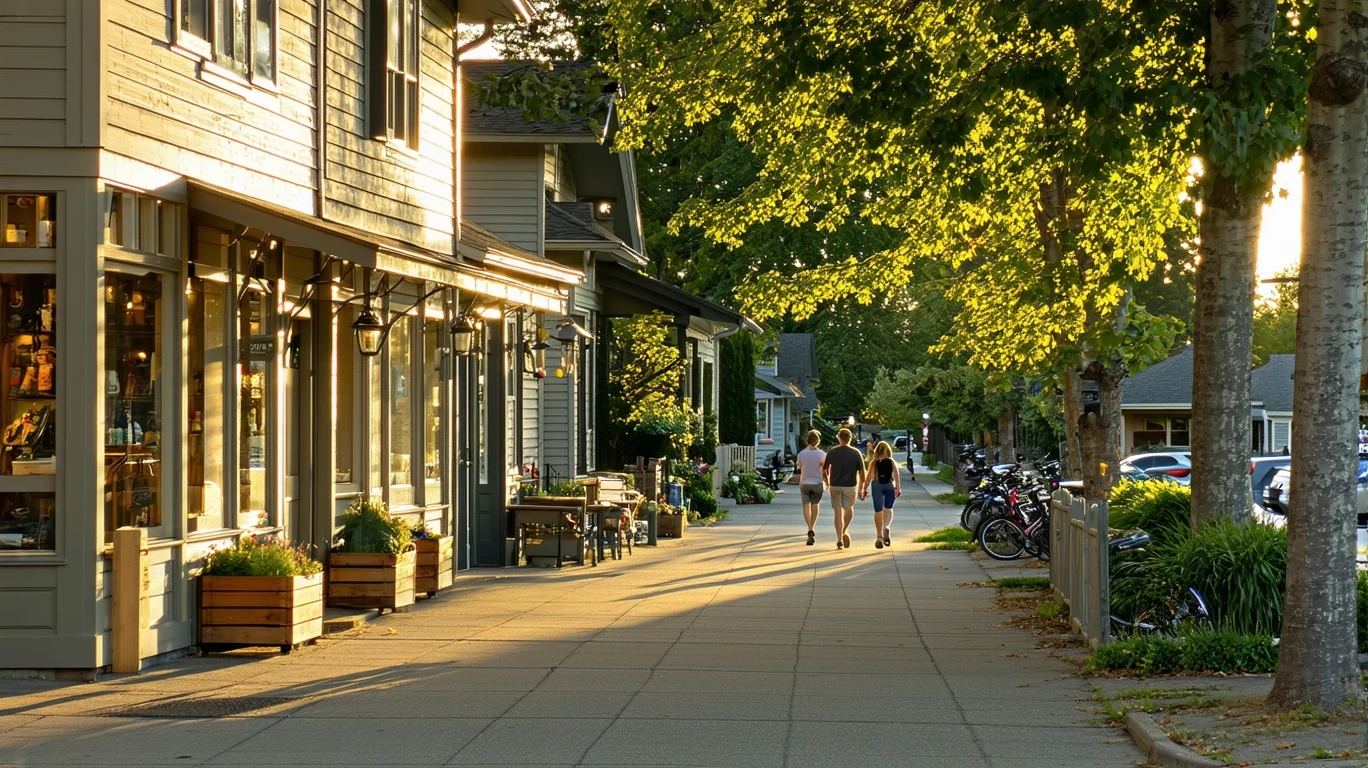
Transportation costs layer on top of housing. Sherwood has walkable pockets with strong pedestrian infrastructure and notable bike presence, and daily errands are broadly accessible—grocery and food density is high. For households living in those pockets, car dependency can be reduced for everyday tasks. But the city is still served only by bus transit, with no rail connection to Portland. That means commuters face either long bus rides or driving, and gas here is $5.01 per gallon. A 25-mile round-trip commute at typical fuel efficiency translates to meaningful monthly exposure, even before considering vehicle maintenance, insurance, and depreciation.
Utilities in Sherwood are moderate but not negligible. Electricity runs 14.64¢ per kWh, and natural gas costs $15.37 per MCF. The climate here brings mild, wet winters and warm, dry summers—heating needs are real but not extreme, and cooling season is extended but manageable. Still, households sensitive to monthly variance will feel the swings between low-usage and high-usage months.
For families, infrastructure access creates another pressure point. Playgrounds are moderately distributed, but school density is low. That can mean longer drives, more logistical complexity, and less spontaneous access to activities. It’s not a dealbreaker, but it adds friction—and friction costs time, which for many households is as limiting as money.
How the Same Income Feels Different by Household
Income pressure in Sherwood isn’t uniform. Households at similar income levels often experience very different financial realities depending on structure, expectations, and where they land within the city’s uneven convenience landscape.
Single adults often find Sherwood more manageable than families do, but only if they’re strategic about housing. A single person renting a one-bedroom in a walkable pocket can take advantage of the city’s strong grocery and errands accessibility, reducing both transportation costs and time burden. But if rent consumes too much of gross income, there’s little room left for saving, travel, or discretionary spending. The margin between “fine” and “stretched” is narrow.
Couples without children have more flexibility. Two incomes can absorb Sherwood’s elevated costs more easily, especially if both partners work locally or have flexible commutes. Walkable neighborhoods become a genuine asset, and the integrated green space access—park density here is high, with water features present—adds quality of life without added cost. But couples also face the temptation to overextend on housing, assuming future income growth will create room. That assumption doesn’t always hold.
Families face the most complex pressure. Sherwood’s family infrastructure is present but uneven—playgrounds exist in moderate density, but schools are sparse. That often means more driving, more planning, and more logistical overhead. Families also tend to need more space, which pushes them toward ownership or larger rentals, both of which are expensive here. The broadly accessible errands landscape helps—grocery runs don’t require long drives—but it doesn’t offset the fixed costs of housing, transportation, and childcare. Families at or near the median income often find themselves making tradeoffs they didn’t anticipate: smaller homes, longer commutes, deferred savings, or reduced flexibility.
The difference isn’t just income—it’s how income interacts with household needs and the specific geography of where you live within Sherwood.
The Comfort Threshold (Qualitative)
There’s a point where income stops dictating every decision. It’s not a number—it’s a shift in how you experience daily life. Below that threshold, you’re constantly optimizing: choosing the cheaper gas station, skipping outings, deferring maintenance, watching every bill. Above it, you’re still aware of costs, but they don’t control your behavior.
In Sherwood, that threshold is shaped by housing. Once your housing cost is stable and proportionate—meaning it doesn’t crowd out everything else—other decisions open up. You can absorb a utility swing without panic. You can choose transportation based on convenience, not just cost. You can save without feeling like you’re sacrificing present stability for distant goals.
For renters, crossing that threshold often means finding a place where rent doesn’t exceed roughly 30% of gross monthly income, and where location reduces transportation burden. For owners, it means a mortgage payment that leaves room for maintenance, taxes, insurance, and life beyond the house.
Comfort also depends on expectations. If you expect a large home, new cars, frequent dining out, and regular travel, the threshold moves higher. If you’re content with a smaller space, walkable errands, and modest discretionary spending, it moves lower. Sherwood can support both lifestyles, but only one of them works at the median income.
Why Online Cost Calculators Get Sherwood Wrong
Most cost-of-living calculators reduce Sherwood to a set of averages: median rent, median home price, estimated utilities, typical transportation. They spit out a total and call it done. But totals don’t explain how life actually feels here.
Calculators don’t account for Sherwood’s uneven walkability. They don’t distinguish between living in a pocket with high pedestrian access and grocery density versus living in a car-dependent edge. They don’t capture the time cost of low school density or the convenience dividend of integrated park access. They don’t explain why two households with identical incomes experience completely different financial pressure based on where they live and how they move through the city.
Calculators also assume static costs. They don’t prepare you for the reality that gas prices here are volatile, that utility bills swing seasonally, or that housing tradeoffs often force you to spend more in one category to save in another. They treat Sherwood as a fixed equation, when it’s actually a set of tradeoffs that shift depending on your household structure, work location, and lifestyle expectations.
People feel surprised after moving here not because the numbers were wrong, but because the numbers didn’t explain the texture of daily life. Comfort isn’t a total—it’s how costs interact with time, convenience, and choice.
How to Judge Whether Your Income Fits Sherwood
Instead of asking “Can I afford Sherwood?” ask these questions:
How sensitive are you to housing tradeoffs? If you need a large home in a specific neighborhood, your income needs are different than if you’re flexible about size and location. Sherwood’s housing costs are high across the board, but the range is wide. Can you accept a smaller space, an older build, or a less central location to reduce pressure elsewhere?
Can you absorb seasonal utility swings without stress? Heating and cooling costs here aren’t extreme, but they’re real. If a $50–$100 variance between low and high months would disrupt your budget, you’re operating without margin.
Is time or money your limiting factor? Sherwood’s walkable pockets and strong errands accessibility can save time and reduce car dependency—but only if you live in those areas. If you’re farther out or commuting to Portland, transportation costs and time both increase. Which constraint matters more to you?
How much logistical complexity can you handle? Families with young children will encounter more driving and planning due to lower school density. If you value spontaneous access to activities and minimal coordination overhead, that friction will feel significant. If you’re used to planning and driving, it’s manageable.
How much flexibility do you expect month to month? Comfort in Sherwood requires some buffer. If your income is fully allocated before discretionary spending, unexpected costs—car repairs, medical bills, home maintenance—will force tradeoffs. Do you have room for the unplanned?
Your answers to these questions matter more than any income figure. Sherwood works well for households with stable income, modest expectations, and flexibility around housing and location. It’s harder for households that need space, convenience, and predictability all at once.
FAQs About Living Comfortably in Sherwood
Is the median household income enough to live comfortably in Sherwood?
It depends entirely on household structure and expectations. The median income of $109,770 per year can support a comfortable life for couples or small families willing to make strategic tradeoffs around housing size and location. But it leaves little margin for larger families, those expecting spacious homes, or households with high transportation costs due to long commutes. Comfort at the median requires discipline and flexibility.
What income level eliminates financial stress in Sherwood?
There’s no single number, because stress depends on lifestyle expectations and fixed obligations. A household earning significantly above the median—enough that housing consumes well under 30% of gross income—will have more breathing room. But even high earners can feel stretched if they overextend on housing or carry other large fixed costs. The key isn’t hitting a specific income—it’s maintaining proportionality between income and obligations.
Can single adults live comfortably in Sherwood?
Yes, but location and housing choice matter enormously. A single adult renting a modest one-bedroom in a walkable pocket, with short or flexible commute, can live comfortably here. But if rent is too high relative to income, or if a long commute adds significant transportation costs, comfort erodes quickly. Single adults have less income cushion than couples, so there’s less room for error.
Does living in a walkable part of Sherwood actually reduce costs?
It can, but it’s not automatic. Walkable pockets with high grocery and errands accessibility reduce the need for frequent driving, which lowers gas, maintenance, and vehicle wear. For households that can genuinely reduce car dependency—running errands on foot or bike, working locally—the savings are real. But if you’re still commuting to Portland or driving kids to activities due to low school density, the walkability benefit is more about convenience than cost reduction.
Why do people with good incomes still feel financially stretched in Sherwood?
Because costs here are elevated across the board, not just in one category. The regional price parity index of 125 means you’re paying more for housing, groceries, services, and daily transactions than the national baseline. That 25% premium doesn’t show up as a single shock—it’s distributed across everything. Even households with solid incomes find that money doesn’t go as far as expected. Combine that with high housing costs and expensive transportation, and the margin shrinks fast.
How this article was built: In addition to public economic data, this article incorporates location-based experiential signals derived from anonymized geographic patterns—such as access density, walkability, and land-use mix—to reflect how day-to-day living actually feels in Sherwood, OR.
Sherwood can work well for some households—but only if expectations match reality. The city offers genuine quality of life: integrated green space, accessible errands, walkable pockets, and a stable economy. But it demands financial discipline, strategic housing choices, and realistic expectations about what your income can support. Comfort here isn’t guaranteed by a number. It’s earned by aligning income, obligations, and lifestyle in a way that leaves room to breathe.