
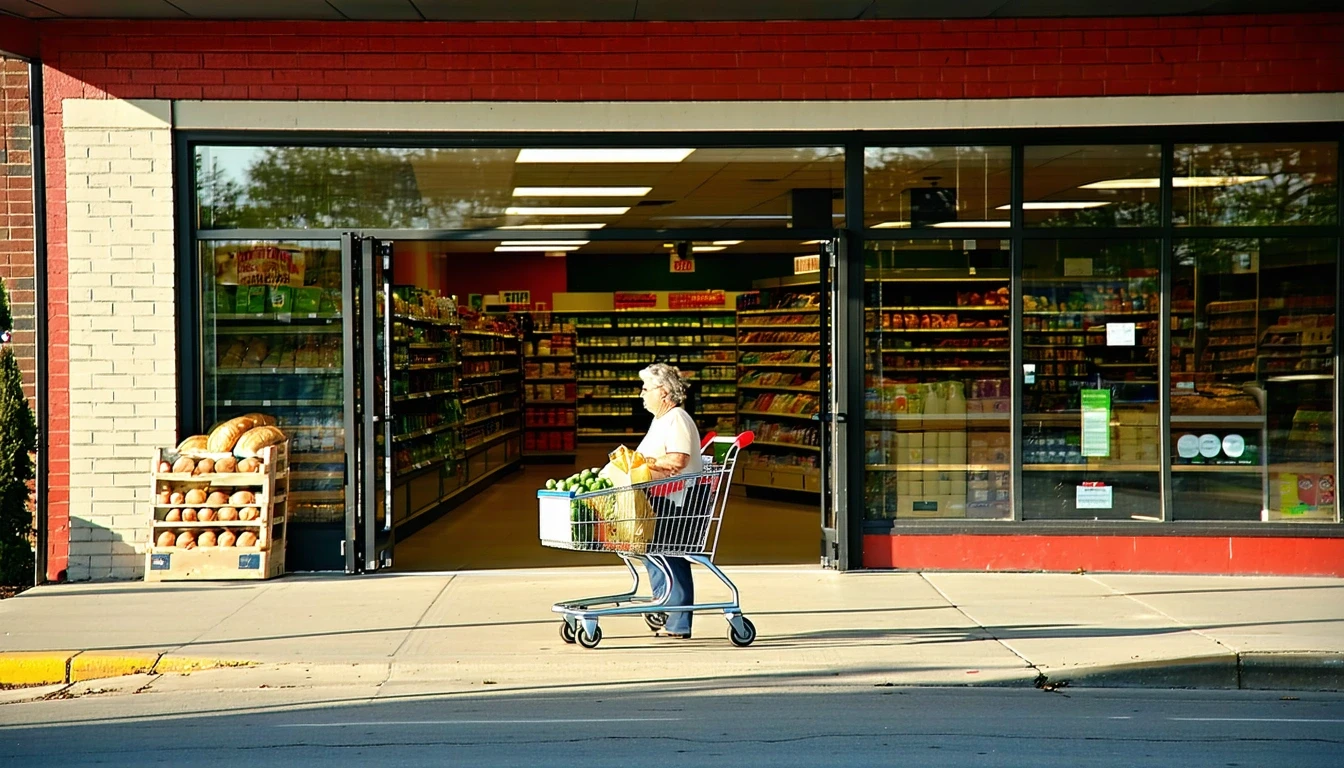
How Grocery Costs Feel in Pontiac
Grocery prices in Pontiac sit slightly below the national baseline, with the regional price index at 95—meaning staple foods tend to run about 5% less expensive than the U.S. average. For households earning close to the city’s median income of $40,307 per year, that modest discount matters. It doesn’t eliminate food cost pressure, but it does mean a careful shopper can stretch each dollar a bit further than they might in higher-cost metros. The experience of grocery shopping here isn’t defined by sticker shock, but it’s not effortless either. Families notice the bill, especially when buying for multiple people, and singles or couples on tight budgets still need to be intentional about where and how they shop.
Who feels grocery costs most in Pontiac? Households with children face the steepest pressure, simply due to volume. A family of four buying fresh produce, dairy, and protein weekly will spend meaningfully more than a single person or couple, even at identical per-unit prices. Seniors on fixed incomes also watch grocery spending closely, particularly when managing chronic health needs that require specific diets. On the other end, higher earners—those well above the median—experience grocery costs as a minor line item, with plenty of room to choose premium or organic options without strain. For the middle band of earners, grocery costs sit in a zone where they’re noticeable but manageable, as long as store choice and habits align with income reality.
The texture of food access in Pontiac also shapes the grocery experience. Food and grocery options here are corridor-clustered, meaning stores tend to concentrate along main commercial routes rather than being evenly distributed across every neighborhood. That pattern creates variability: some households can walk or make a quick drive to their preferred store, while others face a longer trip or need to plan around fewer nearby options. It’s not a food desert, but it’s also not a place where every block offers equal convenience. For households without reliable transportation, or those trying to minimize driving costs, that access gap can push them toward whatever store is closest—even if it’s not the most affordable option.
Grocery Price Signals (Illustrative)
These prices illustrate how staple items tend to compare locally—not a full shopping list. They’re derived estimates based on the regional price environment, useful for understanding relative cost positioning but not precise enough to predict your actual checkout total. Prices vary by store, brand, sales, and season, so treat these as directional anchors, not guarantees.
| Item | Illustrative Price |
|---|---|
| Bread | $1.76/lb |
| Cheese | $4.45/lb |
| Chicken | $1.95/lb |
| Eggs | $2.38/dozen |
| Ground Beef | $6.40/lb |
| Milk | $3.82/half-gallon |
| Rice | $1.02/lb |
Derived estimate based on national baseline adjusted by regional price parity; not an observed local price.
Ground beef stands out as the highest-pressure item here, at $6.40 per pound. For families building meals around affordable protein, that price point creates tension—especially if buying multiple pounds per week. Chicken, at $1.95 per pound, offers a much lighter cost load, and rice at just over a dollar per pound provides an inexpensive base for stretching meals. Eggs and dairy fall into a middle zone: noticeable but not prohibitive. The variability across these items reinforces a key reality—grocery pressure in Pontiac isn’t uniform. It’s shaped by what you buy, how much you need, and whether you’re willing to shift your meal planning around lower-cost staples.
Store Choice & Price Sensitivity
Grocery costs in Pontiac vary significantly depending on where you shop, and understanding store tiers is essential for managing food spending. At the discount tier—chains focused on private-label goods, limited selection, and no-frills layouts—prices run meaningfully lower than mid-tier or premium options. These stores appeal to budget-conscious households willing to trade brand variety and ambiance for lower per-unit costs. A family shopping exclusively at discount grocers can keep their food bills notably tighter than one defaulting to a mid-tier chain, even when buying identical categories of items. For households earning near or below Pontiac’s median income, discount stores often become the primary strategy for avoiding food cost pressure.
The mid-tier—regional and national chains offering broader selection, frequent sales, and loyalty programs—sits in the middle. Prices here aren’t rock-bottom, but they’re also not premium. Mid-tier stores attract households looking for balance: reasonable prices, familiar brands, and enough variety to avoid feeling constrained. Many Pontiac residents shop mid-tier by default, mixing sale items with staples and using coupons or apps to shave costs incrementally. The experience feels less austere than discount shopping but requires more active management to avoid creep toward higher spending. For families with specific dietary needs or preferences, mid-tier stores often provide the flexibility discount chains can’t match.
At the premium tier—stores emphasizing organic, specialty, or prepared foods—prices climb steeply. Premium grocers cater to households prioritizing quality, convenience, or specific sourcing standards, and they charge accordingly. For high earners in Pontiac, premium shopping is frictionless. For median-income households, it’s occasional or limited to specific categories. The gap between discount and premium can be stark: the same basket of goods might cost 30–50% more at a premium store, driven by brand positioning, prepared food markups, and specialty product premiums. That spread means store choice isn’t just a preference—it’s a financial lever that directly determines how tight or loose grocery costs feel month to month.
Because food access in Pontiac is corridor-clustered, not every household has equal access to all three tiers. Some neighborhoods sit close to a discount chain and a mid-tier option, while others might only have a small-format or convenience-oriented store nearby, where per-unit prices run higher due to limited scale. Households without cars, or those trying to minimize driving to control transportation costs, sometimes face a tradeoff: shop the closest store and pay more, or travel farther to access better prices. That friction doesn’t make Pontiac a food desert, but it does mean grocery cost pressure isn’t purely about prices—it’s also about access, time, and the logistics of getting to the right store.
What Drives Grocery Pressure Here
Income is the primary filter through which grocery costs are experienced in Pontiac. With median household income at $40,307 per year, a significant share of residents are managing food spending on modest budgets. For a household earning at or below the median, even a 5% regional discount doesn’t eliminate the need to be strategic. Grocery costs become a weekly negotiation: choosing chicken over beef, buying store brands, skipping convenience items, and timing purchases around sales. Higher earners experience the same prices but feel almost no pressure, while lower earners—particularly those working part-time or gig jobs—can find grocery costs consuming a disproportionate share of take-home pay. The city’s income distribution creates a wide spectrum of grocery experiences, even though everyone shops in the same regional price environment.
Household size amplifies cost pressure in predictable ways. A single person or couple can keep grocery spending relatively contained, even when buying fresh produce and protein regularly. A family of four or five, however, faces exponential growth in volume needs. Kids eat more as they grow, dietary restrictions multiply, and waste becomes harder to avoid. Families also face pressure to buy in larger quantities to reduce per-unit costs, but that requires upfront cash and storage space—luxuries not every household has. The result is that grocery costs feel fundamentally different depending on how many people you’re feeding, and families with children are the demographic most likely to feel sustained pressure, regardless of income tier.
Seasonal variability also plays a role, though it’s less dramatic in Pontiac than in more isolated or extreme-climate regions. Produce prices fluctuate with growing seasons, and winter months can see modest upticks in fresh fruit and vegetable costs as supply chains lengthen. Protein prices shift with commodity cycles, and dairy costs respond to regional production patterns. These swings aren’t severe enough to destabilize budgets, but they do create unpredictability. Households shopping on tight margins notice when strawberries jump in price or when ground beef costs more in early spring than late summer. The lack of extreme seasonality means grocery costs stay relatively stable year-round, but they’re not static—and that variability requires ongoing attention.
Practical Ways People Manage Grocery Costs
The most effective strategy for controlling grocery costs in Pontiac is shopping at discount-tier stores whenever possible. Households that commit to discount grocers as their primary source—supplementing only occasionally at mid-tier chains for specific items—can keep food spending meaningfully lower than those defaulting to convenience or proximity. This approach requires planning: discount stores often carry fewer brands, limited organic options, and less prepared food, so shoppers need to be comfortable cooking from scratch and adapting recipes to available inventory. For families or individuals willing to make that tradeoff, the savings compound quickly over weeks and months.
Buying in bulk works well for non-perishable staples—rice, pasta, canned goods, frozen vegetables—but requires upfront cash and storage space. Households with access to warehouse clubs or bulk sections can lower per-unit costs significantly, especially for items used frequently. The challenge is avoiding waste: buying a large quantity only makes sense if you’ll actually use it before it spoils or goes stale. For smaller households or those without extra freezer space, bulk buying offers limited value. The strategy works best for families with predictable consumption patterns and the financial flexibility to spend more upfront in exchange for lower long-term costs.
Meal planning and cooking from scratch reduce both waste and reliance on convenience items, which carry steep markups. Households that plan weekly menus around sale items, seasonal produce, and lower-cost proteins can stretch their grocery dollars further than those shopping impulsively or leaning on pre-packaged meals. Cooking from scratch takes time and skill, which not every household has in equal measure, but even modest shifts—making rice instead of buying boxed sides, roasting a whole chicken instead of buying breasts—can lower costs without requiring culinary expertise. The key is consistency: occasional meal planning helps, but sustained habit change drives the most meaningful impact.
Using store loyalty programs, digital coupons, and cashback apps adds incremental savings without requiring major behavior change. Many mid-tier grocers offer weekly discounts through apps, and stacking manufacturer coupons with store sales can reduce costs on specific items. These tools work best when used strategically—targeting items you already planned to buy rather than purchasing something just because it’s on sale. The savings per trip are usually modest, but over time they add up, particularly for households shopping frequently or buying in larger quantities.
Groceries vs Eating Out (Directional)
Without specific data on restaurant prices or dining costs in Pontiac, the tradeoff between cooking at home and eating out remains qualitative. In general, preparing meals from groceries costs significantly less per serving than ordering takeout or dining at restaurants, even when accounting for time and effort. A home-cooked dinner built around chicken, rice, and vegetables might cost a few dollars per person, while the same meal at a casual restaurant could easily run three to five times that amount. For households managing tight budgets, eating out becomes an occasional treat rather than a routine convenience, and grocery shopping serves as the primary strategy for controlling food costs.
The decision to cook versus eat out also depends on time, energy, and household composition. Single professionals working long hours might find the convenience of takeout worth the premium, especially if their income allows it. Families with young children often face the opposite calculus: eating out with kids is expensive and logistically challenging, so cooking at home becomes the default. The broader point is that grocery costs and dining costs exist on a spectrum, and where a household lands depends on income, time availability, and priorities. In Pontiac, where median income sits below $41,000, most households tilt heavily toward groceries as the more affordable option, reserving restaurant meals for special occasions or when convenience outweighs cost.
FAQs About Grocery Costs in Pontiac (2026)
Is it cheaper to shop in bulk in Pontiac? Bulk buying lowers per-unit costs for non-perishables and frequently used items, but it requires upfront cash and storage space. For families with predictable consumption and room to store extras, bulk shopping at warehouse clubs or discount grocers can reduce long-term food spending.
Which stores in Pontiac are best for low prices? Discount-tier grocers—chains focused on private-label goods and no-frills layouts—offer the lowest prices. Mid-tier stores provide more variety and frequent sales but run higher overall. Premium grocers charge significantly more, targeting households prioritizing organic or specialty items.
How much more do organic items cost in Pontiac? Organic products typically carry a premium over conventional equivalents, often 20–40% higher depending on category and store. That gap is consistent with national patterns and means organic shopping requires either higher income or tradeoffs elsewhere in the grocery budget.
How do grocery costs for two adults in Pontiac tend to compare to nearby cities? Pontiac’s regional price index of 95 suggests grocery costs run slightly below the national average, which likely makes them comparable to or modestly lower than other mid-sized Michigan cities. Exact comparisons depend on local store competition and access, but the broader regional price environment favors affordability relative to higher-cost metros.
How do households in Pontiac think about grocery spending when cooking at home? Most households view cooking from groceries as the primary strategy for controlling food costs, especially given the city’s median income level. Eating out is typically reserved for convenience or special occasions, while grocery shopping—paired with intentional store choice and meal planning—serves as the foundation of day-to-day costs.
How Groceries Fit Into the Cost of Living in Pontiac
Grocery costs in Pontiac sit in a manageable zone for most households, especially compared to housing and utilities, which tend to dominate monthly budgets. The regional price discount—modest but real—helps stretch food dollars, and the availability of discount-tier stores gives cost-conscious shoppers a clear path to keeping spending contained. That said, grocery costs aren’t negligible. For families with children or individuals earning below the median, food spending requires ongoing attention and strategic choices. The difference between shopping discount versus premium, or cooking from scratch versus relying on convenience items, can shift monthly food costs by hundreds of dollars over time.
Understanding grocery costs in isolation is useful, but it’s only part of the picture. Food spending interacts with transportation (driving to farther stores to access lower prices), housing (storage space for bulk goods), and income (how much flexibility exists to absorb price swings). For a complete view of how grocery costs fit into your overall financial reality in Pontiac, see Your Monthly Budget in Pontiac: Where It Breaks, which walks through how housing, utilities, transportation, and food combine to shape total cost of living. Grocery costs are one lever among many, and the households that manage them best are the ones who understand how that lever fits into the broader system of expenses and tradeoffs that define life in this city.
How this article was built: In addition to public economic data, this article incorporates location-based experiential signals derived from anonymized geographic patterns—such as access density, walkability, and land-use mix—to reflect how day-to-day living actually feels in Pontiac, MI.