
How much is enough to feel at ease? In Knightdale, the answer depends less on a magic number and more on how your household absorbs housing pressure, manages seasonal utility swings, and navigates the gap between where walkable infrastructure exists and where daily errands actually cluster.
This article explains who tends to feel comfortable in Knightdale and who doesn’t — not by calculating a required income, but by examining where financial pressure shows up first and how different households experience the same costs in fundamentally different ways.
What “Living Comfortably” Means in Knightdale
Comfort in Knightdale isn’t about luxury. It’s about having enough margin that a hot summer month doesn’t force you to skip dinners out, that finding a rental doesn’t mean choosing between location and affordability, and that getting to work or running errands doesn’t consume either all your time or all your gas budget.
The town sits in a region where expectations around space, climate control, and mobility are high. Homes here — whether renting at a median of $1,409 per month or buying near a median value of $305,500 — are designed for car access, air conditioning, and yard maintenance. Comfort means being able to afford not just the rent or mortgage, but the infrastructure that makes the home livable: cooling during extended heat, fuel for a necessary commute, and the time or money to reach grocery stores that sit along commercial corridors rather than within walking distance of every neighborhood.
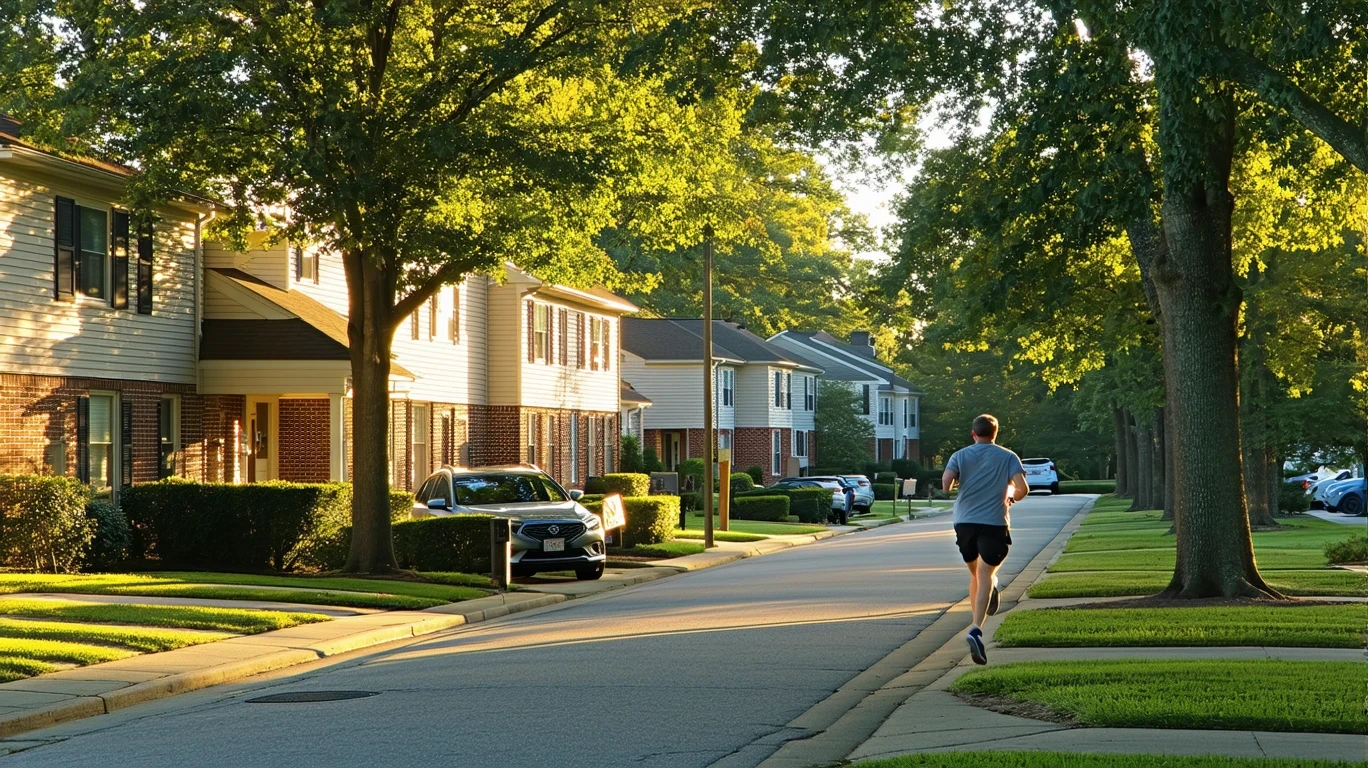
Comfortable living here also means absorbing Knightdale’s structural realities without constant tradeoffs. While walkable pockets exist and bike infrastructure is notably present, daily errands remain corridor-clustered. That means even households who want to walk or bike for some trips still depend on a car for most weekly needs. Comfort is having enough income that this mixed mobility landscape feels like flexibility, not friction.
Where Income Pressure Shows Up First
Housing dominates. At $1,409 per month for a median rental, a household earning Knightdale’s median income of $79,364 per year (roughly $6,614 gross per month) would allocate about 21% of gross monthly income to rent alone — before utilities, transportation, or food. For households earning less, that share climbs quickly, forcing difficult tradeoffs between location, size, and condition.
Buying shifts the pressure but doesn’t eliminate it. A $305,500 home requires not just a mortgage but property taxes, insurance, and maintenance — all of which rise over time in ways renters don’t directly face. Homeownership here often means trading rent volatility for long-term expense exposure.
Utilities add seasonal volatility. Electricity at 13.68¢ per kWh doesn’t sound extreme, but Knightdale’s hot, humid summers mean air conditioning isn’t optional — it’s a baseline cost of living. Households without enough margin to absorb a summer spike in usage often find themselves adjusting behavior (raising the thermostat, limiting cooling hours) in ways that erode comfort.
Transportation creates a different kind of pressure. Gas prices at $3.89 per gallon combine with a car-dependent regional structure to make commuting and errands a fixed cost, not a discretionary one. Even in neighborhoods with sidewalks and bike lanes, the corridor-clustered nature of grocery stores and services means most households drive most of the time. The question isn’t whether you’ll spend on transportation — it’s whether that spending feels manageable or relentless.
For families, pressure multiplies. School density in Knightdale falls below thresholds, and healthcare access is limited — no hospital or clinics were detected in the area. That means families often face additional logistics: longer school commutes, medical appointments in nearby cities, and the time cost of coordinating care and education across a wider geographic footprint. These aren’t luxuries; they’re necessities that require either time or money, and often both.
How the Same Income Feels Different by Household
A single adult earning near the median income often experiences Knightdale as manageable. Housing pressure exists, but flexibility in apartment size and location creates options. One person can live in a smaller unit closer to work, or choose a larger space farther out and accept the commute. Utility costs are lower in smaller spaces, and one car serves all needs. The corridor-clustered errands structure is an inconvenience, not a crisis.
Couples at similar income levels — especially dual-income couples — tend to feel less day-to-day pressure, but lifestyle expectations often expand to meet available income. A second car becomes necessary if both work, doubling transportation exposure. A larger rental or a move toward homeownership shifts housing from 20% of income to 30% or more. Comfort exists, but it’s often thinner than it appears, because spending rises alongside earnings.
Families face the most pressure, even at higher incomes. Two adults and children need more space, which means higher rent or a larger mortgage. Cooling costs rise with square footage. The limited family infrastructure — low school density, no nearby hospital — means more driving, more time spent coordinating logistics, and less ability to rely on walkability even in pockets where it exists. Errands that a single adult handles in one trip become multi-stop, multi-day routines when managing a household with kids. The same income that feels comfortable for a couple often feels tight for a family, not because of reckless spending, but because the structural demands are simply higher.
The Comfort Threshold (Qualitative)
Comfort in Knightdale isn’t a number — it’s a condition. It’s the point where housing no longer forces you to eliminate other priorities. Where a $100 spike in the summer electric bill is annoying, not destabilizing. Where transportation feels like a tool, not a tax. Where running errands doesn’t require military-level planning.
For most households, this threshold sits somewhere above the point where every dollar is already allocated before the month begins. It’s the income level where you can absorb a surprise expense, take advantage of a sale without checking your account first, and make choices — about where to live, how to commute, what to eat — based on preference rather than necessity.
Households below this threshold don’t lack discipline or resourcefulness. They lack margin. And in Knightdale, margin is what separates stress from stability.
Why Online Cost Calculators Get Knightdale Wrong
Most cost-of-living calculators treat Knightdale as a data point: plug in the rent, add utilities, multiply transportation by a standard commute, and sum to a total. But totals don’t explain how life actually feels here.
Calculators assume errands are evenly accessible. In Knightdale, they’re not — they’re clustered along corridors, which means even walkable neighborhoods require cars for most weekly needs. Calculators assume families can access schools and healthcare locally. Here, school density is low and healthcare options are limited, adding time and travel that no formula captures. Calculators assume utility costs are stable. In a hot, humid climate, summer cooling costs swing unpredictably based on weather, usage, and housing quality.
People feel surprised after moving because the costs they anticipated were accurate, but the tradeoffs behind the total were invisible. A rent number doesn’t convey whether you’ll need to drive everywhere. A utility rate doesn’t explain whether your AC will run constantly or occasionally. An income comparison doesn’t reveal whether your household type faces structural friction that others don’t.
Knightdale works well for some households, but only when expectations align with how the town is actually built.
How to Judge Whether Your Income Fits Knightdale
Instead of asking “Is my income enough?”, ask these questions:
How sensitive are you to housing tradeoffs? Can you accept a smaller space, an older building, or a location farther from work in exchange for lower rent? Or do you need a specific type of home in a specific area, regardless of cost?
Can you absorb seasonal utility swings? Will a summer electric bill that’s 40% higher than winter derail your budget, or can you handle that volatility without changing behavior?
Is time or money your limiting factor? Knightdale’s corridor-clustered errands and limited family infrastructure mean you’ll spend either time (driving, coordinating, planning) or money (paying for convenience, proximity, or services). Which can you afford to spend?
How much flexibility do you expect month to month? If your income is fully allocated before discretionary spending, Knightdale’s structural costs — transportation, cooling, logistics — will feel relentless. If you have margin, those same costs feel manageable.
Does your household type match the infrastructure? Singles and couples can navigate limited family amenities without much friction. Families face compounding logistics: school access, healthcare access, errands that require multiple stops. Does your household have the time, income, or flexibility to manage that?
There’s no scoring system here. These are decision filters, not tests. The goal is to surface mismatches before they become regrets.
Day-to-day living in Knightdale reflects a specific infrastructure reality: even in neighborhoods with sidewalks and bike lanes, most errands require a car because grocery stores and services cluster along commercial corridors rather than dispersing throughout residential areas. For families, the limited school density and absence of nearby hospitals mean that routine logistics — school drop-offs, medical appointments, weekend errands — often require more driving, more planning, and more time than households initially expect. This isn’t a failure of the town; it’s how the place is structured. Comfort depends on whether your household can absorb that structure without constant friction.
FAQs About Living Comfortably in Knightdale
Is Knightdale affordable compared to nearby cities?
Knightdale’s housing costs sit near regional norms, but affordability depends on what you’re comparing and what you need. Rent at $1,409 per month is neither cheap nor prohibitive — it’s middle-tier for the Raleigh metro area. The question isn’t whether Knightdale is affordable in general, but whether it’s affordable for your household type and income level given the tradeoffs you’re willing to make.
Can a single income support a family in Knightdale?
It’s possible, but it requires significant margin and careful tradeoffs. A single income household faces the same housing, transportation, and utility costs as a dual-income household, but with half the earning power. Families also face higher structural costs here — limited school density, limited healthcare access, corridor-clustered errands — which add time and money pressure. Single-income families who succeed in Knightdale typically earn well above the median and have flexibility in housing location and lifestyle expectations.
How much do utilities actually cost in Knightdale?
Utility costs vary widely based on housing size, age, and efficiency, but the primary driver is cooling. Knightdale’s hot, humid summers mean air conditioning runs for extended periods, and electricity at 13.68¢ per kWh adds up quickly in larger or poorly insulated homes. Households in newer, efficient spaces may see moderate bills; those in older or larger homes often face sharp seasonal swings. The key isn’t the average — it’s whether your budget can absorb volatility.
Do you need a car to live in Knightdale?
Yes, for most households. While walkable pockets exist and bike infrastructure is notably present, daily errands remain corridor-clustered, meaning grocery stores, pharmacies, and services aren’t within walking distance of most neighborhoods. Transit is limited to bus service, which doesn’t cover the full geographic spread of where people live and work. A car isn’t just convenient in Knightdale — it’s foundational to managing daily life.
What income level feels comfortable for a family in Knightdale?
There’s no single number, because comfort depends on household size, expectations, and flexibility. A family that can accept an older rental, manage logistics across multiple locations, and absorb utility and transportation volatility will feel comfortable at a lower income than a family that needs new construction, nearby schools, and predictable monthly costs. The threshold isn’t about earnings — it’s about whether your income provides enough margin to handle Knightdale’s structural realities without constant tradeoffs.
How this article was built: In addition to public economic data, this article incorporates location-based experiential signals derived from anonymized geographic patterns—such as access density, walkability, and land-use mix—to reflect how day-to-day living actually feels in Knightdale, NC.
Knightdale can work well for some households — but only if expectations match reality.