
A first-time renter in Knightdale faces median gross rent of $1,409 per month—a figure that represents roughly 21% of the city’s median household income of $79,364 per year before utilities, parking, or renters insurance. A first-time buyer looking at the median home value of $305,500 confronts a different calculation: down payment requirements, property taxes, homeowners insurance, and maintenance exposure that renting avoids entirely. Both paths require navigating Knightdale’s position as a commuter suburb east of Raleigh, where housing costs reflect metro proximity without downtown pricing, and where the structure of daily life—how you move, where you shop, how far you drive—shapes which housing choice makes sense.
This article explains housing cost structure and ownership tradeoffs in Knightdale, including what drives rent and purchase prices, how ownership changes cost predictability over time, and which household types fit the market’s current shape. It is not a mortgage calculator or affordability guide. It is a framework for understanding how housing costs behave here, and what that behavior means for renters and buyers making decisions in 2026.
The Housing Market in Knightdale Today
Knightdale’s housing market operates in the gravitational pull of the Raleigh metro, where job growth, university presence, and regional migration have sustained housing demand for over a decade. The city itself functions as a bedroom community—close enough to Research Triangle employers to justify the commute, far enough to offer larger lots and lower per-square-foot costs than inner-ring suburbs. That positioning creates a market where home values and rents are shaped less by Knightdale’s own employment base (unemployment sits at 3.1%) and more by its role as an access point to the broader metro economy.
What newcomers often misunderstand is that Knightdale’s housing costs don’t behave like a rural market or a true exurban fringe. The median home value of $305,500 reflects competition from buyers who work elsewhere but live here for space, school access, or budget relief. Rental demand follows a similar logic: $1,409 per month buys more square footage than comparable Raleigh neighborhoods, but it also buys distance, car dependency, and a reliance on corridor-based errands rather than walkable retail. The city’s infrastructure shows pockets of walkability and notable cycling presence, but daily logistics still tilt heavily toward driving—a reality that affects both renters and owners through transportation costs, commute time, and the friction of running errands across dispersed commercial strips.
The regional price parity index of 103 signals that Knightdale’s overall cost structure runs slightly above the national baseline, driven primarily by housing and transportation rather than groceries or utilities. For renters and buyers, this means the decision isn’t just about monthly payments—it’s about whether the housing cost premium buys meaningful access, convenience, or long-term stability, or whether it simply reflects scarcity in a supply-constrained metro.
Renting in Knightdale
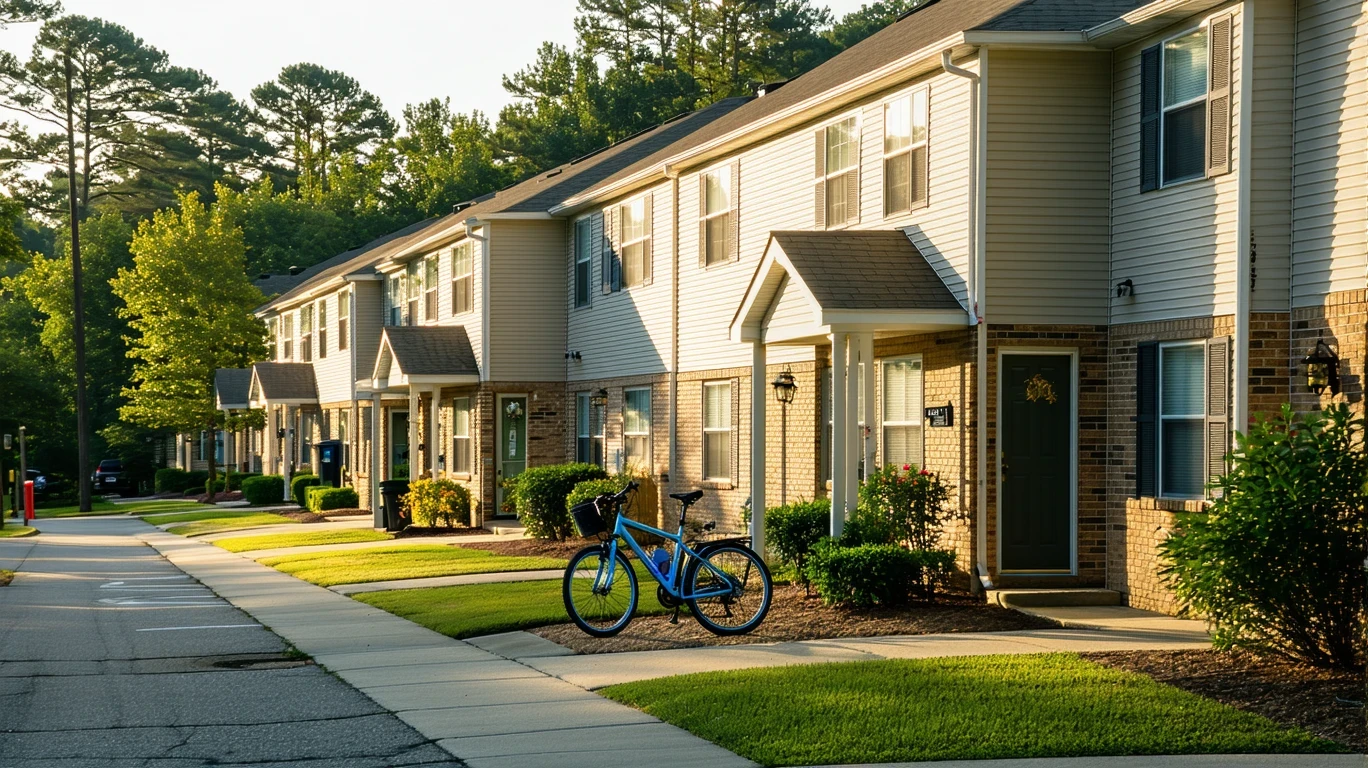
Renting in Knightdale at $1,409 per month positions tenants in a market where rental supply is shaped by single-family home conversions, small multifamily complexes, and newer apartment developments along major corridors. The rental experience here differs from denser metro cores: you’re more likely to rent a townhouse or a unit in a garden-style complex than a mid-rise building, and your rent often includes yard maintenance or assigned parking rather than walkable retail access or transit proximity.
The cost pressure comes not from Knightdale’s own rental scarcity but from metro-wide competition. Renters priced out of Raleigh or Cary push eastward, and Knightdale absorbs that demand without the apartment density to stabilize prices. Lease renewals tend to track regional trends rather than local conditions, meaning your rent can rise even if Knightdale itself hasn’t changed. That volatility is compounded by the fact that most rentals here require a car—bus service exists, but it’s limited to specific routes and schedules that don’t cover the full geography of daily errands. If your job, grocery store, and social life aren’t aligned with those corridors, renting in Knightdale means budgeting for fuel, insurance, and vehicle maintenance on top of rent.
For renters who value flexibility and want to avoid maintenance risk, the $1,409 baseline buys predictability within the lease term and the ability to relocate without selling a property. For renters who planned to walk to work or rely on transit, Knightdale’s infrastructure may create friction that turns an affordable rent into a logistically expensive arrangement.
Owning a Home in Knightdale
Owning a home in Knightdale at a median value of $305,500 shifts cost exposure from monthly rent volatility to long-term obligations: property taxes, insurance, maintenance, and the structural costs of homeownership that don’t appear on a mortgage statement. The purchase price itself reflects the same metro dynamics that drive rent—proximity to Raleigh employment, relative affordability compared to inner suburbs, and competition from buyers seeking space and yard access.
Property taxes in North Carolina are assessed locally, and while specific rates aren’t provided in the data, owners should expect annual tax bills that reflect both the home’s assessed value and the county’s revenue needs for schools, infrastructure, and services. Those taxes don’t stay fixed; reassessments, bond referendums, and municipal budget changes can increase the tax burden over time, creating exposure that renters avoid. Homeowners insurance adds another layer of cost, influenced by the home’s age, construction type, and proximity to flood zones or storm-prone areas. Knightdale’s climate—hot, humid summers and mild winters—means insurance premiums may include wind and water damage coverage, even if the home isn’t in a designated floodplain.
Maintenance exposure in Knightdale depends heavily on housing stock age and type. Older single-family homes may require HVAC replacement, roof repairs, or plumbing updates that cost thousands of dollars and arrive without warning. Newer construction reduces that risk initially but often comes with homeowners association (HOA) fees that cover common area maintenance, landscaping, or neighborhood amenities. Those fees represent another fixed cost that doesn’t build equity and can increase annually.
The ownership experience here also includes the reality of car dependency. Unlike denser cities where walkability reduces transportation costs, Knightdale homeowners typically need at least one vehicle per adult, and often two. That means driveway space, garage access, and the ongoing cost of fuel, insurance, and repairs—all of which are tied to the home’s location relative to work, schools, and errands. The city’s infrastructure shows pockets of pedestrian-friendly design and notable bike presence, but those features don’t eliminate the need for a car; they just reduce how often you use it.
For buyers who plan to stay long enough to absorb transaction costs and build equity, ownership in Knightdale offers stability and control. For buyers who may relocate within a few years, or who underestimate maintenance and tax exposure, the $305,500 entry point can become a financial anchor rather than an asset.
Apartment vs House in Knightdale — Cost Behavior Comparison
The following table isolates cost categories where apartments and single-family houses behave differently in Knightdale, based on local climate, housing stock, and infrastructure. Rows are included only where the distinction reflects meaningful variation specific to this market.
| Expense Category | Apartment | House |
|---|---|---|
| Cooling costs (summer) | Lower total usage; shared walls reduce heat gain | Higher exposure; standalone structure, larger square footage, extended cooling season |
| Heating costs (winter) | Minimal; mild winters and shared walls reduce demand | Moderate; larger volume and standalone construction increase usage |
| Exterior maintenance | Covered by landlord or HOA; no direct cost | Owner responsibility; roof, siding, gutters, landscaping |
| Water/sewer | Often included in rent or billed as flat fee | Billed directly; higher usage for irrigation, larger households |
| Parking | Assigned or covered; included in rent | Driveway/garage; no separate fee but adds to property tax base |
| Commute exposure | Typically closer to corridors with bus access | More dispersed; often requires longer drives to work or errands |
Methodology note: This comparison reflects Knightdale’s hot, humid climate (which drives summer cooling costs), the prevalence of single-family housing stock (which increases maintenance and utility exposure), and the city’s corridor-clustered errands infrastructure (which affects transportation costs). Categories like groceries, internet, and renters/homeowners insurance were excluded because they don’t vary meaningfully by housing type in this market. The table is a diagnostic tool for understanding cost behavior, not a budget template.
Utilities & Upkeep Differences
Utility and maintenance costs in Knightdale don’t just differ by housing type—they’re shaped by the city’s climate and infrastructure in ways that create distinct exposure for apartment renters versus house owners. Knightdale’s long, hot summers and mild winters mean cooling dominates annual utility spending, and that dominance is felt more acutely in single-family homes than in apartments.
For illustrative context, a typical household using 1,000 kWh per month at Knightdale’s electricity rate of 13.68¢/kWh would face roughly $137 per month in electricity costs before fees and taxes. In a standalone house with larger square footage, poor insulation, or older HVAC systems, that usage can climb significantly during summer months when air conditioning runs continuously. Apartments, by contrast, benefit from shared walls that reduce heat gain, smaller conditioned spaces, and landlord-controlled HVAC systems that may be newer or more efficient. The result is lower peak usage and more predictable bills, even if the per-kWh rate is identical.
Natural gas, priced at $17.89 per MCF, plays a smaller role in Knightdale’s utility picture. Mild winters mean heating demand is modest, and many homes rely on electric heat pumps rather than gas furnaces. Where gas is present, it’s typically used for water heating or cooking—applications that don’t create the same seasonal volatility as cooling. Houses with gas service may see slightly higher winter bills, but the exposure is minor compared to summer electricity costs.
Maintenance exposure diverges sharply by housing type. Apartment renters avoid direct responsibility for roof leaks, HVAC failures, or exterior repairs—costs that can run into thousands of dollars for house owners and arrive without warning. In Knightdale’s climate, HVAC systems work hard and age faster, and a compressor failure in July isn’t optional to fix. House owners also face yard maintenance, gutter cleaning, and pest control—tasks that apartment complexes handle centrally. Those differences don’t just affect annual budgets; they affect the unpredictability of housing costs and the time required to manage a home.
Water and sewer costs follow a similar pattern. Apartments often include water in rent or charge a flat fee, insulating tenants from usage spikes. House owners receive direct bills that reflect irrigation, larger households, and the cost of maintaining lawns in a region where summer heat stresses grass and landscaping. That exposure is compounded by the fact that many Knightdale neighborhoods feature larger lots, which require more water and more labor to maintain.
Rent vs Buy: Long-Term Exposure in Knightdale
The decision to rent or buy in Knightdale isn’t a question of which option costs less in month one—it’s a question of how costs behave over time, and which risks you’re willing to accept. Renting offers short-term predictability: your lease defines the cost for 12 months, and you can leave when it ends without selling a property or absorbing transaction costs. But that predictability is narrow. Lease renewals can bring significant rent increases, especially in a metro market where regional demand drives pricing more than local conditions. Over five or ten years, renters face compounding exposure to rent inflation, with no mechanism to lock in costs or build equity.
Buying replaces rent volatility with a different set of risks. A fixed-rate mortgage stabilizes the largest piece of the monthly cost, but property taxes, insurance, and maintenance all increase over time. Taxes rise with reassessments and municipal budget needs. Insurance premiums adjust for inflation, claims history, and regional risk factors like storm exposure. Maintenance costs grow as the home ages—roofs wear out, HVAC systems fail, and appliances need replacement. Those increases aren’t predictable in the way a lease renewal is, and they don’t stop when the mortgage is paid off.
In Knightdale, the long-term tradeoff is further complicated by the city’s role as a commuter suburb. If your job is in Raleigh and you’re renting in Knightdale to save money, you’re betting that the rent discount offsets the cost of commuting and the friction of car dependency. If you buy, you’re betting that home appreciation and equity accumulation outweigh the transaction costs, maintenance exposure, and the risk that your job or family situation changes before you’ve lived there long enough to break even. The city’s limited school infrastructure and healthcare access—signals that show school density below thresholds and no hospital or clinics detected—may also affect long-term fit for families, particularly those planning to stay through school-age years.
Renters retain flexibility and avoid maintenance risk, but they pay for that flexibility with ongoing exposure to rent increases and no equity accumulation. Buyers gain stability and the potential for appreciation, but they accept responsibility for taxes, insurance, and repairs that renters never see. Neither path is universally better; the fit depends on how long you plan to stay, how much volatility you can absorb, and whether Knightdale’s infrastructure aligns with your household’s daily logistics.
How this article was built: In addition to public economic data, this article incorporates location-based experiential signals derived from anonymized geographic patterns—such as access density, walkability, and land-use mix—to reflect how day-to-day living actually feels in Knightdale, NC.
FAQs About Housing Costs in Knightdale
Is renting or buying cheaper in Knightdale over five years?
The answer depends on rent inflation, home appreciation, and how long you stay. Renting avoids maintenance and tax exposure but offers no equity. Buying locks in mortgage costs but adds property taxes, insurance, and repairs that increase over time. Neither option is universally cheaper; the fit depends on your timeline and risk tolerance.
How much do utilities typically add to housing costs in Knightdale?
Electricity dominates utility spending due to Knightdale’s hot summers and extended cooling season. A typical household using 1,000 kWh per month at 13.68¢/kWh would face roughly $137 per month before fees and taxes. Actual costs vary by home size, insulation, and HVAC efficiency. Natural gas plays a smaller role given mild winters.
Does Knightdale’s location affect housing costs compared to Raleigh?
Yes. Knightdale’s median home value of $305,500 and median rent of $1,409 per month reflect its role as a commuter suburb—lower than inner Raleigh but higher than true exurban markets. The tradeoff is distance: you pay less per square foot but absorb higher transportation costs and longer commutes.
What housing costs in Knightdale are hardest to predict?
For renters, lease renewal increases are the largest unknown, driven by metro-wide demand rather than local conditions. For owners, property tax reassessments, insurance premium adjustments, and major maintenance events (HVAC replacement, roof repairs) create the most volatility. Both paths include unpredictable costs; they just arrive differently.
How does Knightdale’s infrastructure affect housing decisions?
Knightdale’s corridor-clustered errands and limited transit options mean most residents need a car, which adds transportation costs to housing expenses. The city shows pockets of walkability and notable bike infrastructure, but daily logistics still tilt toward driving. That car dependency affects both renters and buyers, particularly those who assumed they could rely on transit or walking.
Making Housing Choices in Knightdale
Housing costs in Knightdale behave as a function of metro proximity, commuter demand, and infrastructure that requires a car for most daily tasks. Renters at $1,409 per month gain flexibility and avoid maintenance risk, but they face ongoing exposure to rent increases and no equity accumulation. Buyers at $305,500 lock in mortgage costs and build equity, but they accept responsibility for property taxes, insurance, and repairs that grow over time and don’t stop when the loan is paid off.
The households that fit Knightdale’s housing market are those who value space and relative affordability over walkability and transit access, who plan to stay long enough to absorb transaction costs, and who can manage the logistics of car dependency without financial strain. First-time renters and buyers face significant income commitments, and families with children should weigh the city’s limited school infrastructure against its moderate park access and lower per-square-foot costs.
For a broader view of how housing costs fit into Knightdale’s overall expense structure, see Cost of Living in Knightdale: The Tradeoffs Behind the Total. For a detailed breakdown of monthly expenses beyond housing, including utilities, transportation, and groceries, see What a Budget Has to Handle in Knightdale. And if you’re planning a move to the area, compare moving company costs and options to understand logistics and timing.
Housing decisions in Knightdale aren’t about finding the cheapest option—they’re about understanding which costs you control, which risks you accept, and whether the city’s infrastructure supports the life you’re trying to build.