
Is Kirkland expensive to live in? Kirkland is considered expensive in 2026, with a median home value of $937,700 and median rent of $2,250 per month. The value proposition depends on housing entry cost weighed against partial car-dependence and corridor-based errands access.
Overall Cost of Living Snapshot
Over the last five years, Kirkland’s cost structure has remained firmly above national norms, driven by housing appreciation and sustained pressure on transportation and utilities. The city’s regional price parity index stands at 151, meaning overall costs run approximately 51% above the national baseline. This isn’t a temporary spike—it reflects the structural cost environment of a Seattle-area suburb with high housing values, elevated fuel prices, and moderate utility rates.
Housing dominates the cost landscape. Whether renting or buying, shelter consumes the largest share of household budgets. Transportation follows as the second major pressure point, shaped by gas prices above $5 per gallon and the practical need for at least one vehicle in most situations. Utilities and groceries contribute moderate, predictable costs, but they don’t define affordability here—housing entry cost and vehicle dependency do.
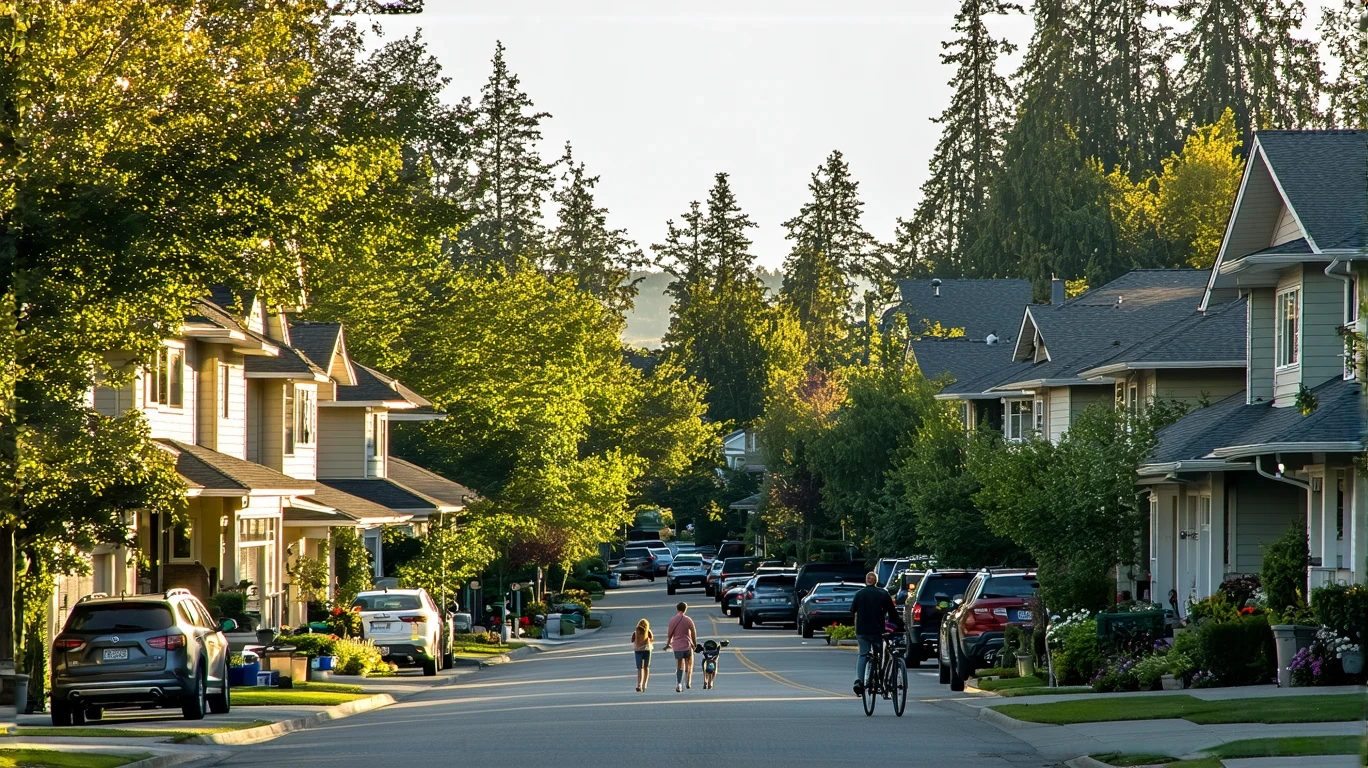
Kirkland’s infrastructure offers some relief from total car dependence. Walkable pockets with high pedestrian and bike infrastructure allow residents in certain neighborhoods to reduce vehicle trips for errands or recreation. Food establishments cluster along corridors, and park access is abundant, with water features integrated throughout. However, transit is bus-only, and grocery density sits in the medium band, meaning households still rely on cars for many weekly tasks. The result is a hybrid cost profile: lower transportation intensity than fully car-dependent suburbs, but higher housing pressure than most peer cities.
Driver verdict: Housing entry cost dominates, with transportation as a significant but variable secondary factor depending on commute length and household vehicle count. Surprises come from the interaction between walkable pockets and corridor-clustered errands—some trips are easy on foot or bike, but full car-free living isn’t viable, leaving households with one foot in each mode.
Housing Costs (Primary Driver)
Kirkland’s median home value of $937,700 represents the steepest cost barrier for most households. Ownership here requires substantial down payment capacity, mortgage qualification well into six figures, and ongoing exposure to property taxes, insurance, and maintenance on a high-value asset. For buyers, the entry cost is the defining challenge—not the monthly carrying cost relative to income, but the sheer capital required to enter the market.
Renting offers a lower entry threshold but still commands $2,250 per month at the median. That figure reflects a competitive rental market where demand remains strong and supply is constrained by the broader Seattle metro housing shortage. Renters avoid the down payment hurdle and property tax exposure, but they face rent renewal risk and limited control over year-to-year cost changes.
The renting versus owning decision here hinges on time horizon and capital availability. Buyers who can clear the entry bar gain long-term cost stability and equity accumulation in a high-value market. Renters preserve flexibility and avoid the transaction costs and maintenance risks of ownership, but they remain exposed to rental market volatility. Kirkland functions as a long-term ownership market for those with access to capital, and a transitional or lifestyle-driven rental market for those prioritizing mobility or testing the region before committing.
| Housing Type | Cost Anchor | What That Buys You |
|---|---|---|
| Median Home Value | $937,700 | Ownership entry in a high-value, stable market with long-term equity potential |
| Median Rent | $2,250/month | Flexibility and lower entry cost, with exposure to renewal increases |
Conclusion: Kirkland is a buying market for households with capital and a long time horizon, and a transitional or lifestyle rental market for those prioritizing flexibility over ownership.
Utilities & Energy Risk
Electricity in Kirkland is billed at 13.81¢ per kilowatt-hour, a rate that sits in the moderate range for the Pacific Northwest. Heating and cooling demands are shaped by the region’s mild, marine climate—extended cool, damp periods drive heating usage in fall and winter, while brief warm spells in summer create modest air conditioning demand. Households here face longer heating seasons than cooling seasons, and electricity often powers both, depending on home systems.
Natural gas is priced at $17.38 per thousand cubic feet (MCF), or roughly 100 therms. For homes using gas heat, this translates to moderate baseline exposure during colder months, with volatility tied to regional supply dynamics and winter weather severity. Gas bills fluctuate more than electric bills, but the swings are predictable and tied to seasonal heating cycles rather than year-round variability.
Utility costs here don’t dominate household budgets the way housing or transportation do, but they introduce seasonal rhythm and modest exposure to rate changes. Homes with older insulation, single-pane windows, or inefficient HVAC systems will see higher usage and correspondingly higher bills. Efficiency upgrades—better insulation, programmable thermostats, heat pumps—reduce usage and stabilize costs, but the payoff is incremental rather than transformative.
Risk classification: Moderate. Utilities contribute steady, predictable costs with seasonal variation, but they don’t create the same financial pressure or decision complexity as housing or transportation.
Groceries & Daily Costs
Kirkland’s grocery and daily cost environment reflects the broader high-cost structure of the Seattle metro area. The regional price parity index of 151 signals that everyday purchases—from fresh produce to household staples—run meaningfully above national norms. This isn’t about individual line-item sticker shock; it’s about cumulative pressure across weekly shopping trips.
Food establishments in Kirkland cluster along commercial corridors, with density exceeding high thresholds for restaurants and cafes but sitting in the medium band for grocery stores. This means dining out and grabbing coffee are highly accessible in certain neighborhoods, while grocery shopping may require a slightly longer trip or a drive to a preferred store. The corridor-clustered pattern creates convenience for some errands and friction for others, depending on where a household lives and what they’re purchasing.
For households, this translates to steady upward pressure on food budgets compared to lower-cost regions, but not the extreme swings seen in utilities or the dominance of housing. Families with multiple members or specific dietary needs will feel the cumulative impact more acutely than single-person households with flexible shopping habits. The key is recognizing that grocery costs here are part of the broader regional cost structure—predictable, persistent, and tied to location rather than household behavior.
Transportation Reality
Transportation in Kirkland operates as a recurring exposure shaped by vehicle dependency, commute patterns, and fuel costs. Gas prices stand at $5.37 per gallon, well above national averages and a persistent drain on households that drive frequently. For commuters traveling to Seattle, Bellevue, or other regional employment centers, fuel costs compound with time, wear on vehicles, and the practical need to own and maintain at least one car per working adult in most households.
Kirkland’s infrastructure reduces but does not eliminate car dependency. Walkable pockets with high pedestrian and bike infrastructure allow some residents to handle errands, recreation, and short trips without driving. Bus service is present, but the absence of rail transit limits the viability of car-free commuting for most workers. Corridor-clustered food and grocery access means some trips are walkable, but weekly shopping or trips outside the immediate neighborhood still require a vehicle.
The result is a hybrid transportation profile. Households can reduce vehicle trips compared to fully car-dependent suburbs, but they can’t eliminate the need for at least one car. Commuters face ongoing fuel and maintenance costs, and those working outside Kirkland bear the time and distance burden of regional travel. Transportation here functions as a secondary but significant cost driver—less dominant than housing, but more variable and tied to individual commute length and household vehicle count.
How this article was built: In addition to public economic data, this article incorporates location-based experiential signals derived from anonymized geographic patterns—such as access density, walkability, and land-use mix—to reflect how day-to-day living actually feels in Kirkland, WA.
Cost Exposure Profiles
Cost exposure in Kirkland is defined by three structural factors: housing entry versus long-term ownership, transportation dependence, and utility seasonality. Each factor creates different pressure depending on household composition, commute patterns, and housing tenure.
Housing entry versus long-term ownership: Buyers face the highest upfront exposure—down payment, closing costs, and qualification requirements tied to a $937,700 median home value. Once ownership is established, costs stabilize around mortgage payments, property taxes, insurance, and maintenance. Renters avoid the entry barrier but remain exposed to rent renewal increases and market volatility. The tradeoff is capital access versus flexibility.
Transportation dependence: Households with long commutes or multiple vehicles face sustained fuel and maintenance costs. Gas at $5.37 per gallon compounds quickly for daily drivers. Households in walkable pockets with short commutes or remote work can reduce vehicle trips and lower transportation exposure. The difference between low-exposure and high-exposure situations here can represent thousands of dollars annually, driven entirely by commute length and vehicle count.
Utility volatility: Seasonal heating and cooling cycles create predictable but variable utility bills. Homes with efficient systems and good insulation face lower exposure; older homes with poor weatherization face higher costs and more volatility. The swings are moderate compared to housing or transportation, but they add rhythm to monthly cash flow.
Low-exposure situations in Kirkland typically involve ownership (or long-term rental stability), short commutes or remote work, one vehicle, and energy-efficient housing. High-exposure situations involve renting with frequent moves, long commutes, multiple vehicles, and older homes with poor insulation. The city’s cost structure rewards stability, proximity, and efficiency—and penalizes transience, distance, and waste.
Frequently Asked Questions
Is Kirkland more affordable than Seattle in 2026? Kirkland’s housing costs are lower than Seattle’s most expensive neighborhoods but higher than many Seattle suburbs. The regional price parity index and gas prices are comparable, so affordability differences hinge on specific neighborhood comparisons and housing type rather than a clear citywide advantage.
What does a typical cost profile look like in Kirkland? A typical household faces high housing costs (either mortgage or rent), moderate utility bills with seasonal variation, elevated fuel costs if commuting, and grocery expenses that run above national norms. The dominant cost is housing, followed by transportation for those with longer commutes.
Do utilities cost more in Kirkland than nearby areas? Utility rates in Kirkland are moderate for the region. Electricity at 13.81¢ per kWh and natural gas at $17.38 per MCF are comparable to other Seattle-area suburbs. Costs vary more by home efficiency and usage patterns than by location within the metro area.
What costs tend to surprise newcomers in Kirkland? Newcomers often underestimate the cumulative impact of high gas prices on commuting costs and the degree to which housing entry cost (down payment, closing costs) dominates the financial picture. The corridor-clustered errands pattern also surprises those expecting uniform walkability—some neighborhoods are highly walkable, others require driving for most tasks.
Are property taxes higher in Kirkland than Bellevue? Property tax rates vary by jurisdiction and are influenced by local levies, school district funding, and assessed home values. Direct comparison requires looking at effective rates and assessed values in specific neighborhoods. Kirkland’s high median home value means property tax bills can be substantial even if rates are moderate.
Can you live in Kirkland without a car? Living without a car in Kirkland is difficult for most households. Walkable pockets and bus service reduce vehicle trips, but the absence of rail transit and corridor-clustered grocery access mean most residents need at least one car for commuting, shopping, and regional travel.
How do grocery costs in Kirkland compare to Redmond? Both cities sit within the same high-cost Seattle metro area, so grocery costs are broadly similar. Differences come down to specific store locations, shopping habits, and proximity to discount retailers rather than meaningful citywide price gaps.
Is Kirkland a good place for renters or buyers? Kirkland favors buyers with capital and a long time horizon—ownership provides cost stability and equity accumulation in a high-value market. Renters benefit from flexibility and lower entry cost but face exposure to rent increases and limited long-term cost predictability. The city works for both, but the financial logic differs sharply between the two paths.
—