
How Grocery Costs Feel in Grand Prairie
Grocery prices in Grand Prairie sit slightly above the national baseline, reflecting a regional price parity index of 103—meaning the same basket of goods costs about 3% more here than in an average U.S. metro. For most households, this doesn’t translate to sticker shock at checkout, but it does mean that food spending requires intentional choices, especially for families managing volume needs or singles watching per-item costs add up. The difference between shopping strategically and shopping casually can be the gap between comfortable and tight, particularly when staple items like ground beef, cheese, and eggs appear in the cart week after week.
Who notices grocery costs most? Singles and young professionals often feel the pressure earlier, since even modest per-pound prices become meaningful when income share is considered. A household earning Grand Prairie’s median income of $76,626 per year has more cushion to absorb week-to-week variability, but families with kids face a different calculus: volume amplifies small differences. When you’re buying chicken, milk, and bread for four or five people instead of one or two, a 20-cent difference per pound or per gallon compounds quickly. Retirees on fixed incomes, meanwhile, prioritize predictability and waste reduction, making store tier and shopping rhythm critical levers.
The texture of grocery shopping in Grand Prairie also reflects how food access is structured. Food and grocery options tend to cluster along commercial corridors rather than distribute evenly across neighborhoods, meaning that store choice often requires intentional routing rather than convenience-driven stops. This pattern doesn’t create food deserts, but it does mean that households who want access to discount-tier pricing or specialty stores need to plan trips around location, not just proximity. For families managing tight schedules, that tradeoff between time and savings becomes a recurring decision point.
Grocery Price Signals (Illustrative)
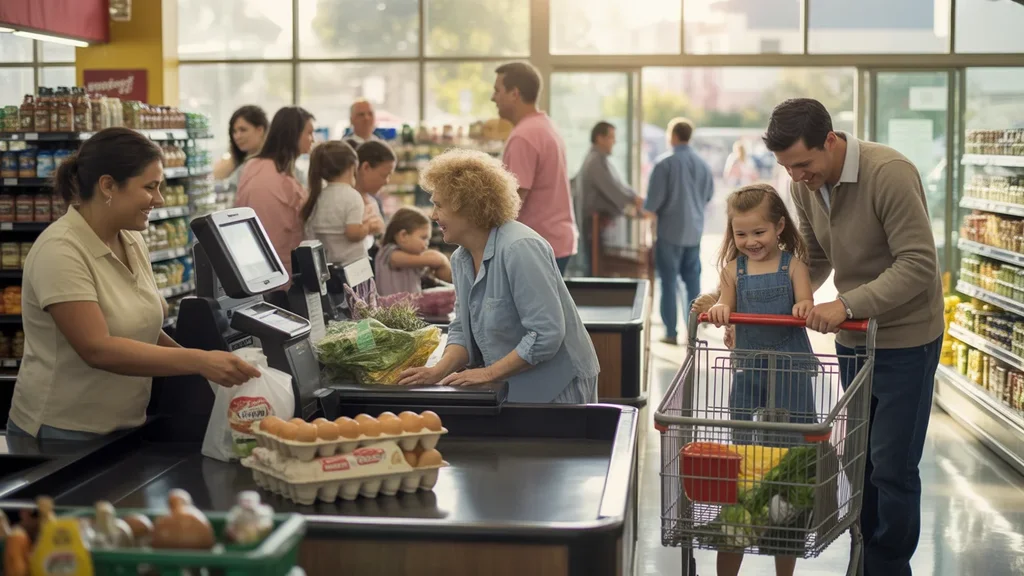
The table below shows illustrative prices for common staple items in Grand Prairie, derived from national baseline data adjusted for regional price parity. These figures are not store-specific or week-specific; they exist to show how staple costs tend to compare locally, not to simulate a full shopping list or guarantee checkout accuracy.
| Item | Price |
|---|---|
| Bread | $1.91/lb |
| Cheese | $4.82/lb |
| Chicken | $2.11/lb |
| Eggs | $2.58/dozen |
| Ground Beef | $6.94/lb |
| Milk | $4.15/half-gallon |
| Rice | $1.11/lb |
Derived estimate based on national baseline adjusted by regional price parity; not an observed local price.
These prices illustrate relative positioning rather than absolute guarantees. Ground beef at nearly $7 per pound and cheese near $5 per pound represent the higher end of the staple spectrum, while rice and bread remain accessible even for budget-conscious shoppers. Eggs at $2.58 per dozen and chicken at $2.11 per pound fall into a middle band—not cheap, but not prohibitive. The key takeaway is that Grand Prairie’s grocery landscape doesn’t tilt dramatically expensive or bargain-priced; it sits in a zone where household behavior and store choice drive outcomes more than the baseline itself.
Store Choice & Price Sensitivity
Grocery price pressure in Grand Prairie varies significantly by store tier, and understanding that variation is more useful than fixating on a single “average” experience. Discount-tier grocers—think no-frills layouts, limited selection, and house brands—offer the lowest per-unit prices, often 15–25% below mid-tier chains. These stores work best for households willing to trade convenience and variety for cost control, and they’re especially valuable for families buying in volume or retirees managing fixed incomes. The tradeoff is time: discount stores may require separate trips for specialty items or fresh produce, and they’re not always located along the most convenient routes.
Mid-tier grocery chains dominate the corridor-clustered food landscape in Grand Prairie, offering a balance of price, selection, and accessibility. These stores stock national brands alongside store labels, maintain predictable layouts, and often anchor shopping centers with ample parking. For dual-income households or families managing tight schedules, mid-tier stores represent the path of least resistance—not the cheapest option, but reliable and efficient. The price premium over discount stores is real, but it buys time and reduces decision fatigue, which matters when you’re shopping with kids or squeezing errands between work and dinner.
Premium grocers—organic-focused chains, specialty markets, or high-service stores—occupy a smaller share of the local landscape but serve households prioritizing quality, sourcing, or dietary preferences. Prices at premium stores can run 30–50% above discount-tier equivalents, and the gap widens for organic, grass-fed, or specialty items. For high-income households or those with specific health or ethical priorities, the premium is justified. For budget-conscious families, premium stores are occasional destinations rather than weekly anchors. The key insight is that Grand Prairie’s grocery market offers tier choice, but accessing that choice requires intentional routing and planning, not passive convenience.
What Drives Grocery Pressure Here
Income interaction is the first lever. At a median household income of $76,626 per year, Grand Prairie households have moderate flexibility, but that flexibility shrinks quickly for families with kids or single-income households. A couple without children might absorb a $150–$200 weekly grocery habit without strain, but a family of four or five managing the same per-person costs faces a different reality. The absence of state income tax in Texas helps—households keep more of their gross income—but that advantage doesn’t eliminate the volume sensitivity that defines family grocery pressure.
Household size sensitivity is the second driver. Small per-unit price differences—20 cents per pound of chicken, 30 cents per half-gallon of milk—compound rapidly when multiplied across weekly volume. A single person buying two pounds of chicken and one half-gallon of milk per week barely notices the difference between discount and mid-tier pricing. A family of four buying ten pounds of chicken and four half-gallons of milk per week sees that difference add up to $10 or $15, week after week. Over a month, that’s $40–$60, and over a year, it’s $500–$700. This is why store tier choice matters more for families than for singles or couples.
Regional distribution and access patterns also shape grocery pressure. Because food and grocery options cluster along corridors rather than distribute evenly, households face a recurring tradeoff between proximity and price. A discount-tier store might be ten minutes farther than the nearest mid-tier chain, and that extra time matters differently depending on schedule flexibility, fuel costs, and household logistics. For dual-income families managing tight schedules, the time cost of chasing savings can outweigh the dollar benefit. For retirees or remote workers with more schedule control, the tradeoff tilts the other way.
Seasonal variability, while not extreme in Grand Prairie’s climate, still affects produce pricing and availability. Summer brings lower prices for tomatoes, peppers, and melons; winter shifts the cost curve toward root vegetables and citrus. Households that adapt menus to seasonal availability reduce costs without sacrificing nutrition, but that requires planning and flexibility. Families locked into rigid meal routines or picky eaters face higher costs year-round, since they’re buying out-of-season produce at premium prices.
Practical Ways People Manage Grocery Costs
Store tier rotation is one of the most effective behavioral strategies. Households that split their shopping between discount stores for staples and mid-tier chains for fresh produce or specialty items capture most of the savings without the full inconvenience cost. This approach works best when paired with intentional trip planning—buying shelf-stable goods in bulk at the discount store once or twice a month, then filling in fresh items weekly at the closer mid-tier chain. The key is avoiding the trap of “just one item” trips, which erode both time and fuel efficiency.
House brands and store labels offer another lever. Mid-tier chains stock house-brand versions of most staples—bread, dairy, canned goods, pasta—at prices 10–20% below national brands. Quality differences are often minimal, especially for commodity items like rice, flour, or canned tomatoes. Families willing to experiment with store brands can reduce weekly costs without changing their diet or shopping rhythm. The savings aren’t dramatic per item, but they’re consistent, and consistency compounds over months.
Waste reduction is a quieter but equally important strategy. Households that plan menus around what’s already in the pantry, freeze leftovers, and repurpose ingredients reduce effective per-meal costs without cutting quality. A family that throws away 15% of what they buy is effectively paying a 15% premium on every trip. Retirees and empty-nesters, who often cook for one or two, face the highest waste risk, since bulk pricing doesn’t always align with consumption speed. Buying smaller quantities more frequently, or splitting bulk purchases with neighbors, helps manage that tradeoff.
Seasonal menu adaptation and flexibility also reduce costs. Households that build meals around what’s cheap and abundant—summer squash in July, sweet potatoes in November—pay less per pound and per meal than those locked into rigid routines. This doesn’t require culinary expertise; it just requires noticing what’s on sale and adjusting accordingly. Families with picky eaters or dietary restrictions face more friction here, but even modest flexibility—swapping one vegetable for another, or choosing chicken over beef when the price gap widens—helps stabilize costs.
Groceries vs Eating Out (Directional)
The tradeoff between cooking at home and eating out shapes grocery pressure in ways that aren’t always obvious. Households that cook most meals at home face higher grocery bills but lower total food spending. Households that eat out frequently—whether for convenience, preference, or time constraints—reduce grocery costs but increase overall food exposure. The break-even point depends on household size, income, and schedule flexibility, but the directional logic holds: cooking at home costs more per trip to the store and less per meal consumed.
For families, the math tilts heavily toward home cooking. Feeding four people at a casual restaurant costs $50–$80 before tip; feeding the same four people a home-cooked meal with similar ingredients costs $15–$25. The time cost is real—shopping, prep, cooking, cleanup—but the dollar savings are large enough that most families treat eating out as occasional rather than routine. Singles and couples face a different calculus: the time cost of cooking for one or two is proportionally higher, and the dollar savings are smaller, so eating out becomes more competitive, especially for lunch or quick dinners.
The key insight is that grocery costs and dining costs aren’t independent; they’re substitutes. Households managing tight budgets reduce dining out to make room for groceries. Households with more income flexibility use dining out to buy back time, accepting higher total food costs in exchange for convenience. In Grand Prairie, where monthly expenses are shaped by housing and transportation as much as food, the grocery-versus-dining tradeoff is one of the few levers households can adjust week to week without long-term commitment.
FAQs About Grocery Costs in Grand Prairie (2026)
Is it cheaper to shop in bulk in Grand Prairie? Bulk purchasing reduces per-unit costs for shelf-stable staples like rice, pasta, canned goods, and household supplies, but only if you have storage space and can use the volume before expiration. Families and larger households benefit most; singles and couples risk waste unless they split purchases or have consistent consumption patterns.
Which stores in Grand Prairie are best for low prices? Discount-tier grocers offer the lowest per-unit prices, typically 15–25% below mid-tier chains, but they require intentional routing since food options cluster along corridors rather than distribute evenly. Mid-tier stores balance price and convenience, while premium grocers serve households prioritizing organic, specialty, or high-service options at a significant markup.
How much more do organic items cost in Grand Prairie? Organic versions of staples like milk, eggs, chicken, and produce typically cost 30–60% more than conventional equivalents, with the gap widening for specialty or grass-fed items. Premium grocers stock the widest organic selection but at the highest prices; mid-tier chains offer limited organic options at moderate premiums.
How do grocery costs for two adults in Grand Prairie tend to compare to nearby cities? Grand Prairie’s regional price parity index of 103 suggests costs run slightly above the national baseline, similar to other Dallas-area suburbs. Households shopping at comparable store tiers in nearby cities will see similar price levels, though specific item costs fluctuate based on local distribution and competition.
How do households in Grand Prairie think about grocery spending when cooking at home? Most households treat grocery spending as a controllable variable, adjusting store tier, brand choice, and waste habits to fit their budget and schedule. Families prioritize volume and predictability; singles and couples balance convenience against per-item costs; retirees focus on waste reduction and fixed-income stability.
Does Grand Prairie’s lack of state income tax affect grocery budgets? Yes, indirectly. Texas households keep more of their gross income compared to states with income tax, leaving more room for discretionary spending including groceries. This doesn’t lower food prices, but it does reduce the income share required to maintain a given standard of living.
How does seasonal produce pricing work in Grand Prairie? Produce prices follow regional and national growing seasons, with summer bringing lower costs for tomatoes, peppers, squash, and melons, and winter favoring root vegetables, citrus, and greens. Households that adapt menus to seasonal availability reduce costs without sacrificing nutrition, but rigid meal routines or picky eaters limit that flexibility.
How Groceries Fit Into the Cost of Living in Grand Prairie
Grocery costs in Grand Prairie occupy a middle position in the household budget hierarchy—less dominant than housing or transportation, but more variable and controllable than utilities. For most households, food spending represents 10–15% of gross income, a share that feels manageable when housing and commuting costs are stable but becomes a pressure point when those larger categories tighten. The advantage of grocery costs is that they respond to behavior: store choice, brand flexibility, waste reduction, and seasonal adaptation all offer levers that households can adjust week to week without long-term commitment.
Understanding how groceries interact with other cost categories is critical for realistic budgeting. A household that secures affordable housing and minimizes commuting costs has more room to absorb grocery variability or prioritize quality and convenience. A household stretched thin by rent and fuel costs will feel grocery pressure more acutely, even if per-item prices are identical. This is why isolated grocery cost analysis is useful for comparison but insufficient for decision-making. The full picture—how food spending fits alongside housing, transportation, utilities, and discretionary costs—is what determines whether a household feels comfortable or strained.
For readers building a complete cost-of-living picture, the Monthly Spending in Grand Prairie: The Real Pressure Points article provides the integrated view that connects grocery costs to housing, transportation, and other recurring expenses. That’s where you’ll find the tradeoffs, the household-specific breakdowns, and the decision framework that turns individual cost categories into actionable budget planning. Grocery costs matter, but they matter most in context, and context is what the monthly budget breakdown delivers.
How this article was built: In addition to public economic data, this article incorporates location-based experiential signals derived from anonymized geographic patterns—such as access density, walkability, and land-use mix—to reflect how day-to-day living actually feels in Grand Prairie, TX.