
Can you live in Germantown without a car? The answer depends less on whether transit exists and more on how you structure your daily life. Germantown sits in Montgomery County’s northwest corridor, about 30 miles from downtown Washington, D.C., with rail access that connects commuters to the regional job market—but a layout that still expects most households to drive for groceries, schools, and errands. Understanding transportation options in Germantown means recognizing that transit works well for some trips and some people, while leaving others dependent on a vehicle for nearly everything.
What newcomers often misunderstand is that Germantown isn’t uniformly car-dependent or uniformly transit-friendly. It’s a place where infrastructure exists in pockets: rail stations anchor certain neighborhoods, bike paths appear along specific corridors, and walkable stretches give way quickly to areas where sidewalks thin out and distances stretch. The result is a mobility landscape that rewards proximity and punishes distance, where your specific address determines whether you’ll use transit daily or whether you’ll need a car just to pick up milk.
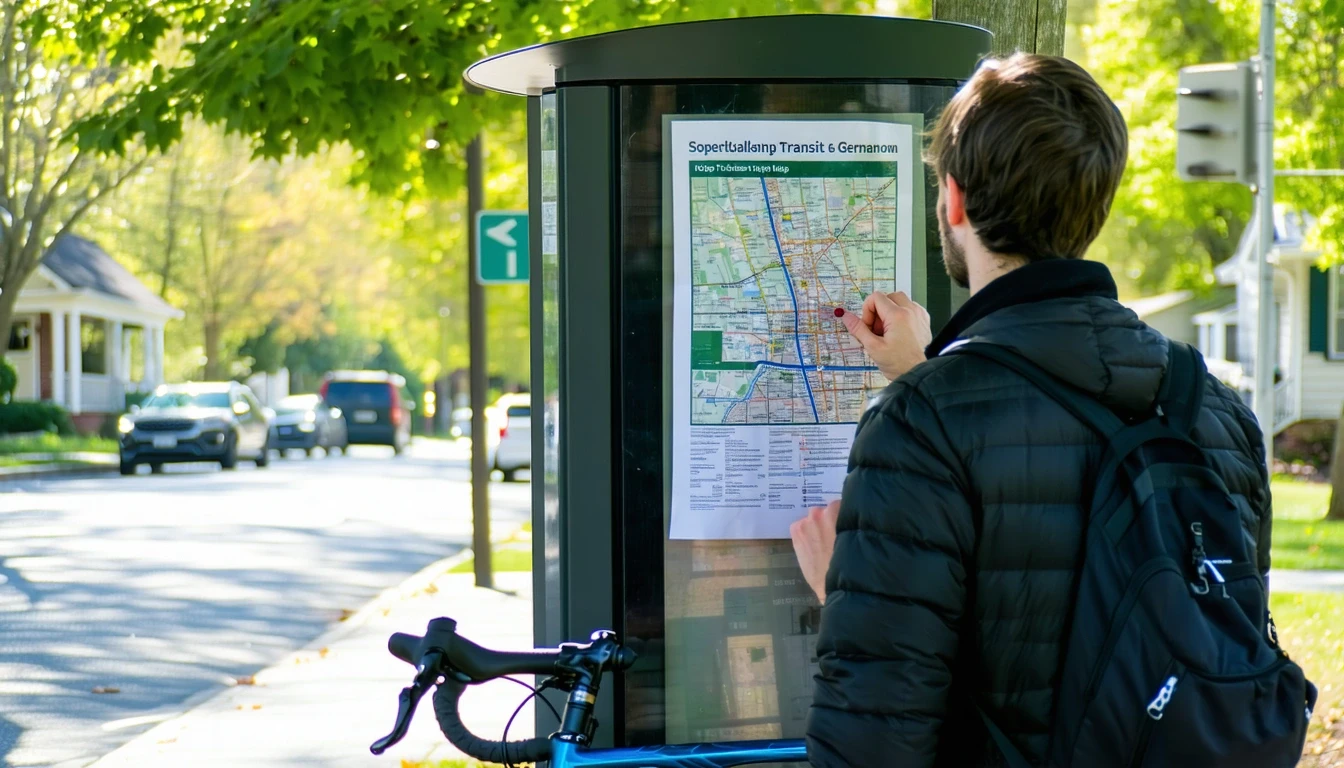
How People Get Around Germantown
Most people in Germantown drive most of the time. The city’s development pattern—a mix of townhome clusters, single-family subdivisions, and commercial centers separated by wider roads—creates a structure where cars handle the majority of daily trips. But that doesn’t mean transit is absent or irrelevant. Rail service connects Germantown to Washington, D.C., and the broader Metro system, making it possible for commuters to avoid driving into the city entirely. The question isn’t whether transit exists; it’s whether it reaches the places you need to go, when you need to get there.
The dominant pattern is selective transit use: people drive to the station, take the train to work, and drive again for everything else. Bike infrastructure appears in certain areas, supporting recreational rides and short commutes for those who live near the right corridors. But the overall rhythm of life here assumes access to a car. Errands, school drop-offs, weekend trips—these typically happen by vehicle, even for households that rely on transit for weekday commuting.
What shapes this pattern isn’t preference—it’s density and land use. Germantown’s grocery stores, medical facilities, and schools are clustered along commercial corridors rather than distributed evenly across neighborhoods. That clustering means some households can walk or bike to daily needs, while others face gaps that make driving the only practical option. The city’s layout doesn’t eliminate car dependence; it creates islands of walkability within a larger car-oriented framework.
Public Transit Availability in Germantown
Public transit in Germantown often centers around systems such as WMATA’s Metrorail Red Line and Ride On, Montgomery County’s bus service. The Red Line provides the most significant connection, linking Germantown to Rockville, Bethesda, and downtown D.C. For commuters working in the District or along the Metro corridor, this rail access changes the transportation equation entirely—it makes car-free commuting viable, at least for the work trip itself.
But transit’s usefulness drops sharply outside the commute context. Rail stations serve specific nodes, and unless you live or work near one, the system doesn’t help much. Bus service fills some gaps, connecting neighborhoods to commercial areas and transit hubs, but coverage varies widely. Some areas see frequent service; others see buses that run only during peak hours or require long waits. The result is a transit network that works well for structured, predictable trips—like a 9-to-5 commute—and poorly for flexible, multi-stop errands.
Transit tends to work best in Germantown’s denser pockets, near the rail stations and along the main commercial corridors. It tends to fall short in the residential subdivisions farther from these nodes, where service is sparse and walking distances to stops stretch beyond what most people will tolerate daily. Late hours and weekends see reduced service, which limits transit’s role in social or recreational trips. For someone living near a station and working along the Metro line, transit is a genuine option. For someone living two miles from the nearest stop, it’s functionally unavailable.
Driving & Car Dependence Reality
Driving isn’t just common in Germantown—it’s structurally necessary for most households. The city’s layout spreads residential areas, schools, grocery stores, and services across a geography that doesn’t support walking or transit for the full range of daily needs. Even households that use transit for commuting typically own at least one car to handle everything else: picking up kids, running errands, getting to appointments, reaching areas without bus service.
Parking pressure is generally low. Most housing includes dedicated parking, whether it’s a driveway, garage, or assigned spot in a townhome community. Street parking exists but isn’t the primary mode. This reduces one of the friction points that makes car ownership costly in denser cities, though it also reflects the reality that Germantown’s design assumes cars as the default.
Car dependence here isn’t about sprawl in the classic suburban sense—it’s about the gaps between walkable nodes. You might live in a neighborhood where you can walk to a park or a small retail strip, but getting to a full grocery store, a medical facility, or a different part of town almost always requires a vehicle. The infrastructure supports driving well: roads are wide, traffic flows relatively smoothly outside peak hours, and commercial areas provide ample parking. But that same infrastructure makes non-car mobility harder, because distances are calibrated for vehicles, not pedestrians.
For families, car dependence intensifies. School locations, activity schedules, and the need to manage multiple stops in a single trip all push households toward driving. Even in areas with decent pedestrian infrastructure, the low density of schools and playgrounds means parents are often shuttling kids across town rather than walking them around the block.
Commuting Patterns & Daily Mobility
Commuting in Germantown reflects its role as a regional bedroom community. The average commute runs 33 minutes, and 53.6% of workers face long commutes, indicating that many residents travel significant distances to reach jobs in Washington, D.C., Rockville, or other parts of the metro area. These aren’t quick neighborhood trips—they’re regional hauls that shape daily schedules and determine how much time people spend in transit.
For those commuting into D.C., rail transit offers a real alternative to sitting in traffic on I-270. The trade-off is predictability versus flexibility: trains run on fixed schedules, but they avoid the variability of highway congestion. For those commuting to suburban job centers or locations not served by Metro, driving remains the only practical option. 17.1% of workers work from home, a meaningful share that reflects both the nature of work in the region and the appeal of avoiding a long commute entirely.
Daily mobility beyond commuting tends to be car-based. The structure of Germantown—where grocery stores, schools, and services cluster along corridors rather than distributing evenly—means most errands require driving. Even households that bike or walk for recreation typically drive for functional trips. The city’s design doesn’t support the kind of dense, mixed-use environment where you can walk out your door and reach everything you need within a few blocks.
Multi-stop trips are particularly difficult without a car. Dropping off kids, stopping for groceries, and picking up a prescription in one loop requires the flexibility that only driving provides. Transit can handle point-to-point commutes, but it breaks down when trips become complex or time-sensitive.
Who Transit Works For—and Who It Doesn’t
Transit works best in Germantown for individual commuters who live near a Metro station and work along the rail line. If your daily trip is home to station to office and back, the system handles that well. You avoid traffic, avoid parking costs in D.C., and gain time to read or work during the ride. Renters in neighborhoods close to transit nodes benefit the most, because they can structure their housing choice around access.
Transit works poorly for families with school-age children. The low density of schools and playgrounds—evident in the infrastructure data—means parents are managing drop-offs, pickups, and activity schedules across distances that don’t align with bus routes or train stations. Even if one parent commutes by Metro, the household almost certainly needs a car for everything else.
Transit also struggles to serve households in Germantown’s less dense residential areas, where the nearest bus stop might be a half-mile walk and service runs infrequently. For these households, transit isn’t a matter of preference—it’s simply not a viable tool for daily life. The infrastructure exists in theory, but the practical barriers (distance, frequency, coverage gaps) make it irrelevant.
Older adults and retirees face a mixed picture. Those who’ve built their routines around driving may find transit difficult to adopt later, especially if mobility limits make walking to stops harder. But those who live near rail or frequent bus service may find transit offers independence without the cost and responsibility of car ownership.
Transportation Tradeoffs in Germantown
Choosing between transit and driving in Germantown isn’t about cost alone—it’s about control, predictability, and flexibility. Transit offers predictability: trains run on schedule, and commute times don’t vary with traffic. But transit sacrifices flexibility: you’re bound to routes, schedules, and the locations the system serves. Driving offers flexibility: you go where you want, when you want, and you can chain errands together. But driving exposes you to traffic variability, parking challenges in D.C., and the ongoing costs of fuel and maintenance.
For commuters, the tradeoff often comes down to whether your job is located along the Metro line. If it is, transit becomes a serious option, and the predictability advantage is significant. If your job is in a suburban office park or an area without rail access, driving is the only real choice, and the flexibility advantage matters less because you don’t have an alternative anyway.
For daily errands and household logistics, driving dominates because the city’s structure doesn’t support transit for these trips. The grocery store, the pediatrician, the hardware store—these are scattered across corridors and centers that aren’t connected by walkable or transit-friendly paths. Households that try to rely on transit for everything face constant friction: long waits, indirect routes, and gaps in coverage that force compromises or fallback driving.
The real tradeoff in Germantown isn’t transit versus driving in the abstract—it’s whether your specific address and daily destinations align with where transit actually goes. If they do, you gain options. If they don’t, you’re driving, and the question becomes how to manage that dependence rather than whether to avoid it.
FAQs About Transportation in Germantown (2026)
Is public transit usable for daily commuting in Germantown?
Yes, if you live near a Metro station and work along the Red Line or another Metro-accessible location. Rail service connects Germantown to Washington, D.C., and the broader transit network, making car-free commuting viable for those trips. For commutes to suburban job centers or areas without rail access, driving remains the primary option.
Do most people in Germantown rely on a car?
Yes. The majority of households own and use cars for daily errands, school runs, and trips outside the transit network. Even households that commute by Metro typically keep a car for everything else, because the city’s layout and service density make driving necessary for most non-commute trips.
Which areas of Germantown are easiest to live in without a car?
Neighborhoods near Metro stations and along corridors with frequent bus service offer the best chance of reducing car dependence. But even in these areas, most households find that a car is necessary for errands, family logistics, and trips outside the immediate transit zone. True car-free living is rare and requires careful alignment of home, work, and daily needs.
How does commuting in Germantown compare to nearby cities?
Germantown’s average commute of 33 minutes and high percentage of long commutes reflect its role as a regional commuter suburb. Compared to closer-in areas like Rockville or Bethesda, commutes here tend to be longer, though rail access keeps them manageable for those working in D.C. Compared to more car-dependent outer suburbs, Germantown offers better transit options but still expects most households to drive.
Can families manage without a car in Germantown?
It’s very difficult. The low density of schools and playgrounds, combined with the distances between residential areas and services, makes car-free family life impractical for most households. Parents managing school schedules, activities, and errands face logistical challenges that transit and walking can’t solve in Germantown’s current layout.
How Transportation Fits Into the Cost of Living in Germantown
Transportation in Germantown isn’t just a line item—it’s a structural factor that shapes where you can live, how you spend your time, and what tradeoffs you’re willing to accept. Choosing a home near Metro might mean higher rent but lower commute stress and no need for parking in D.C. Choosing a home farther out might mean lower housing costs but higher car dependence and longer travel times. These aren’t just financial decisions; they’re decisions about daily rhythm, flexibility, and control.
For a fuller picture of how transportation costs interact with housing, utilities, and other expenses, see Your Monthly Budget in Germantown: Where It Breaks. That article walks through the broader cost structure and helps you see where transportation pressure fits into the overall financial picture.
The key insight is that transportation in Germantown works best when you treat it as a system with options, not a single mode. Rail serves commuters well. Cars handle everything else. Bikes and walking work in pockets. The households that manage transportation costs most effectively are the ones that match their housing location to their daily travel patterns and accept the infrastructure as it is, rather than expecting it to be something it’s not.
How this article was built: In addition to public economic data, this article incorporates location-based experiential signals derived from anonymized geographic patterns—such as access density, walkability, and land-use mix—to reflect how day-to-day living actually feels in Germantown, MD.