
74 out of 100 residents say they’re happy in Federal Way—but that number tells only part of the story. What makes Federal Way feel right for some households creates friction for others, and understanding the emotional texture of life here requires looking past averages into the tradeoffs people navigate daily.
Federal Way sits in a space many suburban cities occupy uncomfortably: close enough to Seattle to feel its gravitational pull, developed enough to offer convenience, yet still shaped by the rhythms and expectations of suburban life. The result is a community where satisfaction depends heavily on what you came looking for—and whether the city’s particular mix of access, infrastructure, and cost aligns with your household’s priorities.
What Federal Way Feels Like Day to Day
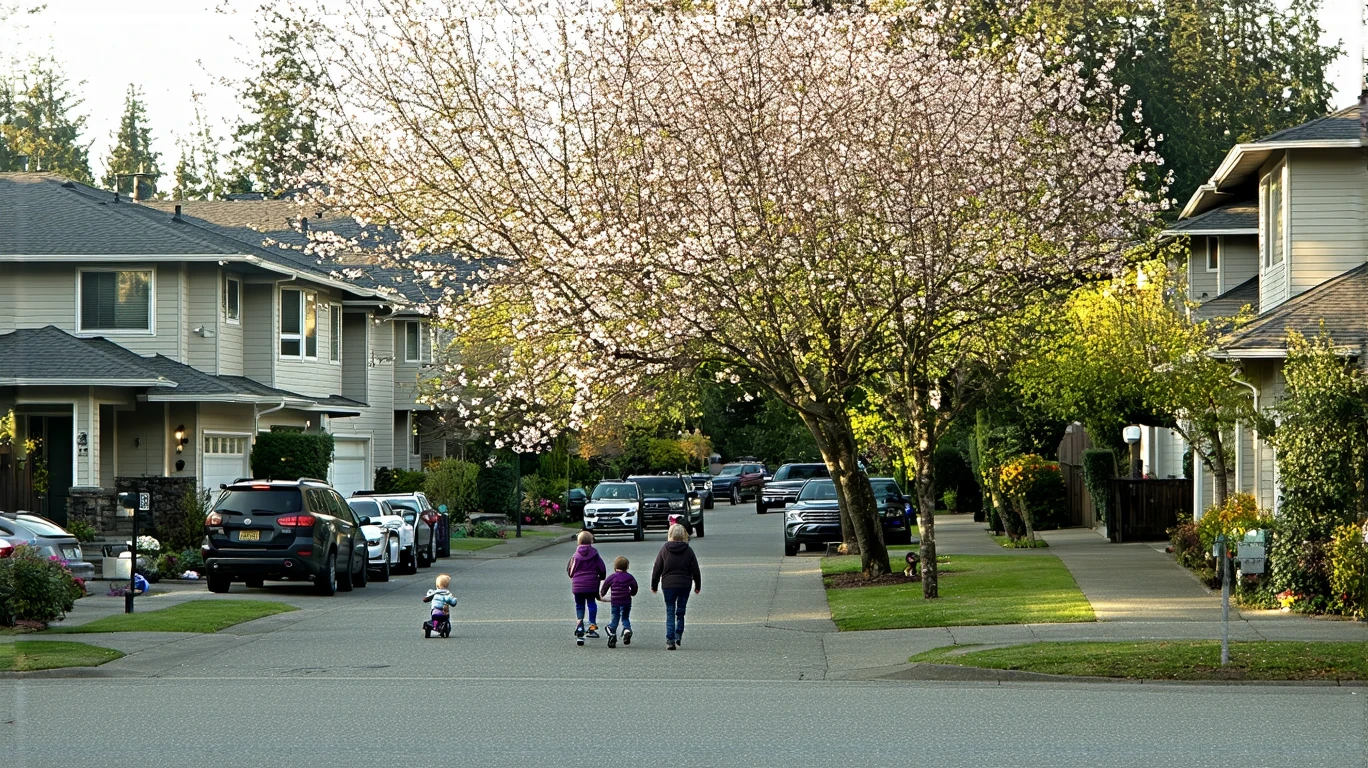
Federal Way rewards pragmatism. Families find strong infrastructure here—schools are accessible, playgrounds are woven throughout neighborhoods, and parks don’t require a weekend expedition. Green space isn’t an occasional amenity; it’s integrated into the city’s layout, with water features adding texture to the outdoor environment. For households with children, this combination creates a reliable daily rhythm: errands are manageable, outdoor time is easy to access, and the logistics of family life don’t require constant problem-solving.
Grocery and food options are broadly accessible, meaning most residents can handle daily errands without long drives or elaborate planning. This isn’t a city where you’re stuck choosing between one overpriced market and a long trip to alternatives. The density of food establishments exceeds typical suburban thresholds, which translates into real convenience when managing a household.
Transit connectivity adds a layer many suburbs lack. Rail service is present, and for commuters willing to build their routines around it, that access to the Seattle metro opens up employment and lifestyle options without requiring full car dependency. Cycling infrastructure is notable throughout parts of the city, and pedestrian-to-road ratios in certain areas support walking as a genuine option—not everywhere, but in pockets where the built environment makes it practical.
Yet Federal Way’s walkability isn’t uniform. The city has areas where pedestrian infrastructure is substantial, but it also has stretches that default to car-oriented patterns. If you’re expecting to walk to most destinations from any address, you’ll likely feel let down. The city works best for people who appreciate having walkable options available without expecting them universally.
Building heights here trend more vertical than in many suburban peers, and mixed land use—residential and commercial woven together—creates a different feel than purely residential subdivisions. For some, this adds vibrancy and reduces the sense of isolation. For others, it signals a departure from the quiet, low-density suburban ideal they were seeking.
Social Media Buzz in Federal Way
Online discussions about Federal Way tend to circle around a few recurring themes: proximity to Seattle, the tension between suburban comfort and urban convenience, and the question of whether the cost premium feels justified.
Residents often express appreciation for what the city offers families. “We’ve got parks, decent schools, and I can actually get groceries without it being a whole thing,” one commenter noted. “It’s not flashy, but it works.” That pragmatic satisfaction shows up frequently—people who came for function rather than excitement tend to feel the city delivers.
But there’s also a thread of restlessness, particularly among younger professionals and those who moved from denser urban environments. “It feels like we’re paying Seattle-adjacent prices for a place that still requires a car for most things,” another voice observed. “The light rail helps, but it’s not the same as actually being in the city.”
Conversations about growth and change carry a protective edge. Long-time residents sometimes express concern that Federal Way is losing its suburban character as development increases, while newer arrivals push for more walkable infrastructure and urban amenities. Neither group is wrong; they’re simply prioritizing different versions of what the city should be.
Local News Tone
Coverage of Federal Way tends to frame the city through the lens of transition and identity. Headlines and story angles often reflect a community negotiating what it wants to become:
- “Community Debates What Growth Should Look Like”
- “New Amenities Arrive as Suburban Identity Evolves”
- “Residents Weigh Convenience Against Affordability”
- “Transit Expansion Shapes Commuter Patterns”
- “Families Find Infrastructure, But Housing Costs Climb”
The tone is rarely celebratory or alarmist—it’s observational, focused on the practical tensions residents navigate. Stories tend to acknowledge that Federal Way offers real advantages while also surfacing the frustrations that come with living in a city caught between suburban tradition and urban aspiration.
Review-Based Public Perception
Public reviews of Federal Way—whether on Google, Yelp, or neighborhood platforms—reveal a city that meets expectations for some household types while disappointing others.
Families and older adults frequently praise the city’s parks, accessibility, and relative quiet. “Great place to raise kids,” one review noted. “Everything we need is close, and we’re not drowning in traffic or noise.” For households prioritizing stability, green space, and logistical ease, Federal Way often delivers.
Younger professionals and remote workers, however, sometimes express frustration with the lack of nightlife, walkable entertainment districts, and cultural texture. “It’s fine if you want suburban life,” one reviewer wrote, “but if you’re looking for energy or spontaneity, you’ll be driving to Seattle a lot.”
Healthcare access draws mixed feedback. Clinics and pharmacies are present, which handles routine needs, but the absence of a hospital means more serious care requires travel. For healthy households, this rarely registers as a problem. For those managing chronic conditions or raising young children, it’s a friction point that adds planning overhead.
Newer planned areas tend to receive more favorable reviews for walkability and amenities, while older pockets are described as more car-dependent and less visually cohesive. The city’s experience isn’t monolithic—where you live within Federal Way significantly shapes how it feels.
Comparison to Nearby Cities
| Aspect | Federal Way | Kent | Tacoma |
|---|---|---|---|
| Overall Vibe | Suburban with urban conveniences; family-focused | Industrial-suburban mix; more working-class feel | Urban core with grit; more cultural texture |
| Walkability | Pockets of strong pedestrian infrastructure | Mostly car-dependent; limited walkable areas | Downtown walkable; neighborhoods vary widely |
| Transit Access | Rail present; solid commuter option | Bus-focused; less rail connectivity | Stronger transit network; more route options |
| Family Appeal | Strong schools and parks; integrated green space | Functional but less polished infrastructure | Urban amenities but more variability in school quality |
| Cost Pressure | Above regional baseline; Seattle proximity premium | More affordable; trade-off in amenities | Mixed; some neighborhoods pricey, others accessible |
Federal Way occupies a middle position between Kent’s more industrial, budget-conscious character and Tacoma’s grittier urban energy. If you want suburban structure with better transit and family infrastructure than Kent offers, Federal Way makes sense. If you’re drawn to Tacoma’s cultural texture and denser urban core but worry about variability in schools and safety, Federal Way offers more predictability—at a cost.
Kent tends to attract households prioritizing affordability over polish, while Tacoma appeals to those who want urban living without Seattle’s price tag and are willing to navigate neighborhood-level inconsistency. Federal Way fits households seeking a stable, family-friendly base with metro access, who can absorb the cost premium that comes with it.
What Locals Are Saying
“We moved here from Seattle when our second kid was born. The parks are great, the schools work for us, and we can still get into the city when we want to. It’s not exciting, but that’s kind of the point.”
— Parent of two, moved from Seattle three years ago
“I take the light rail to work, and it’s honestly been a game-changer. Yeah, the commute isn’t short, but I can read or work instead of sitting in traffic. For me, that makes Federal Way livable.”
— Commuter working in downtown Seattle
“It’s fine, but I feel like I’m paying a lot for ‘fine.’ The grocery stores are good, the parks are nice, but there’s not much happening here. If I want to do anything interesting, I’m driving.”
— Young professional, renting for two years
“I’ve been here for over a decade, and I’ve watched it change. More apartments, more traffic, more people. Some of that’s good—better restaurants, more options—but it doesn’t feel as quiet as it used to.”
— Long-time homeowner
“We looked at Tacoma and Kent, too, but Federal Way felt like the best balance. We’ve got green space, the commute to Seattle is doable, and the schools were a big factor. It’s not cheap, but we’re getting what we need.”
— Family with school-age children
“Healthcare is my only real complaint. For regular stuff, the clinics are fine, but when my mom had a health scare, we had to drive to Tacoma. It’s not a dealbreaker, but it’s something to know going in.”
— Adult child caring for aging parent
“I work remotely, and honestly, Federal Way feels a little isolating. There’s no real downtown vibe, no walkable coffee shop scene. It’s built for families and commuters, not for people like me.”
— Remote worker, single, early 30s
Does Federal Way Feel Like a Good Fit?
Federal Way tends to work well for families who value strong infrastructure, integrated green space, and transit access to Seattle without needing to live in the urban core. It rewards households who appreciate suburban rhythms but want more convenience and connectivity than typical bedroom communities offer. If your priorities include schools, parks, manageable errands, and the option to commute by rail, Federal Way’s structure aligns with those needs.
The city tends to frustrate people seeking uniform walkability, vibrant nightlife, or dense urban texture. It also challenges budget-conscious households, as the cost structure reflects proximity to Seattle and the amenities that come with it. If you’re expecting a low-cost suburban refuge or a place where you can walk everywhere, Federal Way will likely feel like a mismatch.
Satisfaction here hinges on expectation alignment. Federal Way doesn’t try to be Seattle, and it’s not a rural escape. It’s a pragmatic middle ground—functional, accessible, family-oriented, and increasingly vertical. For households whose needs match that profile, the city delivers. For those seeking something else, the friction points will likely outweigh the conveniences.
If you’re considering Federal Way, it’s worth exploring how monthly expenses shape daily life, what quality of life factors matter most to your household, and how housing tradeoffs play out in practice. The city’s vibe isn’t about happiness as a score—it’s about whether the particular mix of access, cost, and infrastructure matches what you’re actually looking for.
How this article was built: In addition to public economic data, this article incorporates location-based experiential signals derived from anonymized geographic patterns—such as access density, walkability, and land-use mix—to reflect how day-to-day living actually feels in Federal Way, WA.
The perspectives shown reflect commonly expressed local sentiment and recurring themes in public discussion, rather than individual accounts.