
Is Federal Way expensive to live in? Federal Way is considered moderately priced in 2026, with median home values at $454,300 and median rent at $1,660 per month. The value proposition depends on housing entry cost versus commute exposure—transportation and ownership structure drive total cost pressure more than day-to-day expenses.
When Jenna moved to Federal Way in early 2026, she expected Seattle-area prices across the board. What she found instead was a city where the biggest financial decisions weren’t about groceries or utilities—they were about whether to rent or buy, and how far she’d be willing to commute. Her first month taught her that Federal Way’s cost structure rewards those who can minimize drive time and lock in stable housing, while penalizing long-distance commuters and those caught between renting and ownership.
Overall Cost of Living Snapshot
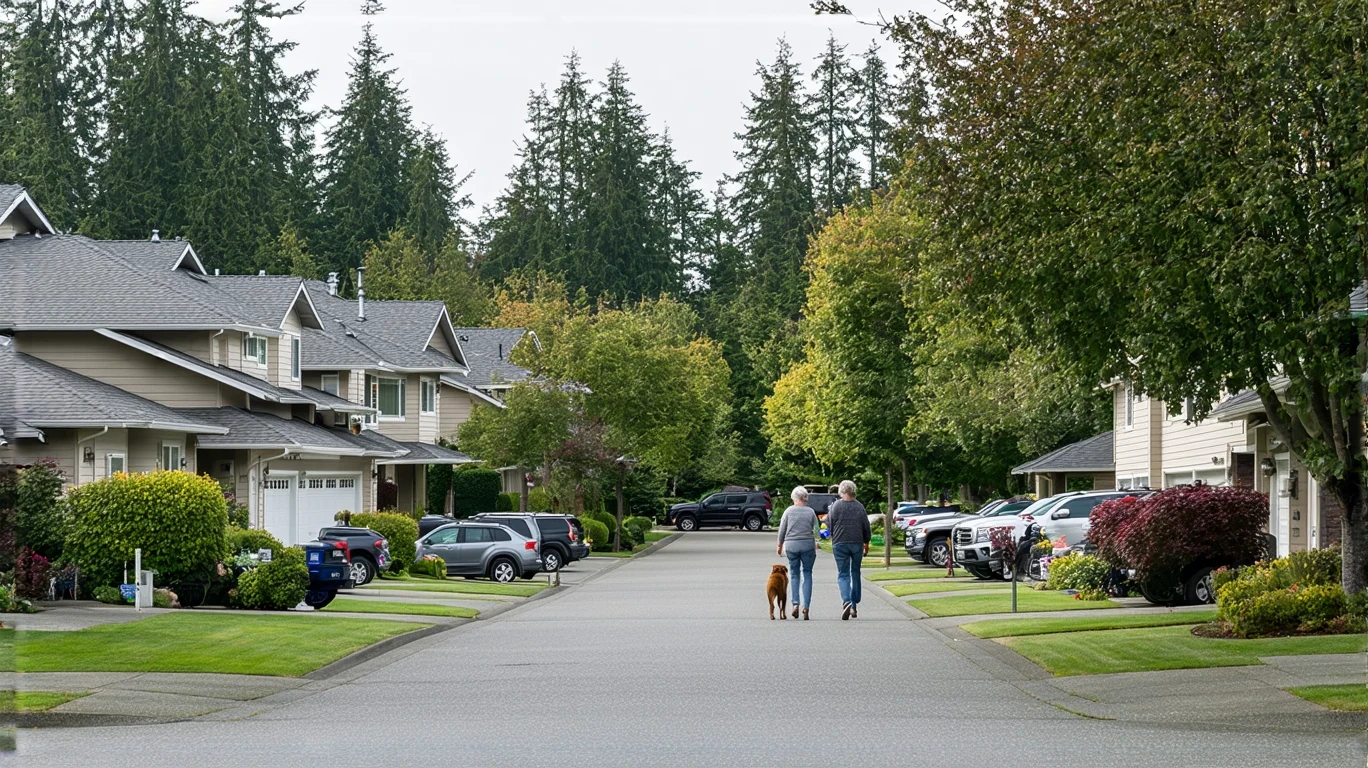
Federal Way sits in the middle tier of Seattle-metro affordability in 2026. With a regional price parity index of 113, the city runs about 13% above the national baseline—but that premium is concentrated in housing and transportation, not spread evenly across all categories. Median household income stands at $80,360 per year, and the cost structure reflects a suburban pattern: high fixed costs (housing, vehicles) paired with moderate variable expenses (groceries, utilities).
The primary cost driver is housing entry—whether that’s a down payment on a $454,300 home or navigating a competitive rental market where median gross rent hits $1,660 per month. Transportation follows closely behind, shaped by a 33-minute average commute and gas prices near $4.72 per gallon. Utilities and groceries exert steady but secondary pressure, with electricity at 13.33¢/kWh and natural gas priced at $15.51 per MCF.
What surprises newcomers isn’t the price of milk or heating bills—it’s the realization that cost structure in Federal Way hinges on two big bets: where you live relative to work, and whether you’re renting or owning. Get those right, and day-to-day expenses feel manageable. Get them wrong, and the city’s moderate baseline costs compound quickly.
Driver verdict: Housing entry cost dominates upfront pressure, while commute length and vehicle dependency determine ongoing exposure. Grocery and utility costs remain predictable and moderate, rarely the source of financial stress.
Housing Costs (Primary Driver)
Housing is the single largest cost lever in Federal Way, and it splits sharply depending on whether you rent or buy. Median gross rent of $1,660 per month positions the city as more accessible than Seattle proper but still a significant monthly commitment. Renters gain flexibility and avoid maintenance risk, but they remain exposed to lease renewals and market-driven increases over time.
Homeownership, by contrast, requires navigating a median home value of $454,300—a substantial entry barrier that demands strong credit, savings, and income stability. Once locked in, however, owners gain long-term cost predictability (especially with fixed-rate financing) and insulation from rental market volatility. Property taxes, insurance, and maintenance add ongoing costs, but these tend to be more stable and controllable than rent trajectories in competitive markets.
The city’s urban form—characterized by more vertical building profiles and mixed land use—means housing stock varies widely. Some neighborhoods offer single-family homes with yards, while others feature townhomes and mid-rise apartments. This diversity creates opportunities for different household types, but it also means that “affordable” in Federal Way is highly dependent on housing type, location within the city, and proximity to transit or employment hubs.
Conclusion: Federal Way functions as a transitional city for many—renters who need flexibility before committing, and buyers who are willing to absorb high entry costs in exchange for long-term stability. It’s neither a pure rental market nor a universally accessible ownership market; it rewards those who can time their entry and align housing choice with commute and lifestyle needs.
| Housing Type | Cost Anchor | What That Buys You |
|---|---|---|
| Renting | $1,660/month median | Flexibility, no maintenance risk, exposure to lease renewals |
| Buying | $454,300 median home value | High entry cost, long-term stability, insulation from rent volatility |
Utilities & Energy Risk
Utility costs in Federal Way remain moderate and predictable, shaped primarily by the Pacific Northwest’s temperate climate. Electricity rates of 13.33¢/kWh sit near regional norms, and natural gas pricing at $15.51 per MCF (roughly $1.55 per therm) reflects typical heating-season exposure rather than extreme volatility.
For illustrative context, a household using around 1,000 kWh per month would face a baseline electric bill near $133 before fees and taxes. Natural gas usage varies seasonally—heating months might see usage around 1 MCF per month (approximately 100 therms), translating to roughly $155 in gas costs during peak winter periods. Cooling demand remains minimal compared to hotter U.S. regions, so summer utility spikes are rare.
The primary risk isn’t price—it’s behavioral. Homes with poor insulation, older HVAC systems, or inefficient water heating can see disproportionate bills relative to neighbors in newer or better-maintained units. Renters have limited control over these factors, while homeowners can invest in efficiency upgrades to reduce long-term exposure.
Risk classification: Minor to moderate. Utilities are a steady, manageable expense for most households, with seasonal swings driven more by usage patterns than price volatility. The biggest exposure comes from housing quality, not rate structures.
Groceries & Daily Costs
Grocery costs in Federal Way reflect the regional price parity index of 113, running modestly above the national baseline but without the extreme premiums seen in urban cores. The city’s infrastructure supports this: food and grocery establishment density exceeds high thresholds, meaning residents have broadly accessible options rather than being forced into single-store dependence or long drives for basics.
Day-to-day shopping feels routine rather than restrictive. Stores such as regional chains and familiar national grocers are present, offering competitive pricing and frequent promotions. The density of options also means households can shop strategically—choosing discount retailers for staples and specialty stores for specific needs—without adding significant drive time or inconvenience.
For most households, grocery pressure is moderate and stable. It’s not a category that swings wildly month to month, nor does it present the kind of structural cost barrier that housing or transportation do. Families with specific dietary needs or preferences may face higher costs, but the baseline accessibility and competition keep everyday grocery runs from becoming a major financial stressor.
Transportation Reality
Transportation is where Federal Way’s cost structure becomes unavoidable. The average commute clocks in at 33 minutes, and 53.6% of workers face long commutes—a clear signal that many residents are traveling significant distances for work. Only 17.2% work from home, meaning the majority are on the road regularly, and that creates recurring exposure to fuel costs, vehicle maintenance, insurance, and depreciation.
Gas prices near $4.72 per gallon add up quickly for those driving substantial distances. For illustrative context, a commuter traveling 25 miles round trip in a vehicle averaging 25 MPG would use about one gallon per day, translating to roughly $95 per month in fuel costs alone (before tolls, parking, or maintenance). Double the commute distance, and that exposure doubles.
The city does offer rail transit service, and bike infrastructure is notably present, with bike-to-road ratios exceeding high thresholds. Pedestrian infrastructure is substantial in parts of the city, creating walkable pockets where car dependency can be reduced—but these benefits are geographically concentrated. For many residents, especially those commuting to Seattle or Tacoma, a personal vehicle remains non-negotiable.
Transportation isn’t just a line item in Federal Way—it’s a structural cost exposure that compounds based on where you live, where you work, and whether you can access transit or reduce drive frequency. It’s the category where small decisions (choosing a job closer to home, carpooling, timing errands) can yield the largest cumulative savings.
Cost Exposure Profiles
Federal Way’s cost structure creates distinct exposure profiles depending on housing choice, commute length, and household composition. Understanding these profiles helps clarify where financial pressure concentrates—and where it can be managed.
Low-exposure situations: Renters with short commutes or remote work arrangements face the most predictable cost structure. Monthly rent is fixed, utilities are moderate, and transportation costs remain minimal. Access to groceries and errands is broadly available, and the city’s parks and green space (which exceed high density thresholds) provide low-cost recreation options. For these households, Federal Way offers a stable, mid-tier cost environment without major volatility.
Moderate-exposure situations: Homeowners with average commutes experience higher fixed costs (mortgage, property taxes, insurance) but gain long-term stability and insulation from rent increases. Transportation becomes a recurring but manageable expense, especially if one household member works locally or from home. Families benefit significantly here—school and playground density both meet medium thresholds, and the mixed land use means errands, schools, and parks are often accessible without long drives.
High-exposure situations: Long-distance commuters—especially those renting and unable to lock in housing costs—face compounding pressure. High rent, high fuel costs, and vehicle depreciation stack quickly, and the time cost of commuting reduces flexibility for cost-saving behaviors (meal prep, comparison shopping, DIY maintenance). Renters in this position are also vulnerable to lease renewals that can reset baseline costs unpredictably.
The city’s experiential structure plays a meaningful role in these profiles. Because Federal Way has broadly accessible grocery options, integrated green space, and strong family infrastructure, households that can minimize commute exposure and stabilize housing costs gain significant quality-of-life benefits without needing to spend heavily on convenience or recreation. Conversely, those stuck in long commutes or unstable housing situations find it harder to leverage the city’s accessible amenities—they’re time-poor and cost-exposed simultaneously.
Federal Way rewards optimization: aligning work location with housing, choosing transit-accessible neighborhoods where possible, and locking in stable housing early. It penalizes misalignment, where high rent and long commutes create a cycle of recurring, unavoidable costs.
Frequently Asked Questions
Is Federal Way more affordable than Seattle in 2026? Yes, directionally. Median home values and rents in Federal Way run lower than Seattle proper, but the affordability advantage depends heavily on commute tradeoffs—savings on housing can be offset by transportation costs if you’re still commuting into the city daily.
What does a typical cost profile look like in Federal Way? Housing dominates, followed by transportation. Utilities and groceries remain moderate and predictable. The biggest variable is commute length—short commutes keep total costs manageable, while long commutes compound quickly.
Do utilities cost more in Federal Way than in nearby cities? Not significantly. Electricity and natural gas rates are near regional norms, and the temperate climate keeps seasonal swings moderate. Utility costs are rarely a primary differentiator compared to housing or transportation.
What costs tend to surprise newcomers in Federal Way? Transportation exposure, especially for those underestimating commute frequency or distance. Many newcomers also don’t anticipate how much housing choice (rent vs. buy, location within the city) shapes total cost structure.
Are property taxes higher in Federal Way than in Tacoma? Property tax rates vary by jurisdiction and assessment practices. Federal Way’s tax burden is shaped by local levies, school district funding, and county-level rates—direct comparison requires looking at effective rates for similar home values, which can shift year to year.
Is Federal Way a good value for families in 2026? Federal Way offers strong family infrastructure—schools and playgrounds both meet density thresholds, parks are integrated throughout the city, and grocery access is broadly available. Families who can minimize commute costs and stabilize housing find significant value here.
Can you live in Federal Way without a car? It’s possible in specific neighborhoods, particularly those near rail transit and within walkable pockets, but the majority of residents rely on personal vehicles. Commute patterns and job locations make car ownership the norm rather than the exception.
How does Federal Way compare to Renton or Kent for overall cost of living? Federal Way tends to be similarly positioned within the Seattle metro’s middle affordability tier. Differences come down to specific housing stock, proximity to employment centers, and transit access rather than dramatic cost gaps across categories.
How this article was built: In addition to public economic data, this article incorporates location-based experiential signals derived from anonymized geographic patterns—such as access density, walkability, and land-use mix—to reflect how day-to-day living actually feels in Federal Way, WA.