
Lynnwood sits in a region where housing costs run high, but the texture of daily life — how you move, where you shop, how much time you spend managing logistics — varies more than the price tags suggest. The question isn’t just whether your income covers the bills. It’s whether the tradeoffs you’ll make to stay within budget align with the lifestyle you’re trying to build. Comfort here isn’t about hitting a magic number. It’s about whether your income gives you enough room to absorb the volatility, make choices that fit your household, and avoid the constant recalculation that defines financial stress.
Median household income in Lynnwood stands at $72,241 per year. Median gross rent is $1,611 per month. The median home value is $596,200. Those figures set the baseline, but they don’t explain who feels stretched and who doesn’t — or why two households earning similar amounts can experience completely different levels of pressure.
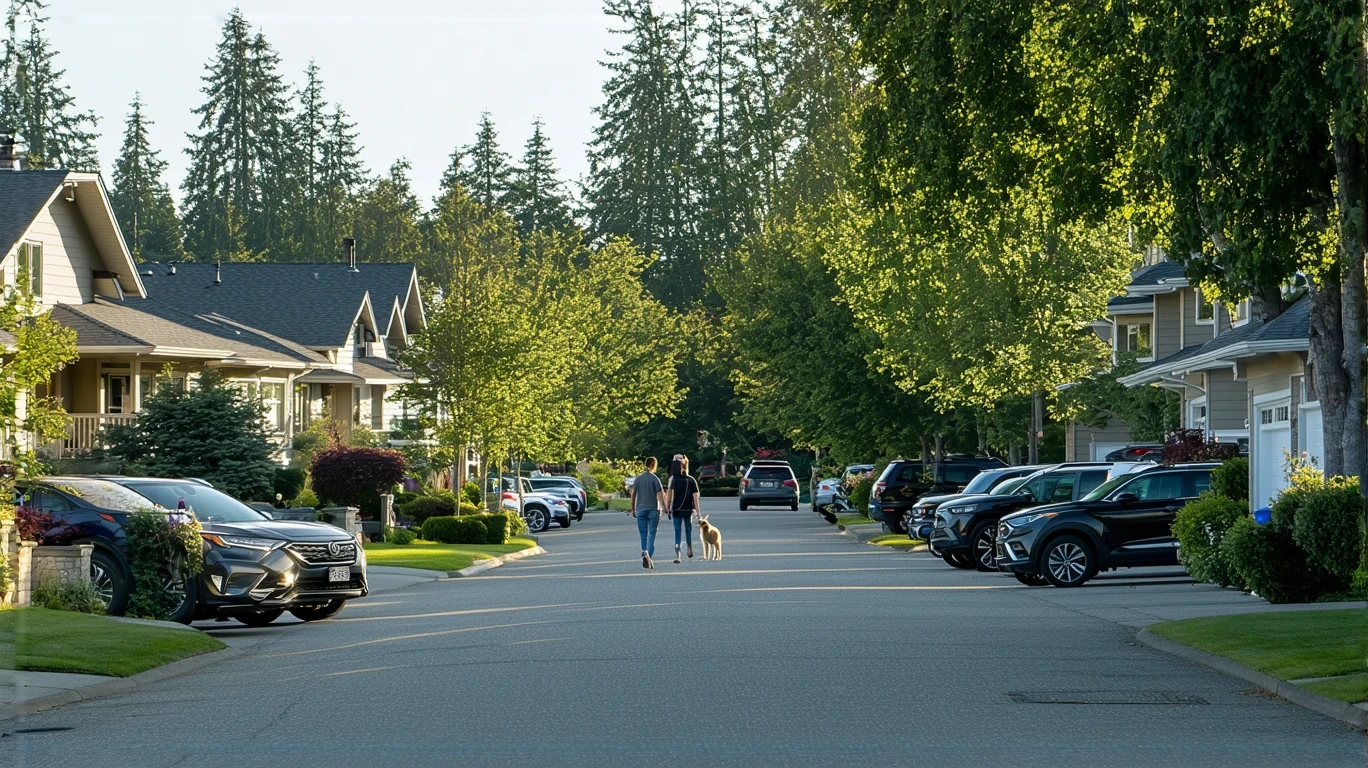
What “Living Comfortably” Means in Lynnwood
Comfort in Lynnwood means different things depending on what you value and what you’re willing to negotiate. For some, it’s the ability to live in a walkable pocket where errands don’t require a car and transit access expands your commute options. For others, it’s space — a yard, an extra bedroom, distance from arterials — even if that means driving more and planning around fuel costs. Comfort also means absorbing seasonal swings in heating and cooling without rethinking your budget every few months, and it means having enough slack that an unexpected expense doesn’t cascade into a crisis.
Lynnwood’s structure creates real differences in how households experience daily life. Walkable pockets with high pedestrian-to-road ratios and rail service mean that some residents can reduce or eliminate car dependency, cutting transportation costs and reclaiming time. Grocery and food establishment density exceeds high thresholds across much of the city, so running errands doesn’t require long drives or advance planning. Parks are integrated throughout, and school and playground infrastructure is strong, which matters for families managing the logistics of children’s routines. But healthcare access is limited to clinics — there’s no hospital in Lynnwood — so households with complex medical needs or young children face additional travel and planning.
Comfort isn’t about whether you can technically afford to live here. It’s about whether the tradeoffs required to make it work leave you with the flexibility, time, and control you expect from your income level.
Where Income Pressure Shows Up First
Housing dominates. Whether you’re renting or buying, the share of income that goes to keeping a roof overhead determines how much room you have for everything else. At $1,611 per month, median rent consumes a significant portion of gross monthly income for single earners and even for couples where one partner works part-time or is between jobs. Families face even steeper pressure — larger units cost more, and the desire for proximity to schools and parks often narrows the pool of affordable options.
Transportation pressure depends heavily on where you live within Lynnwood and how you structure your commute. Walkable pockets and rail access mean that some households can function without a car or reduce vehicle usage significantly, avoiding not just fuel costs but also insurance, maintenance, and parking. But if your job, childcare, or regular obligations sit outside transit-accessible zones, car dependency becomes non-negotiable. Gas prices in Lynnwood stand at $5.39 per gallon, and even moderate commuting quickly adds up. The tradeoff isn’t just money — it’s time. Households that can’t afford to live near work or transit often pay in hours spent behind the wheel.
Utilities introduce seasonal volatility. Electricity rates run 13.81¢ per kWh, and natural gas costs $17.38 per MCF. Lynnwood’s climate means heating expenses during winter months and moderate cooling needs in summer. The issue isn’t the average — it’s the swing. Households operating with thin margins feel the difference between a $60 winter gas bill and a $150 one, and that variability makes it harder to maintain predictable monthly budgets.
For families, pressure also shows up in time and logistics. Even with strong school and playground infrastructure, managing pickups, activities, grocery runs, and healthcare appointments requires either flexibility in your work schedule or the ability to pay for help. Lynnwood’s high grocery and food accessibility reduces some friction — you’re not driving across town for basics — but the absence of a local hospital means that anything beyond routine care requires travel, and that adds both time and unpredictability.
How the Same Income Feels Different by Household
Single adults often find that Lynnwood’s walkable pockets and transit access create real financial breathing room. If you can live near rail service and don’t need a car for daily errands, you eliminate a major cost category entirely. Rent still takes a large share of income, but the ability to avoid car ownership, insurance, and fuel costs makes it easier to stay within budget. The tradeoff is space — smaller units, fewer choices, and less control over neighborhood character. But for someone prioritizing flexibility and minimizing fixed costs, that tradeoff often works.
Couples with two incomes experience Lynnwood differently. Housing costs that would strain a single earner become manageable when split, and the ability to share transportation — or to position one partner near transit while the other drives — creates more options. Couples also have more flexibility to absorb seasonal utility swings and to make strategic tradeoffs around location, space, and commute time. The pressure points shift: instead of whether you can afford to live here, the question becomes whether the lifestyle you’re funding matches what you expected.
Families face compounding pressure. Larger housing units cost more, and the desire to live near strong school and playground infrastructure narrows the options. Grocery accessibility helps — Lynnwood’s high food and grocery density means you’re not adding long drives to an already packed schedule — but healthcare logistics remain a friction point. Families with young children or anyone managing chronic conditions have to plan around the absence of a local hospital, and that adds both time and stress. Transportation costs also multiply: even in walkable areas, families often need a car for activities, appointments, and errands that don’t fit neatly into a transit schedule. Households at similar income levels often experience very different pressure depending on how many of these variables they can control.
The Comfort Threshold (Qualitative)
Comfort in Lynnwood begins when housing pressure stops dictating every other decision. It’s the point where you can choose a neighborhood based on fit rather than affordability alone, where a $100 utility swing doesn’t require recalculating your grocery budget, and where transportation becomes a matter of preference rather than necessity. It’s when saving becomes a regular behavior instead of an aspiration, and when an unexpected expense — a car repair, a medical bill, a broken appliance — doesn’t cascade into a financial crisis.
This threshold isn’t the same for everyone. A single adult living in a walkable pocket with no car might reach it at a lower income than a family of four managing school logistics, healthcare travel, and seasonal utility volatility. A couple with two incomes and no children might feel comfortable at a level that would leave a single parent stretched thin. The threshold isn’t a number — it’s the point where your income gives you enough room to make choices that align with your priorities, rather than forcing you to accept whatever fits the budget.
Why Online Cost Calculators Get Lynnwood Wrong
Most cost-of-living calculators treat Lynnwood as a set of averages: median rent, typical utilities, estimated transportation. They produce a total and call it done. But totals don’t explain how life actually works here. A household living in a walkable pocket near rail service experiences fundamentally different transportation costs and time demands than a household in a car-dependent area. A family with access to strong school and playground infrastructure faces different daily logistics than one navigating long drives for every activity. Seasonal utility swings mean that averages mislead — what matters is whether you can absorb the peaks without stress.
Calculators also ignore structure. Lynnwood’s high grocery and food accessibility means that errands don’t require the same level of planning or driving as in less dense areas, but that advantage doesn’t show up in a line item. The absence of a hospital affects healthcare costs and time in ways that a generic “healthcare” category can’t capture. And the presence of rail transit and notable bike infrastructure creates real options for reducing car dependency — but only if your job, childcare, and daily obligations align with those systems.
People feel surprised after moving because the calculators told them what things cost, but not how those costs interact with the way they actually live. The issue isn’t that the numbers are wrong — it’s that the numbers don’t explain who thrives here and who doesn’t.
How to Judge Whether Your Income Fits Lynnwood
Start by asking how sensitive you are to housing tradeoffs. Can you accept a smaller unit, fewer amenities, or a less desirable location in exchange for lower rent? Or do you need space, quiet, and control over your environment to feel settled? Your answer determines how much of your income will go to housing, and that determines how much room you’ll have for everything else.
Next, consider whether you can function without a car — or with less driving than you do now. If you work remotely, or if your job and daily errands align with Lynnwood’s walkable pockets and rail service, you can eliminate or significantly reduce transportation costs. But if your obligations require regular driving, especially during peak hours or to areas outside the city, fuel costs and time behind the wheel will add up quickly. The question isn’t just whether you can afford a car — it’s whether the time and money spent driving fit within your larger budget and lifestyle expectations.
Ask yourself how much seasonal utility volatility you can absorb without stress. If a $100 swing in your winter gas bill would require you to cut back elsewhere, that’s a signal that your income might not provide enough cushion for Lynnwood’s cost structure. Comfort requires the ability to handle predictable variability without constant recalculation.
If you have children, think about how much time and flexibility you have for managing logistics. Lynnwood offers strong school and playground infrastructure and high grocery accessibility, which reduces some friction. But the absence of a hospital means that anything beyond routine care requires travel, and that adds both time and unpredictability. Families with young children, chronic conditions, or anyone who needs regular access to specialized care should factor that into their planning.
Finally, ask whether time or money is your limiting factor. If you have income to spare but limited time, Lynnwood’s walkable pockets, transit access, and high errands accessibility can reduce the hours you spend managing daily tasks. But if money is tight and you’re willing to spend time to save it — driving farther for cheaper groceries, living in a less convenient location to cut rent — you’ll need to be honest about whether that tradeoff is sustainable over the long term.
FAQs About Living Comfortably in Lynnwood
Is $72,241 per year enough to live comfortably in Lynnwood?
It depends entirely on your household structure and what you’re willing to negotiate. For a single adult living in a walkable area without a car, that income can provide real breathing room. For a family of four, it’s much tighter — housing, transportation, and seasonal utility costs will consume most of it, leaving little margin for unexpected expenses or saving. Comfort isn’t about whether the income technically covers the bills; it’s about whether it leaves you with enough flexibility to make choices that fit your life.
Can you live in Lynnwood without a car?
Yes, but it depends on where you live and work. Lynnwood has walkable pockets with high pedestrian infrastructure, rail service, and notable bike presence. If your job, errands, and daily obligations align with those areas, you can significantly reduce or eliminate car dependency. But if you need to commute outside the city, manage family logistics, or access healthcare beyond routine care, a car becomes much harder to avoid. The structure exists to support car-free living, but only for households whose routines fit that structure.
Why do people say Lynnwood is expensive if the median income seems reasonable?
Because housing costs consume a large share of income, and the remaining expenses — transportation, utilities, groceries — don’t compress easily. Median rent of $1,611 per month represents a significant portion of gross monthly income for many households, and the median home value of $596,200 puts ownership out of reach without substantial savings or dual incomes. The regional price parity index of 151 means that goods and services cost more here than in much of the country. Lynnwood isn’t unaffordable for everyone, but it requires tradeoffs that many people underestimate before moving.
How much do utilities actually cost in Lynnwood?
Electricity runs 13.81¢ per kWh, and natural gas costs $17.38 per MCF. The issue isn’t the rates themselves — it’s the seasonal variability. Winter heating and summer cooling create swings that are hard to predict, and households operating with thin margins feel those swings acutely. Comfort requires the ability to absorb a $100 or $150 spike in a winter gas bill without rethinking your entire budget. If that kind of variability would create stress, your income might not provide enough cushion for Lynnwood’s cost structure.
What’s the biggest mistake people make when evaluating whether they can afford Lynnwood?
They focus on whether their income covers the total costs, rather than on whether the tradeoffs required to stay within budget are sustainable. You can technically afford to live here on a wide range of incomes, but the question is whether the version of life you’ll be funding — the location, the commute, the space, the time spent managing logistics — matches what you expect. People also underestimate how much transportation costs vary depending on where they live and work, and they ignore the impact of seasonal utility swings and healthcare travel. The mistake isn’t bad math — it’s assuming that affordability and comfort are the same thing.
How this article was built: In addition to public economic data, this article incorporates location-based experiential signals derived from anonymized geographic patterns—such as access density, walkability, and land-use mix—to reflect how day-to-day living actually feels in Lynnwood, WA.
Lynnwood can work well for some households — but only if expectations match reality. The city offers real advantages: walkable pockets, rail access, strong grocery and food accessibility, integrated parks, and solid family infrastructure. But it also demands tradeoffs: high housing costs, seasonal utility volatility, car dependency for many households, and the absence of a local hospital. Comfort here isn’t about hitting an income threshold. It’s about understanding which pressures you can absorb and which ones will define your daily life. If your income gives you enough room to make choices rather than accept compromises, Lynnwood can feel manageable. If it doesn’t, the city will remind you of that gap every month.