
Can you live in Queen Creek without a car? For most residents, the answer is no—at least not comfortably. Queen Creek sits on the outer edge of the Phoenix metro area, where suburban sprawl, low-density development, and distance from the urban core shape how people move through daily life. Transportation options in Queen Creek are heavily car-dependent, and understanding that reality is essential before committing to life here.
This isn’t a city where you can hop on a train to work or walk to the grocery store from most neighborhoods. It’s a place built around driving, where mobility means owning a vehicle, managing commute time, and accepting that most errands require a trip behind the wheel. For families who value space, newer homes, and a quieter pace, that tradeoff often makes sense. For those expecting urban transit convenience or walkable access to daily needs, Queen Creek will feel limiting.
This article explains how people actually get around Queen Creek, what public transit exists (and where it falls short), how driving shapes daily routines, and who thrives here versus who struggles with the mobility structure.
How People Get Around Queen Creek
Queen Creek is a car-first community. The vast majority of residents drive to work, drive to shop, and drive their kids to school and activities. The city’s layout—characterized by master-planned subdivisions, wide arterial roads, and commercial centers spaced miles apart—reinforces this pattern. Sidewalks exist in many neighborhoods, but they typically connect homes to other homes, not to transit stops, grocery stores, or employment centers.
Newcomers from denser metro areas often underestimate how much driving defines life here. It’s not just about commuting to Phoenix or Chandler for work; it’s about every trip. A run to Target, a doctor’s appointment, a youth sports practice—all require a car. The city’s growth has been rapid, and infrastructure has prioritized road capacity and parking over alternative transportation modes.
According to available data, only 7.5% of Queen Creek workers work from home, meaning the overwhelming majority must travel to a workplace. The average commute time is 30 minutes, and 20.9% of workers face what’s classified as a long commute. These figures reflect the city’s role as a bedroom community on the metro periphery, where many residents commute inward toward Phoenix, Mesa, or Chandler for employment.
Public Transit Availability in Queen Creek
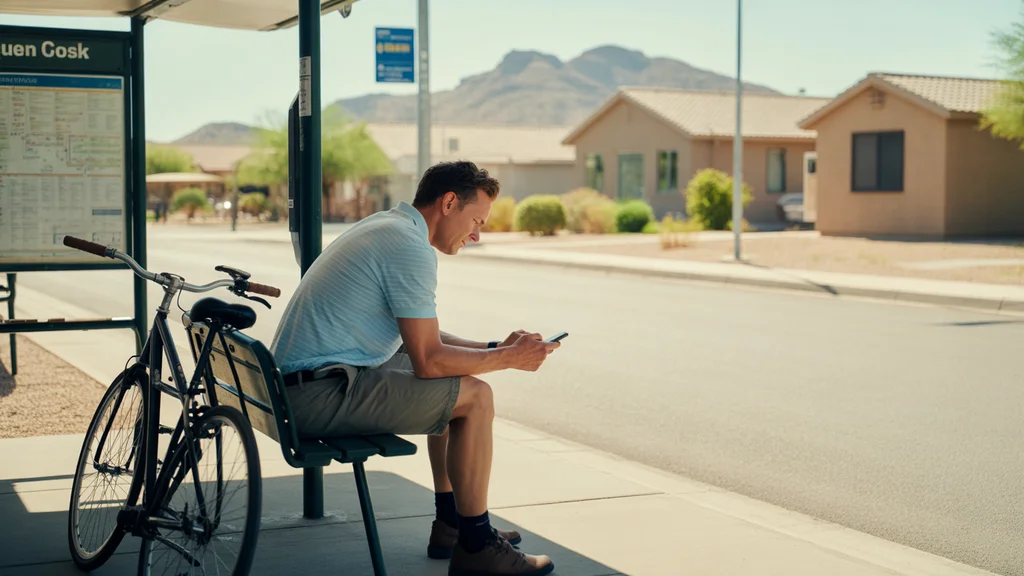
Public transit in Queen Creek is minimal. The city does not operate its own transit system, and regional bus service from the broader Phoenix metro network offers limited coverage. Routes that do reach Queen Creek tend to serve major corridors and connect to regional hubs, but frequency is low, and coverage does not extend into most residential subdivisions.
For residents living in newer developments on the city’s edges—where much of the housing stock has been built in the last decade—transit access is functionally nonexistent. Even in areas closer to major roads, waiting times between buses can stretch to an hour or more, making transit impractical for daily commuting or time-sensitive errands.
Transit works best for residents who live near a handful of key routes and have flexible schedules. It can serve as a backup option or a way to avoid parking costs for occasional trips into central Phoenix. But it does not provide the reliability, frequency, or coverage needed to replace car ownership for most households.
There are no light rail lines serving Queen Creek, and none are planned in the near term. The city’s low density and distance from the Valley Metro rail network make expansion unlikely without significant regional investment and population growth closer to existing transit corridors.
Driving & Car Dependence Reality
Driving isn’t optional in Queen Creek—it’s the default. Most households own at least two vehicles, and many own three or more to accommodate multiple working adults and driving-age teens. Parking is abundant and free in nearly all contexts: at home, at shopping centers, at schools, and at workplaces. This removes one of the friction points common in denser cities, but it also reflects how essential car access is to participating in daily life.
The city’s layout spreads residential, commercial, and employment uses across a wide geographic area. Subdivisions are often separated from shopping and services by arterial roads designed for high-speed vehicle traffic, not pedestrian crossings. Even short distances—say, a mile to a convenience store—can feel impractical to walk due to heat exposure, lack of shade, and infrastructure that prioritizes cars over foot traffic.
For families, this car dependence translates into logistical complexity. Coordinating school drop-offs, extracurricular activities, grocery runs, and work commutes requires planning and often multiple vehicles. Single-car households face significant constraints, particularly if one adult works outside the home and the other needs mobility during the day.
Commute flexibility is one advantage of driving. Residents can choose routes, adjust departure times to avoid congestion, and make multi-stop trips without waiting for transfers. But that flexibility comes with exposure to fuel costs, vehicle maintenance, insurance, and the time cost of sitting in traffic during peak hours.
Commuting Patterns & Daily Mobility
Most Queen Creek residents commute outward to jobs in other parts of the metro area. Phoenix, Chandler, Mesa, Gilbert, and Tempe are common employment destinations, and the drive can range from 20 minutes to well over an hour depending on distance, time of day, and route. The 30-minute average commute reflects a mix of shorter trips to nearby cities and longer hauls into the urban core.
For workers with traditional office hours, the commute often involves navigating congestion on US-60, Loop 202, or other regional highways. Morning and evening rush periods add time and unpredictability. For those with non-traditional schedules—shift workers, early starters, or late finishers—the commute can be faster and less stressful, but it still requires a personal vehicle.
Households with two working adults often structure their days around commute logistics. If both partners work in different directions or have overlapping schedules, coordination becomes essential. Carpooling is rare outside of family units, as the city’s low density and dispersed job locations make shared commutes impractical for most.
Daily mobility extends beyond work. Parents shuttle children to schools that may not be within walking distance, even in the same neighborhood. Errands are typically batched into car trips, as few services are accessible on foot. Social and recreational activities—dining, fitness, entertainment—almost always require driving.
Who Transit Works For — and Who It Doesn’t
Public transit in Queen Creek serves a narrow slice of residents. It works best for individuals who live near one of the limited bus routes, have flexible schedules, and make occasional trips into central Phoenix where transit connections improve. It can also serve as a cost-saving option for households trying to reduce vehicle expenses, though the time tradeoff is significant.
Transit does not work well for families with children, workers with fixed schedules, or anyone who needs reliable, frequent service. Coverage gaps, long wait times, and limited evening or weekend service make it difficult to depend on transit for daily needs. For most Queen Creek households, transit is not a viable primary transportation mode.
Remote workers and retirees face different mobility dynamics. Those who work from home can reduce commute exposure entirely, though they still need a car for errands, appointments, and social activities. Retirees who no longer commute may find that Queen Creek’s car dependence becomes more burdensome over time, particularly if driving becomes difficult due to age or health.
Renters in older, more centrally located apartment complexes may have slightly better access to bus routes than homeowners in newer subdivisions. But even in these cases, transit is more of a supplemental option than a replacement for car ownership.
Transportation Tradeoffs in Queen Creek
Choosing to live in Queen Creek means accepting a transportation structure built around driving. The tradeoff is straightforward: in exchange for newer homes, larger lots, and a suburban lifestyle, residents absorb the time, cost, and logistical demands of car dependence.
Driving offers control and flexibility. Residents can leave when they want, take the route they prefer, and make multiple stops without waiting for connections. They can live farther from work in exchange for more affordable or spacious housing. But that control comes with exposure to fuel price volatility, vehicle maintenance costs, insurance premiums, and the time cost of commuting.
Transit, where it exists, offers predictability in operating cost but sacrifices time and convenience. A trip that takes 20 minutes by car might take an hour or more by bus, assuming the route exists and the schedule aligns. For most Queen Creek households, that tradeoff doesn’t pencil out.
Walkability and biking are limited. While some neighborhoods have internal trail systems and sidewalks, these rarely connect to commercial areas, schools, or transit stops. The desert climate also affects comfort: summer heat makes walking or biking during midday hours impractical for many residents, particularly for trips longer than a few blocks.
The transportation structure in Queen Creek rewards households that can afford multiple vehicles and absorb commute time. It penalizes those who cannot drive, those who need frequent access to urban job centers, and those who value spontaneous mobility without the friction of car ownership.
FAQs About Transportation in Queen Creek (2026)
Is public transit usable for daily commuting in Queen Creek?
For most residents, no. Public transit coverage is limited, frequencies are low, and routes do not serve most residential areas. Transit can work for occasional trips or for individuals living near specific corridors with flexible schedules, but it is not a reliable option for daily commuting to work or school.
Do most people in Queen Creek rely on a car?
Yes. The vast majority of Queen Creek residents depend on personal vehicles for work, errands, and daily activities. The city’s layout, low density, and distance from the metro core make car ownership essential for most households.
Which areas of Queen Creek are easiest to live in without a car?
No area of Queen Creek is truly easy to navigate without a car. Some older neighborhoods closer to major arterial roads may have slightly better access to limited bus routes, but even these areas require a vehicle for most daily needs. Walkability to services is rare across the city.
How does commuting in Queen Creek compare to nearby cities?
Queen Creek’s commute patterns reflect its role as an outer suburb. Residents typically commute longer distances than those living in Gilbert, Chandler, or Mesa, particularly if their jobs are in central Phoenix. The 30-minute average commute and the fact that 20.9% of workers face long commutes highlight the time cost of living on the metro periphery.
Can you bike or walk for transportation in Queen Creek?
Biking and walking are limited to recreational use in most cases. While some neighborhoods have trails and sidewalks, these rarely connect to commercial areas, schools, or transit stops. The desert climate also makes walking or biking uncomfortable during much of the year, particularly in summer months.
How Transportation Fits Into the Cost of Living in Queen Creek
Transportation in Queen Creek is not just a line item—it’s a structural factor that shapes where you can live, how you spend your time, and what flexibility you have in daily life. Car dependence means that vehicle costs, fuel exposure, and commute time are baked into the experience of living here. For households that can absorb those costs and value the housing and lifestyle tradeoffs Queen Creek offers, the transportation structure is manageable. For those who need transit access, walkability, or shorter commutes, the city presents significant challenges.
Understanding how mobility works here helps clarify whether Queen Creek aligns with your priorities. If you’re evaluating planning a monthly budget in Queen Creek, transportation will be one of the largest and least flexible categories. The city rewards those who can afford multiple vehicles and accept commute time as part of the bargain. It’s less forgiving for those who cannot.
Queen Creek is a place where driving defines daily life. That’s not a flaw—it’s a feature of the city’s design and its role in the broader metro area. Recognizing that reality upfront allows you to make a grounded decision about whether this community fits your needs.
—