

Here’s the myth: Santa Clara is the “affordable alternative” to Palo Alto. The reality is more textured. Both cities sit in the heart of Silicon Valley, share the same utility providers, face identical gas prices, and offer similarly strong infrastructure for families, cyclists, and transit users. The meaningful differences aren’t about whether one city is universally cheaper—they’re about where cost pressure concentrates, which households feel it most, and how housing form, healthcare access, and building density shape day-to-day financial exposure in 2026.
People compare these two cities because they’re functionally neighbors with overlapping job markets, school reputations, and lifestyle appeal. But the decision between them hinges less on total affordability and more on which costs dominate your household’s budget, how much flexibility you have around housing entry barriers, and whether you prioritize proximity to hospital care or accept a clinic-based healthcare model. For some households, Palo Alto’s walkable pockets and mixed-height development offer better long-term fit despite higher entry costs. For others, Santa Clara’s lower-rise neighborhoods and reduced housing entry threshold provide breathing room without sacrificing access to groceries, parks, or rail transit.
This article breaks down how cost structure differs between Palo Alto and Santa Clara across housing, utilities, groceries, taxes, transportation, and lifestyle—not to declare a winner, but to help you understand which city’s cost profile aligns with your household’s priorities and constraints.
Housing Costs: Where the Biggest Gap Lives
Housing is where Palo Alto and Santa Clara diverge most sharply. Median home values in Palo Alto reach $2,000,001, while Santa Clara’s median sits at $1,440,200. For renters, median gross rent in Palo Alto is $3,169 per month compared to $2,841 per month in Santa Clara. These aren’t small differences—they represent fundamentally different entry barriers and ongoing obligations that ripple through household budgets in distinct ways.
The gap matters most for first-time buyers and renters operating near the edge of qualification. In Palo Alto, the higher median home value translates to larger down payment requirements, higher monthly mortgage obligations, and greater exposure to property tax assessments. For renters, the higher median rent means less flexibility to absorb other cost shocks—utility spikes, car repairs, or childcare changes—without renegotiating other parts of the budget. Santa Clara’s lower entry threshold doesn’t make housing “affordable” in absolute terms, but it does create more room for households to manage other expenses without constant financial friction.
Building form also plays a role. Palo Alto’s mixed-height character means more variety in housing types—condos, townhomes, and single-family homes coexist in closer proximity. Santa Clara’s low-rise profile skews more heavily toward single-family detached homes and smaller apartment complexes. For families prioritizing yard space and separation from neighbors, Santa Clara’s housing stock may feel more aligned with that preference. For households willing to trade square footage for walkability and proximity to services, Palo Alto’s denser pockets offer more options within shorter distances.
| Housing Type | Palo Alto | Santa Clara |
|---|---|---|
| Median Home Value | $2,000,001 | $1,440,200 |
| Median Gross Rent | $3,169/month | $2,841/month |
| Building Form | Mixed-height (condos, townhomes, single-family) | Low-rise (predominantly single-family and smaller complexes) |
Renters in Palo Alto face higher baseline obligations, which limits their ability to save for a down payment or absorb unexpected costs. Renters in Santa Clara gain slightly more breathing room, though the difference may feel incremental rather than transformative. For buyers, the delta in median home value represents a substantial difference in both upfront capital requirements and long-term equity exposure. Households planning to stay several years may find Palo Alto’s higher entry cost justified by stronger appreciation potential, while those prioritizing near-term cash flow flexibility may prefer Santa Clara’s lower threshold.
Housing takeaway: Palo Alto’s housing costs create higher entry barriers and ongoing obligations for both renters and owners, with mixed-height development offering more variety in housing form. Santa Clara’s lower median values and rents reduce upfront pressure, with low-rise neighborhoods favoring single-family detached homes. Households sensitive to entry costs and near-term cash flow flexibility will feel the difference acutely; those prioritizing long-term equity growth and walkable density may accept Palo Alto’s higher threshold.
Utilities and Energy Costs: Identical Rates, Different Exposure
Utility rates are identical across Palo Alto and Santa Clara—both cities face 30.29¢/kWh for electricity and $22.96/MCF for natural gas. This makes sense: they’re served by the same regional providers and operate within the same climate zone. The meaningful differences in utility exposure come not from pricing, but from housing stock, building age, and household size.
Palo Alto’s mixed-height building character means more variation in unit size and insulation quality. Newer condos and townhomes in Palo Alto tend to feature better thermal envelopes, reducing heating and cooling demand. Older single-family homes, however, may lack modern insulation and efficient HVAC systems, leading to higher baseline usage. Santa Clara’s low-rise profile skews toward single-family detached homes, which generally have larger footprints and more exterior surface area exposed to temperature swings. This increases heating and cooling loads, especially during Silicon Valley’s warm, dry summers and cooler winter evenings.
For single adults or couples living in smaller units—apartments or condos—utility costs in both cities remain relatively predictable and manageable. Baseline usage stays low, and seasonal swings are modest. For families occupying larger single-family homes, utility exposure becomes more volatile. Homes with older windows, minimal attic insulation, or inefficient heating systems will experience sharper seasonal spikes. In Santa Clara, where low-rise single-family homes dominate, this exposure is more widespread. In Palo Alto, it depends heavily on which neighborhood and housing type you occupy.
Both cities benefit from California’s relatively mild climate, which limits extreme heating and cooling demands compared to other U.S. regions. However, the extended cooling season during summer months and the need for occasional heating during winter nights mean that utility bills aren’t static. Households in larger homes—regardless of city—should expect noticeable seasonal variation, particularly if the home was built before modern energy efficiency standards took hold.
Utility takeaway: Identical rates mean the primary driver of utility cost differences is housing form and building age, not location. Palo Alto’s mixed-height stock offers more variation in unit size and insulation quality, while Santa Clara’s low-rise single-family homes tend to have larger footprints and greater thermal exposure. Families in older, larger homes will experience more volatility in both cities; smaller units in newer buildings offer more predictable utility costs.
Groceries and Daily Expenses: Broadly Accessible, Structurally Similar
Both Palo Alto and Santa Clara show broadly accessible food and grocery options, with high densities of both food establishments and grocery stores. This means households in either city can access staples, fresh produce, and prepared foods without long drives or significant planning friction. The structural similarity limits meaningful cost differentiation—both cities support a range of shopping strategies, from discount chains to specialty markets.
Where the two cities differ is in the texture of access. Palo Alto’s mixed-height development and walkable pockets mean more grocery options are reachable on foot or by bike, reducing the need for car trips and the associated time and fuel costs. Santa Clara’s low-rise, car-oriented layout means most grocery trips require driving, even if the stores themselves are plentiful. For households managing tight schedules—dual-income couples, families coordinating school pickups and activities—the difference between walking to a nearby market and driving five minutes each way adds up in time cost, not just cash cost.
Grocery pricing in both cities reflects Silicon Valley’s elevated cost structure. Staples like bread, eggs, and milk carry higher price tags than national averages, and prepared foods—whether from grocery delis or local restaurants—command premium pricing. Households that prioritize convenience—grabbing takeout, buying pre-prepped ingredients, or dining out frequently—will feel this pressure more acutely in both cities. Those willing to cook from scratch, shop sales, and limit convenience purchases can moderate grocery spending, though the baseline cost floor remains higher than in less expensive metro areas.
For single adults, grocery costs in both cities are manageable but not trivial. Cooking at home and avoiding frequent takeout keeps spending predictable. For couples, the ability to split grocery runs and meal prep reduces per-person cost pressure. For families, grocery volume scales quickly, and the temptation to rely on convenience foods—especially during busy weeks—can drive spending higher. In both cities, the availability of diverse grocery options means households have the tools to manage costs; the challenge is maintaining discipline in a high-cost environment where convenience is always within reach.
Grocery takeaway: Both cities offer broadly accessible grocery options with similar pricing structures. Palo Alto’s walkable pockets reduce transportation friction for errands, while Santa Clara’s low-rise layout increases reliance on driving. Households sensitive to time cost and convenience spending will notice the difference in access patterns; those focused purely on grocery pricing will find both cities similarly elevated relative to national norms.
Taxes and Fees: Shared Structure, Different Housing Exposure
Property taxes, sales taxes, and local fees in Palo Alto and Santa Clara operate under the same California framework. Both cities fall within Santa Clara County, which means they share the same baseline property tax rate (around 1% of assessed value, plus local bonds and assessments) and the same state and local sales tax structure. The meaningful difference in tax exposure comes from housing values, not tax rates.
In Palo Alto, where median home values exceed $2,000,001, annual property tax obligations are substantially higher in absolute terms. A household owning a home at the median value faces a larger annual tax bill than a household in Santa Clara owning a home at $1,440,200, even though the effective rate is identical. This difference compounds over time, especially for long-term homeowners who benefit from Proposition 13’s assessment growth caps but still face higher baseline obligations due to initial purchase price.
For renters, property taxes are less visible but still relevant—landlords pass through tax obligations in the form of higher rents. Palo Alto’s elevated home values mean landlords face higher tax bills, which contributes to the higher median gross rent of $3,169 per month. Santa Clara’s lower home values translate to lower landlord tax obligations, which helps explain the lower median rent of $2,841 per month. Renters don’t write the property tax check directly, but they absorb the cost indirectly through rent levels.
Local fees—trash collection, water, sewer, and other municipal services—are generally comparable across both cities, though specific fee structures can vary by neighborhood and service provider. Homeowners in both cities should expect recurring fees for utilities, waste management, and potentially HOA dues if they purchase in a planned community or condo complex. These fees are more predictable than property taxes and less sensitive to home value, but they still represent ongoing obligations that renters avoid.
Tax and fee takeaway: Tax rates are structurally identical, but Palo Alto’s higher home values create larger absolute property tax obligations for owners and contribute to higher rents for tenants. Santa Clara’s lower home values reduce tax exposure in both ownership and rental scenarios. Households planning to own long-term will feel the difference in annual tax bills; renters absorb the difference indirectly through rent levels.
Transportation & Commute Reality: Similar Patterns, Subtle Differences
Both Palo Alto and Santa Clara report identical average commute times of 23 minutes, and both cities offer rail transit access, substantial pedestrian infrastructure, and notable cycling infrastructure. This structural similarity means transportation costs and commute friction are broadly comparable. However, subtle differences in work-from-home adoption and long-commute exposure create distinct patterns for certain households.
Palo Alto shows a 6.0% work-from-home rate, while Santa Clara’s rate is 4.7%. This small gap suggests slightly more flexibility in Palo Alto for households able to reduce commute frequency. For dual-income couples or families managing school drop-offs and pickups, even one fewer commute per week reduces fuel costs, vehicle wear, and time pressure. Santa Clara’s slightly higher long-commute percentage—30.8% compared to Palo Alto’s 27.8%—indicates more residents traveling longer distances to work, which increases exposure to gas price volatility and vehicle maintenance costs.
Gas prices are identical at $5.89/gal, reflecting regional pricing rather than city-specific variation. For households commuting daily, this elevated fuel cost adds up quickly, especially for those driving longer distances. Both cities’ rail transit access provides an alternative for commuters traveling to San Francisco, San Jose, or other regional job centers, but the viability of transit depends on job location and schedule flexibility. Households able to rely on rail or bike infrastructure reduce direct fuel costs and gain more predictable transportation budgets.
Palo Alto’s walkable pockets and mixed-height development mean more daily errands—groceries, coffee, pharmacy runs—are reachable without a car. Santa Clara’s low-rise layout increases car dependency for these shorter trips, which adds incremental fuel and time costs. For households managing tight schedules, the difference between walking two blocks to a grocery store and driving five minutes each way matters more in time cost than cash cost, but both accumulate over weeks and months.
Transportation takeaway: Commute times and transit access are nearly identical, but Palo Alto’s slightly higher work-from-home rate and lower long-commute exposure reduce transportation friction for some households. Santa Clara’s higher long-commute percentage increases fuel and time costs for those traveling farther. Both cities support rail, bike, and pedestrian infrastructure, but Palo Alto’s walkable pockets reduce car dependency for daily errands more than Santa Clara’s low-rise layout.
Cost Structure Comparison: Where Pressure Concentrates
Housing dominates the cost experience in both cities, but the intensity differs. Palo Alto’s higher median home values and rents create steeper entry barriers and larger ongoing obligations, which limits flexibility for households operating near qualification thresholds. Santa Clara’s lower housing costs reduce upfront pressure and create slightly more breathing room for managing other expenses, though the difference is incremental rather than transformative.
Utilities introduce similar exposure in both cities due to identical rates, but housing form shapes volatility. Palo Alto’s mixed-height stock offers more variation in unit size and insulation quality, while Santa Clara’s low-rise single-family homes tend to have larger footprints and greater thermal exposure. Families in older, larger homes will experience more seasonal swings in both cities; smaller units in newer buildings offer more predictable utility costs regardless of location.
Groceries and daily expenses are broadly accessible in both cities, with similar pricing structures. Palo Alto’s walkable pockets reduce transportation friction for errands, while Santa Clara’s low-rise layout increases reliance on driving. Households sensitive to time cost and convenience spending will notice the difference in access patterns; those focused purely on grocery pricing will find both cities similarly elevated.
Transportation patterns matter more for households with long commutes or inflexible schedules. Palo Alto’s slightly higher work-from-home rate and lower long-commute exposure reduce fuel and time costs for some households. Santa Clara’s higher long-commute percentage increases exposure to gas price volatility and vehicle wear. Both cities offer rail, bike, and pedestrian infrastructure, but Palo Alto’s walkable pockets reduce car dependency for daily errands more than Santa Clara’s car-oriented layout.
The decision between Palo Alto and Santa Clara isn’t about which city is cheaper overall—it’s about which cost pressures dominate your household and which tradeoffs you’re willing to accept. Households sensitive to housing entry costs may prefer Santa Clara’s lower threshold. Those prioritizing walkability, mixed-height development, and hospital access may accept Palo Alto’s higher entry barrier. For families, both cities offer strong infrastructure for schools, playgrounds, and parks; the choice hinges more on housing form, healthcare access, and budget flexibility than on total cost of living.
How the Same Income Feels in Palo Alto vs Santa Clara
Single Adult
Housing becomes the non-negotiable first. In Palo Alto, higher rent or mortgage obligations leave less room for discretionary spending, travel, or savings. In Santa Clara, the lower housing threshold creates slightly more flexibility for building an emergency fund or absorbing unexpected costs. Both cities offer walkable errands and rail transit, which reduces car dependency and keeps transportation costs manageable. The difference is less about lifestyle friction and more about how much financial cushion remains after housing is covered.
Dual-Income Couple
Housing entry costs become more significant when planning for long-term stability or future family needs. Palo Alto’s higher home values require larger down payments and create steeper monthly obligations, which may delay other financial goals like retirement contributions or home renovations. Santa Clara’s lower entry threshold reduces upfront pressure and allows more flexibility for managing dual commutes, healthcare costs, or discretionary spending. Both cities support strong transit and bike infrastructure, but Palo Alto’s walkable pockets reduce time friction for daily errands more than Santa Clara’s car-oriented layout.
Family with Kids
Housing form and healthcare access become primary differentiators. Palo Alto’s mixed-height development offers more variety in housing types, and hospital access provides peace of mind for families managing pediatric care or chronic conditions. Santa Clara’s low-rise neighborhoods favor single-family detached homes with yard space, and clinic-based healthcare meets routine needs but requires travel for hospital services. Both cities offer strong family infrastructure—schools, playgrounds, and parks—so the decision hinges more on housing preferences, healthcare priorities, and budget flexibility than on family amenities.
Decision Matrix: Which City Fits Which Household?
| Decision Factor | If You’re Sensitive to This… | Palo Alto Tends to Fit When… | Santa Clara Tends to Fit When… |
|---|---|---|---|
| Housing entry + space needs | Down payment size, monthly obligation, housing form variety | You prioritize walkable density and accept higher entry costs for mixed-height options | You need lower upfront costs and prefer low-rise single-family neighborhoods |
| Transportation dependence + commute friction | Car dependency, fuel costs, time cost of errands | You value walkable errands and slightly higher work-from-home flexibility | You accept car-oriented layout and manage longer commutes with less remote work flexibility |
| Utility variability + home size exposure | Seasonal swings, building age, thermal efficiency | You occupy a smaller or newer unit with better insulation and lower thermal exposure | You manage larger single-family homes with greater seasonal volatility |
| Grocery strategy + convenience spending creep | Access friction, time cost, temptation to overspend on convenience | You benefit from walkable access to groceries and reduce car trips for errands | You accept driving for most errands and maintain discipline around convenience spending |
| Fees + friction costs (HOA, services, upkeep) | Predictability, ongoing obligations, pass-through costs | You accept higher baseline property taxes due to elevated home values | You reduce tax exposure through lower home values and comparable fee structures |
| Time budget (schedule flexibility, errands, logistics) | Commute frequency, errands accessibility, household coordination | You prioritize walkable errands and slightly more remote work flexibility | You manage car-dependent errands and higher long-commute exposure |
Lifestyle Fit: Walkable Pockets vs Low-Rise Neighborhoods
Both Palo Alto and Santa Clara offer strong family infrastructure, integrated green space, and broadly accessible daily errands. Parks, playgrounds, and schools meet density thresholds in both cities, and water features enhance outdoor access. Rail transit, bike infrastructure, and pedestrian-friendly pockets support non-car mobility for households able to take advantage of them. The lifestyle differences come less from amenities and more from housing form, healthcare access, and the texture of daily movement.
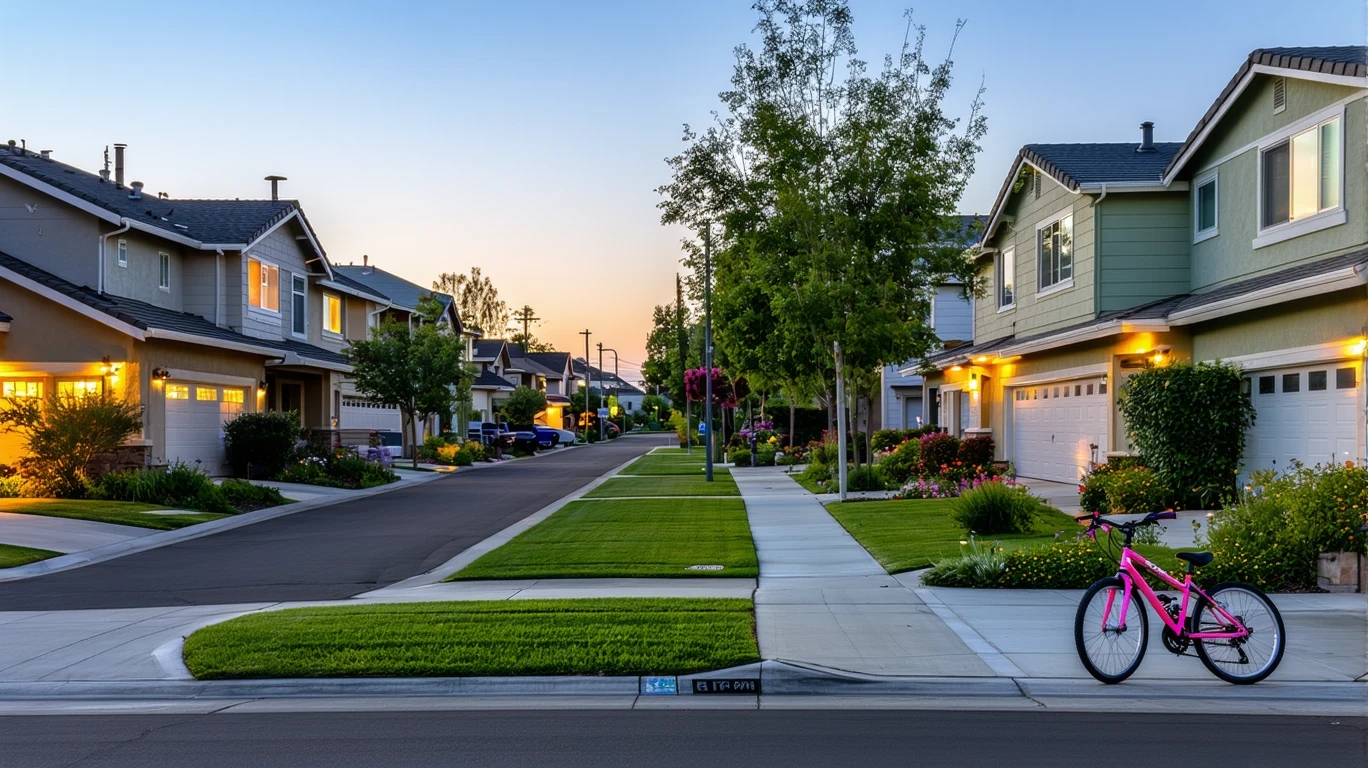
Palo Alto’s mixed-height character creates more variation in neighborhood feel. Some areas feature denser, walkable blocks with shops, cafes, and services within short distances. Others lean more suburban, with single-family homes and quieter streets. This variety allows households to choose between urban-adjacent density and traditional suburban layouts within the same city. Santa Clara’s low-rise profile skews more uniformly toward single-family detached homes and smaller apartment complexes, which appeals to households prioritizing yard space, separation from neighbors, and a more traditional suburban feel.
Healthcare access differs meaningfully. Palo Alto has hospital facilities, which matters for families managing chronic conditions, expecting children, or prioritizing proximity to emergency and specialized care. Santa Clara offers clinics and pharmacies but lacks a hospital within city limits, requiring travel to nearby cities for inpatient services or emergency care. For young, healthy households, this difference may feel negligible. For families with young children, aging parents, or health concerns, hospital access becomes a significant quality-of-life factor.
Quick fact: Both cities show high pedestrian-to-road ratios and bike-to-road ratios, meaning substantial infrastructure exists for non-car mobility.
Quick fact: Palo Alto’s mixed-height building character offers more housing form variety, while Santa Clara’s low-rise profile favors single-family detached homes.
Frequently Asked Questions
Is Santa Clara cheaper than Palo Alto in 2026?
Santa Clara has lower median home values and rents, which reduces housing entry costs and ongoing obligations. However, utility rates, gas prices, and grocery pricing are structurally similar. The difference is less about total affordability and more about where cost pressure concentrates—Palo Alto’s higher housing costs create steeper entry barriers, while Santa Clara’s lower threshold provides more breathing room for managing other expenses.
Which city is better for families: Palo Alto or Santa Clara in 2026?
Both cities offer strong family infrastructure, including schools, playgrounds, and parks. Palo Alto provides hospital access and mixed-height housing options, while Santa Clara offers lower housing entry costs and low-rise single-family neighborhoods. The better fit depends on whether you prioritize healthcare proximity and walkable density or lower upfront costs and traditional suburban housing form.
How do transportation costs compare between Palo Alto and Santa Clara in 2026?
Both cities have identical average commute times, gas prices, and rail transit access. Palo Alto’s slightly higher work-from-home rate and lower long-commute percentage reduce fuel and time costs for some households. Santa Clara’s higher long-commute exposure increases transportation costs for those traveling farther. Palo Alto’s walkable pockets reduce car dependency for daily errands more than Santa Clara’s car-oriented layout.
Do utilities cost more in Palo Alto or Santa Clara in 2026?
Utility rates are identical—both cities face 30.29¢/kWh for electricity and $22.96/MCF for natural gas. The difference in utility exposure comes from housing form and building age. Palo Alto’s mixed-height stock offers more variation in unit size and insulation quality, while Santa Clara’s low-rise single-family homes tend to have larger footprints and greater thermal exposure. Families in older, larger homes will experience more volatility in both cities.
Which city has better walkability: Palo Alto or Santa Clara in 2026?
Both cities show substantial pedestrian infrastructure and high pedestrian-to-road ratios. Palo Alto’s walkable pockets and mixed-height development create more areas where daily errands—groceries, coffee, pharmacy—are reachable on foot. Santa Clara’s low-rise layout increases car dependency for most errands, though bike and pedestrian infrastructure still supports non-car mobility in certain areas. Households prioritizing walkable access to services will find Palo Alto’s layout more aligned with that preference.
Conclusion
Palo Alto and Santa Clara share the same regional cost structure—identical utility rates, gas prices, and broadly accessible groceries—but diverge meaningfully in housing costs, building form, and healthcare access. Palo Alto’s higher median home values and rents create steeper entry barriers and larger ongoing obligations, while its mixed-height development and hospital access appeal to households prioritizing walkability and proximity to specialized care. Santa Clara’s lower housing threshold reduces upfront pressure and favors low-rise single-family neighborhoods, though it lacks hospital facilities and increases car dependency for daily errands.
The decision between these two cities isn’t about which one is cheaper overall—it’s about which cost pressures dominate your household and which tradeoffs you’re willing to accept. Households sensitive to housing entry costs and prioritizing traditional suburban layouts may prefer Santa Clara. Those willing to accept higher housing obligations in exchange for walkable density, mixed-height options, and hospital access may find Palo Alto a better long-term fit. Both cities offer strong family infrastructure, rail transit, and integrated green space, so the choice hinges more on housing form, healthcare priorities, and budget flexibility than on lifestyle amenities.
How this article was built: In addition to public economic data, this article incorporates location-based experiential signals derived from anonymized geographic patterns—such as access density, walkability, and land-use mix—to reflect how day-to-day living actually feels in Palo Alto, CA.