
Imagine you’re weighing an offer that would move you to National City. The salary looks reasonable on paper, but you’ve heard Southern California is expensive. You start Googling “how much do I need to live comfortably in National City?” and find a dozen different numbers—none of which feel quite right. Some seem impossibly high; others suspiciously low. The truth is, comfort in National City isn’t a number. It’s a match between what you earn, how you live, and what you’re willing to trade off.
This article explains how income pressure actually works in National City—not through budgets or thresholds, but by showing who feels comfortable here, who doesn’t, and why. You won’t find a magic income figure, but you will get clarity on whether your earnings and expectations align with reality.
What “Living Comfortably” Means in National City
Comfort in National City doesn’t mean luxury. It means your paycheck covers your bills without constant stress, you have some control over how you spend your time, and you’re not one surprise expense away from crisis. It means you can afford a safe place to live, keep your car running (or avoid needing one), and occasionally go out without guilt.
What comfort looks like depends heavily on your household. A single adult might feel comfortable in a one-bedroom apartment near the trolley, eating out occasionally and keeping transportation costs low. A family of four in the same income bracket might feel squeezed, juggling rent, school schedules, and grocery runs while watching every dollar. The difference isn’t just income—it’s how many people depend on it and what kind of daily logistics you’re managing.
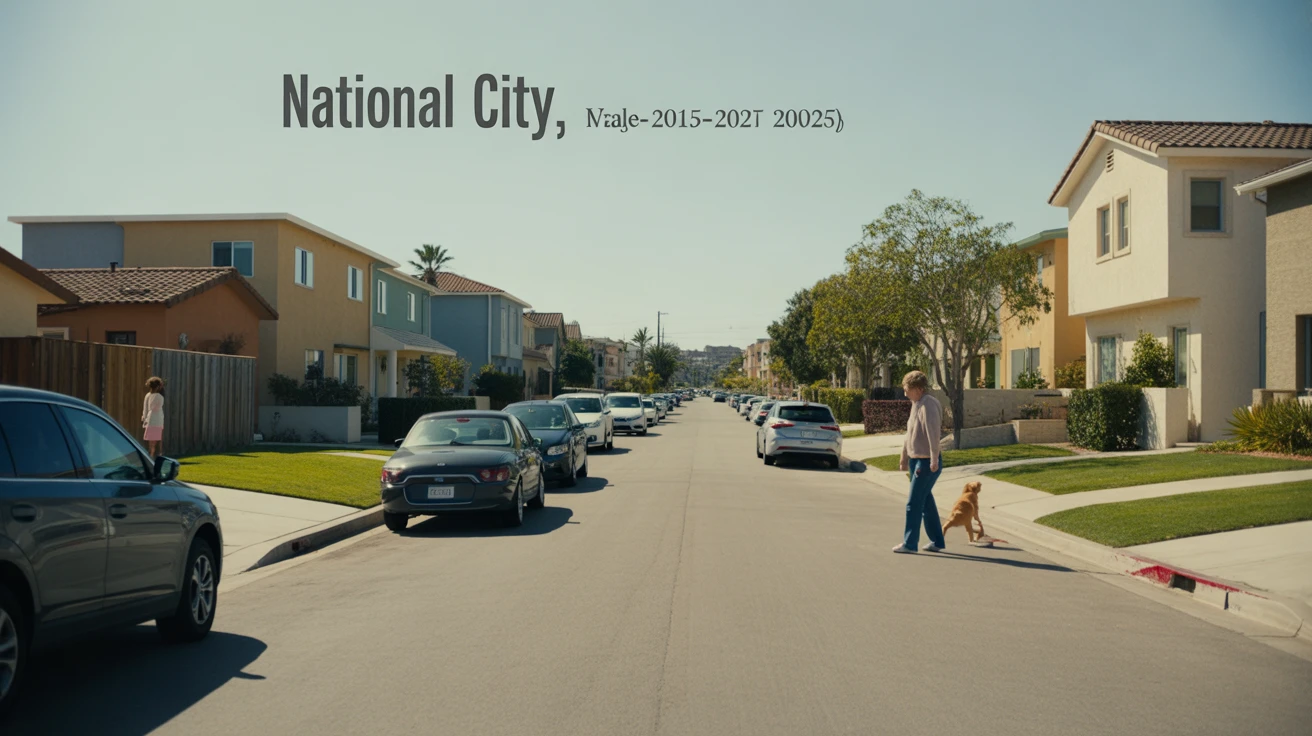
National City sits in a region where housing costs dominate, but the city’s structure offers some relief. Grocery stores and daily errands are broadly accessible, meaning you don’t have to drive far or plan elaborate shopping trips. Parks are integrated throughout the city, and schools are plentiful, which reduces the logistical burden for families. Rail service is present, and the pedestrian-to-road ratio supports mixed mobility—some people walk or take transit, others drive. This mix matters because it creates different pathways to comfort depending on your flexibility.
Where Income Pressure Shows Up First
In National City, financial pressure starts with housing. The median gross rent is $1,504 per month, and the median home value is $505,800. For most households, rent or mortgage payments claim the largest share of income before anything else gets paid. If you’re earning close to the median household income of $59,850 per year (about $4,988 gross per month), that rent figure alone represents roughly 30% of your gross monthly income—the traditional affordability threshold. But that’s before utilities, transportation, food, or any discretionary spending.
Transportation pressure depends on how you move. If you drive, National City’s gas prices—$5.89 per gallon—add up quickly, especially for commuters covering significant distances. If you can use the trolley or live close to work, you avoid that exposure. The city’s mixed mobility texture means both options exist, but not everyone has equal access to the car-light path. Families with school drop-offs, multiple jobs, or schedules that don’t align with transit routes often end up car-dependent by necessity, not choice.
Utilities in National City carry moderate volatility. Electricity rates are 30.29¢ per kilowatt-hour, and natural gas is $22.96 per thousand cubic feet. Coastal proximity keeps temperature extremes mild, but summer cooling and winter heating still create seasonal swings. For households already stretched thin by rent and transportation, a higher-than-expected utility bill can force immediate tradeoffs—skipping a meal out, delaying a purchase, or pulling from savings.
For families, pressure also shows up in time. National City has strong school density and playground access, which helps, but managing multiple schedules, errands, and activities still requires either time or money—and often both. Households that can’t afford convenience (delivery services, prepared meals, closer housing) pay in hours and stress instead.
How the Same Income Feels Different by Household
Households at similar income levels often experience very different pressure depending on size, flexibility, and daily logistics.
Single adults in National City can often make modest incomes work if they’re willing to accept smaller spaces and prioritize location. A one-bedroom apartment near transit and grocery stores reduces both transportation costs and time spent on errands. The city’s broadly accessible food and grocery density means you’re rarely far from what you need. If you can walk, bike, or take the trolley to work, you sidestep fuel costs entirely. Comfort for single adults often hinges on housing tradeoffs—choosing a smaller or older unit in exchange for lower rent and better access.
Couples benefit from shared housing costs and, often, dual incomes. If both partners work locally or can use transit, the household avoids doubling transportation expenses. National City’s mixed-use structure supports this: residential and commercial land use are integrated, so it’s possible to live near work, errands, and transit. Couples with flexibility around housing size and neighborhood can find breathing room that single-income households don’t have. But if one or both partners commute long distances by car, fuel costs and time lost to traffic erode that advantage quickly.
Families face the most sustained pressure. Even with two incomes, the cost of housing large enough for children, combined with transportation needs that don’t fit neatly into transit schedules, creates constant tradeoffs. National City’s strong school density and park access reduce some logistical friction—you’re not driving across town for school or spending weekends searching for safe outdoor space. But the baseline costs remain high, and families have less flexibility to downsize or relocate without disrupting school enrollment and routines. Comfort for families often requires income well above the median, or a willingness to accept older housing, longer commutes, or tighter month-to-month margins.
The Comfort Threshold (Qualitative)
There’s a point where income stops dictating every decision. You’re not scanning grocery receipts, skipping social plans because of gas prices, or lying awake worrying about the next rent increase. You can absorb a surprise car repair or medical bill without panic. You have choices—not unlimited ones, but enough that life doesn’t feel like a constant negotiation with your bank account.
In National City, that threshold isn’t a single number. It’s the point where housing tradeoffs ease—you’re not choosing between safety and affordability, or space and commute time. It’s where transportation costs become predictable rather than volatile, either because you’ve secured a short commute or because your income absorbs fuel swings without forcing cuts elsewhere. It’s where utility bills are annoying but not destabilizing, and where you can occasionally eat out, replace worn-out clothes, or take a weekend trip without guilt.
For single adults, this threshold might arrive at a lower income level if they’ve secured affordable housing and minimized car dependency. For families, it often requires significantly more—enough to cover larger housing, absorb transportation costs for multiple people and schedules, and maintain some cushion for the inevitable expenses that come with children.
The key insight is that comfort isn’t about hitting a target income. It’s about alignment: does your income support the lifestyle National City’s structure requires, or are you constantly fighting against it?
Why Online Cost Calculators Get National City Wrong
Most cost-of-living calculators treat National City as a data point: plug in the city name, get a number. But those tools make assumptions that don’t hold here.
They assume everyone drives the same amount, uses the same amount of electricity, and shops at the same kinds of stores. They don’t account for the fact that National City’s accessible errands structure and rail presence mean some households can live car-light while others can’t. They don’t capture how housing cost dominance makes small differences in grocery or utility spending irrelevant—you can’t budget your way out of a rent or mortgage that claims 40% or 50% of your income.
Calculators also miss lifestyle fit. They’ll tell you the “average” cost of living, but they won’t tell you whether you’ll feel comfortable with the tradeoffs required to hit that average. If you’re used to a detached single-family home with a yard and you’re comparing that to National City’s mixed building heights and denser blocks, the sticker shock isn’t just about money—it’s about expectations.
People often feel surprised after moving because the calculator said they could afford it, but it didn’t explain what “affording it” would actually feel like day-to-day. National City works well for people who value access and proximity over space and privacy. It works less well for people who need a car for every errand, expect large living spaces, or can’t tolerate financial tightness.
How to Judge Whether Your Income Fits National City
Instead of asking “Is my income enough?”, ask yourself these questions:
How sensitive are you to housing tradeoffs? Can you accept an older building, a smaller unit, or a less-than-ideal neighborhood in exchange for lower rent? Or do you need a certain standard of space and finish to feel comfortable? In National City, housing costs dominate, and flexibility here determines how far your income stretches.
Can you absorb seasonal utility swings? National City’s mild coastal climate keeps extremes manageable, but electricity and gas bills still fluctuate. If a $50 or $100 swing in your utility bill would force immediate cuts elsewhere, you’re operating without cushion. Comfort requires some ability to absorb variability.
Is time or money your limiting factor? National City’s structure supports car-light living if your schedule allows it, but many households—especially families—end up car-dependent because of logistics, not preference. If you’re already time-constrained, adding long commutes or complex transit connections will erode quality of life even if it saves money. If money is tighter than time, the reverse tradeoff might work.
How much flexibility do you expect month to month? Comfort isn’t just covering bills—it’s having enough left over that you’re not constantly recalculating. If your income leaves little room after rent, transportation, and essentials, you’re vulnerable to any surprise expense. National City rewards households with either higher incomes or lower fixed costs; it’s unforgiving to those stretched thin.
Do you value access over space? National City offers proximity—to transit, to errands, to parks and schools. If that matters more to you than square footage or a private yard, your income will feel like it goes further. If you prioritize space and privacy, you’ll either pay significantly more or feel perpetually cramped.
FAQs About Living Comfortably in National City
Is the median household income enough to live comfortably in National City?
For some households, yes—but it depends on size, flexibility, and expectations. A single adult or couple without children, willing to accept modest housing and minimize car use, can make it work. Families or households with less flexibility around housing and transportation often feel sustained pressure at that income level.
Can you live in National City without a car?
It’s possible, especially if you live near the trolley and work locally. The city’s broadly accessible errands structure and mixed mobility texture support car-light living for some residents. But families with children, multiple jobs, or schedules that don’t align with transit often find car ownership necessary, which adds significant cost.
How much of your income will go to rent in National City?
At the median rent of $1,504 per month and median household income of $59,850 per year, you’re looking at roughly 30% of gross monthly income—right at the traditional affordability threshold. Many households exceed that, especially if they’re single-income, have children, or need more space. Rent dominates the budget here, and there’s limited room to reduce it without accepting significant tradeoffs.
Does National City feel more affordable than the rest of San Diego County?
In some ways, yes—rent and home prices are lower than many nearby cities. But the cost structure is similar: housing dominates, transportation depends on your situation, and utilities and groceries reflect regional pricing. National City can feel more accessible if you’re comparing it to coastal or northern parts of the county, but it’s not a budget escape hatch. You’re still operating within Southern California’s cost reality.
What’s the biggest mistake people make when estimating whether they can afford National City?
Underestimating how much housing will claim and overestimating how much they can cut elsewhere. You can’t budget your way out of rent that takes 40% or 50% of your income. People also misjudge transportation costs—they assume they’ll drive less or use transit more than they actually do once they’re managing real schedules and logistics. The other common mistake is not accounting for the time cost of cheaper choices. Saving money by commuting farther, shopping at distant stores, or piecing together transit connections works on paper but erodes quality of life quickly.
How this article was built: In addition to public economic data, this article incorporates location-based experiential signals derived from anonymized geographic patterns—such as access density, walkability, and land-use mix—to reflect how day-to-day living actually feels in National City, CA.
National City can work well for some households—but only if expectations match reality. Comfort here isn’t about hitting a magic income number. It’s about understanding where pressure shows up, what tradeoffs you’re willing to make, and whether your earnings support the lifestyle the city’s structure requires. If you value proximity, can tolerate housing compromises, and have some flexibility around transportation, National City offers a viable path. If you need space, predictability, and financial cushion, you’ll need income well above the median—or a different city altogether.