
“I thought I could make it work without a second car when we first moved here,” says Marcus, who relocated to McKinney from Austin in 2023. “But after a month of trying to coordinate errands and pickups, we realized the city just isn’t set up that way. Now we both drive, and honestly, it’s just easier.”
Marcus’s experience reflects a fundamental reality about transportation options in McKinney: this is a city built around the automobile. While McKinney offers tree-lined streets, growing commercial corridors, and pockets of walkable infrastructure, the daily rhythm of life here assumes access to a personal vehicle. Understanding how people actually get around—and what that means for your household—is essential before committing to a move.
How People Get Around McKinney
McKinney operates as a car-first environment. The city’s development pattern, characterized by residential subdivisions separated from commercial corridors, creates a geography where most daily destinations require intentional trips rather than spontaneous walks. While some neighborhoods feature sidewalks and pedestrian paths, these amenities typically serve recreational purposes or connect homes within a subdivision rather than linking residential areas to grocery stores, schools, or workplaces.
The street network reflects this structure. Major thoroughfares like Eldorado Parkway, Custer Road, and Lake Forest Drive carry most cross-town traffic, while residential streets branch off into quieter cul-de-sac patterns. This layout prioritizes driving convenience and neighborhood separation over walkable density. Newcomers often underestimate how much ground they’ll need to cover for routine tasks—picking up groceries, dropping kids at activities, commuting to work, or meeting friends across town all assume car access.
Geographic patterns show that food and grocery options cluster along commercial corridors rather than distributing evenly throughout residential areas. This corridor-clustered pattern means that even residents in well-maintained neighborhoods with sidewalks typically drive to reach daily errands. The infrastructure supports driving as the primary—and often only practical—mode of transportation.
Public Transit Availability in McKinney
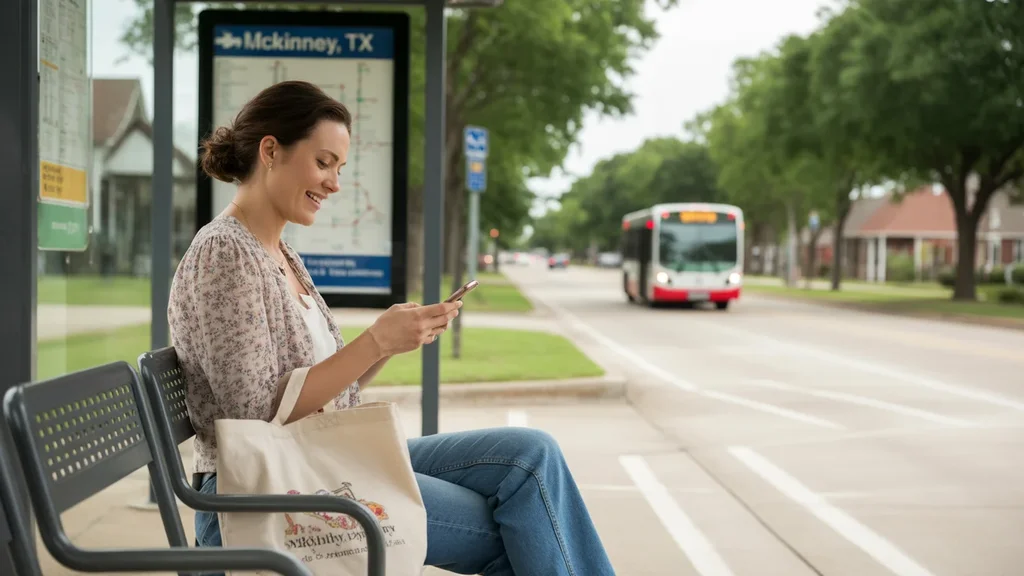
Public transit plays a minimal role in McKinney’s transportation landscape. The city’s infrastructure does not support the kind of transit-dependent lifestyle common in denser urban cores or cities with established rail networks. While regional connections exist for commuters traveling to Dallas or other parts of the metro area, local transit options within McKinney itself remain sparse.
For residents hoping to rely on buses, trains, or shuttles for daily mobility, McKinney presents significant challenges. The low-density suburban form, spread-out destinations, and limited service coverage mean that transit works only for highly specific routes or schedules—typically peak-hour commutes to employment centers outside the city. Evening, weekend, and off-peak travel by transit is largely impractical.
Transit infrastructure tends to serve commuters rather than residents running errands, attending appointments, or managing household logistics within McKinney. If your daily life requires frequent, flexible trips—school pickups, grocery runs, medical visits—transit will not provide adequate coverage or frequency. The city’s layout simply does not align with the density thresholds that make public transportation viable for everyday use.
Driving & Car Dependence Reality
Driving is not optional in McKinney; it is structural. Households without reliable vehicles face significant friction in managing daily life. Grocery stores, pediatricians, gyms, and social destinations are rarely within walking distance, and the distances involved make biking impractical for most errands, especially during McKinney’s hot summer months.
Parking, by contrast, is abundant and typically free. Residential subdivisions include driveways and garages, while commercial centers offer large surface lots. This removes one of the major pain points associated with car ownership in denser cities—finding and paying for parking is rarely a concern here.
The tradeoff is time and autonomy. Driving gives households control over their schedules and the ability to handle multi-stop trips efficiently. Parents shuttling kids between school, sports, and playdates; professionals commuting to offices in Plano, Frisco, or Dallas; and retirees managing medical appointments all rely on personal vehicles to maintain flexibility. The infrastructure rewards car ownership with convenience, predictability, and access.
However, this dependence also means that households must budget for vehicle acquisition, maintenance, insurance, and fuel. Gas prices, currently around $3.72 per gallon in the area, represent an ongoing exposure that fluctuates with regional and national trends. Multi-car households—common in McKinney—multiply these costs, though the alternative of coordinating a single vehicle across multiple schedules often proves more disruptive than the expense of a second car.
Commuting Patterns & Daily Mobility
McKinney functions as both a residential community and a regional employment node, which shapes commuting patterns in distinct ways. Some residents work locally in McKinney’s growing corporate and retail sectors, enjoying short drives and minimal traffic exposure. Others commute south to Plano, Frisco, Allen, or Dallas, where longer distances and highway congestion become daily realities.
The city’s position within the broader Dallas-Fort Worth metro area means that commute length varies widely depending on job location. Residents working in McKinney’s historic downtown, along the Central Expressway corridor, or in nearby suburban office parks experience different time and stress exposures than those commuting to downtown Dallas or Fort Worth. Highway access via US-75 and the Sam Rayburn Tollway provides connectivity, but also subjects commuters to the typical congestion patterns of a fast-growing metro region.
Daily mobility in McKinney often involves chaining trips—dropping kids at school, stopping for coffee, heading to work, picking up groceries on the way home. The car-oriented layout makes this kind of multi-stop efficiency possible, but it also means that households spend significant time behind the wheel. The structure of the city rewards those who can absorb drive time in exchange for space, newer housing stock, and suburban amenities.
Who Transit Works For — and Who It Doesn’t
Transit in McKinney serves a narrow slice of residents: primarily commuters with fixed schedules traveling to major employment centers outside the city. If you work regular hours in downtown Dallas or another transit-accessible hub, regional options may provide a viable alternative to driving, particularly during peak congestion periods.
For everyone else—families managing school and activity schedules, retirees running daytime errands, service workers with variable shifts, or remote workers who need occasional flexibility—transit does not offer practical coverage. The absence of frequent, multi-directional local service means that car ownership remains the default.
Renters in McKinney face the same transportation realities as homeowners. Proximity to work or key destinations can reduce drive time, but it does not eliminate the need for a vehicle. Even residents living in McKinney’s more walkable pockets—near the historic downtown square, for example—find that most weekly needs still require driving. The city’s infrastructure does not support a car-free or car-light lifestyle for the majority of households.
Transportation Tradeoffs in McKinney
Choosing to rely on driving in McKinney means accepting certain tradeoffs. On one side: control, flexibility, and access. Households with cars can live anywhere in the city, choose from a wider range of housing options, and manage complex schedules without depending on fixed transit routes or limited service windows.
On the other side: cost exposure, maintenance responsibility, and time spent commuting. Vehicles require insurance, registration, repairs, and fuel—all ongoing expenses that scale with household size and commute distance. Multi-car households, while common, double these exposures. Depreciation, unexpected repairs, and the eventual need for replacement add layers of financial planning that transit-dependent households in other cities avoid.
The predictability of driving also comes with variability in traffic conditions. Commuters traveling during peak hours face congestion on major routes, while those with flexible schedules can avoid the worst delays. Weather, construction, and accidents introduce unpredictability, though McKinney’s road network generally offers multiple route options for most trips.
For households evaluating McKinney, the question is not whether to own a car, but whether the benefits of suburban space, newer housing, and access to the broader metro area justify the transportation structure. The city offers a clear value proposition for car-owning households; it presents significant challenges for those seeking transit-oriented urban living.
FAQs About Transportation in McKinney (2026)
Is public transit usable for daily commuting in McKinney?
Public transit in McKinney serves a limited role, primarily supporting peak-hour commutes to employment centers outside the city, such as downtown Dallas. For daily errands, school runs, or flexible schedules within McKinney, transit does not provide adequate coverage or frequency. Most residents rely on personal vehicles for day-to-day mobility.
Do most people in McKinney rely on a car?
Yes. McKinney’s development pattern, with residential subdivisions separated from commercial corridors, makes car ownership essential for most households. Even neighborhoods with sidewalks and pedestrian paths typically require driving to reach grocery stores, medical offices, and other daily destinations. Multi-car households are common, particularly among families.
Which areas of McKinney are easiest to live in without a car?
No area of McKinney fully supports a car-free lifestyle. The historic downtown square offers the most walkable environment, with some dining, retail, and community spaces accessible on foot. However, even residents in this area typically need a car for groceries, healthcare, and employment. The city’s overall infrastructure assumes vehicle access across all neighborhoods.
How does commuting in McKinney compare to nearby cities?
McKinney’s commute experience depends heavily on job location. Residents working locally enjoy short drives and lighter traffic. Those commuting south to Plano, Frisco, or Dallas face longer distances and highway congestion typical of the metro area. Compared to denser cities with established transit, McKinney offers more parking and road capacity but requires car ownership and exposes households to fuel and maintenance costs.
Can families manage with one car in McKinney?
Single-car households are possible but require significant schedule coordination. Families with school-age children, dual working parents, or activity-heavy routines often find that the logistics of sharing one vehicle create more stress than the cost of a second car. The city’s layout and lack of transit alternatives make two-car households the norm for families.
How Transportation Fits Into the Cost of Living in McKinney
Transportation in McKinney is not just a line item—it is a structural factor that shapes where you can live, how you spend your time, and what a budget has to handle in McKinney. Car ownership unlocks access to housing options across the city, enables efficient multi-stop errands, and provides the flexibility needed to manage work and family obligations. But it also introduces ongoing costs—fuel, insurance, maintenance, and eventual replacement—that must be planned for alongside housing, utilities, and other essentials.
The absence of viable transit alternatives means that households cannot trade car expenses for transit passes or walkability. Instead, transportation costs remain fixed and necessary, scaling with household size and commute patterns. For families, this often means budgeting for two vehicles. For retirees, it means maintaining at least one reliable car even as driving needs may decrease over time.
Understanding McKinney’s transportation reality helps clarify the city’s broader cost structure. The trade is straightforward: lower housing density and suburban space come with higher transportation dependence. If your household values control, flexibility, and access to the metro area, and can absorb the costs and time associated with car ownership, McKinney’s infrastructure will feel intuitive and functional. If you’re seeking a transit-rich, walkable urban environment, the city’s layout will present daily friction that no amount of planning can fully resolve.
McKinney rewards households that embrace its car-oriented design. The infrastructure is clear, the tradeoffs are predictable, and the city’s growth continues to reinforce this pattern. Know what you’re choosing, budget accordingly, and the transportation structure becomes a tool rather than a constraint.
How this article was built: In addition to public economic data, this article incorporates location-based experiential signals derived from anonymized geographic patterns—such as access density, walkability, and land-use mix—to reflect how day-to-day living actually feels in McKinney, TX.