
It’s 7:15 a.m., and Maria is already in her car, pulling out of her driveway in Maricopa. The coffee shop she likes is four miles away. The grocery store is another three beyond that. Her office? Twenty-five miles north, closer to Phoenix. She tried walking to the corner store once—it took forty minutes round-trip in the heat, and the selection was limited. So now, like most mornings, she drives. The car isn’t a preference here; it’s the structure of daily life.
Understanding transportation options in Maricopa means recognizing that this city was built around the assumption that residents would drive. The layout is low-rise and spread out, with residential neighborhoods separated from commercial corridors by distance and design. While some areas feature sidewalks and pedestrian infrastructure that exceeds typical suburban standards, the scarcity of nearby food and grocery options means that even short errands often require a vehicle. For newcomers, the biggest surprise isn’t the lack of walkability—it’s that walkability exists in pockets but doesn’t translate into car-free living.
How People Get Around Maricopa
Maricopa operates as a car-first city. The street network is designed to move vehicles efficiently across longer distances, and most daily destinations—work, shopping, healthcare—are structured around driving. Pedestrian infrastructure is present in certain neighborhoods, with sidewalks and crossings that support walking within residential areas. But the broader geography works against foot traffic: commercial zones are clustered rather than distributed, and the density of essential services is low enough that walking to meet daily needs isn’t practical for most households.
This creates a transportation reality that’s more nuanced than “suburban sprawl.” Some residents live in areas where they can walk their kids to school or stroll around the block comfortably. But those same residents still drive to buy groceries, pick up prescriptions, or commute to work. The walkable moments are real—they’re just not enough to eliminate car dependency.
Public Transit Availability in Maricopa
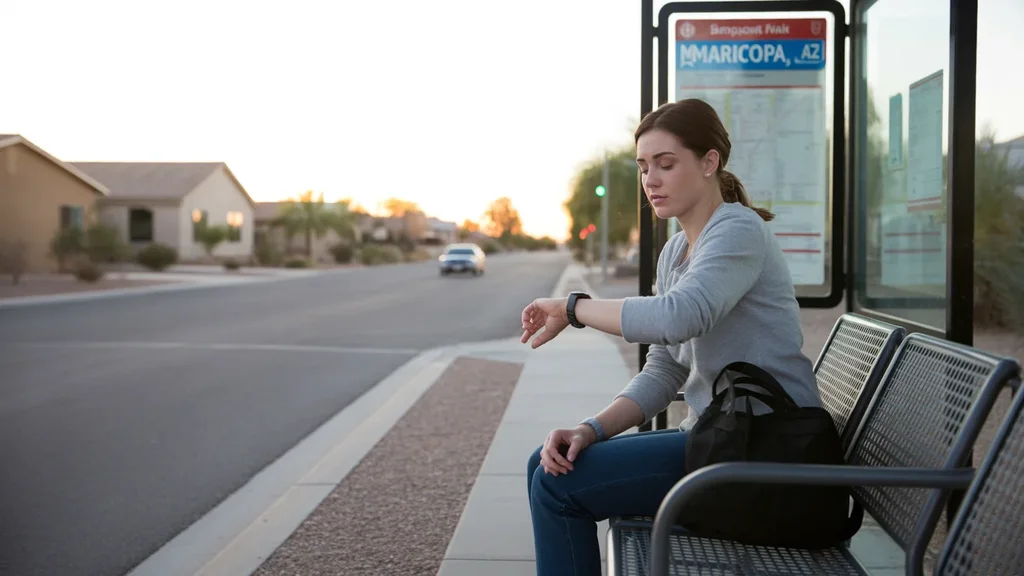
Public transit does not play a significant role in daily mobility for most Maricopa residents. The city’s infrastructure and land-use patterns were not designed to support frequent, high-coverage transit service, and the low density of both housing and commercial activity makes it difficult to sustain viable routes. While regional connections to nearby employment centers exist in principle, the practical reality is that commuters who need to reach Phoenix or other metro areas typically drive.
For households that rely on transit for economic reasons—those without access to a vehicle, or those trying to minimize transportation costs—Maricopa presents significant challenges. Coverage is limited, and the distances between home, work, and errands are often too great to navigate on foot or by infrequent bus service. This isn’t a gap that can be closed by better planning; it’s a structural mismatch between the city’s layout and the requirements of a functional transit system.
Driving & Car Dependence Reality
Driving in Maricopa is not optional for the vast majority of households. The city’s design assumes that residents will own at least one vehicle, and in many cases, two. Parking is abundant and free in most areas, and traffic congestion is generally manageable compared to denser metro cores. But the tradeoff is distance: daily errands that might take ten minutes on foot in a compact city require a five- to ten-minute drive here, and commutes to employment centers outside Maricopa can easily stretch to thirty or forty minutes each way.
This creates a different kind of cost exposure. Households aren’t paying for transit passes or dealing with crowded trains, but they are absorbing fuel costs, vehicle maintenance, insurance, and depreciation. The car becomes a fixed cost of living here, not a discretionary expense. For families with multiple workers or school-age children, that often means multiple vehicles, each with its own operating costs.
The upside is control and flexibility. Residents can leave when they want, stop where they need to, and adjust their routes in real time. There’s no waiting for a bus that may or may not arrive, and no need to plan trips around a fixed schedule. But that flexibility comes at the cost of financial exposure to fuel price swings and the ongoing burden of vehicle ownership.
Commuting Patterns & Daily Mobility
Commuting in Maricopa typically means driving out of the city. Many residents work in Phoenix or surrounding metro areas, and the commute is structured around highway access and timing. Morning and evening peaks can add time, but the routes themselves are generally straightforward. For households with flexible schedules or remote work arrangements, the commute burden is lighter. For those with fixed hours and long distances, it’s a daily cost in time and fuel.
Daily mobility beyond commuting follows a similar pattern. Errands are batched rather than spontaneous. Grocery runs, medical appointments, and school pickups are planned around driving routes, not walking distance. This isn’t necessarily inefficient—it’s just a different rhythm. Households that adapt to this structure often find it manageable. Those who expect to run quick errands on foot or rely on transit for flexibility will find Maricopa frustrating.
Who Transit Works For — and Who It Doesn’t
Transit in Maricopa works for almost no one as a primary mode of transportation. The infrastructure simply isn’t there to support daily commuting, errands, or household logistics without a car. Households that depend on transit for economic reasons—those who cannot afford a vehicle or choose not to own one—face significant barriers to employment, healthcare access, and grocery shopping.
Renters in more central areas might assume proximity to commercial corridors will reduce car dependence, but the sparse distribution of food and grocery options means that even well-located households still drive frequently. Homeowners in newer developments are even more car-reliant, as these neighborhoods are often farther from commercial zones and designed entirely around vehicle access.
The households that fare best in Maricopa are those with reliable vehicles, predictable commutes, and the financial capacity to absorb fuel and maintenance costs. Single-car households with one primary commuter can make it work, but multi-worker families or those with complex schedules often need two vehicles to avoid logistical gridlock.
Transportation Tradeoffs in Maricopa
The central tradeoff in Maricopa is between control and cost. Driving offers autonomy, flexibility, and the ability to structure your day without depending on external schedules. But it also locks households into ongoing expenses that don’t fluctuate with usage—insurance, registration, and depreciation continue whether you drive ten miles a week or two hundred.
Transit, where it exists, offers lower direct costs but at the expense of time, coverage, and convenience. In Maricopa, that tradeoff is mostly theoretical—there isn’t enough transit service to make it a viable alternative for most trips. The real choice is between accepting car dependency and its costs, or choosing to live somewhere else with different infrastructure.
For households evaluating whether Maricopa fits their transportation needs, the question isn’t “Can I get by without a car?” It’s “Am I comfortable with the financial and logistical reality of driving as the default for nearly everything?”
FAQs About Transportation in Maricopa (2026)
Is public transit usable for daily commuting in Maricopa?
Public transit is not a practical option for daily commuting in Maricopa. The city’s infrastructure and land-use patterns do not support frequent or comprehensive transit service, and most employment, shopping, and healthcare destinations require a vehicle to reach efficiently.
Do most people in Maricopa rely on a car?
Yes. The vast majority of Maricopa residents depend on a personal vehicle for commuting, errands, and daily mobility. The city’s layout and the sparse distribution of essential services make car ownership effectively mandatory for most households.
Which areas of Maricopa are easiest to live in without a car?
No area of Maricopa is designed to support car-free living. While some neighborhoods feature pedestrian infrastructure that makes walking within the neighborhood pleasant, the low density of grocery stores, healthcare facilities, and other essential services means that even the most walkable areas still require a vehicle for routine errands.
How does commuting in Maricopa compare to nearby cities?
Commuting in Maricopa typically involves driving to employment centers outside the city, often toward Phoenix or surrounding metro areas. Compared to denser cities with transit options, Maricopa offers less congestion and more parking availability, but at the cost of longer distances and full reliance on personal vehicles.
Can I reduce transportation costs by living closer to work in Maricopa?
If your workplace is within Maricopa, living closer can reduce commute distance and fuel costs. But most employment in the region is outside the city, and Maricopa’s internal layout still requires driving for errands and daily needs. Proximity helps, but it doesn’t eliminate the need for a vehicle or the costs that come with it.
How Transportation Fits Into the Cost of Living in Maricopa
Transportation in Maricopa isn’t just a budget line—it’s a structural factor that shapes where you live, how you organize your day, and what financial flexibility you have. The need for a vehicle is baked into the cost of living here, and households that underestimate that dependency often find themselves stretched thin, not by high prices, but by the cumulative weight of fuel, insurance, and maintenance.
The walkable pockets that exist in some neighborhoods offer quality-of-life benefits—places to walk the dog, safe routes for kids, a sense of neighborhood cohesion. But they don’t reduce what a budget has to handle in Maricopa. The car remains essential, and the costs associated with it remain fixed.
For a fuller picture of how transportation costs interact with housing, utilities, and other expenses, the monthly budget breakdown provides numeric context. But the takeaway here is simpler: Maricopa works best for households that accept driving as the default, plan accordingly, and have the financial margin to absorb the costs without stress. If that describes your situation, the city’s layout offers space, ease of parking, and manageable traffic. If it doesn’t, the transportation structure will be a constant source of friction.
How this article was built: In addition to public economic data, this article incorporates location-based experiential signals derived from anonymized geographic patterns—such as access density, walkability, and land-use mix—to reflect how day-to-day living actually feels in Maricopa, AZ.