
Maricopa sits in the outer ring of the Phoenix metro, where suburban growth has accelerated over the past two decades. The city’s housing market reflects that expansion: newer construction, mixed residential and commercial land use, and a cost structure shaped by both metro-wide demand and the realities of living in the Sonoran Desert. For newcomers, the challenge isn’t just affordability in the abstract—it’s understanding how Maricopa’s particular combination of climate, infrastructure, and development pattern changes what housing actually costs to occupy over time.
Home values here stand at $292,300, while median gross rent reaches $1,768 per month. Those figures place Maricopa in the moderately elevated tier relative to Arizona’s regional baseline, but below the core Phoenix metro. What matters more than the sticker price is how the city’s structure—low-rise, car-dependent, with sparse grocery and errands accessibility—shapes the hidden costs of daily life. Renters and buyers alike face a market where housing itself may be attainable, but the friction of getting around, managing utilities in triple-digit summer heat, and navigating a spread-out built environment adds layers of exposure that don’t show up in the lease or the purchase agreement.
How this article was built: In addition to public economic data, this article incorporates location-based experiential signals derived from anonymized geographic patterns—such as access density, walkability, and land-use mix—to reflect how day-to-day living actually feels in Maricopa, AZ.
The Housing Market in Maricopa Today
Maricopa’s housing market is defined by its position as a growth suburb in the Phoenix metro’s southern corridor. Development here has been rapid and relatively recent, producing a housing stock dominated by single-family homes in planned communities. The city’s low-rise character and mixed land use—both residential and commercial zones are present—suggest a development model built around car access rather than transit or pedestrian convenience.
What sets Maricopa apart from older Phoenix suburbs is the combination of newer construction and geographic isolation. The city sits roughly 35 miles south of central Phoenix, far enough that commuters face meaningful time and fuel costs, but close enough that housing demand spills over from the metro core. This creates a market where buyers and renters are often trading proximity for space and relative affordability, but that tradeoff comes with infrastructure constraints. Grocery and food establishment density falls below typical thresholds, meaning even routine errands require planning and car trips. Walkable pockets exist—pedestrian infrastructure is present in parts of the city—but they don’t eliminate the need for a vehicle.
For newcomers evaluating Maricopa, the key misunderstanding is assuming that lower home values or rents automatically translate to lower total [cost structure](/maricopa-az/cost-overview/). The city’s layout and climate introduce recurring expenses—fuel, cooling, time—that compound over months and years. The market rewards buyers and renters who can absorb those frictions without financial strain, and penalizes those who underestimate them.
Renting in Maricopa
At $1,768 per month, median gross rent in Maricopa reflects the broader Phoenix metro’s rental pressure, tempered slightly by distance from the urban core. For a household earning the city’s median income of $88,795 per year, rent represents roughly 24% of gross income—within the conventional affordability threshold, but only if that income is stable and the household can manage the additional costs that come with living here.
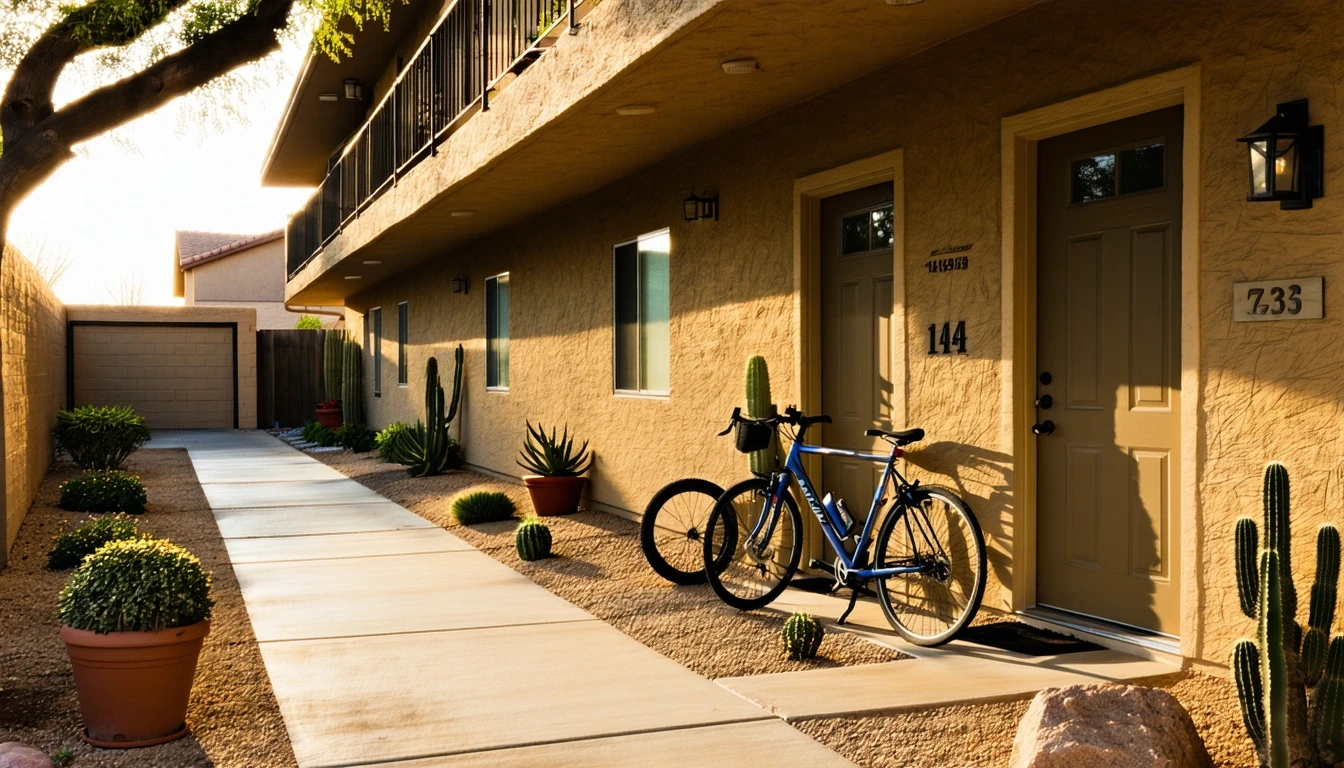
Rental housing in Maricopa tends to cluster in apartment complexes and townhome communities, many built within the past 15 years. These properties often include amenities—pools, fitness centers, landscaping—that appeal to renters seeking suburban comfort, but they also come with the expectation of car ownership. Because grocery and errands accessibility is sparse, renters without reliable transportation face meaningful logistical barriers. The city’s walkable pockets offer some relief in select neighborhoods, but they don’t extend citywide, and public transit options are minimal.
Renters in Maricopa also face exposure to utility volatility driven by the desert climate. Triple-digit summer heat dominates the cooling season, and electricity costs—billed at 16.03¢/kWh—can spike sharply during peak months. Apartment renters may benefit from smaller square footage and shared-wall insulation, but those advantages are limited if the unit faces west or lacks modern HVAC efficiency. Lease terms rarely account for seasonal utility swings, so renters need to budget for variability that can exceed $100 per month between winter and summer.
The rental market here rewards those who can absorb both the base rent and the secondary costs of car dependency and climate exposure. For single-income households, students, or those transitioning between jobs, the combination of rent, fuel, and utilities can tighten margins quickly. Dual-income households or those earning above the median have more room to navigate the tradeoffs, but even then, the city’s infrastructure requires planning and flexibility that renters in denser, more walkable markets don’t face.
Owning a Home in Maricopa
At $292,300, the median home value in Maricopa positions the city as accessible for buyers with stable income and down payment capacity, particularly compared to closer-in Phoenix suburbs where values climb significantly higher. But ownership here introduces exposure that extends well beyond the mortgage payment. Property taxes, homeowners association fees, and the ongoing cost of maintaining a home in a climate with extreme heat and occasional dust storms create a recurring financial load that renters don’t carry.
Maricopa’s housing stock skews toward planned communities, many governed by HOAs that bundle services like landscaping, common-area maintenance, and sometimes water or trash collection. These fees vary widely but represent a fixed monthly cost that doesn’t decline with the mortgage. For buyers accustomed to older neighborhoods without HOA governance, this shift can feel restrictive, both financially and in terms of autonomy over property modifications.
Ownership in Maricopa also means taking on the full weight of utility exposure. Unlike apartment renters, homeowners face the cost of cooling (and occasionally heating) larger square footage, often in single-story layouts with significant roof and wall surface exposed to the sun. Electricity bills during summer months can dominate [monthly expenses](/maricopa-az/monthly-budget/), and the burden falls entirely on the homeowner. Efficiency upgrades—programmable thermostats, insulation, window treatments—can reduce usage, but the baseline exposure remains high due to the extended cooling season.
Maintenance costs in the desert climate also differ from temperate regions. HVAC systems work harder and wear faster. Exterior paint, roofing, and landscaping face stress from heat and UV exposure. Dust infiltration requires more frequent filter changes and cleaning. These aren’t catastrophic expenses individually, but they accumulate in ways that buyers from milder climates often underestimate.
The ownership experience in Maricopa rewards those who can manage both predictable costs (mortgage, taxes, HOA) and variable exposure (utilities, maintenance, fuel). It’s a market where the home itself may be attainable, but the infrastructure around it—sparse errands accessibility, car dependency, climate intensity—demands financial and logistical resilience that not all buyers are prepared to sustain.
Apartment vs House in Maricopa — Cost Behavior Comparison
| Expense Category | Apartment | House |
|---|---|---|
| Cooling (Summer) | Lower square footage and shared walls reduce exposure, but west-facing units or older HVAC can still spike bills | Larger square footage and single-story layouts with roof exposure drive higher electricity usage during extended cooling season |
| Maintenance | Landlord or property management handles HVAC, exterior, and common areas; tenant exposure limited to interior damage | Owner absorbs all HVAC wear, exterior paint/roofing stress from UV and heat, and landscaping in desert climate |
| HOA/Community Fees | Typically included in rent or billed separately as part of lease; covers amenities and common-area upkeep | Billed monthly as separate line item; often covers landscaping, water, trash, and community facilities; does not decline over time |
| Fuel/Transportation | Same car dependency due to sparse errands accessibility; apartment location within walkable pockets may reduce some trips | Same car dependency; single-family neighborhoods may be farther from commercial clusters, increasing trip frequency and distance |
Why these differences matter in Maricopa: The comparison above isolates categories where the city’s climate, development pattern, and infrastructure create meaningful cost divergence between apartments and houses. Categories like water, trash, and internet were excluded because they either vary by lease structure or don’t differ predictably by housing type in this market. The dominant drivers—cooling exposure, maintenance burden, and car dependency—are shaped by Maricopa’s desert climate, low-rise suburban form, and sparse daily errands accessibility, all of which affect both renters and owners but with different intensity and control.
Utilities & Upkeep Differences
In Maricopa, utility and maintenance exposure is driven primarily by climate intensity and housing form. The extended cooling season—often running from May through September—creates electricity demand that dominates household budgets during peak months. At 16.03¢/kWh, the rate itself is moderate, but the volume of usage in triple-digit heat pushes bills well above what households in milder climates experience. Apartment renters benefit from smaller square footage and shared-wall insulation, but those advantages erode quickly in poorly oriented units or buildings with aging HVAC systems. Homeowners face the full weight of cooling larger spaces, often with single-story layouts that maximize roof exposure to the sun.
Maintenance costs in the desert also carry distinct characteristics. HVAC systems cycle more frequently and wear faster under sustained heat. Exterior surfaces—paint, roofing, stucco—degrade more quickly due to UV intensity and temperature swings. Landscaping, whether native or ornamental, requires either irrigation or tolerance for seasonal dormancy. Dust infiltration is a recurring issue, requiring more frequent filter changes and interior cleaning than in humid or temperate regions. For apartment renters, most of these costs are absorbed by the landlord or property management. For homeowners, they represent ongoing exposure that doesn’t pause, even in months when the home’s value appreciates.
The difference in upkeep burden between apartments and houses in Maricopa isn’t just about who pays—it’s about predictability and control. Renters face less volatility but also less ability to reduce costs through efficiency upgrades. Homeowners can invest in insulation, programmable thermostats, or shade structures, but those investments require upfront capital and time to pay off. Both groups face the same climate, but the financial texture of managing it differs sharply depending on housing type.
Rent vs Buy: Long-Term Exposure in Maricopa
The decision between renting and buying in Maricopa hinges less on monthly payment comparisons and more on how each path distributes risk, control, and volatility over time. Renters face the possibility of rent increases at lease renewal, particularly in a market where Phoenix metro demand continues to push outward. That exposure is unpredictable and largely outside the tenant’s control, but it comes with the flexibility to relocate without the transaction costs of selling a home. Buyers, by contrast, lock in a mortgage payment (assuming a fixed-rate loan) but take on the full spectrum of ownership costs—property taxes, insurance, HOA fees, maintenance, and utilities—all of which can shift over time.
In Maricopa’s climate, ownership introduces sustained exposure to cooling costs that renters may avoid by moving to a more efficient unit or a different market entirely. Homeowners can mitigate some of that exposure through efficiency upgrades, but the baseline demand remains high due to the extended cooling season and the city’s low-rise, single-family housing form. Maintenance costs also accumulate in ways that renters don’t experience: HVAC replacement, roof repair, exterior repainting, and landscaping all represent irregular but inevitable expenses that compound over years.
The city’s sparse errands accessibility and car dependency affect both renters and owners, but ownership magnifies the stakes. Buyers commit to a location with limited walkability and minimal transit options, meaning fuel costs and vehicle maintenance become fixed components of the household budget. If gas prices rise or commute patterns change, homeowners have less flexibility to adjust than renters, who can relocate closer to work or services without selling a property.
Over a multi-year horizon, ownership in Maricopa rewards those who can absorb volatility in utilities, maintenance, and transportation without financial strain, and who value the stability of a fixed housing payment and the potential for home value appreciation. Renting rewards those who prioritize flexibility, lower upfront costs, and the ability to avoid the long-term exposure that comes with managing a home in a climate and infrastructure environment that demands constant attention and adaptation.
FAQs About Housing Costs in Maricopa
Is Maricopa affordable for first-time homebuyers?
At $292,300, median home values in Maricopa are accessible relative to closer-in Phoenix suburbs, making the city a viable option for first-time buyers with stable income and down payment capacity. However, affordability depends not just on the purchase price but on the ability to manage ongoing costs—utilities, HOA fees, maintenance, and fuel—that are elevated due to the city’s climate and car-dependent infrastructure. Buyers who underestimate those secondary costs may find that the home itself is attainable but the total cost of occupancy strains their budget over time.
How does renting in Maricopa compare to buying?
Renting in Maricopa offers lower upfront costs and flexibility to relocate, but exposes tenants to potential rent increases and limits their ability to control utility and maintenance expenses. Buying locks in a mortgage payment and allows for efficiency upgrades, but introduces sustained exposure to property taxes, HOA fees, and the full cost of managing a home in a desert climate. The choice depends on whether a household values predictability and equity-building (ownership) or flexibility and lower initial commitment (renting).
What drives utility costs in Maricopa housing?
Utility costs in Maricopa are dominated by electricity usage during the extended cooling season, when triple-digit summer heat drives air conditioning demand for months at a time. At 16.03¢/kWh, the rate is moderate, but the volume of usage—especially in single-family homes with larger square footage and roof exposure—pushes bills well above what households in milder climates experience. Apartment renters face lower exposure due to smaller spaces and shared walls, but poorly oriented units or aging HVAC systems can still produce significant seasonal spikes.
Are HOA fees common in Maricopa?
Maricopa’s housing stock is heavily concentrated in planned communities, many of which are governed by homeowners associations. HOA fees are common and typically cover landscaping, common-area maintenance, and sometimes water or trash collection. These fees represent a fixed monthly cost that does not decline over time and can vary widely depending on the community’s amenities and services. Buyers should account for HOA fees as a permanent component of ownership costs, not a temporary or optional expense.
Does Maricopa’s layout affect housing costs?
Yes. Maricopa’s low-rise, car-dependent layout and sparse grocery and errands accessibility increase transportation costs for both renters and owners. Households need reliable vehicles and must budget for fuel, maintenance, and time spent driving to access daily services. The city’s walkable pockets offer some pedestrian relief in select neighborhoods, but they don’t eliminate the need for a car. This infrastructure pattern adds recurring costs that don’t appear in rent or mortgage payments but significantly affect total household expenses over time.
Making Housing Choices in Maricopa
Housing costs in Maricopa reflect a market shaped by suburban growth, desert climate, and car-dependent infrastructure. The city offers attainable home values and rents relative to the Phoenix metro core, but the total cost of living here extends well beyond the lease or mortgage payment. Cooling exposure, sparse errands accessibility, and the need for reliable transportation create recurring expenses that compound over time, rewarding households with stable income, dual earners, or above-median earnings, and challenging those operating on tighter margins or single incomes.
Renters gain flexibility and lower upfront costs but face exposure to rent increases and limited control over utilities and maintenance. Buyers lock in a mortgage payment and gain the ability to invest in efficiency upgrades, but take on the full weight of property taxes, HOA fees, and the ongoing cost of managing a home in a climate that demands constant attention. Both paths require understanding not just what housing costs today, but how Maricopa’s particular combination of climate, layout, and infrastructure changes [what a budget has to handle](/maricopa-az/monthly-budget/) over months and years.
For those evaluating [where your money goes in Maricopa](/maricopa-az/cost-overview/), the housing decision is less about finding the lowest monthly payment and more about matching cost structure to household capacity—financially, logistically, and in terms of tolerance for volatility and friction. The city’s market rewards those who can absorb the secondary costs of living here without strain, and penalizes those who assume that attainable housing alone guarantees long-term affordability.