
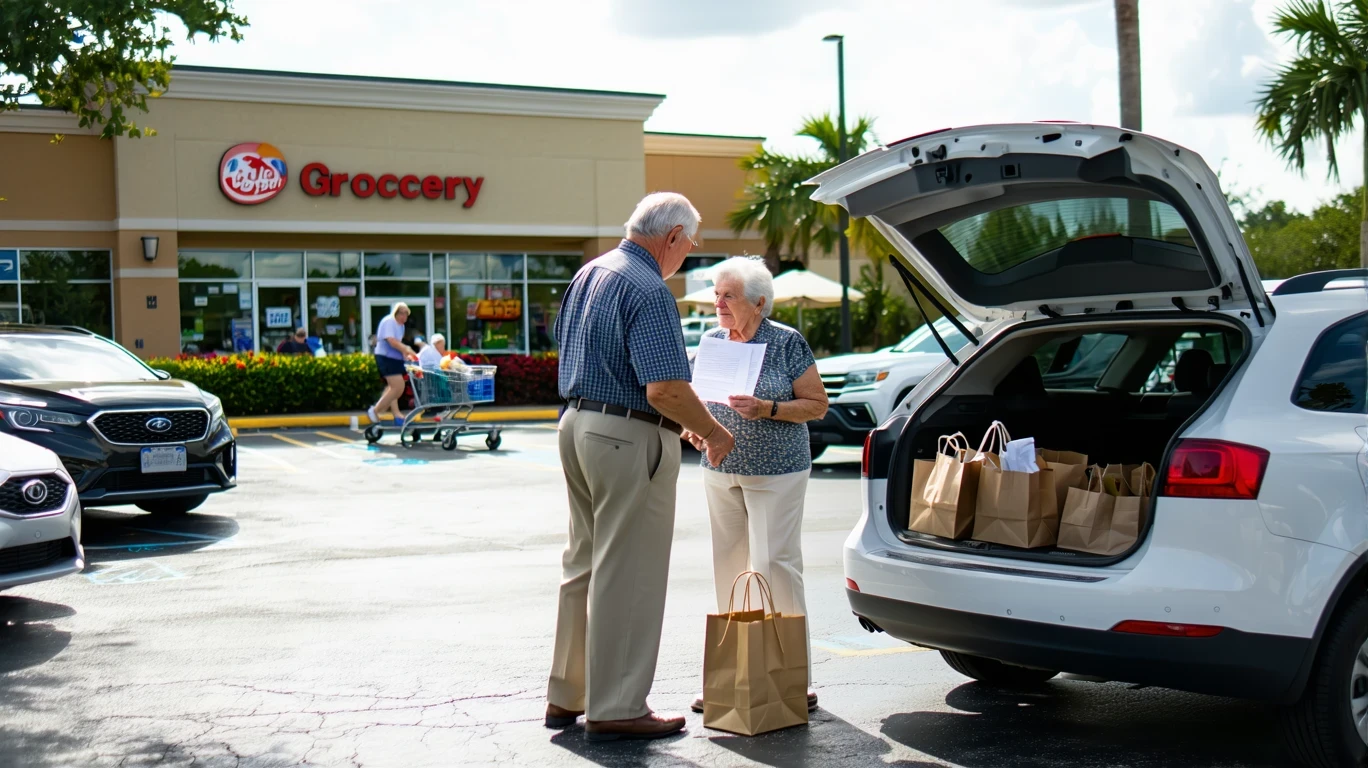
How Grocery Costs Feel in Hollywood
Grocery shopping in Hollywood doesn’t follow a single script. The city sits in a coastal corridor where discount chains, mid-tier grocers, and premium organic markets all compete within a few miles of each other, and where you shop matters as much as what you buy. For a household earning around $61,958 per year—the median income here—grocery costs represent one of the few spending categories where deliberate choices still create meaningful room to maneuver. Unlike housing or insurance, food prices respond to strategy: store selection, trip frequency, and willingness to adapt brands all influence how tightly or loosely the budget feels at checkout.
Families with children notice grocery pressure most acutely. A household of four moving through a typical week of meals, snacks, and school lunches will cycle through staples quickly, and small per-unit price differences compound across dozens of items. Singles and couples without kids experience grocery costs differently—not because individual items cost less, but because waste, spoilage, and bulk-buying economics don’t favor them the same way. In Hollywood, where both retirees and young professionals share neighborhoods, the grocery aisle becomes a microcosm of broader financial variability: same prices, different pressure.
The city’s position within the Miami-Fort Lauderdale metro also means grocery costs reflect regional distribution patterns rather than purely local dynamics. Prices here don’t operate in isolation—they’re shaped by the same supply chains, port access, and retail competition that influence the broader South Florida market. That creates a certain baseline consistency, but it also means households can’t escape regional cost structure simply by crossing city lines. What changes isn’t the price floor—it’s how much control you retain over where and how often that floor matters.
Grocery Price Signals (Illustrative)
Item-level prices offer a way to understand how Hollywood’s grocery landscape compares in relative terms, not as a literal shopping list. These figures illustrate cost positioning for everyday staples—useful for sensing whether your current grocery habits will translate smoothly or require recalibration. They don’t represent a complete cart, a specific store, or a guaranteed weekly outcome, but they do show how certain anchor items tend to price out locally.
| Item | Illustrative Price |
|---|---|
| Bread (per pound) | $1.90/lb |
| Cheese (per pound) | $4.99/lb |
| Chicken (per pound) | $2.10/lb |
| Eggs (per dozen) | $2.65/dozen |
| Ground beef (per pound) | $6.95/lb |
| Milk (per half-gallon) | $4.22/half-gallon |
| Rice (per pound) | $1.09/lb |
Derived estimate based on national baseline adjusted by regional price parity; not an observed local price.
These prices cluster around a regional baseline that reflects South Florida’s cost structure—not dramatically high, but not bargain-territory either. Ground beef and cheese carry the most per-pound weight, while rice and bread remain relatively accessible. Eggs and milk sit in a middle band where small shifts in household consumption (an extra carton per week, switching from skim to whole) don’t destabilize budgets but do accumulate over time. For families planning around these staples, the math isn’t punishing, but it doesn’t forgive inattention either.
What these numbers don’t capture is variability across store formats. The same pound of chicken that rings up at one price in a discount grocer may cost 30% more in a specialty market three blocks away. Hollywood’s grocery infrastructure supports that range, and households that treat all stores as interchangeable pay a premium for convenience they may not have intended to buy.
Store Choice & Price Sensitivity
Grocery price pressure in Hollywood isn’t uniform—it’s tiered. Discount grocers anchor the low end, offering no-frills environments where private-label dominance and high-volume turnover keep prices compressed. These stores reward households willing to trade brand familiarity and ambiance for straightforward savings. Mid-tier chains occupy the center, blending competitive pricing on staples with enough variety and convenience to avoid feeling like a compromise. Premium grocers—often organic-focused or specialty-oriented—serve households for whom ingredient sourcing, prepared foods, or shopping experience justify higher per-item costs.
For a family of four on a median income, the discount-to-mid tier gap represents the difference between tight discipline and modest flexibility. Shopping exclusively at premium grocers without adjusting consumption patterns can push food costs into territory that competes with other fixed expenses. Conversely, households that split trips—stocking pantry staples at discount stores while filling in fresh produce or specific items at mid-tier chains—often find a sustainable middle path that doesn’t require constant coupon management or brand sacrifice.
Singles and couples face a different calculus. Smaller households don’t benefit as much from bulk pricing, and discount stores’ large-format packaging can create waste rather than savings. For them, mid-tier grocers often offer better unit economics on smaller quantities, and the convenience of location and trip frequency becomes a hidden cost factor. Premium grocers, meanwhile, become viable for households with higher incomes or specific dietary priorities, where the per-item premium aligns with values rather than stretching budgets.
Hollywood’s relatively high grocery density—a signal that emerges from the city’s commercial land-use mix and corridor clustering—means most residents live within practical distance of multiple store tiers. That access doesn’t eliminate price pressure, but it does mean households retain more control over how much of that pressure they absorb. The question isn’t whether cheaper options exist—it’s whether your routine, schedule, and preferences allow you to use them consistently.
What Drives Grocery Pressure Here
Income is the most direct lever. At $61,958 per year, Hollywood’s median household income sits below the metro-wide average, which means grocery costs—even when objectively moderate—claim a larger share of take-home pay than they might in higher-earning suburbs. A family spending $800 per month on groceries isn’t facing unusually high prices, but that figure represents a more significant budget commitment here than it would in a community where median income exceeds $80,000. The pressure isn’t the price—it’s the proportion.
Household size amplifies that pressure unevenly. A single adult earning the median can absorb grocery costs with relative ease, even when shopping at mid-tier stores. A household of four on the same income faces a fundamentally different equation: more mouths, more trips, more volume, and less margin for waste or impulse purchases. Families also contend with dietary variability—children’s preferences, school lunch gaps, snack demands—that singles don’t navigate. The same grocery infrastructure serves both groups, but the experience of cost pressure diverges sharply.
Regional distribution patterns also shape what’s available and when. South Florida’s position as a logistics hub means certain items benefit from proximity to import channels and regional warehouses, while others—particularly specialty or cold-chain products—carry premiums tied to distance and handling. Seasonal variability exists but operates quietly: produce prices shift with growing cycles and weather disruptions, and households that adapt their buying patterns around what’s abundant rather than what’s habitual smooth out some of that volatility. Those who don’t adapt simply absorb the swings.
Hollywood’s urban form—a mix of low-rise residential blocks and commercial corridors—creates pockets of strong grocery access alongside areas where the nearest full-service store requires a deliberate trip. That unevenness doesn’t make groceries unaffordable, but it does mean convenience and cost don’t always align. Households with easy access to multiple stores can optimize; those farther from commercial nodes face a tradeoff between time, fuel, and price.
Practical Ways People Manage Grocery Costs
Meal planning remains the most effective behavioral tool for controlling grocery spending. Households that plan a week’s worth of dinners before shopping avoid duplicate purchases, reduce impulse buys, and minimize food waste—all of which erode budgets more quietly than high prices. Planning also enables strategic use of pantry staples and leftovers, turning one roasted chicken into three meals or stretching a pot of rice across multiple dishes. The discipline isn’t glamorous, but it creates slack in the budget that ad-hoc shopping never does.
Store rotation—splitting trips between discount grocers for shelf-stable staples and mid-tier chains for fresh items—gives households access to lower prices without sacrificing quality where it matters. This approach requires more logistical effort than one-stop shopping, but it avoids the all-or-nothing tradeoff between convenience and cost. Families with predictable schedules and nearby access to multiple stores benefit most; those juggling long commutes or limited vehicle access find rotation harder to sustain.
Brand flexibility also reduces pressure. Private-label products in Hollywood’s discount and mid-tier grocers often match or exceed national-brand quality at lower price points, particularly for basics like canned goods, pasta, dairy, and frozen vegetables. Households willing to experiment with store brands on low-risk items—where taste and texture differences are minimal—free up budget for categories where brand or quality matters more. The savings per item are modest, but they compound across a cart.
Buying in bulk works well for non-perishables and household staples, but only when storage space and consumption rates support it. A family of four can justify bulk rice, beans, or canned tomatoes; a single adult often can’t use the volume before quality degrades. Bulk buying also requires upfront cash, which creates timing pressure for households managing tight pay cycles. The strategy isn’t universally effective—it rewards specific household profiles and living situations.
Seasonal produce buying, even without strict adherence to farmers market schedules, helps smooth costs. Tomatoes, peppers, and squash cost less when locally abundant; berries and stone fruits spike in winter. Households that adjust recipes and meal plans around what’s in season encounter fewer price shocks and better quality. This doesn’t require expert knowledge—just attention to what’s prominently displayed and competitively priced each week.
Groceries vs Eating Out (Directional)
The tradeoff between cooking at home and eating out isn’t purely financial—it’s also about time, effort, and mental load. Groceries require planning, prep, and cleanup; restaurant meals and takeout eliminate that labor but carry a significant price premium. In Hollywood, where casual dining and quick-service chains are abundant, the temptation to outsource meals is constant, and households that drift into frequent takeout often find their food spending doubles without a corresponding increase in satisfaction.
A home-cooked dinner for four—built around chicken, rice, and vegetables—might cost $12 to $15 in ingredients. The same meal as takeout easily runs $40 to $50 after tax and tip, and often includes less control over portion size, sodium, and quality. The gap isn’t subtle, and it compounds quickly. Families that cook five nights a week and eat out twice maintain a sustainable rhythm; those who flip that ratio face budget strain that grocery prices alone don’t explain.
Singles and couples face a different version of this tradeoff. Cooking for one or two often feels inefficient—ingredients spoil, recipes don’t scale down neatly, and the effort-to-reward ratio feels skewed. For smaller households, the convenience premium of eating out compresses, and the financial penalty softens. That doesn’t make takeout cheaper than groceries, but it does mean the lifestyle fit and budget impact vary more by household size than by city.
Hollywood’s mix of chain restaurants, ethnic eateries, and fast-casual spots creates a dining landscape where eating out doesn’t always mean fine dining. A $10 lunch or $15 dinner exists, but frequency still matters more than per-meal cost. Households that treat dining out as occasional rather than default preserve the bulk of their food budget for groceries, where dollar-for-dollar value remains higher. Those who blur the line between convenience and habit often lose track of how much they’re spending until monthly expenses tighten elsewhere.
FAQs About Grocery Costs in Hollywood (2026)
Is it cheaper to shop in bulk in Hollywood? Bulk buying reduces per-unit costs for non-perishables and household staples, but only if you have storage space and consumption rates that prevent waste. Families of four benefit more than singles, and the strategy works best for items like rice, canned goods, and frozen vegetables that don’t spoil quickly.
Which stores in Hollywood are best for low prices? Discount grocers offer the lowest baseline prices, especially on private-label staples and high-turnover items. Mid-tier chains provide a balance of competitive pricing and product variety, while premium grocers cater to households prioritizing organic, specialty, or prepared foods. Store choice matters as much as what you buy.
How much more do organic items cost in Hollywood? Organic products typically carry a premium over conventional equivalents, with the gap widest on produce, dairy, and meat. The exact difference varies by store tier and item, but households committed to organic shopping should expect meaningfully higher grocery totals unless they adjust volume or frequency to offset the per-item cost.
How do grocery costs for two adults in Hollywood tend to compare to nearby cities? Hollywood’s grocery prices reflect broader South Florida regional patterns rather than sharp city-to-city variation. Costs here align closely with Fort Lauderdale and Miami suburbs, meaning households won’t find dramatic relief by relocating within the metro. Store tier and shopping habits drive more variation than city boundaries.
How do households in Hollywood think about grocery spending when cooking at home? Most households treat groceries as a controllable expense where planning, store selection, and brand flexibility create room to adjust. Families focus on stretching staples and minimizing waste, while smaller households balance convenience against per-unit cost. Cooking at home remains the most cost-effective option, but it requires consistent effort and discipline.
Do grocery costs in Hollywood fluctuate seasonally? Produce prices shift with growing seasons and weather patterns, and certain items become more or less expensive depending on regional availability. Households that adapt their buying around what’s abundant rather than what’s habitual encounter fewer price spikes. Meat and dairy costs remain more stable year-round.
How does Hollywood’s grocery access compare to other South Florida cities? Hollywood benefits from relatively high grocery density, with discount, mid-tier, and premium stores distributed across commercial corridors. That access gives most residents practical proximity to multiple store formats, which supports price comparison and strategic shopping. Not all neighborhoods have equal access, but the overall infrastructure is stronger than in more sprawling or car-dependent suburbs.
How Groceries Fit Into the Cost of Living in Hollywood
Groceries occupy a middle position in Hollywood’s cost structure—less dominant than housing, less volatile than utilities, but more responsive to behavior than insurance or transportation. For a household earning the median income, food costs represent a meaningful but manageable share of the budget, assuming deliberate choices around store selection, meal planning, and dining-out frequency. Families with children feel the most pressure, while singles and couples retain more flexibility to absorb premium grocers or occasional convenience without destabilizing their finances.
The city’s grocery infrastructure—anchored by corridor clustering and a mix of store tiers—provides the tools for cost control, but it doesn’t eliminate the need for discipline. Households that treat grocery shopping as a strategic activity rather than a routine errand consistently spend less without sacrificing quality. Those who shop reactively, prioritize convenience, or default to takeout when planning falters often find their food spending creeping into territory that competes with other priorities.
Understanding how groceries interact with housing, utilities, and transportation requires looking at the full picture, not isolated line items. A household that saves $100 per month on groceries through careful planning but loses $200 to inefficient commuting or undersized housing hasn’t improved their position—they’ve just shifted pressure. For a complete view of where money goes each month and how these categories fit together, see A Month of Expenses in Hollywood: What It Feels Like. Grocery costs matter, but they’re one lever among many, and pulling it effectively means knowing what else is moving in the background.
How this article was built: In addition to public economic data, this article incorporates location-based experiential signals derived from anonymized geographic patterns—such as access density, walkability, and land-use mix—to reflect how day-to-day living actually feels in Hollywood, FL.