
“It’s quiet, green, and the schools are great — but you’re definitely driving everywhere unless you stick to your neighborhood loop.”
That’s the refrain you hear again and again when people talk about life in Flower Mound. This affluent suburb northwest of Dallas offers a specific kind of comfort: excellent parks, strong family amenities, and a residential feel that prioritizes space and calm over spontaneity and density. But that same structure creates friction for anyone who craves walkable errands, cultural texture, or the ability to grab what they need without planning the route first.
Understanding whether Flower Mound feels like home depends less on whether it’s “good” and more on whether its tradeoffs align with what you actually value day-to-day.
What Defines the Flower Mound Vibe
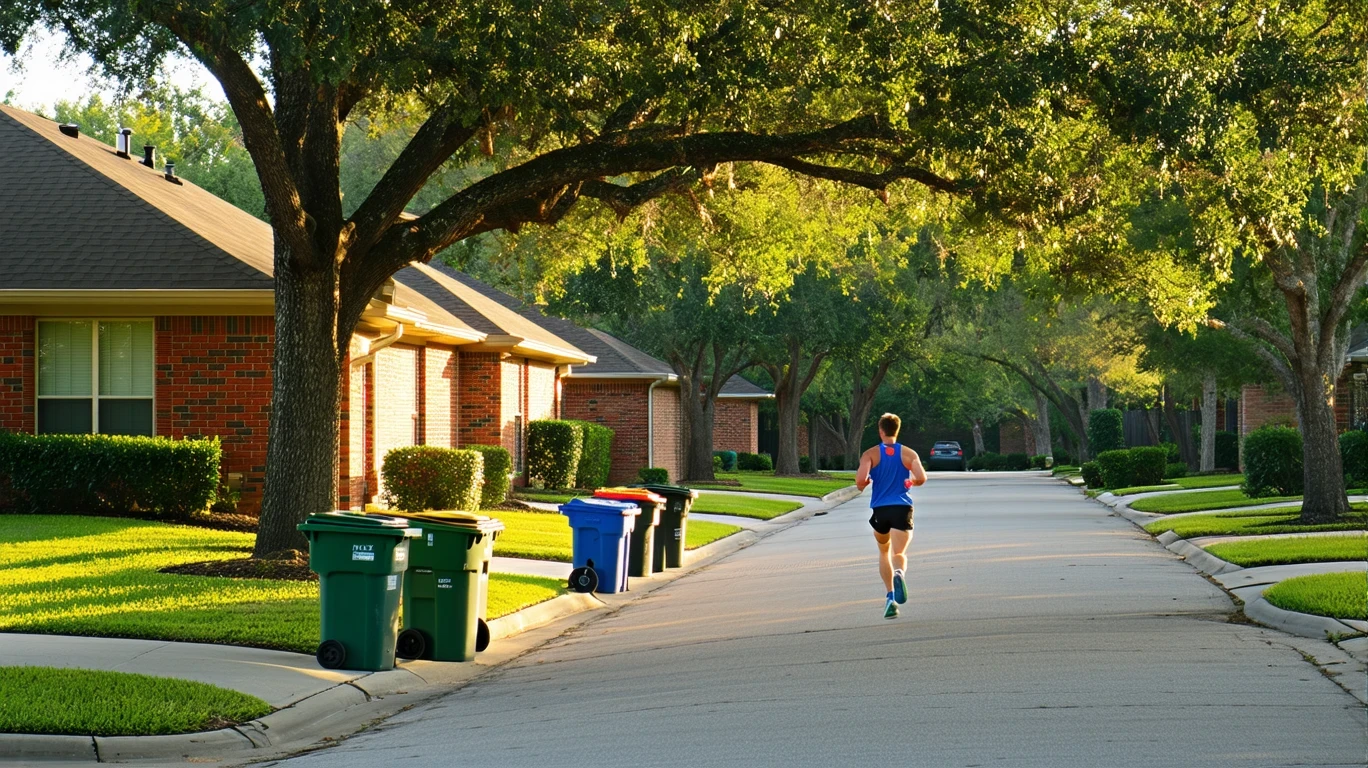
Flower Mound rewards people who want suburban predictability with pockets of natural beauty. The town sits on rolling terrain with significant park infrastructure — density here exceeds high thresholds, and water features add visual and recreational variety. Playgrounds are plentiful, schools are accessible, and the overall layout supports families managing kid-centered logistics.
But the structure also reflects car-oriented planning. Food and grocery options cluster along commercial corridors rather than spreading evenly across neighborhoods. That means errands require intention: you batch trips, you plan routes, and you don’t casually walk to grab a missing ingredient. Walkable pockets do exist — pedestrian infrastructure in some areas supports neighborhood strolls and park access — but those moments are exceptions, not the default texture of daily life.
For households that see driving as a non-issue and prioritize outdoor space, school access, and residential quiet, this setup feels seamless. For those who measure convenience by how little they need to think about logistics, it can feel like constant low-level planning.
What People Talk About Online
Local social media and community forums reveal a consistent emotional split. Parents and outdoor enthusiasts tend to express satisfaction and even protectiveness: the parks deliver, the schools feel stable, and the neighborhoods offer safety and space. There’s pride in what the town provides for families, and frustration when outsiders dismiss it as “just another suburb.”
At the same time, younger professionals, renters, and people who moved from denser cities often describe a sense of isolation or inconvenience. The recurring theme isn’t that Flower Mound is bad — it’s that it requires you to be comfortable with a specific rhythm.
“We love the trails and the lake access, but I miss being able to walk to a coffee shop or pick up dinner without getting in the car.”
“It’s perfect if you have kids and want them outside all the time. If you’re single or don’t care about parks, it might feel pretty boring.”
“People complain about driving, but that’s the tradeoff for space and quiet. You can’t have both.”
Discussion often centers on whether growth will change the character of the town — whether new development will add walkability and variety, or just more of the same residential sprawl. There’s no consensus, but the question itself reflects an underlying tension: some residents want Flower Mound to stay exactly as it is, while others want it to evolve toward greater convenience and texture.
How Local Coverage Frames the Town
Local news and community outlets tend to frame Flower Mound through the lens of growth management, identity preservation, and infrastructure adaptation. Coverage doesn’t focus on crisis or conflict, but on the ongoing negotiation between maintaining suburban character and accommodating change.
Typical themes include:
- “New Retail and Dining Options Arrive Along Major Corridors”
- “Residents Debate Density and Development Proposals”
- “Town Celebrates Trail Expansions and Park Improvements”
- “Families Highlight School Quality and Extracurricular Access”
- “Commuters Weigh Convenience Against Residential Calm”
The tone is generally civic and measured, reflecting a community that sees itself as stable and family-focused, but aware of the pressures that come with proximity to a growing metro area. There’s less emphasis on dramatic transformation and more on incremental adjustments.
What Reviews and Public Perception Reveal
Public reviews of Flower Mound — whether on neighborhood platforms, Google, or local discussion boards — tend to cluster around a few predictable themes.
Praise centers on outdoor access, school quality, and residential safety. People who wanted suburban space with strong parks and family infrastructure tend to feel they got exactly what they expected. The hospital presence and pharmacy access also register as reassuring for households managing health needs.
Criticism, when it appears, is rarely about failure — it’s about mismatched expectations. People who assumed “suburb” would still mean walkable town centers or easy access to diverse dining feel let down. The corridor-clustered errands structure means that even though grocery stores and restaurants exist, reaching them requires driving and often dealing with traffic along a few major routes.
Newer planned neighborhoods tend to receive more positive feedback for internal walkability and amenity access, while older pockets are described as quieter but less connected. The mixed building character — neither purely low-rise nor notably vertical — reflects a town that has grown in phases without a singular architectural identity.
Renters, in particular, sometimes express frustration with cost relative to convenience. With a median gross rent of $2,039 per month and a median household income of $154,471 per year, the town skews affluent, and the rental market reflects that. For those who don’t own and don’t have kids in the school system, the value proposition can feel less clear.
How Flower Mound Compares to Nearby Cities
| Dimension | Flower Mound | Lewisville | Coppell |
|---|---|---|---|
| Overall Vibe | Affluent, park-rich, family-suburban | More diverse, denser, mixed affordability | Polished, compact, high-income suburban |
| Errands & Walkability | Corridor-clustered, car-dependent | More urban texture, better spontaneous access | Car-oriented but tighter layout |
| Outdoor Access | Exceptional park density, water features | Good lake access, fewer neighborhood parks | Solid parks, less natural terrain |
| Family Infrastructure | Strong schools and playgrounds | Good schools, more varied demographics | Excellent schools, very family-focused |
| Cost & Income Context | High income, expensive rent | More accessible, broader income range | High income, premium pricing |
Flower Mound sits between Lewisville’s denser, more accessible layout and Coppell’s polished, high-income compactness. If you want more walkability and don’t mind trading some park access and residential quiet, Lewisville may feel more convenient. If you want similar affluence with a slightly tighter suburban form, Coppell offers that — though it lacks Flower Mound’s dramatic outdoor infrastructure.
None of these towns will satisfy someone looking for urban density or nightlife. The question is which version of suburban tradeoff feels most aligned with your daily priorities.
What Locals Are Saying
“We moved here for the trails and the lake, and we use them constantly. Our kids are outside every day. For us, it’s exactly what we wanted.”
“It’s a great place to raise a family, but if you’re renting and don’t have kids, it can feel isolating. Everything requires a drive, and there’s not much spontaneous social life.”
“I work remotely, and I love the quiet. But I do miss being able to walk to a café or a bookstore. You have to be intentional about leaving the house.”
“The schools are solid, the parks are beautiful, and it feels safe. But the traffic on the main roads during rush hour is worse than people expect.”
“It’s not walkable in the way a city is, but our neighborhood has sidewalks and we can walk to the park. That’s enough for us.”
“If you’re used to having everything nearby, Flower Mound will feel like a lot of driving. If you’re used to suburbs, it’s pretty standard.”
“We’ve been here for ten years, and it’s changed a lot. More people, more traffic, but still quiet compared to closer-in suburbs.”
Does Flower Mound Feel Like a Good Fit?
Flower Mound works best for families and outdoor-oriented households who see driving as a non-issue and prioritize space, parks, and school access over walkable convenience. The town delivers on those promises with exceptional outdoor infrastructure, strong family amenities, and residential calm.
It tends to frustrate people who measure quality of life by how little they need to plan — those who want to walk to errands, stumble into social opportunities, or access diverse dining and culture without driving. The corridor-clustered structure means that even though amenities exist, reaching them requires intention and time behind the wheel.
If you’re deciding whether Flower Mound aligns with your expectations, the key questions aren’t about whether it’s “good” — they’re about whether its specific rhythm matches how you actually want to move through daily life. For some households, that rhythm feels seamless. For others, it feels like friction they didn’t anticipate.
To explore how these tradeoffs translate into financial pressure, see Monthly Spending in Flower Mound: The Real Pressure Points. For a closer look at housing tradeoffs, or to understand what drives quality of life in practice, those guides offer additional context.
How this article was built: In addition to public economic data, this article incorporates location-based experiential signals derived from anonymized geographic patterns—such as access density, walkability, and land-use mix—to reflect how day-to-day living actually feels in Flower Mound, TX.
The perspectives shown reflect commonly expressed local sentiment and recurring themes in public discussion, rather than individual accounts.