
“Elmhurst has that thing where it looks perfect on paper—good schools, nice parks, train to the city—but you don’t really know if it’s your kind of place until you spend time here. It’s not trying to be edgy. It’s trying to be solid.”
That tension—between polished suburban comfort and the texture people actually want in daily life—shapes much of how Elmhurst feels to the people living here. It’s an affluent, family-oriented suburb west of Chicago with rail access, integrated green space, and a reputation for stability. But it’s also expensive, car-dependent for many errands, and lacks the urban density or local hospital some households expect at this price point.
Understanding whether Elmhurst feels like a good fit means understanding what tradeoffs people navigate emotionally, what keeps coming up in local conversation, and who tends to feel “this works for me” versus “this isn’t quite it.”
What Defines the Emotional Tone Here
Elmhurst operates in a specific tier: high-income, established, family-focused, and expensive. The median household income sits at $143,492 per year, and the median home value is $516,900. That pricing creates a set of expectations—people moving here tend to want excellence, convenience, and a return on investment that feels proportional.
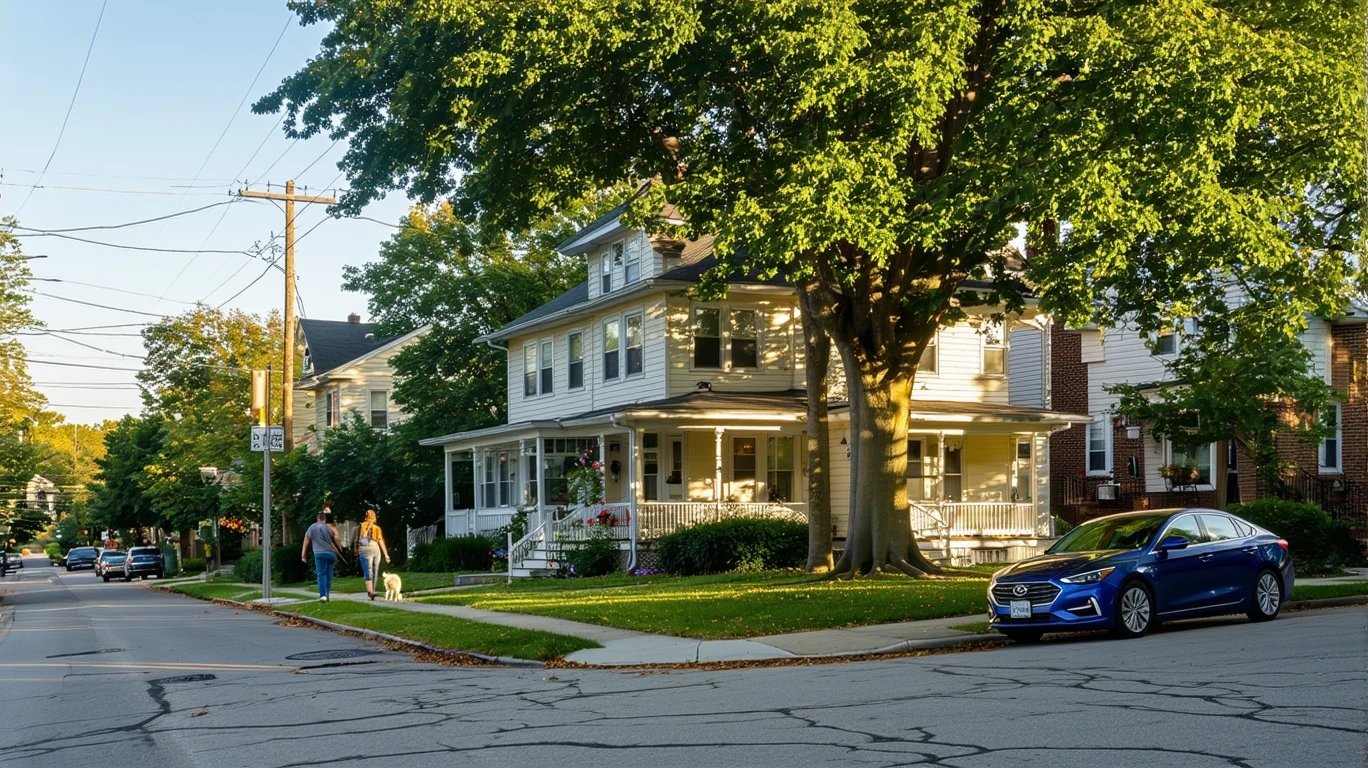
The city delivers strongly on parks and schools. Green space is highly integrated throughout the area, and both school density and playground availability meet thresholds that matter to families. There’s also rail service into Chicago, which gives the place a commuter-suburb identity that shapes daily rhythms and social patterns.
But the quality of life factors that define Elmhurst also create friction for certain households. Walkability exists in pockets—pedestrian infrastructure is present relative to the road network, but it’s not uniform. Errands tend to cluster along corridors rather than being broadly accessible, meaning most people still rely on a car for groceries, pharmacies, and appointments. There’s no hospital in town, which surprises some newcomers given the income level and family density.
The vibe isn’t “we’re figuring it out.” It’s “we’ve figured it out, and this is what we are.” That clarity is comforting to people who want it and limiting to people who don’t.
Social Media Buzz in Elmhurst
Local online discussion—across neighborhood Facebook groups, regional subreddits, and community forums—tends to center on a few recurring themes: protecting what makes the town feel stable, managing growth without losing character, and debating whether the premium pricing still delivers premium experience.
There’s pride in the parks, the tree-lined streets, and the accessibility of the Metra. There’s also fatigue around housing pressure, rising property taxes, and the perception that some amenities haven’t kept pace with cost increases.
“It’s a great place to raise kids, but you’re paying for that in every possible way—mortgage, taxes, even groceries feel more expensive here because everything skews toward convenience over value.”
“I love that I can take the train downtown and still come home to quiet streets and good schools. That combination is hard to find.”
“Elmhurst feels like it’s stuck between wanting to be a walkable town and being a car suburb. You get pieces of both, but not enough of either.”
The tone is generally protective rather than boosterish. People who live here tend to like it, but they’re also aware of what it costs—financially and logistically—to make it work.
Local News Tone
Coverage of Elmhurst in local outlets and community blogs tends to frame the city through the lens of managed growth, infrastructure updates, and identity preservation. The stories aren’t dramatic—they’re about zoning discussions, park improvements, school board decisions, and downtown development.
Simulated topic buckets that reflect recurring coverage themes include:
- “Community Debates What Growth Should Look Like”
- “New Retail and Dining Options Arrive Downtown”
- “Residents Weigh Convenience Against Charm”
- “Schools and Parks Remain Top Draw for Families”
- “Commuters Balance City Access with Suburban Space”
The framing is rarely critical, but it’s not celebratory either. It’s pragmatic, focused on tradeoffs, and attentive to the concerns of long-time residents who worry about losing the qualities that originally attracted them.
Review-Based Public Perception
On platforms like Google Reviews, Yelp, and Nextdoor-style community boards, Elmhurst tends to earn praise for exactly what it prioritizes: safety, schools, parks, and train access. Complaints tend to come from people whose expectations didn’t align with what the city actually offers.
Positive sentiment clusters around:
- Family-friendly infrastructure and recreational options
- Metra access making Chicago commutes manageable
- Tree-lined streets and well-maintained public spaces
- Strong sense of community among families
Frustration tends to show up around:
- Cost of housing relative to space and walkability
- Car dependency for errands despite higher density pockets
- Limited nightlife, dining variety, or urban texture
- Lack of a local hospital or urgent care density
- Perception that some services feel “good but not great” given the price tier
The mismatch often comes down to expectation setting. People who wanted a polished, quiet, family-centered suburb with easy access to Chicago tend to feel satisfied. People who wanted walkable urbanism, spontaneous street life, or a self-contained town center tend to feel let down.
Comparison to Nearby Cities
| Dimension | Elmhurst | Oak Park | Naperville |
|---|---|---|---|
| Overall Vibe | Polished, family-focused, commuter-oriented | Progressive, walkable, architecturally distinct | Sprawling, corporate, master-planned |
| Walkability Feel | Pockets of walkability, still car-reliant | Highly walkable, urban texture throughout | Car-dependent, designed around driving |
| Transit Access | Metra rail to Chicago | CTA and Metra, more frequent service | Metra available, less central to identity |
| Family Appeal | Strong parks and school infrastructure | Family-friendly but more urban feel | Highly family-oriented, larger lots |
| Cost Perception | Premium pricing, high expectations | Expensive but urban amenities justify | Expensive, sprawl requires more driving |
Elmhurst sits between Oak Park’s urban walkability and Naperville’s sprawling suburban scale. If you want more texture, density, and transit frequency, Oak Park delivers that—but with less yard space and a different political and social culture. If you want more land, newer construction, and a fully car-oriented layout, Naperville offers that—but with longer commutes and less pedestrian infrastructure.
Elmhurst appeals to people who want elements of both: some walkable pockets, rail access, family amenities, and green space—without fully committing to urban density or exurban sprawl. That middle position is its strength and its limitation.
What Locals Are Saying
“We moved here for the schools and the parks, and on that front it’s been everything we hoped for. But we definitely underestimated how much we’d still need to drive for everything.”
“I work downtown and the Metra makes it doable. I don’t love the commute, but I love coming home to a quiet street with actual trees and space to breathe.”
“Elmhurst feels like it’s trying to be a small town, but it’s really just an expensive suburb. The downtown is nice, but it’s not a place you hang out—it’s a place you run errands.”
“If you have kids and you can afford it, it’s hard to beat. The infrastructure is there. But if you’re single or don’t have school-age kids, I’m not sure what the draw is.”
“I appreciate that it’s not cookie-cutter new construction everywhere. There’s variety in the housing stock and the neighborhoods have some character. But you’re paying a premium for that.”
“We thought we’d use the parks all the time, and we do. That part has been great. But we also thought we’d walk to more places, and that just hasn’t happened. You still need a car here.”
“It’s a solid, stable place. I don’t wake up excited about living here, but I also don’t wake up frustrated. It works, and that’s worth something.”
Does Elmhurst Feel Like a Good Fit?
Elmhurst works best for families who prioritize schools, parks, and proximity to Chicago, and who can afford the premium that comes with those things. It works for commuters who want rail access but also want space, trees, and a quieter home environment. It works for people who value stability, low crime, and a well-maintained public realm.
It tends to frustrate people who expected more walkability, urban texture, or self-contained completeness. It frustrates households on tighter budgets who feel the cost doesn’t align with the convenience. It frustrates people who wanted nightlife, spontaneity, or the ability to live car-free.
The city isn’t trying to be everything. It’s trying to be a high-quality, family-friendly suburb with good access to Chicago. For people who want exactly that, the fit can feel natural. For people who wanted something else—more urban, more affordable, more walkable, more dynamic—the friction shows up quickly.
If you’re considering Elmhurst, the question isn’t “Is this a happy place?” It’s “Does this specific combination of tradeoffs align with what I actually need day to day?” The answer depends entirely on what you’re optimizing for—and what you’re willing to give up to get it.
For more context on how these tradeoffs play out financially, explore monthly spending patterns and the broader lifestyle requirements that shape daily life here.
How this article was built: In addition to public economic data, this article incorporates location-based experiential signals derived from anonymized geographic patterns—such as access density, walkability, and land-use mix—to reflect how day-to-day living actually feels in Elmhurst, IL.
The perspectives shown reflect commonly expressed local sentiment and recurring themes in public discussion, rather than individual accounts.