
Des Plaines is considered moderately priced in 2026, with a median home value of $304,100 and median rent of $1,300 per month. The value proposition depends on housing entry cost versus transportation dependence—rail access exists, but car ownership remains the norm for most households.
You’re staring at spreadsheets, trying to figure out if Des Plaines fits your budget. The rent looks reasonable compared to downtown Chicago, but you’re not sure what else you’re signing up for. Will commuting eat your savings? Do utilities swing wildly with the seasons? And what about the day-to-day costs that don’t show up in the lease?
This guide breaks down the cost structure in Des Plaines so you can see where money actually goes—and where the surprises tend to come from.
Overall Cost of Living Snapshot
Des Plaines sits at 103 on the regional price parity index, meaning the overall cost of goods and services runs about 3% above the national baseline. That’s a modest premium, not a dramatic one, and it reflects the city’s position in the Chicago metro without carrying the full weight of urban core pricing.
Housing dominates the cost structure here. Whether you’re renting or buying, securing a place to live will claim the largest share of your budget. Transportation comes next—not because gas or transit fares are unusually high, but because most households depend on a car for daily logistics. The average commute is 29 minutes, and only 11.7% of workers operate from home, which means most people are moving regularly. Utilities add moderate seasonal pressure, driven by cold winters that demand heating and warm summers that require cooling.
Compared to nearby suburbs, Des Plaines offers a middle position: less expensive than Evanston or Oak Park, but not as budget-friendly as some farther-out communities. The city’s proximity to O’Hare and access to Metra rail service add value, but they don’t eliminate the need for a vehicle in most cases.
Driver verdict: Housing entry cost sets the baseline, but transportation dependence and utility seasonality create the ongoing pressure. The biggest surprises come from underestimating car ownership costs and winter heating exposure.
Housing Costs (Primary Driver)
The median home value in Des Plaines is $304,100, which positions the city as accessible for buyers who are priced out of closer-in suburbs but still want reasonable access to Chicago. Median rent is $1,300 per month, a figure that reflects the availability of both older apartment stock and newer developments near the downtown area and Metra stations.
Renting makes sense for households prioritizing flexibility or testing the area before committing. The rental market offers a range of unit types, from smaller apartments near Mannheim Road corridors to single-family homes in residential neighborhoods. Ownership, on the other hand, appeals to families seeking stability and proximity to schools and parks—Des Plaines has strong family infrastructure, with playground and school density that supports household logistics.
The city isn’t purely a rental market or purely a homeownership destination. It functions as both, with the choice hinging on timeline, household size, and whether you value locking in a fixed housing cost versus maintaining mobility. Property taxes in Cook County add a recurring expense for owners that renters don’t face directly, though landlords typically pass some of that cost through in rent.
Conclusion: Des Plaines is a buying-and-renting city. Ownership dominates among families, but renters have viable options, especially near transit.
| Housing Type | Cost Anchor | What That Buys You |
|---|---|---|
| Renting | $1,300/month (median) | Access to transit-adjacent units, flexibility, no property tax exposure |
| Buying | $304,100 (median home value) | Stability, equity building, access to family-oriented neighborhoods, property tax responsibility |
Utilities & Energy Risk
Electricity in Des Plaines is billed at 17.07¢ per kWh. For a household using around 1,000 kWh per month—typical for a moderate-sized home with standard appliances and seasonal air conditioning—that translates to roughly $170 per month in electricity costs before fees or taxes. Summer cooling and winter lighting drive the higher-use months, but electricity remains the more predictable of the two major utilities.
Natural gas, priced at $9.48 per MCF (roughly 100 therms), introduces more volatility. Heating a home through a cold Illinois winter can mean using significantly more gas during December through February than in milder months. For context, a household using 1 MCF per month during peak heating season might see a gas bill near $9.48 for the commodity alone, before distribution charges and fees. Mild winters reduce exposure; harsh winters amplify it.
The combination of electric cooling in summer and gas heating in winter creates a seasonal swing in utility costs. Households in larger homes or older buildings with less insulation face greater exposure. Those in smaller, newer units—especially apartments where landlords cover some utilities—experience less volatility.
Risk classification: Moderate. Utility costs are not negligible, and winter heating represents a meaningful seasonal pressure point, but they don’t typically dominate the budget the way housing or transportation do.
Groceries & Daily Costs
Grocery costs in Des Plaines reflect the regional price environment, running slightly above national averages in line with the 103 regional price parity index. Staples like bread, eggs, milk, and chicken cost a bit more here than in lower-cost regions, but the difference is incremental rather than dramatic. A household buying the same mix of items week to week will notice the premium, but it won’t redefine affordability on its own.
What matters more than individual item prices is how grocery shopping fits into daily logistics. Des Plaines has high grocery density concentrated along commercial corridors, meaning access is strong but not uniformly distributed. If you live near Mannheim Road, Oakton Street, or the downtown area, you’ll find familiar chains and independent grocers within a short drive. If you’re farther from these corridors, grocery runs become a deliberate errand rather than a quick stop, which can nudge households toward less frequent, larger shopping trips or increased reliance on a vehicle.
The corridor-clustered pattern also means that while grocery availability is high, convenience varies by neighborhood. Households near the commercial spines experience lower friction; those in quieter residential pockets may drive a bit farther or adjust their routines.
Daily costs beyond groceries—pharmacy visits, household goods, occasional takeout—follow a similar logic. The city supports these needs well, but the structure rewards car access and familiarity with where services cluster.
Transportation Reality
The average commute in Des Plaines is 29 minutes, and 45.8% of workers face a commute classified as long by census standards. Those figures reflect a workforce that largely travels to jobs outside the immediate area—whether to downtown Chicago, O’Hare, or other suburban employment centers.
Des Plaines has Metra rail service on the Union Pacific Northwest Line, which connects to downtown Chicago and offers a viable alternative to driving for workers whose jobs align with the rail schedule and station locations. That said, only a minority of households can structure their entire transportation needs around transit. Most still depend on a car for errands, grocery runs, school drop-offs, and non-commute travel.
Gas is currently priced at $3.68 per gallon. For a typical commuter driving 25 miles round trip in a vehicle averaging 25 MPG, that’s about 1 gallon per day, or roughly $3.68 in fuel alone—before maintenance, insurance, or parking. Over a month, that’s over $80 in fuel for one commute, and many households operate more than one vehicle.
The rail option reduces exposure for some, but it doesn’t eliminate the baseline need for car ownership. Even transit-oriented households often keep a vehicle for weekend errands, family logistics, or trips that don’t align with train schedules. The result is that transportation functions as a recurring, non-trivial cost layer—one that doesn’t fluctuate as wildly as utilities but accumulates steadily.
Transportation as exposure: Car dependency is the norm, even with rail access. Households should budget for vehicle ownership, fuel, and maintenance as ongoing fixed costs, not occasional expenses.
How Place Structure Shapes Daily Costs
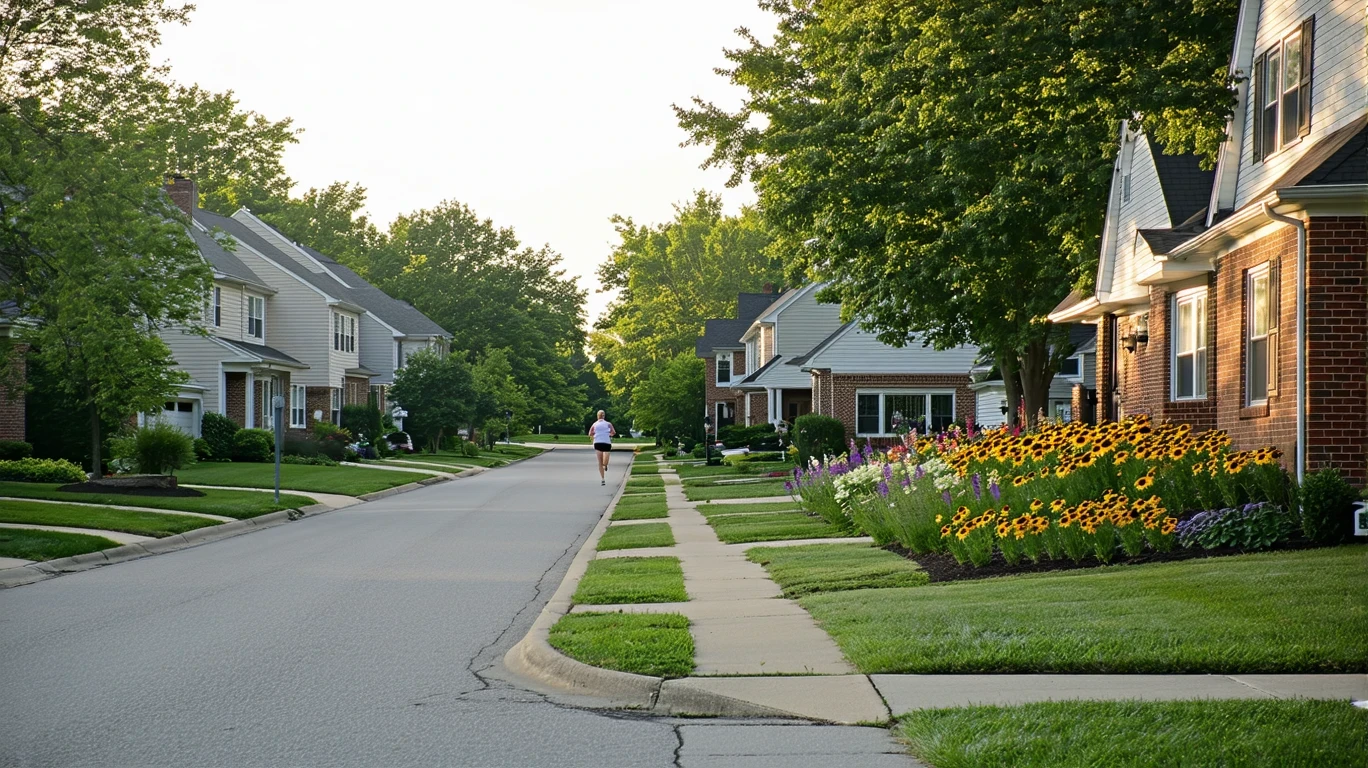
Des Plaines has a mixed urban form—residential neighborhoods with moderate building heights, commercial corridors with retail and services, and pockets of walkable infrastructure where pedestrian-to-road ratios are high. That combination creates a lived experience where some errands are easy and others require planning.
If you live near a Metra station and work downtown, your commute can bypass the car entirely. But if you need to pick up groceries, drop off dry cleaning, and get to a pediatrician appointment on the same day, you’re almost certainly driving. The grocery density is high along key corridors, but food establishment density is only moderate, meaning that while supermarkets are accessible, the grab-and-go convenience of walkable urban neighborhoods isn’t uniformly present.
The city’s park density is high, and playgrounds are plentiful, which supports family life and reduces the need to drive to recreational spaces. But the overall mobility texture still leans car-dependent for most households. Walkable pockets exist—particularly near the downtown area and along certain residential streets with good sidewalk infrastructure—but they don’t define the entire city.
What this means in practice: households that can align their routines with the rail line and live near commercial corridors experience lower transportation friction and more control over costs. Households farther from these nodes, or with schedules that don’t fit transit timetables, face higher transportation exposure and more reliance on vehicle access. The place structure doesn’t force one outcome, but it rewards certain patterns and penalizes others.
Cost Exposure Profiles
Cost pressure in Des Plaines varies sharply depending on housing choice, transportation needs, and household structure. The city doesn’t impose a single affordability outcome—it creates different exposure levels based on how you live.
Low-exposure situations: Renting a smaller unit near a Metra station, working downtown or remotely, and keeping vehicle use minimal. In this scenario, housing is fixed and moderate, transportation costs are controlled, and utilities remain modest due to smaller square footage. Grocery and daily errands still require some car access, but the frequency is lower.
High-exposure situations: Owning a larger single-family home in a residential neighborhood, commuting by car to a distant job, and operating two vehicles. Here, housing costs include mortgage, property taxes, and maintenance. Transportation becomes a significant recurring expense due to fuel, insurance, and upkeep. Utilities swing more dramatically with the seasons due to greater heating and cooling loads. Errands and family logistics add mileage and time.
The difference isn’t about income level—it’s about structural exposure. A household earning the median income of $86,552 per year (roughly $7,213 per month gross) will experience very different cost pressure depending on whether they’re in the low-exposure or high-exposure scenario. The city’s cost structure doesn’t exclude either path, but it doesn’t flatten the difference between them.
Ownership versus renting sets the baseline. Commute length and vehicle count determine transportation pressure. Home size and age drive utility volatility. These aren’t surprises—they’re the levers that define [where money goes](https://indexyard.com/best-moving-companies-guide/).
Frequently Asked Questions
Is Des Plaines more affordable than Evanston or Oak Park in 2026? Yes, Des Plaines tends to be less expensive than both Evanston and Oak Park, particularly in housing costs. Median home values and rents are lower, though Des Plaines also offers less walkability and fewer transit options than those closer-in suburbs.
What does a typical cost profile look like in Des Plaines? Housing claims the largest share, followed by transportation (car ownership and commuting), then utilities with seasonal swings. Groceries and daily costs add steady but smaller pressure. The profile shifts based on whether you own or rent and how much you drive.
Do utilities cost more in Des Plaines than in nearby areas? Utility rates in Des Plaines are consistent with the broader northern Illinois region. Electricity at 17.07¢/kWh and natural gas at $9.48/MCF are not outliers, but winter heating and summer cooling still create seasonal cost swings that affect larger homes more than smaller units.
What costs tend to surprise newcomers in Des Plaines? Transportation often surprises people who underestimate car dependency. Even with Metra access, most households need a vehicle for errands and non-commute travel. Winter heating bills can also catch renters off guard if they’re not used to cold-climate utility exposure.
Are property taxes higher in Des Plaines than in neighboring suburbs? Property taxes in Des Plaines reflect Cook County rates, which tend to be higher than many other parts of Illinois. Compared to DuPage or Lake County suburbs, Cook County generally imposes a heavier property tax burden, though rates vary by municipality and district.
Is Des Plaines a good option for renters trying to stay near Chicago? Yes, Des Plaines offers a viable rental market with access to Metra rail service, making it a reasonable choice for renters who want proximity to Chicago without paying downtown or near-downtown rents. The tradeoff is reduced walkability and greater reliance on a car for most errands.
How does commuting affect the overall cost of living in Des Plaines? Commuting is a major cost factor for most households. With an average commute of 29 minutes and nearly half of workers facing long commutes, transportation costs accumulate quickly through fuel, vehicle maintenance, insurance, and time. Rail access helps some, but car ownership remains the norm.
Does Des Plaines have a higher cost of living than the national average? Slightly. The regional price parity index of 103 means costs run about 3% above the national baseline. The premium is modest and reflects the Chicago metro context, but it’s not as pronounced as in the urban core or some higher-cost suburbs.
How this article was built: In addition to public economic data, this article incorporates location-based experiential signals derived from anonymized geographic patterns—such as access density, walkability, and land-use mix—to reflect how day-to-day living actually feels in Des Plaines, IL.
—