
How Grocery Costs Feel in Davenport
Grocery prices in Davenport, FL sit close to the national baseline, with a regional price parity index of 101—just one point above the reference average. For households planning weekly meals, this means staple items like bread, eggs, chicken, and milk track near what you’d expect in much of the country, without the pronounced markups seen in high-cost metros or the discounts common in lower-cost rural areas. The pressure comes not from extreme pricing, but from how grocery costs interact with income and access. Davenport’s median household income of $64,428 per year sits below the national median, meaning food spending claims a larger share of take-home pay for many families here than the raw price index might suggest.
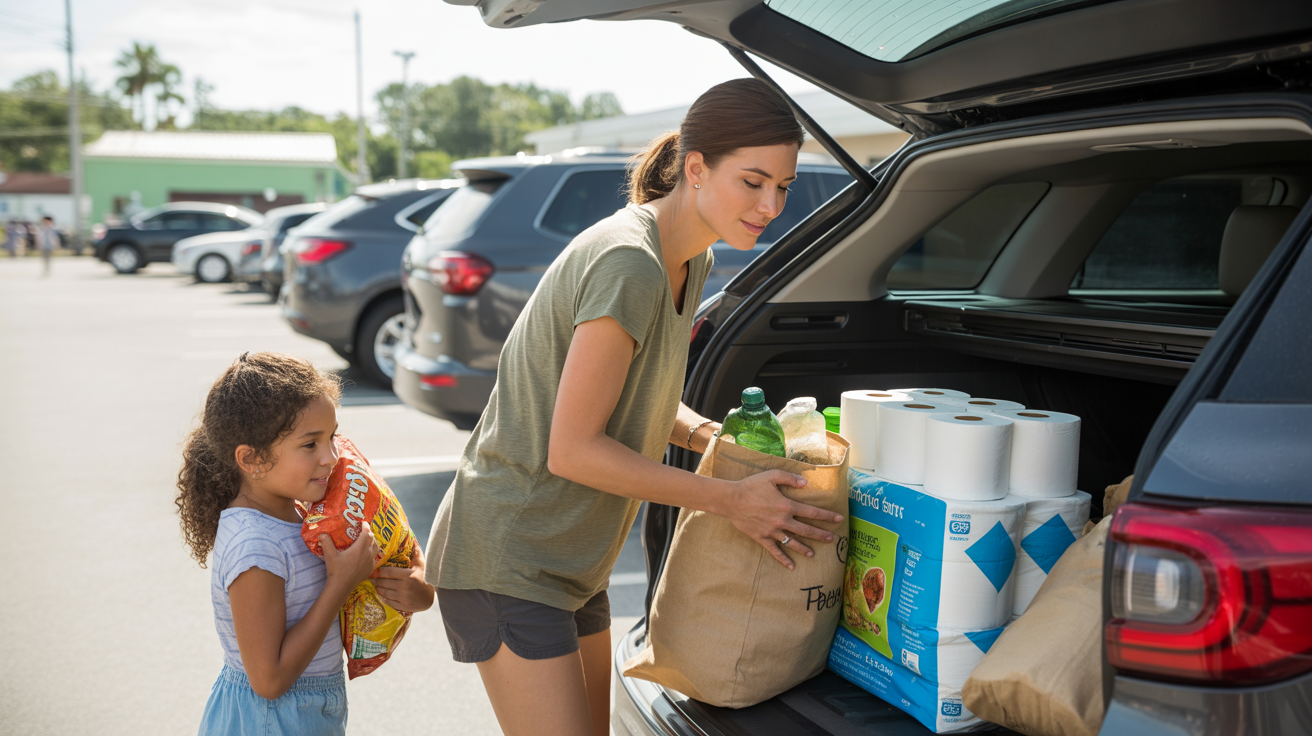
Singles and smaller households often notice grocery costs most acutely. A single earner buying for one faces higher per-serving costs and less ability to leverage bulk discounts, while also absorbing the same transportation and time costs as a family of four. Families with children feel pressure differently—not from unit prices alone, but from volume, variety demands, and the compounding effect of feeding multiple people three meals a day. In Davenport, where food and grocery establishment density falls below typical thresholds, most households must drive to shop, often consolidating trips to reduce frequency. This car-dependent shopping pattern increases reliance on larger, less frequent hauls and reduces flexibility to chase weekly sales across multiple stores, particularly for households managing tight budgets or unpredictable schedules.
The experience of grocery shopping in Davenport is shaped as much by logistics as by prices. Sparse commercial density means fewer nearby options, longer average trip distances, and a practical need to plan around driving. For households with reliable transportation, this translates to intentional trip consolidation and a preference for stores that offer breadth under one roof. For those without a car or with limited mobility, the same layout creates meaningful access friction, narrowing choices and increasing dependence on whichever store is reachable by bus or within walking distance. Understanding grocery costs here requires looking beyond the price per pound—it’s about how distance, density, and income together determine who feels food spending pressure and why.
Grocery Price Signals (Illustrative)
These prices illustrate how staple items tend to compare locally—not a complete shopping list or a snapshot of any single store’s shelf. They’re derived estimates based on regional price parity, useful for understanding relative positioning but not precise enough to guide week-to-week purchasing decisions. Actual prices vary by store tier, brand, sales cycles, and package size. The table below offers context for how common grocery items are priced in Davenport relative to baseline national costs.
| Item | Illustrative Price |
|---|---|
| Bread (per pound) | $1.86 |
| Cheese (per pound) | $4.89 |
| Chicken (per pound) | $2.06 |
| Eggs (per dozen) | $2.60 |
| Ground beef (per pound) | $6.82 |
| Milk (per half-gallon) | $4.14 |
| Rice (per pound) | $1.07 |
Protein costs—chicken at roughly $2.06 per pound and ground beef at $6.82—anchor meal planning for most households. The gap between these two reflects broader market dynamics: poultry remains the most cost-effective animal protein, while beef pricing responds to supply-chain pressures and regional distribution patterns. Eggs at $2.60 per dozen offer another flexible, affordable protein source, though prices fluctuate seasonally and in response to production disruptions. Dairy, represented here by milk at $4.14 per half-gallon, and cheese at $4.89 per pound, tends to hold steadier but still varies by brand and fat content. Staples like bread and rice provide foundational carbohydrate options at the lower end of the cost spectrum, forming the base of budget-conscious meal plans.
These illustrative figures help explain why grocery pressure in Davenport isn’t driven by outlier pricing in any single category, but by cumulative exposure across a full week’s worth of meals. A household buying mid-tier brands and preparing most meals at home will find costs predictable but not negligible. Substituting within categories—choosing chicken over beef, store-brand bread over name-brand, bulk rice over smaller packages—creates meaningful room for adjustment without requiring extreme couponing or store-hopping. The key is recognizing that these prices represent starting points, not fixed outcomes, and that store choice and purchasing habits determine where a household lands within the range.
Store Choice & Price Sensitivity
Grocery price pressure in Davenport varies significantly by store tier, and understanding this variation matters more than fixating on a single “average” cost. Discount-tier stores—such as Aldi, Walmart, and Save-A-Lot where present—offer the lowest baseline pricing, particularly on private-label staples, produce sold in bulk, and high-turnover items like eggs, milk, and bread. These stores reduce costs by limiting selection, simplifying store layout, and minimizing service overhead. For households prioritizing price above all else, discount chains provide the most direct path to lowering weekly food spending, though often at the expense of variety, specialty items, and brand-name familiarity.
Mid-tier grocers—including regional chains like Publix and Winn-Dixie—occupy the middle ground, offering broader selection, more consistent stock of name brands, and a shopping experience that balances cost with convenience. Prices here run higher than discount stores but remain accessible for dual-income households or families willing to trade modest cost increases for better product variety and store amenities. Mid-tier stores also tend to anchor weekly sales and loyalty programs, creating opportunities for strategic shoppers to lower per-item costs without fully committing to the discount-store model. For many Davenport households, mid-tier stores represent the default choice—close enough to reach easily, familiar enough to navigate quickly, and affordable enough to fit within a working budget.
Premium grocers—such as Whole Foods, Fresh Market, or specialty organic retailers—serve a smaller, higher-income segment willing to pay significantly more for organic certification, specialty diets, prepared foods, and curated selection. Prices at premium stores can run 30–50% higher than discount equivalents for comparable items, with the gap widening further for organic, grass-fed, or specialty-labeled products. For most Davenport households earning near or below the median income, premium stores function as occasional destinations rather than primary shopping venues. The existence of these tiers matters because it illustrates that grocery costs in Davenport are not monolithic—households experience food pricing through the lens of the stores they can access, afford, and prioritize, and those choices create divergent cost realities even within the same city.
What Drives Grocery Pressure Here
Income is the primary determinant of how grocery costs feel in Davenport. At a median household income of $64,428 per year, many families find themselves allocating a larger percentage of monthly earnings to food than households in higher-income metros, even when per-item prices remain near the national average. The standard budgeting heuristic suggests that food costs—including both groceries and dining—should claim no more than 10–15% of gross income for financial stability. For a household at Davenport’s median, that translates to roughly $5,350–$8,050 annually, or $445–$670 per month, split between groceries and eating out. Families with children, single earners, or those carrying other fixed costs like rent, utilities, and transportation often find this threshold difficult to maintain without deliberate planning and substitution strategies.
Household size amplifies cost sensitivity in predictable but non-linear ways. A single adult buying for one faces higher per-serving costs and less opportunity to benefit from bulk pricing or multi-pack discounts. Adding a second adult improves efficiency modestly, but the real inflection point comes with children—each additional mouth to feed increases volume demands, dietary variety, and the frequency of restocking trips. Larger families also face greater exposure to price volatility in high-turnover categories like fresh produce, dairy, and protein, where even small per-unit increases compound quickly across a week’s worth of meals. In Davenport, where grocery access requires intentional trip planning due to sparse commercial density, larger households must balance the cost savings of bulk purchasing against the logistical challenge of transporting and storing larger quantities.
Regional distribution patterns and seasonal variability also shape grocery costs, though these forces operate more subtly than income or household size. Florida’s climate allows for year-round production of certain fruits and vegetables, which can lower costs for locally grown produce during peak seasons. Conversely, items that require long-distance shipping or cold-chain logistics—such as berries, leafy greens, or specialty proteins—remain vulnerable to fuel costs, weather disruptions, and supply-chain bottlenecks. Davenport’s position within the Orlando metro provides access to regional distribution hubs, which helps stabilize availability and moderate price swings, but the city’s car-dependent layout and limited grocery density mean households cannot easily shift between stores to capitalize on short-term sales or regional price differences. The result is a grocery cost environment that feels stable on average but offers limited flexibility for households seeking to minimize spending through tactical shopping behavior.
Practical Ways People Manage Grocery Costs
Meal planning stands as the most effective behavioral lever for controlling grocery spending. Households that plan weekly menus before shopping reduce impulse purchases, minimize food waste, and create opportunities to build meals around sale items or seasonal produce. In Davenport, where most grocery trips require driving and intentional scheduling, planning also reduces trip frequency, cutting both transportation costs and the temptation to pick up unplanned items during mid-week runs. A well-constructed meal plan anchors shopping lists, prevents duplicate purchases, and allows households to buy in bulk when unit prices favor larger quantities, particularly for shelf-stable staples like rice, pasta, canned goods, and frozen proteins.
Store-brand substitution offers another high-impact, low-friction strategy. Private-label products—often produced by the same manufacturers as name brands—typically cost 20–40% less while delivering comparable quality for most staple categories. Switching from name-brand to store-brand bread, dairy, canned vegetables, and dry goods lowers per-item costs without requiring significant changes to recipes or eating habits. In Davenport, where mid-tier grocers like Publix maintain robust private-label lines, households can adopt this strategy without needing to shop exclusively at discount stores. The cumulative effect of store-brand substitution across a full cart can reduce weekly grocery bills meaningfully, particularly for families buying high volumes of packaged and processed foods.
Buying in bulk and batch cooking extend cost control further, though both require upfront investment—either in larger package sizes or in time spent preparing multiple meals at once. Bulk purchasing works best for non-perishable items and proteins that freeze well, allowing households to take advantage of lower per-unit pricing without risking spoilage. Batch cooking—preparing large quantities of soups, casseroles, or grain-based dishes and portioning them for later use—reduces reliance on convenience foods and takeout, both of which carry higher per-serving costs. For Davenport households managing tight budgets, these strategies require planning and storage capacity, but they offer tangible reductions in both food costs and daily decision fatigue around meal preparation.
Groceries vs Eating Out (Directional)
The tradeoff between cooking at home and eating out shapes grocery spending in ways that extend beyond simple cost comparison. Preparing meals from purchased groceries almost always costs less per serving than restaurant dining or takeout, but the gap varies depending on the type of cuisine, the household’s cooking skill, and the time available for meal preparation. In Davenport, where car dependency and sparse commercial density already impose logistical friction on daily errands, the decision to cook versus order out often hinges on convenience, schedule pressure, and energy levels as much as cost. Households with predictable routines and time to cook find grocery-based meal preparation the most economical path, while those juggling irregular work hours, long commutes, or childcare demands may lean more heavily on prepared foods and dining out despite the higher cost.
Restaurant meals and takeout typically cost two to four times more per serving than home-cooked equivalents, with the premium rising further for full-service dining, alcohol, and delivery fees. A household that eats out several times per week can easily spend as much on dining as on groceries, effectively doubling total food costs. For families at or below Davenport’s median income, frequent dining out compresses the budget quickly, leaving less room for other discretionary spending or savings. The key insight is not that dining out is inherently unaffordable, but that its frequency and context determine whether it functions as an occasional convenience or a structural cost driver. Households that treat dining out as a planned, budgeted expense—rather than a default response to time pressure—maintain better control over total food spending and preserve flexibility elsewhere in their monthly budget.
Balancing groceries and dining out requires intentionality rather than rigid rules. Some households find success by designating one or two nights per week for takeout or restaurant meals, building that cost into their monthly plan and cooking the rest of the time. Others reduce dining frequency by investing in meal-prep strategies that lower the friction of cooking on busy weeknights—pre-chopping vegetables, marinating proteins in advance, or keeping a rotation of simple, reliable recipes that require minimal active cooking time. In Davenport, where [What a Budget Has to Handle in Davenport](/davenport-fl/monthly-budget/) includes not just food but housing, utilities, and transportation, managing the grocery-versus-dining tradeoff becomes part of a broader effort to align spending with income and priorities, ensuring that food costs—whether from the grocery store or a restaurant—don’t crowd out other essential expenses or long-term financial goals.
FAQs About Grocery Costs in Davenport (2026)
Is it cheaper to shop in bulk in Davenport? Bulk purchasing lowers per-unit costs for shelf-stable items, frozen proteins, and household staples, but requires upfront spending and adequate storage space. Households with predictable consumption patterns and room to store larger quantities benefit most from bulk buying, particularly at warehouse clubs or discount grocers that emphasize volume pricing.
Which stores in Davenport are best for low prices? Discount-tier stores like Walmart and Aldi offer the lowest baseline pricing on private-label staples and high-turnover items. Mid-tier chains like Publix and Winn-Dixie provide broader selection and frequent sales, making them competitive for households willing to shop strategically. Premium grocers serve niche demand for organic and specialty items but carry significantly higher costs.
How much more do organic items cost in Davenport? Organic products typically cost 30–50% more than conventional equivalents, with the premium varying by category and store tier. Produce, dairy, and meat see the largest markups, while organic dry goods and packaged items often carry smaller premiums. Households prioritizing organic certification should budget accordingly and consider focusing on high-impact categories rather than converting the entire cart.
How do grocery costs for two adults in Davenport tend to compare to nearby cities? Davenport’s regional price parity index of 101 places it near the national average, meaning grocery costs for two adults track closely with what you’d find in much of the Orlando metro and similar mid-sized Florida markets. Differences emerge more from store choice, shopping habits, and income levels than from dramatic city-to-city price gaps.
How do households in Davenport think about grocery spending when cooking at home? Most households view grocery spending as a controllable cost that responds to planning, substitution, and store choice. Cooking at home consistently costs less per serving than dining out, but the time and effort required mean that grocery spending must be weighed against schedule demands, convenience needs, and the household’s capacity for meal preparation.
Does Davenport’s car-dependent layout affect grocery costs? Indirectly, yes. Sparse grocery density and limited walkable access mean most households must drive to shop, which increases reliance on less-frequent, larger trips and reduces flexibility to chase sales across multiple stores. Households without reliable transportation face access friction that can narrow choices and increase effective costs.
Are there seasonal patterns in grocery prices in Davenport? Florida’s climate supports year-round production of certain fruits and vegetables, which can lower costs for locally grown produce during peak seasons. Proteins, dairy, and imported produce remain more stable but still respond to national supply-chain dynamics, fuel costs, and weather disruptions that affect distribution networks.
How Groceries Fit Into the Cost of Living in Davenport
Grocery costs in Davenport represent a significant but manageable component of household spending, particularly when compared to the larger, less flexible costs of housing and utilities. For a household at the city’s median income of $64,428 per year, food spending—including both groceries and occasional dining—typically claims 10–15% of gross income, or roughly $445–$670 per month. That share rises for families with children, single earners, or households facing high fixed costs elsewhere in the budget. Unlike rent or mortgage payments, which remain fixed month to month, grocery spending responds to deliberate choices around store selection, meal planning, and substitution strategies, giving households meaningful control over this category even when income is constrained.
Housing and utilities dominate the cost structure for most Davenport households, with median rent at $1,968 per month and electricity rates of 15.78¢/kWh driving seasonal volatility in cooling costs. Groceries, by contrast, offer more day-to-day flexibility—households can adjust spending by shifting between store tiers, cooking more frequently, or prioritizing sale items and store brands. This flexibility makes grocery costs a key lever for households managing tight budgets or responding to income disruptions, though it also means that food spending often absorbs pressure when other costs rise. Understanding how groceries fit into the broader cost structure requires recognizing both their controllability and their cumulative weight—small, frequent decisions around food purchasing add up quickly, and the difference between intentional and reactive shopping can shift monthly spending by hundreds of dollars.
For a complete picture of how grocery costs interact with housing, transportation, utilities, and other essential expenses, households should consult [What a Budget Has to Handle in Davenport](/davenport-fl/monthly-budget/), which breaks down the full monthly cost structure and explains how different spending categories compete for limited income. Grocery costs don’t exist in isolation—they’re part of a larger system of tradeoffs, and managing them effectively requires understanding not just what food costs, but how food spending fits within the household’s total financial capacity and priorities. Davenport’s near-national-average pricing and car-dependent layout create a grocery cost environment that rewards planning, consistency, and strategic store choice, offering households the tools to control this category without requiring extreme frugality or unsustainable effort.
How this article was built: In addition to public economic data, this article incorporates location-based experiential signals derived from anonymized geographic patterns—such as access density, walkability, and land-use mix—to reflect how day-to-day living actually feels in Davenport, FL.