
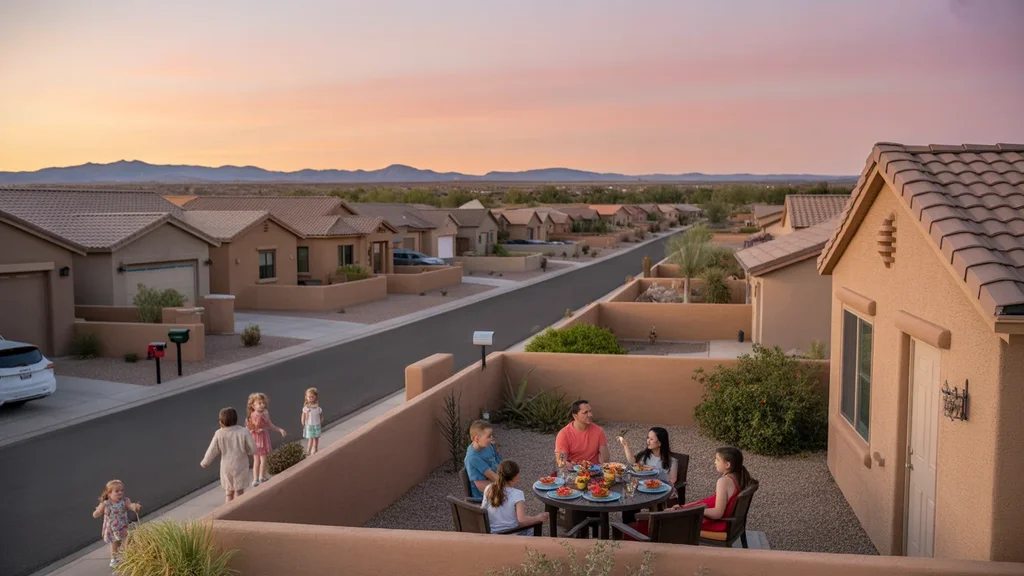
Chandler’s median home value sits at $423,900, while median rent reaches $1,675 per month—figures that immediately signal where cost pressure concentrates for households moving to this Phoenix metro suburb in 2026. With a median household income of $99,374 per year and an unemployment rate of just 3.1%, Chandler attracts dual-income professionals and families seeking predictable suburban infrastructure, but the housing entry barrier shapes every downstream decision about transportation, utilities, and daily spending.
Understanding Chandler’s cost structure matters because the city’s low-rise, mixed-use character creates pockets of walkability and strong errands accessibility that can offset car dependency for some households, while its integrated park system and family infrastructure appeal to parents prioritizing space and stability. The decision isn’t about whether Chandler is “affordable” in the abstract—it’s about which cost pressures dominate your household type, and whether front-loaded housing costs trade favorably against ongoing transportation and utility exposure in Arizona’s extended cooling season.
Housing Costs in Chandler
Chandler’s housing market reflects its role as an established Phoenix suburb with strong employment ties and family appeal. The $423,900 median home value represents a significant entry barrier for first-time buyers, particularly those without substantial savings or dual incomes. Single-family homes dominate the housing stock, and the low-rise building character means apartment inventory tends toward garden-style complexes rather than high-density options, which can limit rental flexibility for singles or couples seeking smaller footprints.
Renters face $1,675 per month in median gross rent, a figure that includes baseline utilities in some complexes but often excludes electricity—a meaningful distinction in a climate where cooling costs run year-round. The rental market skews toward two- and three-bedroom units designed for families or roommate arrangements, so single adults may find fewer studio or one-bedroom options at proportionally lower rents. For homeowners, property taxes and HOA fees (common in newer subdivisions) add predictable but non-negotiable monthly obligations that renters avoid, though renters sacrifice equity accumulation and rent stability over time.
The housing cost structure in Chandler favors households planning to stay several years and willing to absorb front-loaded down payment and closing costs in exchange for predictable monthly obligations. Families benefit from the space and school access that single-family homes provide, while younger professionals or those prioritizing flexibility may feel the entry barrier more acutely. The low-rise, mixed-use development pattern means some neighborhoods offer walkable errands access, which can reduce the need for a second vehicle and indirectly lower the total cost of occupying housing in those pockets.
| Housing Type | Typical Cost Pressure | Who Feels It Most |
|---|---|---|
| Single-family home (owned) | High entry barrier, predictable monthly obligations | First-time buyers, single-income households |
| Apartment (rented) | Moderate monthly rent, limited small-unit inventory | Single adults, couples without kids |
| Townhome or condo (owned) | Moderate entry barrier, HOA fees add ongoing costs | Downsizers, professionals prioritizing location |
Housing takeaway: Chandler’s housing costs are front-loaded, with the median home value creating the primary barrier to entry. Renters face moderate monthly obligations but limited flexibility in unit size, while homeowners trade upfront costs for long-term predictability. Families and dual-income households absorb these costs more easily, while single adults and first-time buyers experience the entry barrier as the dominant cost pressure.
Utilities and Energy Costs
Chandler’s utility cost structure is shaped by Arizona’s extended cooling season and the prevalence of single-family homes with larger square footage. Electricity rates sit at 15.66¢/kWh, a figure that becomes meaningful when air conditioning runs from late spring through early fall—and intermittently even in winter months during warmer stretches. Households in older homes or those with less efficient HVAC systems experience higher exposure, while newer construction with better insulation and modern cooling equipment reduces baseline usage without eliminating seasonal volatility.
Natural gas, priced at $19.89/MCF, plays a smaller role in Chandler’s utility profile compared to heating-dominant climates. Most homes use gas for water heating and cooking rather than space heating, so monthly gas bills remain relatively predictable year-round. The primary utility pressure comes from electricity, and the difference between a well-insulated home and an older, less efficient one can shift monthly bills significantly during peak summer months. Apartment dwellers in smaller units face lower absolute costs due to reduced square footage, but those in top-floor or west-facing units may see disproportionate cooling loads.
Utility cost exposure in Chandler varies more by housing type and home age than by household size alone. A family of four in a newer, well-insulated single-family home may experience lower per-person costs than a couple in an older, poorly sealed house. Time-of-use rate structures offered by local utilities can reduce costs for households able to shift usage to off-peak hours, but this requires schedule flexibility that not all households possess. The predictability of natural gas costs and the volatility of summer electricity bills mean that households sensitive to seasonal spikes should prioritize housing stock age and insulation quality when evaluating total occupancy costs.
Utility takeaway: Chandler’s utility costs are dominated by cooling season electricity exposure, with housing stock age and insulation quality determining volatility more than household size. Families in newer homes experience more predictable bills, while renters in older apartments or those in less efficient single-family homes face higher seasonal swings. Natural gas remains a minor, stable cost component, so the primary decision variable is how much cooling-season exposure a household can absorb or mitigate through housing choice.
Groceries and Daily Expenses
Chandler’s grocery and daily expense landscape reflects its suburban density and strong errands accessibility. Food establishment density exceeds high thresholds, and grocery density is similarly robust, meaning most households can reach multiple grocery options without long drives. This access reduces the friction cost of comparison shopping and allows households to choose between big-box stores, regional chains, and specialty markets based on price sensitivity rather than convenience alone.
Grocery staples in Chandler carry moderate price exposure shaped by the regional price parity index of 106, meaning costs run slightly above the national baseline. For context, derived estimates suggest bread around $1.95 per pound, ground beef near $7.16 per pound, and eggs approximately $2.73 per dozen—figures that illustrate price levels without serving as guarantees. Households managing larger grocery volumes, such as families with multiple children, feel this exposure more acutely than single adults or couples, particularly when balancing fresh produce and protein-heavy diets. The availability of discount grocers and bulk retailers in the Phoenix metro provides some relief, but requires intentional trip planning and storage capacity that apartment dwellers may lack.
Dining out and convenience spending represent a secondary cost pressure in Chandler, shaped more by lifestyle habits than by structural necessity. The mixed-use land development pattern and corridor-clustered food options mean that takeout and casual dining are accessible without long drives, which can encourage frequency creep for households with tight schedules or limited meal-prep time. Coffee shops, fast-casual chains, and delivery services are broadly available, so the cost pressure comes from behavioral patterns rather than scarcity. Families with young children often face higher convenience spending when balancing school schedules and extracurriculars, while single adults and couples have more control over dining frequency and can more easily substitute home cooking.
Grocery takeaway: Chandler’s strong errands accessibility and high grocery density reduce friction costs and enable price-sensitive shopping, but the regional price parity index means staple costs run moderately above national norms. Families managing larger volumes feel this pressure more than smaller households, while convenience spending on dining and takeout represents a discretionary cost that varies by schedule flexibility and meal-planning discipline. The primary decision variable is whether a household can leverage access to discount options and resist convenience creep, rather than whether grocery options exist.
Taxes and Fees

Chandler’s tax and fee structure reflects Arizona’s reliance on a mix of property taxes, sales taxes, and local service fees, with the balance varying by housing type and neighborhood. Property taxes in Arizona are assessed based on limited property value, which can create predictability for long-term homeowners but still represents a significant ongoing obligation when combined with the city’s median home value. Newer subdivisions often include HOA fees that bundle services like landscaping, trash collection, and community amenities, adding another layer of predictable monthly costs that renters typically avoid but homeowners cannot escape.
Sales taxes in Chandler apply to most goods and services, meaning that households with higher consumption—particularly families managing groceries, clothing, and household goods for multiple people—experience more cumulative exposure than single adults or couples with lower transaction volumes. The tax structure doesn’t distinguish between necessity and discretionary spending, so even cost-conscious households feel the impact on everyday purchases. Renters avoid property tax obligations directly but often absorb them indirectly through rent levels, while homeowners face the full weight of annual assessments and any special district fees tied to schools or infrastructure.
The predictability of Chandler’s tax and fee structure favors households planning to stay several years, as property tax growth is constrained by state law and HOA fees typically adjust incrementally. Recent movers and first-time homeowners may underestimate the cumulative weight of these obligations when budgeting based on mortgage payments alone. Renters experience fewer line-item fees but sacrifice the ability to lock in long-term housing costs, making them more exposed to rent increases that reflect landlords’ own tax and fee burdens. The primary difference between homeowners and renters isn’t magnitude alone—it’s the trade-off between predictability and flexibility.
Taxes and fees takeaway: Chandler’s tax and fee structure imposes predictable ongoing costs on homeowners through property taxes and HOA fees, while renters avoid direct exposure but face less control over rent stability. Families and long-term residents benefit from the predictability, while recent movers and those prioritizing flexibility may feel the cumulative weight more acutely. The decision variable is whether a household values locking in predictable obligations over maintaining the flexibility to relocate without selling property.
Transportation and Commute Reality
Chandler’s transportation cost structure is shaped by its suburban form and the Phoenix metro’s car-oriented regional layout. Gas prices sit at $3.14 per gallon, a moderate figure that becomes meaningful when most households rely on personal vehicles for commuting, errands, and family logistics. The city’s OSM-derived signals reveal walkable pockets with high pedestrian-to-road ratios and notable cycling infrastructure, but these features are concentrated rather than universal, meaning that most residents still depend on cars for daily mobility even if some neighborhoods support walking or biking for local errands.
Transit options in Chandler consist of bus service without rail, which limits viability for households seeking to avoid car ownership entirely. Bus routes serve key corridors and connect to regional transit hubs, but frequency and coverage mean that relying on transit alone requires significant time investment and schedule flexibility. For dual-income households where both adults commute to different employment centers, car ownership becomes non-negotiable, and the decision shifts to whether a second vehicle is necessary or whether one partner can carpool, work from home, or adjust hours to share a car.
The transportation cost pressure in Chandler is less about fuel prices alone and more about the baseline obligation of car ownership—insurance, registration, maintenance, and depreciation—combined with the time cost of commuting in a metro where distances between home, work, and services can be substantial. Families managing school drop-offs, extracurriculars, and grocery runs face higher logistical complexity and mileage accumulation than single adults or couples without children. The walkable pockets and strong errands accessibility in some neighborhoods can reduce trip frequency for daily needs, but they don’t eliminate the need for a vehicle when accessing employment, healthcare, or regional amenities outside Chandler’s boundaries.
Transportation takeaway: Chandler’s transportation costs are dominated by the baseline obligation of car ownership rather than fuel prices alone, with most households requiring at least one vehicle and many needing two. The city’s walkable pockets and bus service provide limited relief in specific neighborhoods, but regional commute patterns and family logistics make car dependence the norm. Households sensitive to transportation costs should evaluate whether they can function with one vehicle and whether their work and daily routines align with the neighborhoods where walking or biking can substitute for some trips.
Cost Structure in Chandler
Housing costs dominate Chandler’s cost structure, with the $423,900 median home value creating the largest single barrier to entry and the $1,675 per month median rent representing the most significant ongoing obligation for those not ready to buy. This front-loaded pressure shapes every downstream decision, as households that can clear the housing hurdle—whether through down payment savings, dual incomes, or rental flexibility—then face more predictable utility, grocery, and transportation costs. The housing decision isn’t just about monthly affordability; it’s about whether a household can absorb the entry cost and commit to staying long enough to justify it.
Utilities introduce seasonal volatility rather than year-round unpredictability, with cooling-season electricity exposure varying more by housing stock age and insulation quality than by household size. Families in newer, well-sealed homes experience stable bills, while those in older construction face higher swings during summer months. This cost pressure is manageable for households with budget flexibility but can strain those already stretched by housing obligations. Groceries and daily expenses reflect Chandler’s strong errands accessibility, which reduces friction costs and enables price-sensitive shopping, but the regional price parity index means staple costs run moderately above national norms, hitting larger households harder.
Transportation costs in Chandler are less about fuel prices and more about the baseline obligation of car ownership, with most households requiring at least one vehicle and many needing two. The city’s walkable pockets and bus service provide limited relief in specific neighborhoods, but regional commute patterns and family logistics make car dependence the norm. Taxes and fees add predictable ongoing costs for homeowners, while renters avoid direct exposure but sacrifice long-term cost control. The cumulative effect is a cost structure where housing and transportation represent the largest fixed obligations, utilities introduce seasonal variability, and groceries and fees add incremental pressure that scales with household size and consumption patterns.
For households sensitive to housing entry barriers, Chandler’s cost structure requires either significant upfront capital or acceptance of ongoing rent obligations without equity accumulation. For those prioritizing predictability, the city’s stable tax structure and manageable utility exposure (in newer homes) offer long-term control once the housing hurdle is cleared. For families managing logistics across multiple people and schedules, the strong family infrastructure and integrated green space provide qualitative value that offsets some cost pressure, while the car dependence and larger housing footprints add ongoing obligations that single adults or couples can more easily avoid.
How the Same Income Feels in Chandler
Single Adult
For a single adult in Chandler, housing becomes the first non-negotiable cost, with median rent consuming a substantial share of gross income and limited studio or one-bedroom inventory forcing compromises on location or unit size. Flexibility emerges in grocery spending, dining frequency, and transportation—one reliable vehicle suffices, and walkable neighborhoods can reduce trip frequency for errands. The pressure point is whether housing costs leave enough margin for savings, discretionary spending, and unexpected expenses, or whether the baseline obligations of rent, car ownership, and utilities leave little room for financial cushion.
Dual-Income Couple
A dual-income couple in Chandler experiences housing costs as significant but more manageable when spread across two earners, and the decision shifts from whether they can afford the median rent or mortgage to whether they prioritize space, location, or long-term equity. Flexibility exists in transportation—sharing one vehicle becomes viable if work schedules align—and in discretionary spending on dining, entertainment, and travel. The non-negotiable costs are housing, utilities during cooling season, and maintaining reliable transportation for both partners’ commutes, but the combined income typically provides enough margin to absorb these obligations without constant tradeoff decisions.
Family with Kids
For a family with children, housing costs become non-negotiable not just in dollar terms but in space and location requirements—proximity to schools, parks, and family infrastructure drives decisions more than price alone. Transportation pressure intensifies with multiple drop-offs, extracurriculars, and errands, often requiring two vehicles and higher mileage accumulation. Grocery spending scales with household size, and convenience spending creeps upward when managing tight schedules. Flexibility disappears in most categories, as the baseline obligations of housing, transportation, utilities, and food leave less discretionary margin, and the cost structure rewards long-term planning and stability over short-term adaptability.
Decision Matrix: Which Household Fits Chandler Best?
| Decision Factor | If You’re Sensitive to This… | Chandler Tends to Fit When… | Chandler May Not Fit When… |
|---|---|---|---|
| Housing entry + space needs | You need to minimize upfront costs or prioritize flexibility over equity | You have dual incomes or substantial savings and plan to stay several years | You’re a first-time buyer with limited down payment or a renter prioritizing small-unit affordability |
| Transportation dependence + commute friction | You want to avoid car ownership or minimize driving for daily errands | You work from home or your job is within Chandler’s walkable pockets and your errands align with local access | You commute to distant employment centers or need two vehicles for household logistics |
| Utility variability + home size exposure | You want predictable monthly bills without seasonal spikes | You choose newer, well-insulated housing and can absorb moderate cooling-season increases | You’re in older construction or larger square footage without budget margin for summer electricity swings |
| Grocery strategy + convenience spending creep | You need to control food costs tightly and avoid discretionary dining expenses | You have storage capacity for bulk shopping and discipline to meal-plan consistently | You’re managing a large household without access to discount grocers or you rely heavily on takeout due to schedule constraints |
| Fees + friction costs (HOA, services, upkeep) | You want to avoid ongoing obligations beyond rent or mortgage | You value predictable, bundled services and plan to stay long enough to justify homeownership costs | You prioritize flexibility and want to avoid property taxes, HOA fees, and maintenance obligations |
| Time budget (schedule flexibility, errands, logistics) | You need to minimize time spent on household logistics and errands | You live in neighborhoods with strong errands accessibility and can walk or bike for daily needs | You’re managing complex family schedules across multiple locations and need maximum driving efficiency |
Lifestyle Fit in Chandler
Chandler’s lifestyle character reflects its role as an established Phoenix suburb with strong family infrastructure and integrated green space. The city’s park density exceeds high thresholds, and water features add recreational variety, making outdoor access a meaningful quality-of-life factor for households prioritizing active lifestyles or child-friendly environments. The low-rise building character and mixed-use land development create a suburban texture that feels spacious without sacrificing errands accessibility, and the walkable pockets with high pedestrian-to-road ratios offer neighborhood-level walkability even as the broader metro remains car-oriented.
For families, Chandler’s strong family infrastructure—with school and playground density in the medium band—supports daily routines and reduces the logistical burden of finding safe, accessible spaces for children. The presence of a hospital and pharmacies ensures that routine and urgent healthcare needs can be met locally, reducing the need for long drives to medical facilities. The city’s notable cycling infrastructure and bus service provide alternative mobility options in specific corridors, though most households still rely on cars for the majority of trips. These lifestyle factors don’t eliminate cost pressure, but they do reduce the friction costs of daily living and can indirectly lower transportation expenses for households able to take advantage of walkable or bikeable routes.
Chandler’s retirement city designation signals an established, stable community with amenities and services oriented toward long-term residents rather than transient populations. The regional price parity index of 106 reflects moderate cost exposure across categories, but the city’s strong errands accessibility and integrated outdoor spaces mean that households can access daily needs and recreation without premium pricing or long drives. The lifestyle fit in Chandler favors those seeking suburban predictability, family-oriented infrastructure, and outdoor access over urban density, nightlife, or transit-dependent living. Quick fact: Chandler’s unemployment rate of 3.1% reflects a stable local economy with strong employment ties to the broader Phoenix metro. Quick fact: The city’s current temperature of 65°F (feels like 63°F) illustrates the mild winter climate that reduces heating costs but signals the extended cooling season that drives summer utility exposure.
Frequently Asked Questions
How do housing costs in Chandler affect first-time buyers in 2026?
Chandler’s $423,900 median home value creates a significant entry barrier for first-time buyers, requiring substantial down payment savings or dual incomes to qualify for financing. The low-rise, single-family housing stock means fewer affordable entry-level options like condos or townhomes, so buyers without significant capital may need to rent longer or consider neighborhoods farther from employment centers. The trade-off is that once the entry barrier is cleared, property taxes and HOA fees provide predictable ongoing costs, and the stable local economy supports long-term value retention.
What drives utility costs in Chandler, and how can households manage seasonal spikes?
Chandler’s utility costs are dominated by cooling-season electricity exposure, with the 15.66¢/kWh rate becoming meaningful when air conditioning runs from late spring through early fall. Households in newer, well-insulated homes experience lower baseline usage and smaller seasonal swings, while those in older construction face higher volatility. Managing spikes requires prioritizing housing stock age and insulation quality during the home search, and considering time-of-use rate structures that reward off-peak electricity usage for households with schedule flexibility.
Is it possible to live in Chandler without a car in 2026?
Living in Chandler without a car is challenging but possible in specific neighborhoods with walkable pockets and strong errands accessibility. The city’s bus service connects key corridors and regional transit hubs, but frequency and coverage mean that relying on transit alone requires significant time investment and limits job and activity options. Most households find that car ownership remains necessary for commuting, healthcare, and regional access, though some can reduce driving frequency by choosing neighborhoods where daily errands are walkable or bikeable.
How do grocery costs in Chandler compare to national norms, and what strategies help control spending?
Chandler’s regional price parity index of 106 means grocery costs run moderately above national norms, with derived estimates suggesting bread near $1.95 per pound and ground beef around $7.16 per pound. The city’s high grocery density and strong errands accessibility enable price-sensitive shopping by providing access to discount grocers, big-box stores, and regional chains without long drives. Families managing larger volumes benefit most from bulk shopping and meal planning, while single adults and couples can control costs through strategic store selection and limiting convenience spending on takeout and dining.
What household types feel the most cost pressure in Chandler, and why?
First-time buyers and single-income households feel the most acute cost pressure in Chandler due to the high housing entry barrier and limited affordable rental inventory for smaller units. Families with children face ongoing pressure from transportation logistics requiring two vehicles, higher grocery volumes, and the need for larger housing footprints, though the strong family infrastructure and integrated green space provide qualitative value that offsets some costs. Dual-income couples without children experience the least pressure, as combined earnings make housing more manageable and flexibility exists in transportation, dining, and discretionary spending.
Understanding Chandler’s Cost Structure
Chandler’s cost structure in 2026 rewards households that can clear the housing entry barrier and commit to staying long enough to justify the upfront investment. The $423,900 median home value and $1,675 per month median rent represent the dominant cost pressures, shaping every downstream decision about transportation, utilities, and daily spending. For families and dual-income professionals, the city’s strong family infrastructure, integrated green space, and stable local economy provide a suburban environment where predictable ongoing costs trade favorably against the front-loaded housing obligation.
Single adults and first-time buyers face the housing barrier most acutely, with limited small-unit rental inventory and high home prices requiring either significant savings or acceptance of ongoing rent obligations without equity accumulation. The city’s walkable pockets and strong errands accessibility offer some relief by reducing car dependency in specific neighborhoods, but the broader Phoenix metro’s car-oriented layout means that most households still require at least one vehicle, and many need two. Utility costs introduce seasonal volatility tied to cooling-season electricity exposure, with housing stock age and insulation quality determining whether bills remain manageable or spike unpredictably during summer months. Chandler fits households seeking suburban stability, family-oriented amenities, and outdoor access, but it requires financial capacity to absorb front-loaded housing costs and ongoing transportation obligations that smaller, more transit-accessible cities might reduce.
How this article was built: In addition to public economic data, this article incorporates location-based experiential signals derived from anonymized geographic patterns—such as access density, walkability, and land-use mix—to reflect how day-to-day living actually feels in Chandler, AZ.