
“It’s not quite Dallas, not quite small-town — it’s this middle space where you can hop on the train downtown but still have a yard and quiet streets. Some days that feels perfect. Other days you wish there was more going on right here.”
That tension — between suburban comfort and urban energy, between convenience and texture — runs through much of what people say about living in Carrollton. It’s a city that offers real advantages: rail access into Dallas, strong grocery and retail density, pockets of walkability, and a low-rise landscape that feels open and manageable. But it’s also a place where you’ll spend time in the car, where nightlife is minimal, and where the pace can feel too quiet for those craving spontaneity or density.
Understanding whether Carrollton feels like a good fit means understanding what tradeoffs you’re willing to make — and what you’re hoping to gain in return.
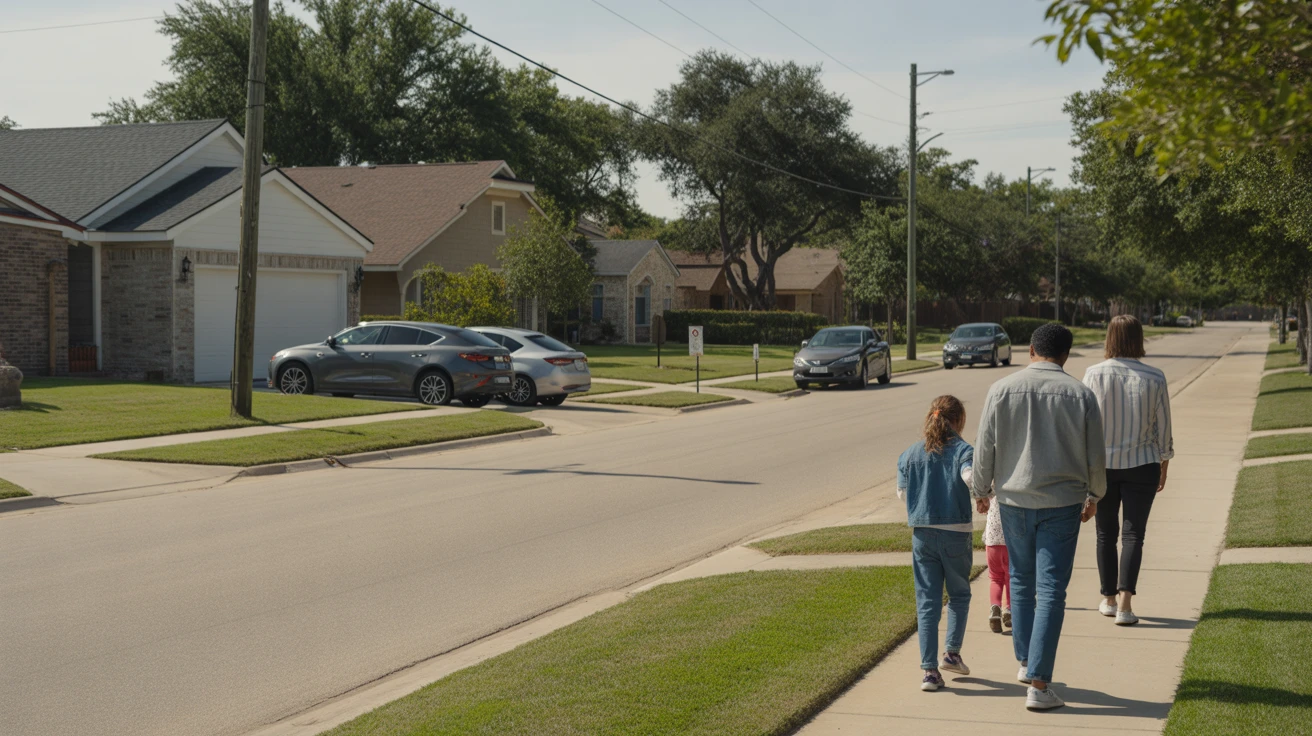
What Living in Carrollton Actually Feels Like
Carrollton sits in the northern Dallas suburbs, part of the sprawling Dallas-Fort Worth metro. With a median household income of $95,380 per year and median home values around $327,300, it attracts a mix of families, commuters, and professionals looking for suburban stability without sacrificing all access to the city.
The city’s structure shapes daily life in specific ways. While much of Carrollton is car-oriented, there are walkable pockets where the pedestrian-to-road ratio is high enough to support errands on foot. Grocery and food establishments are broadly accessible — density exceeds high thresholds across the city, meaning you’re rarely far from a supermarket, pharmacy, or restaurant. Parks are integrated throughout, with water features adding to the outdoor appeal. Rail transit is present, offering a real alternative to driving into Dallas for work or leisure.
But the city’s low-rise character and suburban layout mean that spontaneous walkable experiences — the kind where you step out your door and find cafes, shops, and activity without planning — are limited. Most daily movement still requires a car, even if you can occasionally walk to the grocery store or take the train downtown.
For people who want suburban space, good schools and playgrounds (though school density is below thresholds), and the option to commute by rail, Carrollton tends to deliver. For those seeking dense, walkable neighborhoods with nightlife and urban texture, it often feels like a compromise.
What People Talk About Online
In local Facebook groups and on platforms like Reddit, Carrollton residents tend to focus on a few recurring themes: commute logistics, the balance between suburban quiet and access to Dallas, and the ongoing tension between growth and neighborhood character.
There’s pride in the city’s rail access — people appreciate being able to skip the highway and take DART into Dallas for work or events. But there’s also frustration that outside of those transit corridors, most errands and activities require driving. The grocery density helps; people mention being able to reach multiple supermarkets within a short drive, which reduces the friction of weekly shopping.
Composite sentiments that come up frequently:
- “It’s a solid place to raise kids — good parks, decent schools, safe neighborhoods. But if you’re looking for things to do on a Friday night without driving, you’ll be disappointed.”
- “I love that I can take the train to Dallas and not deal with parking. But day-to-day, I’m still in my car for everything else.”
- “It feels like a bedroom community. People live here, but they go elsewhere for fun.”
The tone is generally pragmatic rather than enthusiastic. People recognize what Carrollton offers — stability, convenience, access — but they’re also clear-eyed about what it doesn’t offer: spontaneity, walkable urban texture, or a strong local nightlife scene.
How Local Coverage Frames the City
Local news and community coverage in Carrollton tends to focus on growth, infrastructure, and the evolving identity of the city as it balances suburban character with increasing density and development.
Common themes that appear in coverage include:
- “Community Debates What Growth Should Look Like”
- “New Retail and Dining Options Arrive as City Expands”
- “Residents Weigh Convenience of Transit Against Suburban Pace”
- “Parks and Green Spaces Remain Priority Amid Development”
- “Families Drawn to Stability, Accessibility, and Schools”
The framing is rarely alarmist, but it’s not celebratory either. Instead, it reflects a city in transition — one where longtime residents are adjusting to change, and newcomers are figuring out whether the tradeoffs align with their expectations.
What Reviews and Public Perception Reveal
On platforms like Google Reviews, Yelp, and Nextdoor-style forums, Carrollton’s public perception tends to split along expectation lines.
People who wanted suburban comfort, good grocery access, and proximity to Dallas without living in the city center tend to be satisfied. They mention clean neighborhoods, well-maintained parks, and the convenience of having multiple shopping options nearby. The presence of a hospital and pharmacies also comes up as a reassurance for families and older residents.
People who hoped for more walkability, local nightlife, or dense urban texture tend to feel let down. They describe the city as “quiet” or “sleepy,” and note that while there are pockets where you can walk, most of the city still requires a car for daily life. The low-rise building character and suburban layout mean there’s little vertical density or mixed-use energy.
Neighborhood variation exists — newer planned areas tend to feel more polished and amenity-rich, while older pockets have more established trees and a slightly more lived-in character. But across the board, the vibe is suburban: predictable, manageable, and car-dependent.
How Carrollton Compares to Nearby Cities
| Aspect | Carrollton | Plano | Irving |
|---|---|---|---|
| Overall Vibe | Suburban comfort with rail access, walkable pockets | Polished suburban, corporate, family-focused | More urban texture, denser, closer to DFW airport |
| Transit Access | Rail present, reduces Dallas commute stress | Rail present, strong highway access | Rail present, central location advantage |
| Walkability | Pockets exist, but mostly car-dependent | Limited, very car-oriented | More walkable corridors, mixed-use areas |
| Grocery/Errands | Broadly accessible, high density | Broadly accessible, many chain options | Broadly accessible, diverse retail |
| Family Appeal | Good parks, playgrounds; schools adequate | Strong school reputation, family infrastructure | Family-friendly but more urban feel |
| Nightlife/Activity | Minimal, mostly chain dining | Minimal, family-oriented dining | More dining variety, some nightlife |
Carrollton sits between Plano’s polished suburban predictability and Irving’s denser, more urban texture. If you want the strongest school reputation and the most corporate-suburban feel, Plano might edge ahead. If you want more walkable mixed-use corridors and closer proximity to the airport, Irving might feel more dynamic. But if you want suburban space with rail access and strong grocery density — without the intensity of Irving or the corporate polish of Plano — Carrollton tends to hit that middle ground.
None of these cities will satisfy someone seeking dense urban living or vibrant nightlife. But for families and commuters who want suburban stability with some access to Dallas, Carrollton offers a workable balance.
What Locals Are Saying
Here’s a snapshot of the kinds of sentiments that come up across different household types and life stages:
Young professional, renting:
“I moved here because rent was more reasonable than downtown Dallas, and I can still take the train to work. But honestly, there’s not much to do here on weekends. I end up driving into Dallas or Addison most of the time.”
Family with young kids:
“We love the parks and the neighborhood feel. The schools are fine, and we feel safe. It’s not the most exciting place, but that’s kind of the point — we wanted calm and predictable.”
Remote worker, moved from out of state:
“I thought being near Dallas would mean more walkability and local energy, but Carrollton is pretty car-dependent. The grocery stores are everywhere, which is nice, but I miss being able to walk to coffee shops and restaurants.”
Long-time resident:
“It’s changed a lot over the years — more people, more traffic, more development. But it’s still a good place to live. Quiet, safe, and you can get to Dallas when you need to.”
Retiree:
“We downsized here after the kids moved out. It’s manageable, the hospital is nearby, and we can get to everything we need without too much hassle. It’s not flashy, but it works.”
Commuter to Dallas:
“The train is a game-changer. I don’t have to sit in traffic every day, and parking downtown is expensive. Carrollton itself is quiet, but that’s fine — I’m in Dallas all day anyway.”
Newcomer from a walkable city:
“I underestimated how much I’d miss being able to walk places. There are a few pockets where you can, but mostly you’re driving. It’s fine if that’s what you’re used to, but it was an adjustment for me.”
Does Carrollton Feel Like a Good Fit?
Carrollton doesn’t try to be everything. It’s a suburban city with rail access, strong grocery and retail density, integrated parks, and a low-rise landscape that feels open and manageable. It works well for families seeking stability, commuters who value transit options, and households that prioritize convenience and predictability over spontaneity and urban texture.
It tends to frustrate people who want dense, walkable neighborhoods, vibrant nightlife, or the ability to live car-free. The city’s structure rewards planning and car ownership, even if you can occasionally walk to the store or take the train downtown.
If you’re deciding whether Carrollton aligns with your expectations, ask yourself: Do you value suburban space and access to Dallas more than local walkability and nightlife? Are you comfortable with car dependency for most errands, even if transit is available for commuting? Do you want a place that feels calm and predictable, or are you looking for energy and spontaneity?
The answers to those questions will tell you whether Carrollton’s tradeoffs feel like compromises — or like exactly what you’re looking for.
For a deeper look at monthly expenses and where your budget goes, or to explore what quality of life factors matter most, those resources can help you move from vibe to practical planning. And if you’re weighing housing tradeoffs and availability, that context can sharpen your sense of what’s realistic here.
How this article was built: In addition to public economic data, this article incorporates location-based experiential signals derived from anonymized geographic patterns—such as access density, walkability, and land-use mix—to reflect how day-to-day living actually feels in Carrollton, TX.
The perspectives shown reflect commonly expressed local sentiment and recurring themes in public discussion, rather than individual accounts.