
Buckeye sits at the western edge of the Phoenix metro, where rapid suburban growth meets open desert. The city’s housing market reflects its role as an affordability valve for buyers priced out of central Phoenix and Scottsdale, offering newer construction and larger lots at lower entry points. But that affordability comes with tradeoffs: car dependency is near-total, grocery and retail access is sparse, and the infrastructure that makes daily life convenient elsewhere requires deliberate planning here. For newcomers weighing rent against ownership, understanding Buckeye’s cost structure means recognizing that housing expense is only part of the equation—transportation, time, and household logistics shape the true cost of living here.
The Housing Market in Buckeye Today
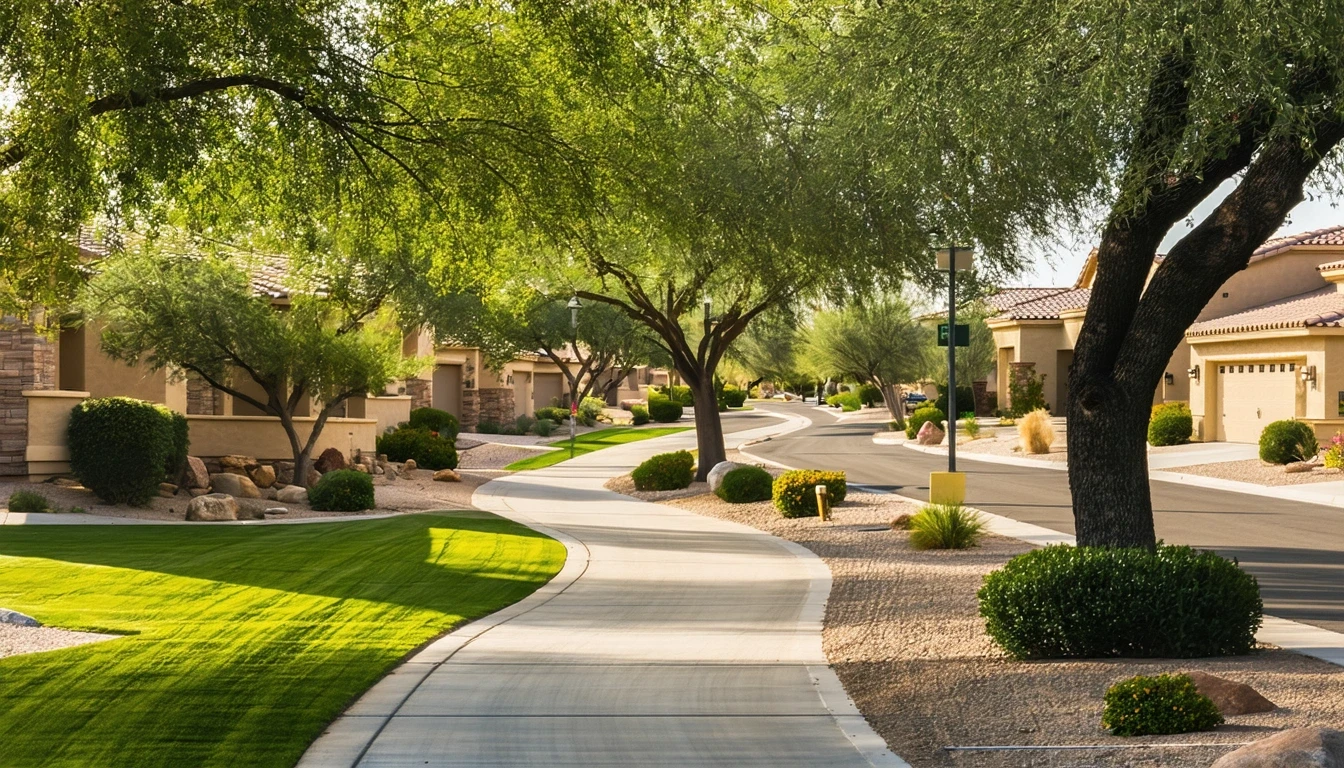
Buckeye’s housing market is defined by its position as one of the fastest-growing cities in the U.S., driven by families and first-time buyers seeking space and new construction at prices below the Phoenix core. The median home value of $341,700 reflects a market where single-family homes dominate, most built within the last two decades, with low-rise neighborhoods stretching across former agricultural land. This is not a city shaped by urban infill or historic districts—it’s a planned suburban expansion where housing stock is relatively uniform in age and style.
What newcomers often misunderstand is that Buckeye’s lower home prices are inseparable from its geographic isolation and infrastructure gaps. The city’s car-oriented layout and sparse food and grocery density mean that convenience costs are embedded in transportation and time, not just housing payments. Buyers attracted by the price gap between Buckeye and Tempe or Chandler need to account for longer commutes, fewer nearby services, and higher reliance on vehicle ownership. The market rewards households that prioritize space and newness over walkability and proximity.
Renting in Buckeye
Rental housing in Buckeye is less common than ownership, reflecting the city’s development pattern as a destination for buyers rather than renters. The median gross rent of $1,597 per month positions Buckeye in the middle range for the Phoenix metro, but rental availability is concentrated in newer apartment complexes and single-family rentals rather than older multifamily stock. Renters face a market where options are limited by location—most rental properties sit along major corridors rather than distributed evenly across neighborhoods.
For renters without reliable vehicles, Buckeye presents significant friction. Bus service exists but is limited, and the sparse accessibility of groceries and daily errands means that households dependent on transit or ride-sharing face higher indirect costs and longer trip times. Renters who work in central Phoenix or Scottsdale should expect commutes that exceed an hour each way, with few alternatives to driving. The rental experience here favors households with two vehicles, flexible schedules, and tolerance for planning trips around clustered errands rather than spontaneous walkable access.
Owning a Home in Buckeye
Ownership in Buckeye offers predictability in housing payments and access to newer homes with modern layouts and energy-efficient construction. The median home value of $341,700 reflects a market where buyers can secure three- to four-bedroom homes with garages and yards—space that would cost significantly more in Gilbert or Surprise. But ownership here also means exposure to costs that renters avoid: property taxes, homeowners association fees (common in newer developments), and maintenance on single-family homes in a climate where triple-digit summer heat stresses roofs, HVAC systems, and landscaping.
Property tax rates vary by district and are not provided in the data, but Arizona’s property tax structure generally favors owners compared to higher-tax states. However, newer homes in master-planned communities often carry HOA fees that fund shared amenities and exterior maintenance, adding a recurring cost that behaves more like rent than equity. Owners also face the long-term reality that Buckeye’s low-rise, car-dependent layout increases household transportation costs—two vehicles are often necessary, and fuel, insurance, and maintenance expenses compound over time.
The ownership experience in Buckeye differs from renting primarily in control and exposure. Owners lock in principal and interest payments (assuming fixed-rate financing), gaining protection from rent volatility but accepting responsibility for all maintenance, utilities, and governance fees. In a city where cooling costs dominate summer months and where retail and healthcare access requires driving, ownership shifts cost predictability to the housing payment while leaving transportation and convenience costs variable.
Apartment vs House in Buckeye — Cost Behavior Comparison
| Expense Category | Apartment | House |
|---|---|---|
| Cooling Costs (Summer) | Lower; shared walls reduce heat gain, smaller square footage | Higher; standalone structure with full sun exposure, larger conditioned space |
| Maintenance Responsibility | Minimal; landlord or HOA handles exterior, HVAC, landscaping | Full owner responsibility; roof, HVAC, desert landscaping all require regular upkeep |
| Transportation Exposure | Moderate; apartments often located near corridors with some bus access | Higher; single-family neighborhoods typically farther from transit and services |
| Governance Fees | Included in rent; no separate HOA bill | Common in newer developments; separate monthly HOA fee for amenities and exterior maintenance |
Why these categories? The table reflects cost differences driven by Buckeye’s climate, housing stock, and infrastructure. Cooling exposure varies significantly due to building type and sun exposure in a city where summer heat is extreme and prolonged. Maintenance responsibility differs because most rental apartments bundle upkeep, while single-family homeownership in desert conditions requires active management of HVAC, roofing, and landscaping. Transportation exposure is included because Buckeye’s car-oriented layout and sparse errands accessibility mean that location within the city—whether near a corridor or deep in a subdivision—directly affects household logistics and fuel costs. Governance fees appear because newer master-planned communities dominate Buckeye’s housing stock, making HOA fees a common ownership cost that renters avoid.
Categories like water/sewer or trash are omitted because they do not vary meaningfully by housing type in Buckeye—both apartments and houses face similar utility structures, and differences are driven more by household size than building form.
Utilities & Upkeep Differences
Utility exposure in Buckeye is shaped overwhelmingly by summer cooling demand. Triple-digit heat from May through September drives electricity usage far above winter levels, and the difference between an apartment with shared walls and a standalone house with full sun exposure is substantial. Apartment renters benefit from smaller conditioned spaces and reduced heat gain, while single-family homeowners face higher baseline cooling costs even with efficient HVAC systems. The electricity rate of 15.66¢ per kWh is moderate for Arizona, but the intensity and duration of cooling season mean that summer bills dominate annual utility spending.
Maintenance exposure also differs by housing type in ways specific to Buckeye’s climate and building stock. Newer construction—common in both apartments and houses—reduces some maintenance frequency compared to older housing markets, but desert conditions stress roofing materials, exterior paint, and landscaping. Homeowners bear full responsibility for these costs, while apartment renters shift that exposure to landlords. For houses, HVAC replacement is a major periodic expense, and desert landscaping (often required by HOA rules) demands either ongoing water costs or investment in xeriscaping.
The car-oriented layout also creates indirect upkeep differences. Households in single-family neighborhoods farther from services face higher vehicle usage, accelerating maintenance cycles for oil changes, tires, and brake wear. Apartment renters closer to corridors may reduce some of this exposure, but the sparse accessibility of groceries and errands means that even well-located renters in Buckeye drive more than they would in denser parts of the metro.
Rent vs Buy: Long-Term Exposure in Buckeye
The rent-versus-buy decision in Buckeye is less about monthly payment comparison and more about exposure to different types of cost volatility over time. Renters face the risk that lease renewals will increase faster than inflation, particularly in a fast-growing market where demand for rental housing outpaces supply. Owners with fixed-rate financing lock in their principal and interest payments, gaining predictability in the largest component of housing cost. But ownership introduces exposure to property tax changes, insurance premium increases, and maintenance events that renters avoid entirely.
Over a five- to ten-year horizon, ownership in Buckeye offers more control but less flexibility. Owners build equity as they pay down principal, and they benefit from any appreciation in home values—though future price growth is not guaranteed and depends on continued regional demand and employment growth. Renters retain mobility, avoiding the transaction costs and time required to sell a home, but they do not benefit from equity accumulation or property appreciation. In a city where new construction continues to expand, rental supply may stabilize over time, but the current market favors owners seeking long-term cost predictability.
The climate and infrastructure context also shapes long-term exposure. Owners in Buckeye must plan for periodic HVAC replacement, roof repairs, and landscaping costs—expenses that occur irregularly but are unavoidable in desert conditions. Renters shift these risks to landlords but accept that rent increases may reflect landlords’ own rising costs for insurance, taxes, and maintenance. Both paths require households to account for transportation costs that remain high regardless of housing tenure, given Buckeye’s car-dependent layout and sparse errands accessibility.
How this article was built: In addition to public economic data, this article incorporates location-based experiential signals derived from anonymized geographic patterns—such as access density, walkability, and land-use mix—to reflect how day-to-day living actually feels in Buckeye, AZ.
FAQs About Housing Costs in Buckeye
Is Buckeye cheaper than other Phoenix suburbs?
Buckeye’s median home value of $341,700 is lower than many central and eastern Phoenix suburbs, but that price difference reflects geographic distance, car dependency, and sparser access to services. Buyers save on housing but face higher transportation costs and longer commutes.
What drives utility costs in Buckeye homes?
Summer cooling dominates utility spending. Triple-digit heat from May through September drives electricity usage far above winter levels, and single-family homes with full sun exposure face higher baseline costs than apartments with shared walls.
Are HOA fees common in Buckeye?
Yes, particularly in newer master-planned communities that make up much of Buckeye’s housing stock. HOA fees fund shared amenities, landscaping, and exterior maintenance, adding a recurring cost that owners must budget for beyond their mortgage payment.
How does renting in Buckeye compare to owning?
Renting offers flexibility and shifts maintenance responsibility to landlords, but renters face potential lease renewal increases and do not build equity. Ownership locks in principal and interest payments but requires households to absorb property taxes, insurance, maintenance, and HOA fees.
What should buyers know about maintenance costs in Buckeye?
Desert conditions stress roofing, HVAC systems, and landscaping. Owners should expect periodic HVAC replacement, roof repairs, and either ongoing water costs for landscaping or investment in xeriscaping. Newer construction reduces some maintenance frequency but does not eliminate these exposures.
Making Housing Choices in Buckeye
Housing costs in Buckeye reflect a market built for buyers seeking space, newness, and lower entry prices than central Phoenix, but those advantages come with infrastructure tradeoffs that shape what a budget has to handle beyond the rent or mortgage payment. The city’s car-oriented layout, sparse errands accessibility, and extreme summer heat create cost exposures in transportation, utilities, and time that renters and owners alike must account for. Ownership offers predictability in housing payments and equity accumulation, but it also introduces maintenance, governance, and cooling costs that compound in desert conditions. Renting provides flexibility and shifts upkeep responsibility to landlords, but it leaves households exposed to lease renewal volatility in a fast-growing market.
The households that fit Buckeye best are those that prioritize space and newer construction over walkability, accept car dependency as a baseline condition, and plan logistics around clustered errands rather than spontaneous access. For buyers comparing cost of living tradeoffs, the decision hinges not on whether Buckeye is cheaper in absolute terms, but on whether the savings in housing payments justify the higher costs in transportation, time, and household coordination. Renters without reliable vehicles or those expecting transit-oriented convenience will find Buckeye’s infrastructure misaligned with their needs. Owners prepared for the long-term maintenance and cooling exposure of single-family desert homes will find a market that rewards stability and space over urban amenities.
For those planning a move, understanding how pods vs trucks fit your timeline and budget can ease the transition into Buckeye’s housing market, whether renting or buying.