
Queen Creek’s housing market reflects its identity as a rapidly developed suburban community on Phoenix’s southeastern edge, where newer construction, master-planned neighborhoods, and commuter-oriented infrastructure shape what households pay and how ownership behaves over time. With a median home value of $493,700 and median gross rent of $2,030 per month, the city sits above the regional baseline for both purchase and rental costs, driven by relatively recent development patterns and the appeal of newer housing stock in a desert climate that demands year-round cooling capacity.
Understanding Queen Creek cost of living: housing, utilities & daily costs requires recognizing that housing expenses here are not just about the sticker price—they reflect exposure to property governance structures, cooling-intensive summers, and the long-term cost behavior of owning versus renting in a market where most inventory has been built within the last two decades. This article explains how housing costs are structured in Queen Creek, which expenses remain predictable, and how ownership and rental tradeoffs play out in a community where suburban growth and desert conditions intersect.
The Housing Market in Queen Creek Today
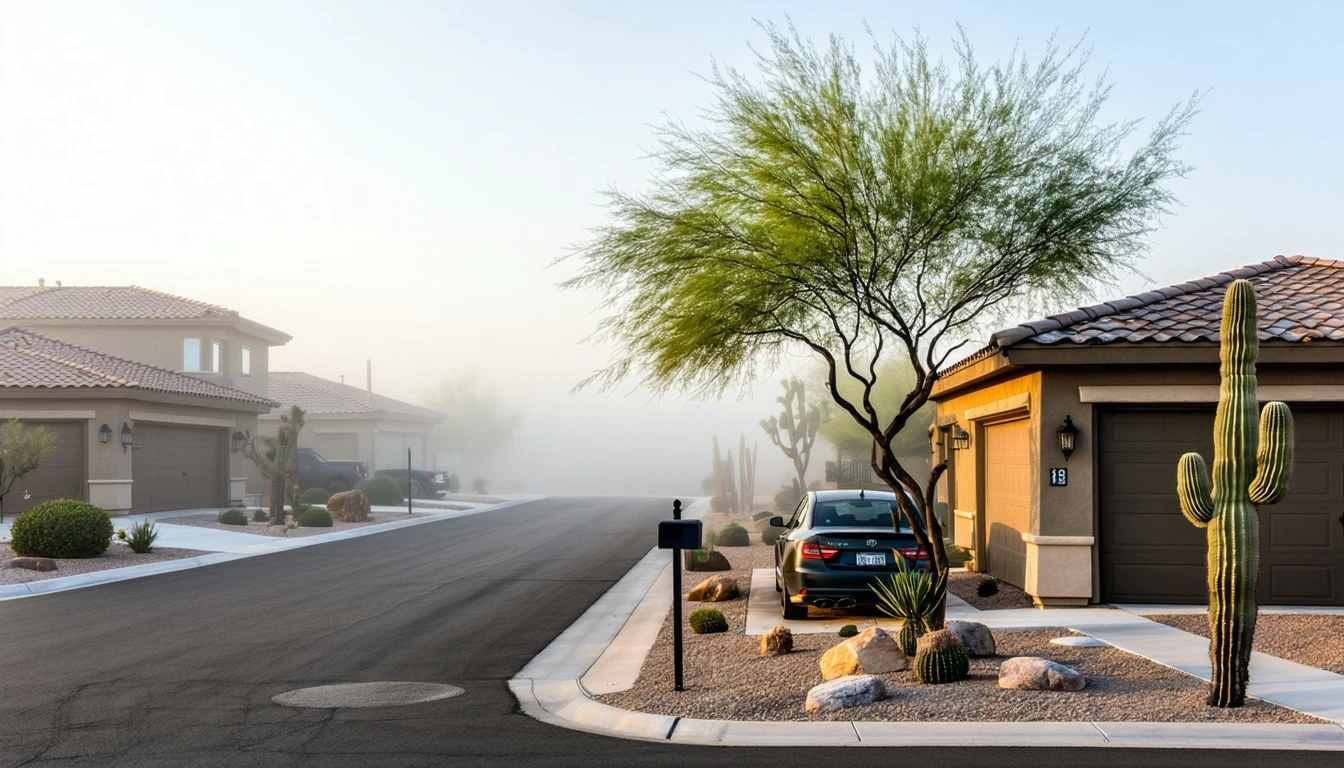
Queen Creek’s housing market is shaped by its transformation from rural agricultural land to one of the Phoenix metro area’s fastest-growing suburban communities. The majority of residential development has occurred since 2000, resulting in a housing stock dominated by single-family homes in master-planned communities with HOA governance, deed restrictions, and shared amenities. This newer construction base means homes typically feature modern floor plans, energy-efficient building codes, and desert landscaping designed to minimize water use—but it also means buyers and renters are paying for relatively recent construction in a market where land values have risen alongside Phoenix’s outward expansion.
The median home value of $493,700 reflects this newer inventory and the premium attached to suburban space, larger lots, and access to newer schools and infrastructure. Unlike older Phoenix neighborhoods where housing stock varies widely in age and condition, Queen Creek offers less variation in vintage, which narrows the range of entry points for buyers but also reduces the risk of inheriting deferred maintenance or outdated systems. For renters, the median gross rent of $2,030 per month reflects similar dynamics: most rental inventory consists of newer single-family homes or townhomes rather than older apartment complexes, and landlords price accordingly.
What newcomers often misunderstand is that Queen Creek’s housing costs are tied not just to the structure itself but to the broader infrastructure and governance model that comes with master-planned suburban growth. HOAs are common, and while they provide amenities and maintain common areas, they also introduce recurring fees and rule structures that affect both ownership flexibility and long-term cost exposure. The city’s location as a commuter suburb—roughly 40 miles from central Phoenix—also means housing affordability must be weighed against transportation time and fuel costs, particularly for households with multiple earners working in different parts of the metro area.
Renting in Queen Creek
Renting in Queen Creek means navigating a market where most rental inventory consists of single-family homes, townhomes, and newer apartment communities rather than older multifamily stock. This inventory composition pushes median gross rent to $2,030 per month, a figure that reflects not just space but also the cost of renting relatively new construction in a suburban setting where landlords often price for families seeking yards, garages, and proximity to newer schools.
Rental pressure in Queen Creek is shaped by the city’s rapid population growth and limited availability of older, lower-cost apartment inventory. Unlike urban cores where older buildings provide a range of price points, Queen Creek’s rental market offers fewer budget-friendly options because the housing stock itself is newer and was built during a period of higher land and construction costs. Renters seeking lower monthly payments often face tradeoffs: moving farther from main corridors, accepting older construction in neighboring communities, or choosing smaller units in complexes with fewer amenities.
Location within Queen Creek affects rental experience significantly. Properties closer to Ellsworth Road or Rittenhouse Road offer better access to retail, dining, and commuter routes toward Phoenix, but they also command higher rents due to convenience. Renters willing to live in newer developments on the city’s southern or western edges may find slightly lower prices, but they trade convenience for longer drives to employment centers and services. The city’s layout—characterized by master-planned communities with limited through-streets—also means that proximity to main arterials can add or subtract 10 to 15 minutes from daily commutes, a factor that compounds over time for households with multiple earners.
Renters should also anticipate that lease renewals in Queen Creek are influenced by regional rental demand and the relatively tight inventory of single-family rental homes. Because much of the rental stock is owned by individual landlords or small investment groups rather than large corporate operators, renewal terms and rent adjustments can vary widely. Tenants in master-planned communities may also encounter HOA rules that restrict parking, limit exterior modifications, or regulate noise and guest policies, even though they are not the property owners—these governance structures affect day-to-day living regardless of tenure type.
Owning a Home in Queen Creek
Owning a home in Queen Creek means taking on the median home value of $493,700 along with the full suite of ownership-specific exposures that come with suburban desert living and master-planned community governance. Unlike renting, where monthly costs are bundled and predictable, ownership introduces property taxes, homeowners insurance, HOA fees, and maintenance obligations that vary with home age, lot size, and community rules. These costs are not optional, and they do not remain static—they respond to market conditions, climate events, and local governance decisions in ways that renters are insulated from.
Property taxes in Queen Creek are levied by Maricopa County and multiple overlapping jurisdictions, including the town itself, school districts, and special service districts. While specific rates are not provided in the data feed, owners should understand that assessed values are tied to market conditions and that reassessments can adjust tax obligations as home values shift. In a market where home values have risen alongside regional growth, tax exposure tends to increase over time, particularly for owners who purchased during earlier development phases and have seen significant appreciation.
Homeowners insurance in desert climates carries distinct exposure profiles. Queen Creek’s location in the Sonoran Desert means homes face intense summer heat, monsoon storms with high winds and dust, and occasional hail. These conditions increase the likelihood of roof damage, HVAC system strain, and exterior wear, which insurers price into premiums. Homes in master-planned communities with newer construction may benefit from modern building codes and materials designed for desert conditions, but they are not immune to storm damage or the long-term effects of UV exposure on roofing and exterior surfaces.
HOA fees are a defining feature of ownership in Queen Creek, where most residential neighborhoods operate under community associations that manage common areas, enforce architectural standards, and provide amenities such as pools, parks, and landscaping. These fees are mandatory and typically range from modest monthly amounts in smaller subdivisions to several hundred dollars per month in larger master-planned communities with extensive amenities. HOA fees do not remain fixed—they adjust over time to cover rising maintenance costs, capital improvements, and reserve fund requirements. Owners should recognize that HOA governance also limits flexibility: exterior paint colors, landscaping choices, and even vehicle parking are often subject to approval, and violations can result in fines or liens.
Maintenance obligations in Queen Creek are shaped by the desert climate and the age of the housing stock. Cooling systems dominate utility usage and require regular servicing to handle summer temperatures that routinely exceed 110°F. HVAC systems in desert climates experience higher wear rates than in milder regions, and replacement costs—often several thousand dollars—are a predictable long-term expense. Pool maintenance, common in many Queen Creek homes, adds another layer of recurring cost and labor. Landscaping, while often designed for low water use, still requires irrigation system upkeep, and desert plants are not maintenance-free. Owners also face exposure to monsoon-related repairs: roof inspections, gutter cleaning, and exterior sealing become routine rather than occasional tasks.
Ownership in Queen Creek offers control and stability that renting does not—monthly housing costs become more predictable once a mortgage is locked in, and owners are not subject to lease renewals or landlord decisions. But that stability comes with the responsibility to absorb all cost variability, from rising insurance premiums to unexpected HVAC failures, and to navigate the governance structures that shape how homes can be used and modified. For households with the income and savings to manage these exposures, ownership provides long-term equity accumulation and protection from rental market volatility. For those without substantial reserves or the ability to handle multi-thousand-dollar repair events, ownership introduces financial risk that renting does not.
Apartment vs House in Queen Creek — Cost Behavior Comparison
The table below compares cost behavior between apartments and single-family houses in Queen Creek, focusing only on categories where local conditions—climate, housing stock, and governance—create meaningful differences. Generic distinctions that apply universally are omitted.
| Expense Category | Apartment | House |
|---|---|---|
| Cooling Costs | Lower exposure due to smaller square footage and shared-wall insulation; central systems serve compact layouts | Dominant cost driver in summer; larger square footage and standalone construction increase cooling load; HVAC systems work harder in desert heat |
| Water & Landscaping | Typically included in rent or covered by property management; minimal tenant responsibility | Owner-paid; desert landscaping requires irrigation system maintenance, and pools (common in Queen Creek) add recurring water and chemical costs |
| HOA Fees | Rare in apartment complexes; property management handles common areas without separate HOA charges | Nearly universal in Queen Creek’s master-planned neighborhoods; fees cover amenities, landscaping, and governance; adjust over time |
| Monsoon & Storm Exposure | Property owner absorbs roof, exterior, and structural repair costs; tenants unaffected unless damage disrupts habitability | Owner fully exposed to roof damage, exterior wear, and HVAC strain from high winds, dust, and hail; repairs can reach thousands of dollars |
| Maintenance Predictability | Landlord or property management handles HVAC, appliances, and structural issues; tenant cost exposure limited to lease terms | Owner responsible for all systems; HVAC replacement, pool equipment, and irrigation repairs are recurring and expensive in desert climates |
Methodology Note: This table isolates cost categories where Queen Creek’s desert climate, newer housing stock, and master-planned community structure create distinct differences between apartments and houses. Generic categories such as rent vs mortgage, insurance, or property taxes are excluded because they do not vary meaningfully by housing type in ways specific to Queen Creek. The focus is on operational and environmental cost drivers that households experience differently depending on structure type and tenure.
Utilities & Upkeep Differences
Utility and maintenance exposure in Queen Creek diverges sharply between apartments and single-family homes due to the intensity of desert cooling demands and the structural differences in how housing types handle heat, water, and storm exposure. These are not minor variations—they represent fundamentally different cost profiles that shape long-term housing affordability.
Cooling costs dominate utility bills in Queen Creek, where summer temperatures routinely exceed 110°F and air conditioning runs continuously from May through September. In apartments, smaller square footage and shared-wall construction reduce the cooling load, and central HVAC systems are sized for compact layouts. Tenants in apartments benefit from lower exposure to extreme cooling costs, though they still face elevated summer bills compared to milder climates. In single-family homes, larger square footage, standalone construction, and often two-story layouts increase cooling demands significantly. Homeowners also bear the full cost of HVAC maintenance and eventual replacement, a recurring expense that can reach several thousand dollars and is accelerated by the constant strain of desert heat.
Water and landscaping costs follow a similar pattern. Apartment tenants typically have water included in rent or managed by the property, with no direct responsibility for irrigation or outdoor maintenance. Single-family homeowners, by contrast, pay for all water usage, including irrigation systems that keep desert landscaping alive and pool maintenance if the property includes one—common in Queen Creek’s newer developments. Pools add not just water costs but also chemicals, equipment upkeep, and energy for pumps and heaters, creating a recurring expense stream that apartment tenants never encounter.
Monsoon season introduces another layer of maintenance exposure that affects houses far more than apartments. High winds, dust storms, and occasional hail can damage roofs, exteriors, and HVAC systems. Homeowners are fully responsible for inspections, repairs, and preventive maintenance such as sealing and gutter clearing. Apartment tenants are insulated from these costs—property management handles storm-related repairs, and tenants are only affected if damage disrupts habitability. This difference in exposure is not trivial in a region where monsoon storms are an annual certainty and roof lifespans are shortened by intense UV exposure and thermal cycling.
The upkeep differences between apartments and houses in Queen Creek are driven by climate intensity and housing structure, not just size or tenure type. Homeowners take on the full volatility of desert living—cooling system strain, storm damage, and water-intensive landscaping—while apartment tenants trade higher rent for insulation from these variable costs. For households evaluating housing options, understanding this tradeoff is essential: apartments offer predictability and lower exposure to climate-driven expenses, while houses offer space and control at the cost of absorbing all operational and environmental risk.
Rent vs Buy: Long-Term Exposure in Queen Creek
The decision to rent or buy in Queen Creek is not primarily a question of monthly payment size—it is a question of which cost exposures a household is prepared to manage over time and how much control and predictability matter relative to flexibility and insulation from volatility. Both paths involve substantial housing costs, but they distribute risk, responsibility, and long-term financial exposure in fundamentally different ways.
Renting in Queen Creek provides insulation from the variable costs of ownership: property taxes, insurance premium shifts, HOA fee increases, and major maintenance events such as HVAC replacement or roof repair. Tenants pay a fixed monthly rent and are not responsible for storm damage, system failures, or the long-term wear that desert heat imposes on homes. This insulation comes at the cost of exposure to lease renewals, where rent can adjust in response to regional demand and landlord decisions. In a market where rental inventory is dominated by newer single-family homes and townhomes, tenants also face limited options for downgrading or finding lower-cost alternatives without leaving Queen Creek entirely.
Buying in Queen Creek transfers all cost volatility to the homeowner but locks in the largest component of housing expense—the mortgage principal and interest—for the life of the loan. This stability is significant in a region where rental demand has grown alongside population, but it does not eliminate variability. Property taxes respond to assessed values and local fiscal needs, homeowners insurance premiums adjust with claims experience and climate risk, and HOA fees rise to cover maintenance and capital improvements. Cooling costs remain high regardless of tenure, but homeowners also absorb the cost of HVAC system replacement, pool upkeep, and monsoon-related repairs—expenses that can reach thousands of dollars and occur on unpredictable timelines.
The long-term exposure difference is structural. Renters remain flexible: they can relocate when leases end, avoid responsibility for major repairs, and are not tied to a single property if neighborhood conditions or personal circumstances change. But they build no equity, and they remain subject to the decisions of landlords and the broader rental market. Homeowners gain equity accumulation and protection from rent increases, but they take on the full responsibility for all systems, all governance obligations, and all climate-related wear. In Queen Creek, where desert heat accelerates system degradation and monsoon storms create recurring repair exposure, this responsibility is not abstract—it is a predictable, ongoing cost stream that renters never encounter.
For households with stable income, substantial savings, and the ability to manage multi-thousand-dollar repair events, ownership in Queen Creek offers long-term cost predictability and equity growth. For those without significant reserves, or for whom flexibility and mobility are priorities, renting provides insulation from the operational and environmental risks that define homeownership in a desert climate. The choice is not about which path costs less—it is about which risk profile and responsibility structure aligns with a household’s financial capacity and long-term plans.
FAQs About Housing Costs in Queen Creek
What is the median home value in Queen Creek?
The median home value in Queen Creek is $493,700, reflecting the city’s newer housing stock, master-planned community emphasis, and location as a growing suburban area southeast of Phoenix. This figure represents the midpoint of the market and does not account for lot size, specific neighborhood amenities, or HOA governance structures, all of which vary across developments.
How much does it cost to rent in Queen Creek?
The median gross rent in Queen Creek is $2,030 per month. This figure reflects a rental market dominated by single-family homes and newer townhomes rather than older apartment complexes, and it includes rent only—tenants should anticipate additional costs for utilities, particularly cooling during summer months when air conditioning runs continuously.
Are HOA fees common in Queen Creek?
Yes, HOA fees are nearly universal in Queen Creek due to the prevalence of master-planned communities. These fees cover common area maintenance, amenities such as pools and parks, and enforcement of architectural and landscaping standards. Fee amounts vary by community size and amenity level, and they adjust over time to cover rising maintenance costs and capital reserves.
How does Queen Creek’s climate affect housing costs?
Queen Creek’s desert climate drives cooling costs to the forefront of utility expenses, with air conditioning running continuously from late spring through early fall. Homeowners also face accelerated wear on HVAC systems, roofing, and exterior surfaces due to intense heat and UV exposure, and monsoon storms introduce recurring repair exposure from high winds, dust, and hail. These climate factors create ongoing cost obligations that are more intense than in milder regions.
Is it better to rent or buy in Queen Creek?
The answer depends on a household’s financial reserves, income stability, and tolerance for cost variability. Buying offers long-term cost predictability and equity accumulation but requires the ability to absorb property taxes, insurance, HOA fees, and major maintenance events such as HVAC replacement. Renting provides insulation from these variable costs and maintains flexibility, but tenants remain exposed to lease renewals and rental market conditions. Neither path is universally better—each fits different financial situations and long-term goals.
Making Housing Choices in Queen Creek
Housing costs in Queen Creek are shaped by the city’s identity as a rapidly developed suburban community where newer construction, master-planned governance, and desert climate conditions converge to create a distinct cost structure. With a median home value of $493,700 and median gross rent of $2,030 per month, the city sits above regional baselines for both ownership and rental, reflecting the premium attached to newer inventory, larger lots, and access to modern infrastructure and schools.
The choice between renting and buying in Queen Creek is not a question of which costs less in the short term—it is a question of which exposures a household is prepared to manage and how much control and predictability matter relative to flexibility and insulation from volatility. Renters avoid the variable costs of ownership but remain subject to lease renewals and limited inventory options. Homeowners lock in mortgage costs and build equity but take on the full responsibility for property taxes, insurance, HOA fees, and the recurring maintenance demands of desert living, from HVAC replacement to monsoon-related repairs.
For households with stable dual incomes, substantial savings, and the capacity to handle multi-thousand-dollar repair events, ownership in Queen Creek offers long-term stability and equity growth in a market where rental demand continues to rise. For those without significant reserves, or for whom mobility and flexibility are priorities, renting provides a predictable monthly cost and protection from the operational risks that define homeownership in a desert climate. Understanding how housing costs behave in Queen Creek—and which exposures come with each tenure type—is essential for making decisions that align with financial capacity and long-term goals.
For a broader view of how housing fits into overall expenses, see planning a monthly budget in Queen Creek. Households preparing to relocate should also consider logistics and timing by reviewing the best moving companies guide.