
Mira wakes at 6:45 a.m. in her apartment three blocks from a rail station in Santa Clara. She walks to the platform, boards the 7:18 train, and arrives at her office in San Jose 28 minutes later. No traffic. No parking hunt. She reads on the way. Her coworker David, living four miles west in a quieter neighborhood, leaves at the same time but sits in stop-and-go traffic for 35 minutes, circling twice for parking. Both live in Santa Clara. Both work in San Jose. Their mornings couldn’t be more different.
That gap—between rail-corridor convenience and car-dependent sprawl—defines transportation options in Santa Clara more than any single system or policy. This isn’t a city where everyone drives, and it’s not a city where everyone rides transit. It’s a place where your address determines your mobility, and your mobility shapes your day.
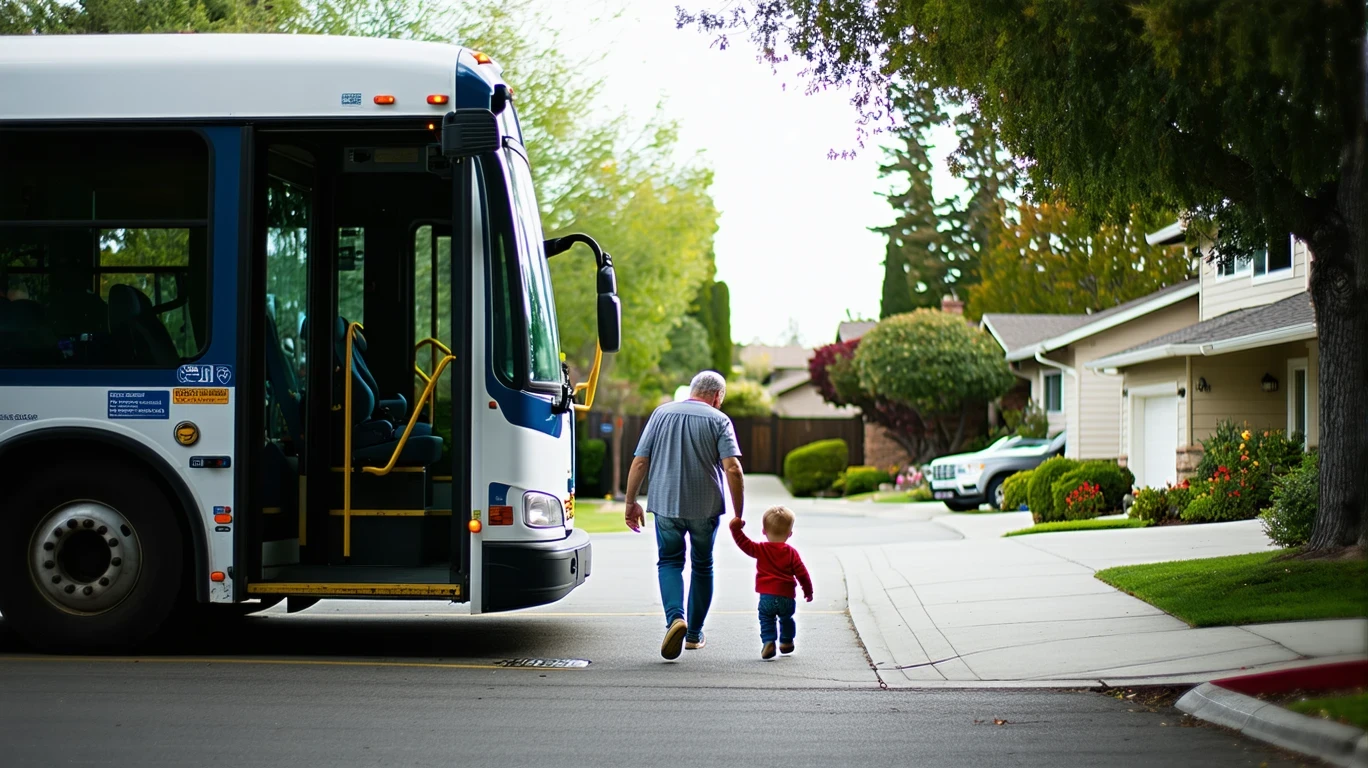
How People Get Around Santa Clara
Santa Clara operates as a multi-modal city with genuine infrastructure to support it. Rail service runs through the city, pedestrian infrastructure exceeds typical suburban levels, and cycling networks are present and substantial. But the city’s low-rise, spread-out form means that access to these options isn’t evenly distributed. If you live near a station or along a commercial corridor, you can structure a life with minimal driving. If you’re in a residential pocket two miles from the nearest transit stop, you’ll likely own a car.
The average commute here is 23 minutes, which suggests proximity to major employment centers in Silicon Valley. But nearly 31% of workers face long commutes, indicating a split: some people work locally or have short, predictable trips; others are making regional commutes to San Francisco, the East Bay, or South Bay campuses scattered across the region. That bifurcation shows up in how people move. Some rely on rail and bikes. Others drive every day.
Newcomers often assume Santa Clara is either “car country” or “transit-friendly,” but it’s neither in absolute terms. It’s both, depending on where you live and where you need to go.
Public Transit Availability in Santa Clara
Public transit in Santa Clara often centers around systems such as Caltrain and VTA light rail, though coverage varies by area. Rail service is present and plays a meaningful role for commuters traveling along established corridors—particularly those heading to San Jose, Palo Alto, or San Francisco. If your job sits near a station and your home does too, rail becomes a legitimate daily option, not a backup plan.
Bus service exists but functions more as a supplementary layer, connecting neighborhoods to rail stops or filling gaps in coverage. It’s less useful for cross-town trips or late-night travel, where frequency and span of service tend to thin out. Transit works best during peak commute hours along high-demand routes. Outside those windows, or outside those corridors, the system’s limitations become more visible.
Santa Clara’s transit infrastructure isn’t tokenistic. The presence of rail, the density of stops, and the integration with regional networks indicate real investment. But the city’s layout—low-rise, spread across several square miles, with employment dispersed rather than concentrated—means transit can’t serve everyone equally well. It’s a tool that works for specific trip patterns, not a universal solution.
Driving & Car Dependence Reality
Most households in Santa Clara own at least one car, even if they don’t use it daily. Driving offers flexibility that transit can’t match: multi-stop errands, late-night trips, travel to job sites outside the rail network, or simply the ability to leave on your own schedule. Parking is generally available, both on-street and in lots, though density near commercial areas and transit hubs can make it competitive during business hours.
The city’s street grid and highway access make driving practical. U.S. 101 and I-280 run nearby, and local roads connect residential areas to shopping, schools, and services without major bottlenecks—most of the time. Traffic does build during peak hours, particularly for commuters heading toward San Jose or Mountain View, but it’s rarely gridlock. The bigger cost of driving here isn’t congestion; it’s the ongoing expense of fuel, insurance, and maintenance in a region where gas prices run nearly $6 per gallon.
Car dependence in Santa Clara isn’t about a lack of alternatives. It’s about the structure of daily life. If your routine involves dropping kids at school, grocery runs, and a job in a suburban office park, transit probably won’t cover it. If your day is more linear—home to station to office to station to home—you can skip the car entirely.
Commuting Patterns & Daily Mobility
Commuting in Santa Clara reflects two distinct realities. One group works locally or within the immediate South Bay, keeping trips short and predictable. The other commutes regionally, often to San Francisco or the East Bay, where travel time stretches and variability increases. The 23-minute average commute suggests that many people work close by, but the 31% facing long commutes shows that a significant minority is absorbing much longer, more complex trips.
For those commuting via rail, the trip is generally stable. Trains run on schedule, and the time cost is predictable. For those driving, commute length depends on traffic, time of day, and route. A 25-minute drive at 7:00 a.m. can become 40 minutes at 8:15 a.m. That variability matters for parents managing school drop-offs, for workers with rigid start times, or for anyone trying to structure a day around fixed commitments.
Only 4.7% of workers in Santa Clara work from home, which is notably low for a tech-adjacent city. That suggests most jobs here still require physical presence, whether in offices, labs, retail, or service roles. The implication: most people are moving every day, and the quality of that movement—its cost, its predictability, its friction—shapes daily life in ways that aren’t always visible until you live it.
Who Transit Works For — and Who It Doesn’t
Transit in Santa Clara works best for single commuters with fixed schedules, students, and workers whose jobs align with rail corridors. If you’re renting near a station and commuting to San Jose or San Francisco for work, you can realistically build a car-free or car-light life. Your commute becomes reading time, your transportation costs drop, and your exposure to traffic and parking stress disappears.
Transit works less well for families managing multiple daily stops—school, daycare, groceries, activities. It also struggles to serve workers whose jobs sit outside the rail network, particularly in office parks or industrial areas that require driving the last mile. And for anyone whose schedule doesn’t align with peak service hours—shift workers, evening employees, weekend commuters—the system’s reduced frequency becomes a friction point.
Homeowners in peripheral neighborhoods, even within Santa Clara’s boundaries, often find themselves too far from stations to make transit practical for daily use. Walking 15 minutes to a bus stop, waiting 12 minutes for a bus, then transferring to rail adds enough time and unpredictability that driving becomes the default. Proximity isn’t just convenience—it’s the difference between transit being usable or theoretical.
Renters, particularly those in denser areas near commercial corridors, tend to have better access. The city’s walkable pockets and high pedestrian infrastructure density mean that day-to-day costs related to errands, groceries, and short trips can often be managed on foot or by bike, reducing the need for a car even if transit isn’t used for commuting.
Transportation Tradeoffs in Santa Clara
Choosing between transit and driving in Santa Clara isn’t about picking the “better” option—it’s about matching your transportation mode to your specific circumstances. Transit offers predictability, lower ongoing costs, and freedom from parking stress, but it requires living near a station and working along a served corridor. Driving offers flexibility, control, and the ability to structure complex trip chains, but it exposes you to fuel costs, traffic variability, and the need for parking.
For someone commuting alone to a fixed location five days a week, rail makes sense. For someone managing household logistics across multiple locations, driving is often unavoidable. The tradeoff isn’t binary; many households use both, keeping a car for weekends and errands while riding transit for weekday commutes.
The city’s infrastructure supports both modes, but it doesn’t eliminate the tension between them. You can live car-free in Santa Clara, but only if your housing, job, and daily needs align geographically. You can live car-dependent, but you’ll absorb the costs and friction that come with it. The city doesn’t force one choice, but it doesn’t make either choice costless.
FAQs About Transportation in Santa Clara (2026)
Is public transit usable for daily commuting in Santa Clara?
Yes, if you live near a rail station and work along a served corridor. Rail service is present and functions reliably for commuters traveling to San Jose, Palo Alto, or San Francisco. If your home and job both sit within walking distance of stations, transit becomes a practical daily option. Outside those corridors, or for trips requiring multiple transfers, transit becomes less competitive with driving.
Do most people in Santa Clara rely on a car?
Most households own at least one car, but not everyone uses it daily. The city’s rail access, pedestrian infrastructure, and cycling networks mean that some residents—particularly those near transit hubs—can manage without driving regularly. However, the majority of workers commute by car, especially those in peripheral neighborhoods or with jobs outside the rail network.
Which areas of Santa Clara are easiest to live in without a car?
Neighborhoods within walking distance of rail stations or along commercial corridors with high pedestrian infrastructure offer the most car-free viability. Areas with direct access to grocery stores, services, and transit stops allow residents to handle daily errands on foot or by bike. Peripheral residential areas farther from transit and commercial centers generally require a car for practical daily living.
How does commuting in Santa Clara compare to nearby cities?
Santa Clara’s 23-minute average commute is shorter than many neighboring cities, reflecting proximity to South Bay employment centers. However, nearly a third of workers face long commutes, often to San Francisco or the East Bay. The city’s rail access provides an advantage for regional commuters compared to more car-dependent suburbs, but it’s not as transit-rich as San Francisco or as universally car-oriented as more sprawling South Bay cities.
Can you bike safely for transportation in Santa Clara?
Yes, in many areas. The city’s bike-to-road ratio exceeds typical suburban levels, indicating substantial cycling infrastructure. Bike lanes and paths are present throughout parts of the city, particularly along commercial corridors and near transit hubs. However, cycling viability depends on your specific route, comfort level with traffic, and distance. Short trips within walkable pockets tend to be more bikeable than longer cross-city commutes.
How Transportation Fits Into the Cost of Living in Santa Clara
Transportation in Santa Clara isn’t just a line item—it’s a structural factor that shapes where you can live, how you spend your time, and what tradeoffs you’re willing to accept. Living near transit might mean higher rent but lower transportation costs and more predictable commutes. Living farther out might mean cheaper housing but higher fuel expenses and longer, more variable travel times.
The city’s infrastructure gives you options, but it doesn’t eliminate the need to choose. Your transportation mode affects your housing search, your daily schedule, and your exposure to cost volatility. A car offers freedom but requires ongoing expense. Transit offers predictability but requires proximity. Walking and biking offer low cost but depend on density and distance.
For a fuller picture of how transportation costs interact with housing, utilities, and daily expenses, see what a budget has to handle in Santa Clara. The goal isn’t to optimize every decision—it’s to understand the tradeoffs well enough to make choices that fit your actual life, not an idealized version of it.
How this article was built: In addition to public economic data, this article incorporates location-based experiential signals derived from anonymized geographic patterns—such as access density, walkability, and land-use mix—to reflect how day-to-day living actually feels in Santa Clara, CA.