
Is Sherwood expensive to live in? Sherwood is considered expensive in 2026, with a median home value of $520,500 and median rent of $1,980 per month. The value proposition depends on housing entry cost versus how much you drive—commuting and vehicle ownership create recurring exposure that compounds the upfront housing pressure.
When Maya pulled into Sherwood on a rainy February afternoon, she had her spreadsheet ready: rent budget, utility estimates, gas money. What she didn’t expect was how the city’s layout would quietly reshape her weekly routine—and her costs. The grocery store was a ten-minute walk. The park was two blocks over. Her Portland commute, though, meant filling the tank twice a week. Sherwood’s cost structure isn’t just about the rent check; it’s about which expenses you can control and which ones follow you home every evening.
Overall Cost of Living Snapshot
Sherwood sits 25% above the national cost baseline, reflected in a regional price parity index of 125. This isn’t a uniform markup—housing absorbs the majority of the premium, while groceries and utilities track closer to regional norms. The primary cost driver is housing entry, whether you’re renting or buying. Median home values exceed half a million dollars, and rental pricing approaches $2,000 per month, creating immediate pressure on household budgets before utilities, transportation, or groceries enter the picture.
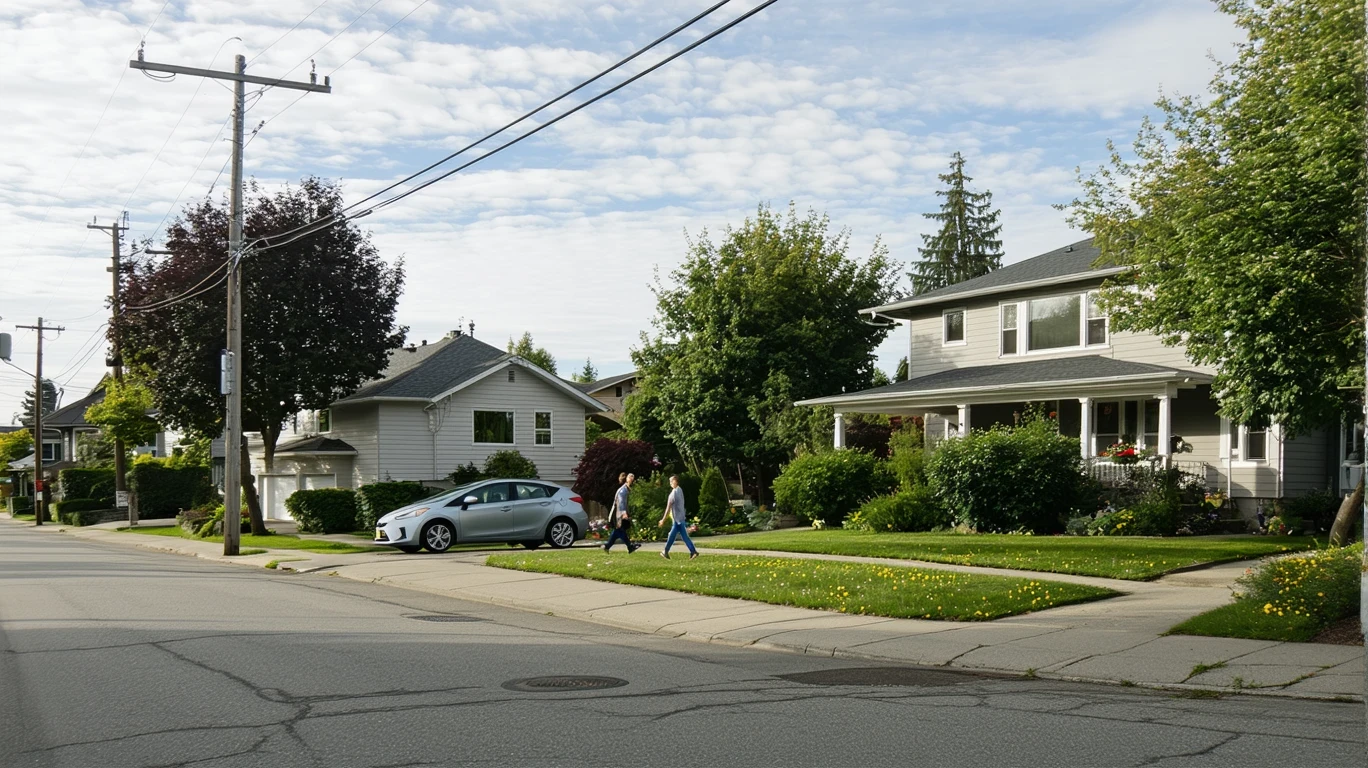
What separates Sherwood from other expensive markets is the interplay between local accessibility and commute dependence. The city offers walkable pockets with high pedestrian infrastructure density relative to roads, and food and grocery establishments are broadly accessible throughout the area. Parks are integrated into neighborhoods, and bike infrastructure is notable. But most workers still rely on cars for employment access, particularly those commuting into the Portland metro. The result is a cost structure where day-to-day errands can be managed on foot or by bike in many areas, but transportation remains a recurring fixed expense tied to work travel.
Driver verdict: Housing dominates upfront cost pressure, but transportation creates the ongoing volatility. Surprises come from how much commute length and vehicle count amplify total exposure, even when local errands are accessible.
Housing Costs (Primary Driver)
Sherwood’s housing market presents a clear entry threshold. The median home value of $520,500 requires substantial down payment capacity and mortgage qualification. For context, a 20% down payment would require over $104,000 in cash, with monthly principal and interest payments shaped by prevailing mortgage rates. Property taxes, insurance, and maintenance add recurring layers that don’t appear in the purchase price but define long-term ownership cost.
Renting offers a different exposure profile. At $1,980 per month for median gross rent, tenants avoid the capital requirement and maintenance risk but face lease renewal volatility and no equity accumulation. Rental markets in commuter suburbs often tighten when metro employment centers grow, creating upward pressure during renewals. The tradeoff is liquidity and flexibility versus long-term cost control.
Sherwood functions as a ownership-oriented market with a meaningful rental segment. Buyers gain stability and equity exposure; renters gain flexibility but less insulation from market swings. Neither path is low-cost, but each serves different household timelines and risk tolerance.
| Housing Type | Cost Anchor | What That Buys You |
|---|---|---|
| Median Home Purchase | $520,500 | Equity accumulation, fixed mortgage payment, maintenance responsibility, tax/insurance exposure |
| Median Rental | $1,980/month | Flexibility, no maintenance risk, lease renewal volatility, no equity |
Conclusion: Sherwood is a buying market for those with capital and long timelines; a transitional rental market for those prioritizing flexibility or building toward purchase.
Utilities & Energy Risk
Electricity in Sherwood is priced at 14.64¢ per kilowatt-hour, a moderate rate in the Pacific Northwest context. For illustrative context, a household using 1,000 kWh per month would face roughly $146 in electricity charges before fees and taxes. Actual usage varies with home size, insulation quality, and appliance efficiency, but the rate itself doesn’t create extreme exposure compared to higher-cost regions.
Natural gas, priced at $15.37 per thousand cubic feet (MCF), introduces more volatility. Heating season drives the majority of gas consumption, and Oregon’s temperate climate means most homes don’t face the sustained deep-cold exposure of northern states. Still, winter months bring intermittent cold snaps that push furnace usage higher. For context, a household using 1 MCF per month during heating season would see roughly $15–$16 in commodity charges before distribution fees and taxes. Shoulder seasons (spring, fall) typically see much lower usage.
The risk profile here is moderate. Electricity remains relatively predictable; natural gas creates seasonal swings but not the extreme exposure seen in colder climates or volatile rate environments. Households with poor insulation, older HVAC systems, or larger square footage will feel the swings more acutely. Those in newer, efficient homes can keep usage—and bills—more stable.
Groceries & Daily Costs
Grocery costs in Sherwood reflect the regional price premium. Derived estimates based on national baselines adjusted by regional price parity show staples like ground beef at $8.38 per pound, milk at $5.08 per half-gallon, and eggs at $2.93 per dozen. These are not observed local prices but indicative of the cost pressure households face when stocking a kitchen.
Derived estimate based on national baseline adjusted by regional price parity; not an observed local price.
What this means in practice: a household buying proteins, dairy, and produce weekly will notice the markup, particularly on meat and fresh items. The impact isn’t catastrophic, but it’s persistent. Families cooking at home frequently should budget for grocery spending that runs 20–25% above national norms, consistent with the regional index. Stores such as Safeway, Fred Meyer, and Trader Joe’s operate in the area, offering some competitive pressure, but the baseline cost structure remains elevated.
The city’s high food and grocery establishment density—exceeding density thresholds across the area—means access is not the friction point. You can walk to a grocery store in many neighborhoods. The pressure comes from the prices once you’re inside, not the distance to get there.
Transportation Reality
Sherwood’s transportation costs split into two layers: local errands and commute exposure. Locally, the city’s pedestrian infrastructure and bike-to-road ratio support non-car errands in many areas. Grocery stores, parks, and daily services are accessible on foot or by bike for residents in walkable pockets. Bus service is present, offering some public transit access, though rail is not available.
Commute exposure is where transportation costs accumulate. Sherwood sits within the Portland metro area, and many residents work outside city limits. For illustrative context, a 25-mile round-trip commute at $5.01 per gallon and 25 MPG fuel efficiency would consume roughly $5 per day in fuel alone, before tolls, parking, insurance, or vehicle depreciation. Over a month, that’s $100–$110 in gas for one commuter. Households with two working adults and two vehicles double that baseline.
The unemployment rate of 3.7% suggests a tight labor market, but job proximity varies widely by industry. Commuting into Portland or Beaverton is common, and those trips are almost exclusively car-dependent despite local walkability. The recurring exposure isn’t the trip to the store—it’s the trip to work, repeated daily, with fuel prices and vehicle wear compounding over time.
Cost Exposure Profiles
Cost pressure in Sherwood is shaped by housing entry, commute length, and vehicle count. These are the structural levers that determine whether a household experiences low or high ongoing exposure.
Low-exposure situations: Homeowners with significant equity or paid-off mortgages face stable housing costs, limited to property tax and maintenance. Those working locally or remotely eliminate commute fuel and vehicle depreciation. Single-vehicle households in walkable neighborhoods can handle errands on foot, keeping transportation costs to insurance and occasional trips.
High-exposure situations: New buyers or renters face maximum housing pressure—mortgage payments or rent approaching $2,000+ per month. Long commutes into Portland require daily fuel spending, and multi-vehicle households double insurance, registration, and maintenance outlays. Renters also face lease renewal risk, where landlords can adjust pricing annually in response to market conditions.
The difference isn’t about income sufficiency—it’s about which costs are fixed, which are variable, and which can be controlled. Homeowners with short commutes have locked in their biggest expenses. Renters with long commutes face compounding volatility across housing and transportation simultaneously.
How this article was built: In addition to public economic data, this article incorporates location-based experiential signals derived from anonymized geographic patterns—such as access density, walkability, and land-use mix—to reflect how day-to-day living actually feels in Sherwood, OR.
Frequently Asked Questions
Is Sherwood more affordable than Portland in 2026? Sherwood’s median home value of $520,500 is lower than many Portland neighborhoods, but the gap narrows when factoring in commute costs for those working in the city. Renting in Sherwood at $1,980 per month may offer more space than urban Portland, but transportation exposure often offsets the savings.
What does a typical cost profile look like in Sherwood? Housing dominates, whether renting or owning. Transportation follows, especially for commuters. Utilities and groceries add moderate pressure but rarely exceed housing and commute costs combined. The profile depends heavily on how far you drive and how many vehicles you maintain.
Do utilities cost more in Sherwood than nearby areas? Electricity at 14.64¢/kWh and natural gas at $15.37/MCF are consistent with regional rates across Washington County. Utility costs tend to be similar to Tigard, Tualatin, and Beaverton, with seasonal variation driven by heating and cooling needs rather than rate differences.
What costs tend to surprise newcomers in Sherwood? Commute fuel expenses surprise households underestimating trip frequency or distance. Grocery prices also run higher than national averages, and the cumulative effect of regional price parity across categories adds up faster than many expect when coming from lower-cost states.
Are property taxes higher in Sherwood than Beaverton? Property tax rates vary by district and voter-approved measures, but both cities fall under Oregon’s property tax structure. Differences are typically modest and depend more on assessed home value than jurisdiction. Sherwood’s higher median home value can result in higher absolute tax bills even if rates are similar.
Can you live in Sherwood without a car? Local errands are manageable on foot or bike in many neighborhoods due to strong pedestrian infrastructure and accessible grocery options. However, most employment is outside city limits, and bus service, while present, doesn’t replace car dependency for commuting into Portland or other metro job centers.
How does Sherwood compare to Wilsonville for overall cost? Both cities share similar suburban cost structures with elevated housing and commute exposure. Sherwood tends to have slightly higher walkability in pockets and more integrated park access, which can reduce some local trip costs, but the difference in total cost of living is modest and depends more on specific commute and housing choices.
Is Sherwood a good value for families? Sherwood offers playground and park infrastructure, accessible groceries, and walkable pockets that support family logistics. However, the value depends on housing entry cost, school quality priorities, and whether both adults commute. Families with one remote worker and manageable housing costs find better cost control than dual long-commute households.
—