
| Expense Category | Apartment | House |
|---|---|---|
| Base Housing Cost | $1,843/month median rent | Mortgage on $516,900 median value (varies by down payment and rate) |
| Property Tax Exposure | Embedded in rent; landlord absorbs volatility | Direct annual liability; Chicago-area rates apply with potential volatility |
| Heating Cost Structure | Often shared or metered; insulation benefits from shared walls | Full exposure to natural gas prices ($9.65/MCF) across long heating season |
| Cooling Cost Structure | Smaller square footage limits electricity draw | Larger footprint increases summer exposure at 16.36¢/kWh |
| Maintenance Volatility | Landlord responsibility; renter avoids capital repair risk | Owner absorbs roof, HVAC, foundation, and system replacement costs |
| Governance & Fees | Minimal; some buildings include utilities or amenities | Potential HOA or special assessments depending on neighborhood |
Table methodology: This comparison reflects cost behavior differences driven by Elmhurst’s climate (long heating season, moderate cooling demand), Chicago-area property tax structure, and housing stock characteristics (mixed building heights, varied ownership models). Categories omitted (e.g., insurance, trash collection) do not vary meaningfully by housing type in this market or lack local data to justify inclusion.
The Housing Market in Elmhurst Today
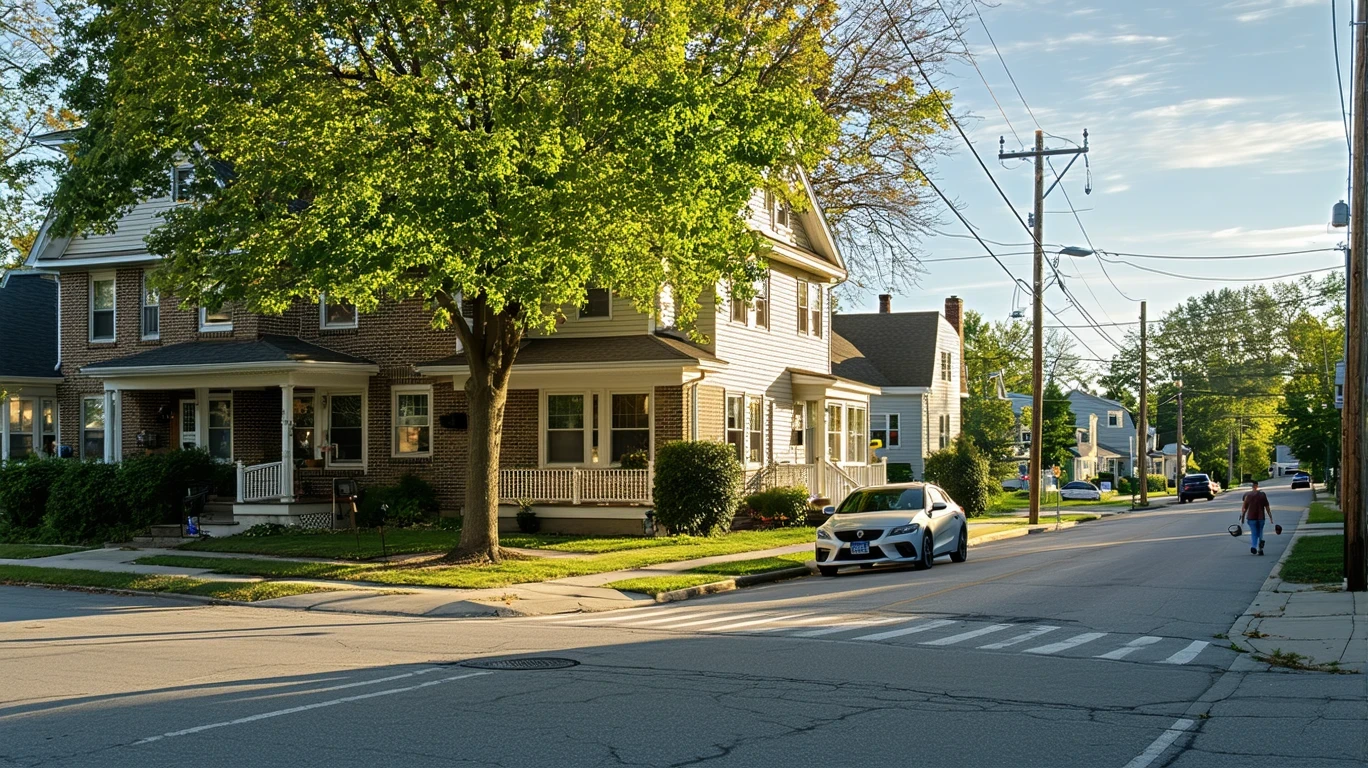
Elmhurst’s housing market operates under the gravitational pull of Chicago proximity, rail transit access, and strong family infrastructure. The median home value of $516,900 reflects demand from dual-income households seeking suburban schools, parks, and commuter rail without sacrificing walkable pockets or mixed-use corridors. This is not a bedroom community where housing costs are divorced from amenities—Elmhurst’s price floor is shaped by what the city offers: rail stations that connect to Chicago employment centers, park density that exceeds high thresholds, and school and playground infrastructure that meets family needs.
Newcomers often misunderstand how tightly Elmhurst’s housing costs are tied to commute viability. The presence of rail transit means buyers and renters are paying not just for shelter, but for reduced car dependency and time savings. Walkable pockets exist, but errands remain corridor-clustered, meaning housing location within Elmhurst determines whether daily logistics require a car or can be managed on foot. This creates price stratification within the city that isn’t immediately visible in median figures.
The rental market, with a median gross rent of $1,843 per month, reflects similar pressures. Renters are competing for access to the same transit, schools, and parks that drive ownership demand, but without the ability to lock in costs through a mortgage. The rental floor is high because the alternative—ownership at $516,900—requires substantial capital and income to sustain. Median household income of $143,492 per year supports ownership for many, but renters without dual incomes or significant savings face sustained pressure.
Renting in Elmhurst
Renting in Elmhurst means accepting a high baseline cost in exchange for flexibility and reduced exposure to property tax volatility, maintenance surprises, and long-term capital risk. At $1,843 per month, the median rent reflects competition for housing stock near rail stations, within walkable pockets, or close to corridor-clustered errands. Renters who prioritize car-light living or rail commutes will find themselves competing for units in specific neighborhoods, which drives rents higher than the median in those areas.
The rental experience in Elmhurst is shaped by what renters avoid as much as what they pay for. Property taxes in the Chicago area are a significant ownership cost, and renters are insulated from year-to-year increases, special assessments, and reassessment shocks. Maintenance risk—furnace failure during a long heating season, roof replacement, HVAC breakdowns—falls to landlords, not tenants. For households uncertain about long-term plans or unwilling to absorb capital repair volatility, renting offers predictability despite the high monthly outlay.
However, renters face exposure to lease renewal increases and limited control over housing stability. In a market where ownership demand is strong and rental supply is constrained by the same factors that drive home values, landlords can adjust rents to reflect rising property taxes, insurance, and maintenance costs. Renters also miss the opportunity to stabilize housing costs through a fixed-rate mortgage, meaning their long-term cost trajectory is less predictable than owners who lock in principal and interest payments.
Owning a Home in Elmhurst
Ownership in Elmhurst is a bet on stability, control, and long-term cost predictability in exchange for upfront capital, ongoing tax liability, and maintenance exposure. The median home value of $516,900 requires a down payment, closing costs, and the income to sustain a mortgage, property taxes, insurance, and utilities. For households with median income of $143,492 per year, ownership is feasible but demands careful management of cash flow and reserves.
Property taxes are the most significant ongoing exposure for Elmhurst homeowners. Chicago-area property tax rates are among the highest in the nation, and while the specific rate for Elmhurst is not provided in the data, owners should expect annual tax bills that rival or exceed monthly mortgage payments in some cases. Unlike rent, which bundles tax exposure into a single payment controlled by the landlord, ownership makes tax liability direct and visible. Reassessments, local referendums, and school district funding needs can all drive tax increases that owners cannot avoid.
Maintenance and capital repair risk are the other defining features of ownership. Elmhurst’s long heating season means furnaces, boilers, and natural gas systems are under sustained stress each winter. Cooling systems face moderate but consistent summer demand. Roofs, foundations, and exterior systems are exposed to freeze-thaw cycles, precipitation, and seasonal temperature swings. Owners must budget for these repairs and replacements, which arrive unpredictably and often in clusters. A furnace failure in January or a roof leak after a spring storm can cost thousands of dollars with little warning.
Governance varies by neighborhood. Some Elmhurst homes are subject to HOA rules, fees, and special assessments, while others are governed only by municipal codes. HOAs can provide shared amenities, landscaping, and snow removal, but they also introduce another layer of cost volatility and control. Buyers should verify governance structure before purchase, as it affects both monthly costs and long-term flexibility.
Utilities & Upkeep Differences
Utility and maintenance costs in Elmhurst are shaped by climate, housing type, and infrastructure age. The long heating season drives natural gas consumption, with prices at $9.65 per MCF. Houses face full exposure to heating costs across their entire square footage, while apartments benefit from shared walls, smaller footprints, and sometimes shared or landlord-paid heating systems. A house with poor insulation or an aging furnace will see noticeable winter utility bills, while a well-insulated apartment may experience only minor heating costs.
Cooling costs are driven by electricity rates of 16.36¢ per kWh, which are above the national average. Summer demand is moderate but sustained, and houses with larger square footage, multiple floors, or poor insulation will see higher bills than compact apartments. Owners of houses also control thermostat settings, insulation upgrades, and HVAC efficiency, which means they can reduce exposure through investment—but they must fund those improvements themselves.
Maintenance exposure differs sharply between apartments and houses. Apartment dwellers avoid responsibility for roofs, exterior walls, HVAC systems, and structural repairs. These costs are borne by landlords or building associations, and renters are insulated from both the expense and the logistics. Homeowners, by contrast, must manage every system: furnace tune-ups, air conditioning maintenance, gutter cleaning, foundation monitoring, and appliance replacement. In Elmhurst’s climate, deferred maintenance can lead to compounding problems—frozen pipes, ice dams, basement water intrusion—that are both expensive and disruptive.
Rent vs Buy: Long-Term Exposure in Elmhurst
The choice between renting and buying in Elmhurst is not a savings calculation; it is a decision about which risks to accept and which to avoid. Renters accept high monthly costs and limited control in exchange for flexibility, insulation from property tax volatility, and freedom from maintenance risk. Owners accept upfront capital requirements, tax liability, and repair exposure in exchange for cost stability, equity accumulation, and control over their living environment.
Over time, renters face the risk that lease renewals will outpace income growth, particularly in a market where ownership demand is strong and rental supply is constrained. Landlords can adjust rents to reflect rising property taxes, insurance, and maintenance costs, and renters have limited recourse beyond moving. This makes long-term cost predictability difficult for renters, especially those on fixed or slowly growing incomes.
Owners, by contrast, lock in principal and interest payments through a fixed-rate mortgage, which stabilizes the largest component of housing cost. Property taxes and insurance will still rise, and maintenance costs will fluctuate, but the mortgage payment remains constant. This creates a hedge against inflation and income growth, as housing costs become a smaller share of income over time for households whose earnings increase.
However, ownership introduces risks that renters avoid entirely. Property tax increases can be sudden and large, particularly in response to school funding needs or municipal budget shortfalls. Maintenance and capital repairs arrive unpredictably, and owners must have cash reserves or credit access to manage them. In Elmhurst’s climate, heating system failures, roof damage, and foundation issues are not hypothetical—they are recurring realities that owners must budget for and manage.
The decision also depends on how long a household plans to stay. Ownership costs are front-loaded: down payments, closing costs, and early mortgage payments that are mostly interest. Renters who move frequently avoid these transaction costs and retain flexibility. Buyers who stay for many years amortize transaction costs over time and benefit from equity accumulation, but those who move within a few years may find that selling costs and market timing erase any financial advantage.
FAQs About Housing Costs in Elmhurst
Why is the median rent in Elmhurst $1,843 per month?
Elmhurst’s rental market reflects demand for rail transit access, strong family infrastructure, and walkable pockets within a Chicago-area suburb. Renters are competing for housing stock near rail stations, schools, and parks, which drives the median rent higher than in communities without these amenities. The rental floor is also shaped by the high cost of ownership—median home values of $516,900 mean that landlords face significant property tax, mortgage, and maintenance costs, which are passed through to tenants.
What drives home values to $516,900 in Elmhurst?
Home values in Elmhurst are driven by proximity to Chicago employment centers via rail transit, strong schools and playgrounds, integrated park access, and walkable pockets that reduce car dependency. Buyers are paying for a combination of commute viability, family infrastructure, and quality of life that is difficult to replicate in other Chicago-area suburbs. The mixed building heights and land-use mix also create neighborhood variety, which supports a range of housing types and price points within the broader market.
How do property taxes in Elmhurst compare to other Chicago-area suburbs?
Specific property tax rates for Elmhurst are not provided in the data, but Chicago-area property taxes are generally high relative to national averages. Owners should expect annual tax bills that are a significant share of total housing costs, potentially rivaling or exceeding monthly mortgage payments. Tax rates vary by school district, municipality, and special districts, so buyers should verify the exact tax liability for any property before purchase.
Is renting or buying better for long-term cost stability in Elmhurst?
Buying offers greater long-term cost stability for households who plan to stay in Elmhurst for many years. A fixed-rate mortgage locks in principal and interest payments, which stabilizes the largest component of housing cost and creates a hedge against inflation. Renters face the risk that lease renewals will outpace income growth, particularly in a market where ownership demand is strong. However, ownership introduces property tax volatility, maintenance unpredictability, and upfront capital requirements that renters avoid. The better choice depends on time horizon, income stability, and risk tolerance.
What utility costs should homeowners in Elmhurst expect?
Homeowners in Elmhurst face heating costs driven by natural gas prices of $9.65 per MCF across a long heating season, and cooling costs driven by electricity rates of 16.36¢ per kWh during moderate summer demand. Actual bills depend on home size, insulation quality, HVAC efficiency, and thermostat settings. Houses with poor insulation or aging systems will see noticeable seasonal utility bills, while well-maintained homes with efficient systems can reduce exposure. Owners control these variables through investment in insulation, HVAC upgrades, and behavioral adjustments, but they must fund those improvements themselves.
Making Housing Choices in Elmhurst
Housing costs in Elmhurst are shaped by Chicago proximity, rail transit access, and strong family infrastructure that together create demand for both rental and ownership housing. Renters pay $1,843 per month for flexibility and insulation from property tax and maintenance risk, but they accept limited control and uncertain long-term cost trajectories. Owners pay $516,900 for stability, control, and equity accumulation, but they absorb property tax liability, maintenance volatility, and upfront capital requirements.
The decision between renting and buying depends on time horizon, income stability, and willingness to manage risk. Households planning to stay in Elmhurst for many years, with stable dual incomes and cash reserves, will benefit from ownership’s cost stability and equity growth. Households with shorter time horizons, single incomes, or limited savings may find renting offers better flexibility and lower risk, despite the high monthly cost.
Within Elmhurst, housing location determines daily logistics. Walkable pockets near rail stations reduce car dependency and improve access to corridor-clustered errands, but they command premium rents and home prices. Buyers and renters who prioritize car-light living should focus on these areas, while those willing to drive for errands can access lower-cost housing farther from transit and commercial corridors.
For readers evaluating monthly expenses beyond housing, understanding how rent or ownership fits into broader cost structure is essential. Housing is the largest single expense for most households, but it interacts with transportation, utilities, and daily errands in ways that vary by location within Elmhurst. Readers comparing Elmhurst to other cities can explore what costs people most in Elmhurst to see how housing pressure relates to other budget categories. Those planning a move can review moving company costs and options to manage relocation expenses effectively.
How this article was built: In addition to public economic data, this article incorporates location-based experiential signals derived from anonymized geographic patterns—such as access density, walkability, and land-use mix—to reflect how day-to-day living actually feels in Elmhurst, IL.