
A first-time renter moving to Johns Creek faces median gross rent of $1,944 per month, while a buyer entering the market confronts a median home value of $525,100. Both figures sit well above Georgia averages, reflecting Johns Creek’s position as an affluent suburban enclave north of Atlanta. The gap between these two entry points—one requiring immediate monthly liquidity, the other demanding substantial upfront capital—defines the housing decision for most newcomers. Neither path is forgiving to households without either strong dual income or accumulated equity, and the cost structure doesn’t ease once you’re in. Ownership brings exposure to property taxes, insurance, and maintenance on homes that command premium valuations, while renters face a market shaped by professional commuters willing to pay for proximity and space. Understanding how these costs behave over time, and which expenses remain predictable versus volatile, determines whether Johns Creek’s housing market aligns with your financial position and long-term plans.
The Housing Market in Johns Creek Today
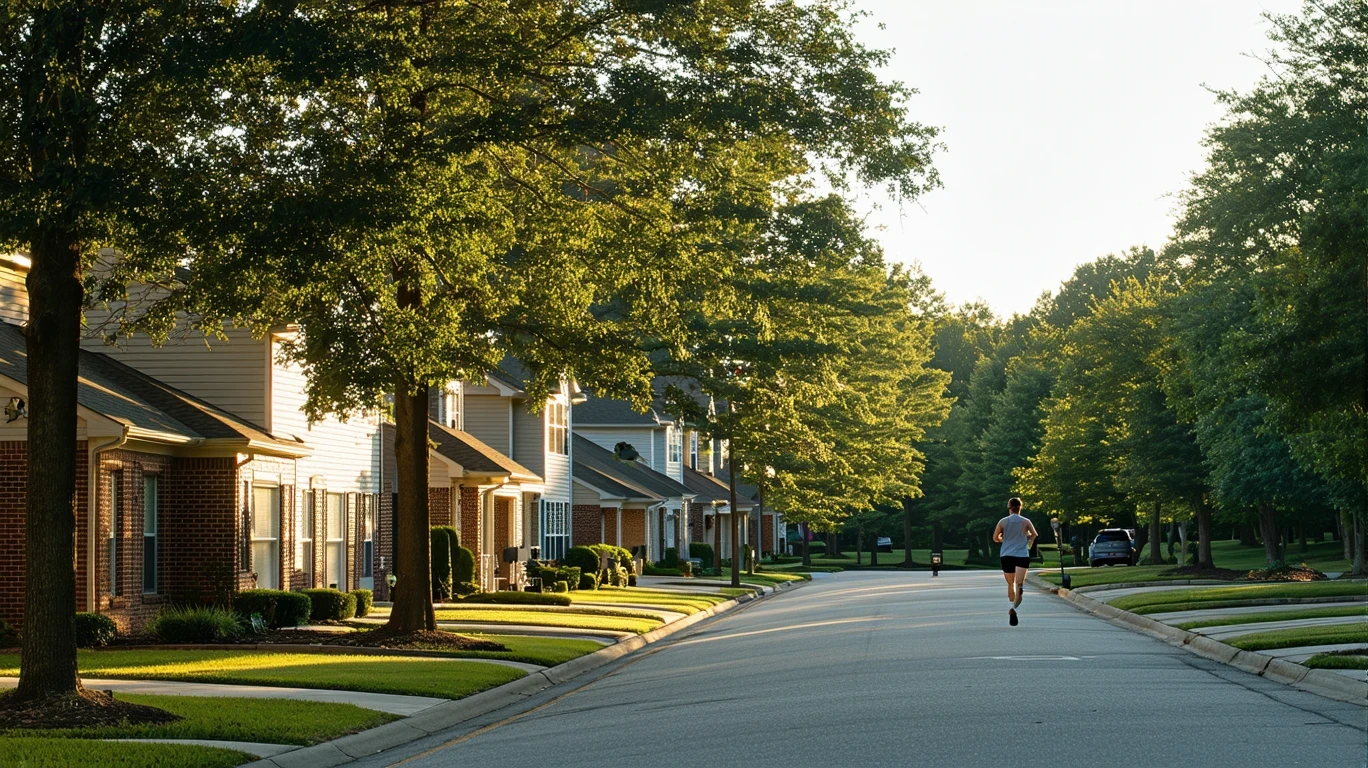
Johns Creek’s housing market reflects its role as a high-income suburb serving Atlanta’s northern corridor. With a median household income of $153,882 per year, the city attracts dual-income professionals, established families, and relocating corporate employees. The housing stock skews toward single-family homes on larger lots, with apartment and townhome inventory concentrated near commercial corridors. This composition creates a market where ownership dominates long-term residency, while rentals serve transient professionals and households in transition.
What newcomers often misunderstand is that Johns Creek’s housing costs aren’t driven by urban density or walkable convenience—they’re driven by space, school district reputation, and commuter access. The city’s infrastructure reflects car-oriented suburban development, with grocery and food options clustered along specific corridors rather than distributed evenly across neighborhoods. This means that even within Johns Creek, location determines how much driving your daily routine requires. Walkable pockets exist, particularly where pedestrian infrastructure exceeds typical suburban ratios, but these areas don’t define the overall living experience. Most households rely on cars for errands, school runs, and commuting, which adds a transportation cost layer that renters and buyers alike must account for.
The market also reflects limited density of family-oriented infrastructure—school and playground availability falls below thresholds that would support high-density family neighborhoods. This doesn’t mean families avoid Johns Creek, but it does mean that households expecting abundant parks, playgrounds, and schools within walking distance may find the reality more dispersed than anticipated. Hospital and pharmacy access is strong, but the day-to-day logistics of managing a household with young children often require more planning and driving than in cities with denser family amenities.
Renting in Johns Creek
At $1,944 per month median gross rent, Johns Creek’s rental market prices out single-income households and entry-level professionals unless they’re willing to accept smaller units or less desirable locations. Rental inventory concentrates in apartment complexes and townhome communities near major roads, where access to groceries, dining, and services is more direct. Renters in these corridor-clustered areas experience shorter errand loops, but those in more residential pockets face longer drives for routine tasks.
Rental pressure in Johns Creek doesn’t stem from scarcity—it stems from income sorting. Landlords price to the market’s median income, and that income is high. Renters competing for units near Alpharetta’s corporate campuses or along GA-141 face additional pressure from professionals prioritizing commute reduction over space. Those willing to accept longer drives or less convenient access to errands can find slightly lower rents, but the tradeoff is real: more time in the car, more fuel costs, and less flexibility for spontaneous errands.
Lease renewals in Johns Creek follow broader Atlanta metro trends, where increases track regional demand rather than hyperlocal conditions. Renters should expect volatility tied to employment growth in the northern suburbs, corporate relocation activity, and regional housing supply. Unlike ownership, where property taxes and insurance create predictable annual expenses, rental increases arrive with less warning and less control. This makes renting in Johns Creek a viable short-term strategy for professionals testing the market or awaiting equity accumulation, but a challenging long-term position for households seeking cost stability.
Owning a Home in Johns Creek
A median home value of $525,100 places Johns Creek firmly in the upper tier of Georgia’s housing markets. Buyers entering at this level need substantial down payments, strong credit, and income sufficient to service not just the mortgage but also property taxes, insurance, and maintenance on homes that often exceed 2,500 square feet. Ownership in Johns Creek isn’t just about affording the purchase—it’s about sustaining the ongoing costs that come with larger homes, HOA governance, and suburban infrastructure.
Property taxes in Johns Creek reflect Fulton County’s assessment and millage structure, which applies to home values that have appreciated significantly over the past decade. Buyers should expect annual tax bills that rise with assessed value, though the timing and magnitude of reassessments vary. Unlike rent, which can spike at lease renewal, property taxes increase more gradually but with less opportunity for negotiation. Homeowners also face insurance costs that reflect Georgia’s storm exposure, particularly for homes with older roofs or in areas with mature tree canopy. These aren’t catastrophic risks, but they do create ongoing expense that renters avoid entirely.
Maintenance exposure in Johns Creek is shaped by housing age and lot size. Many homes were built in the 1990s and early 2000s, meaning roofs, HVAC systems, and water heaters are reaching or past replacement cycles. Buyers purchasing homes in this vintage should budget for capital expenses that arrive in clusters—roof and HVAC in the same year, for example—rather than spreading evenly over time. Larger lots also mean more landscaping, irrigation, and exterior upkeep, which translates to either higher service costs or more personal labor.
HOA presence varies across Johns Creek, with some neighborhoods enforcing strict architectural and maintenance standards while others operate with minimal oversight. HOA fees, where applicable, cover amenities like pools, tennis courts, and common area maintenance, but they also represent a fixed monthly cost that doesn’t decline with market conditions. Buyers evaluating HOA-governed communities should verify not just current fees but also reserve fund health and any planned special assessments.
Apartment vs House in Johns Creek — Cost Behavior Comparison
Table Construction Note: This comparison includes only expense categories where cost behavior differs meaningfully in Johns Creek due to local housing stock, climate, infrastructure, or governance. Generic distinctions applicable to any U.S. market have been omitted. Rows reflect qualitative exposure based on typical housing characteristics; no numeric totals are provided.
| Expense Category | Apartment | House |
|---|---|---|
| Cooling Costs | Lower due to smaller square footage and shared wall insulation; summer exposure is noticeable but contained | Dominant summer expense due to larger square footage, vaulted ceilings, and full sun exposure on all sides; extended cooling season drives higher bills |
| Yard and Exterior Maintenance | None; landlord or HOA handles landscaping and exterior upkeep | Significant ongoing cost due to larger lots, irrigation systems, and mature trees; either recurring service fees or substantial personal labor |
| Commute and Errands Driving | Lower if located near corridor-clustered grocery and services; shorter errand loops reduce fuel and time costs | Higher if located in residential pockets away from commercial corridors; routine errands require longer drives and more planning |
| HVAC and Roof Replacement | None; landlord absorbs capital replacement costs | High exposure for homes built in 1990s–2000s; roof and HVAC replacements often cluster in same period, creating lumpy expense |
| HOA Fees | Often included in rent or minimal; covers shared amenities and exterior maintenance | Variable but fixed monthly cost where applicable; covers amenities but also represents non-negotiable expense regardless of usage |
Why these categories matter in Johns Creek: Cooling costs differ substantially due to Georgia’s extended summer heat and the size gap between typical apartments and single-family homes. Yard maintenance reflects Johns Creek’s larger lot sizes and mature landscaping, which create ongoing labor or service costs that apartment renters avoid. Driving costs vary based on proximity to corridor-clustered errands—apartments near commercial zones reduce transportation friction, while houses in residential pockets increase it. Capital replacement exposure (HVAC, roof) is specific to Johns Creek’s housing vintage, where many homes are reaching the end of original equipment lifecycles. HOA fees appear in both housing types but function differently: in apartments they’re often embedded in rent, while in houses they represent a separate, fixed monthly obligation.
Categories omitted: Rent vs mortgage principal, property taxes, and insurance are excluded because their cost behavior is generic and doesn’t vary meaningfully by housing type within Johns Creek specifically—they’re driven by market-wide factors rather than local infrastructure or climate.
Utilities & Upkeep Differences
Johns Creek’s extended cooling season—spanning late spring through early fall—creates dominant summer utility exposure for homeowners, particularly those in larger single-family homes with full sun exposure and vaulted ceilings. At 14.46¢/kWh, electricity costs aren’t extreme by regional standards, but consumption is. Homes exceeding 2,500 square feet with aging HVAC systems can see summer bills that dwarf winter heating costs, especially during stretches of high heat and humidity. Apartment renters face the same seasonal pressure but at lower intensity due to smaller square footage and shared wall insulation that reduces thermal load.
Natural gas, priced at $16.56/MCF, plays a smaller role in Johns Creek’s utility profile. Winters are mild, with heating demand concentrated in short cold snaps rather than sustained freezing periods. Homeowners with gas heating see noticeable bills during these stretches, but the expense doesn’t approach the magnitude of summer cooling. Apartment renters with electric or gas heat face similar seasonal spikes, though again at lower absolute cost due to smaller spaces.
Maintenance exposure for homeowners in Johns Creek is shaped by housing age and lot size. Homes built in the 1990s and early 2000s are reaching the point where roofs, HVAC systems, and water heaters require replacement. These aren’t annual expenses, but when they arrive, they cluster—roof and HVAC in the same year, for example—creating lumpy capital costs that renters never face. Larger lots also mean irrigation systems, mature trees, and extensive landscaping, all of which require either recurring service contracts or significant personal labor. Renters avoid this entirely, as landlords or HOAs absorb exterior and structural maintenance.
Rent vs Buy: Long-Term Exposure in Johns Creek
Renting in Johns Creek offers short-term flexibility and insulation from capital expenses, but it comes with ongoing volatility and no equity accumulation. Lease renewals track regional demand, which means rent increases can arrive with little warning and no opportunity for negotiation. Renters also remain exposed to landlord decisions—property sales, renovation plans, or shifts in tenant screening—that can force relocation regardless of financial preference. For professionals testing the Atlanta market or awaiting equity accumulation, renting provides a low-commitment entry point. For households seeking long-term cost stability, it’s a position of sustained exposure.
Ownership in Johns Creek trades upfront capital and ongoing maintenance risk for predictability and control. Mortgage principal and interest remain fixed (for fixed-rate loans), and while property taxes and insurance will rise over time, the increases are gradual and tied to assessments rather than market whims. Homeowners also control maintenance timing and quality, which matters in a market where housing stock is aging and capital expenses are clustering. The tradeoff is illiquidity—selling a home in Johns Creek requires navigating a market that favors buyers with substantial down payments and strong credit, which can extend time-to-sale during downturns.
The structural difference between renting and owning in Johns Creek isn’t about monthly cost equivalence—it’s about risk profile. Renters face income-driven volatility and zero equity capture, but they avoid capital expense clusters and can relocate without transaction costs. Owners face property tax exposure, maintenance lumpiness, and illiquidity, but they gain cost predictability and wealth accumulation through principal paydown and appreciation. Neither path is universally superior; the fit depends on income stability, savings position, and timeline. Households with strong dual income and substantial savings fit ownership better. Single-income renters or first-time buyers without significant down payments face steeper barriers and should weigh whether Johns Creek’s housing market aligns with their financial trajectory.
FAQs About Housing Costs in Johns Creek
Is renting or buying more affordable in Johns Creek, GA?
Neither path is objectively “affordable” in Johns Creek—median rent of $1,944 per month and median home values of $525,100 both require substantial income. Renting offers lower upfront cost but ongoing volatility and no equity. Buying requires significant capital but provides cost predictability and wealth accumulation. The better fit depends on income stability, savings, and timeline, not monthly equivalence.
What drives housing costs higher in Johns Creek compared to other Atlanta suburbs?
Johns Creek’s housing costs reflect its position as a high-income suburb with strong school district reputation, proximity to corporate employment centers in Alpharetta and northern Atlanta, and housing stock that skews toward larger single-family homes on spacious lots. The market attracts dual-income professionals willing to pay for space and commuter access, which sustains elevated pricing for both rentals and ownership.
How much should I budget for utilities in a Johns Creek home?
Utility exposure in Johns Creek is dominated by summer cooling costs due to extended heat and humidity. Larger homes with aging HVAC systems face the highest bills, while apartments and smaller homes see lower but still noticeable seasonal spikes. Electricity at 14.46¢/kWh isn’t extreme, but consumption is. Winter heating costs are minor by comparison due to Georgia’s mild climate.
Are there hidden costs to owning a home in Johns Creek?
Homeowners in Johns Creek face property taxes tied to Fulton County assessments, insurance costs reflecting storm exposure, and maintenance expenses driven by housing age and lot size. Homes built in the 1990s and early 2000s are reaching capital replacement cycles for roofs, HVAC, and water heaters, which can cluster in the same year. Larger lots also mean ongoing landscaping and irrigation costs. HOA fees, where applicable, add fixed monthly expenses.
Does Johns Creek’s infrastructure affect housing costs?
Yes. Johns Creek’s car-oriented infrastructure means most households rely on driving for errands, school runs, and commuting, which adds transportation costs to housing expenses. Grocery and food options cluster along corridors rather than distributing evenly, so location within Johns Creek determines how much driving your routine requires. Limited density of schools and playgrounds also means families may face longer drives for activities, increasing both time and fuel costs.
Making Housing Choices in Johns Creek
Johns Creek’s housing market rewards households with strong dual income, accumulated equity, and tolerance for car-dependent logistics. Ownership at a median home value of $525,100 demands not just purchase capital but also the financial resilience to absorb property taxes, insurance, and maintenance on aging homes with larger lots. Renters at $1,944 per month face a market priced to professional incomes, with limited relief for single-income households or those seeking walkable convenience. The city’s infrastructure—corridor-clustered errands, limited family amenity density, and car-oriented mobility—shapes daily cost behavior as much as the housing payment itself.
For households evaluating Johns Creek, the decision isn’t just rent versus buy—it’s whether the city’s cost structure aligns with your income trajectory and lifestyle priorities. Dual-income professionals with savings and long timelines fit ownership well, particularly if they value space and school access over walkable density. Single-income renters or first-time buyers without substantial down payments face steeper barriers and should weigh whether Johns Creek’s market offers better long-term value than alternatives with lower entry costs. Understanding what a budget has to handle in Johns Creek beyond the housing payment—transportation, utilities, and maintenance—clarifies whether the city’s housing market serves your financial position or strains it.
How this article was built: In addition to public economic data, this article incorporates location-based experiential signals derived from anonymized geographic patterns—such as access density, walkability, and land-use mix—to reflect how day-to-day living actually feels in Johns Creek, GA.